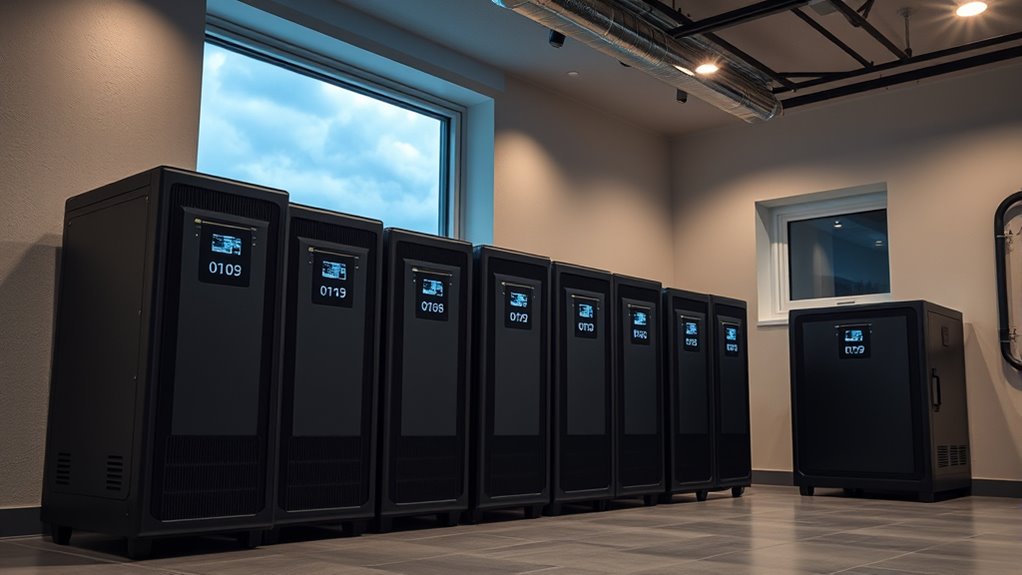

The EF ECOFLOW DELTA Pro Ultra 12kWh is my best overall whole home battery backup system because its 7200W 120/240V output and substantial starting capacity suit more household loads than most portable rivals. The ECO-WORTHY Powermega offers stronger value for buyers comfortable with a fixed 48V installation, while the DELTA Pro Ultra X is the premium choice for very high output and long-term expansion. The main tradeoffs are usable storage, support for 240V appliances, installation complexity, portability, and the cost of adding enough batteries for longer outages. Smaller systems can keep selected circuits running, but they should not be mistaken for unrestricted whole-house power. Continue reading for the full breakdown and the factors that separate these 11 options.
Complete the kit


Key Takeaways
- The DELTA Pro Ultra 12kWh configuration leads overall because it combines meaningful storage with 7200W split-phase output, making it more practical for household circuits than smaller 120V stations.
- Battery capacity alone did not determine the ranking: inverter output, 240V support, transfer equipment, and expansion costs often mattered more than the advertised kWh figure.
- ECO-WORTHY’s Powermega offers the strongest capacity-per-dollar case for fixed installations, but its setup demands more planning than the portable Jackery and EcoFlow alternatives.
- The Jackery HomePower 3600 Plus is the friendliest modular starting point, though its 3600W output places tighter limits on simultaneous appliances than the 7200W and 10,000W systems.
- The DELTA Pro Ultra X has the highest ceiling in this lineup with 12,000W output and expansion up to 180kWh, but that scale makes sense mainly for large homes, heavy loads, or extended outages.
| Jackery HomePower 3600 Plus |  | Best Portable Whole-Home Starter | Base capacity: 3,584Wh | AC output: 3,600W | Expandable capacity: Up to 21kWh | VIEW ON AMAZON | See Our Full Breakdown |
| ECO-WORTHY Powermega 48V 314Ah Energy Storage System |  | Best Fixed-System Value | Battery voltage: 48V | Battery capacity: 314Ah | Usable energy: 16.1kWh | VIEW ON AMAZON | See Our Full Breakdown |
| ECO-WORTHY 5120Wh Home Power Station Backup System |  | Best for Long-Term Expansion | Battery capacity: 5,120Wh | Battery chemistry: LiFePO4 | Battery voltage: 51.2V | VIEW ON AMAZON | See Our Full Breakdown |
| Jackery Explorer 2000 Plus |  | Best Compact Portable Pick | Base capacity: 2,042Wh | AC output: 3,000W | Battery chemistry: LiFePO4 | VIEW ON AMAZON | See Our Full Breakdown |
| EF ECOFLOW DELTA Pro Ultra 12kWh |  | Best Overall | Base capacity: 12kWh | AC output: 7,200W | Output voltage: 120/240V | VIEW ON AMAZON | See Our Full Breakdown |
| ECO-WORTHY 48V 100Ah LiFePO4 Home Power Station Backup System |  | Best Fixed High-Output System | Included battery capacity: 10,240Wh total | Battery configuration: Two 51.2V 100Ah LiFePO4 batteries | Continuous output: 10,000W | VIEW ON AMAZON | See Our Full Breakdown |
| EF ECOFLOW DELTA Pro Portable Power Station |  | Best Portable Starter System | Battery capacity: 3,600Wh | Battery chemistry: LiFePO4 | Rated AC output: 3,600W | VIEW ON AMAZON | See Our Full Breakdown |
| EF ECOFLOW DELTA Pro Ultra Power Station |  | Best Overall | Battery capacity: 6,144Wh | Battery chemistry: LiFePO4 | AC output: 7,200W | VIEW ON AMAZON | See Our Full Breakdown |
| Anker SOLIX F3800 Plus Portable Power Station and Home Power Panel |  | Best for Panel Integration | Battery capacity: 3,840Wh | Battery chemistry: LiFePO4 | Maximum AC output: 6,000W | VIEW ON AMAZON | See Our Full Breakdown |
| Jackery HomePower 3600 Plus Portable Power Station with Solar Panels |  | Best Solar Bundle | Battery capacity: 3,584Wh | Battery chemistry: LFP | Output power: 3,600W | VIEW ON AMAZON | See Our Full Breakdown |
| EF ECOFLOW DELTA Pro Ultra X |  | Best for Maximum Expansion | Battery Capacity: 12,288Wh | Running Output: 12,000W | Maximum Expansion: 180kWh | VIEW ON AMAZON | See Our Full Breakdown |
| whole home battery backup system | Battery chemistry | Battery capacity | Expandable capacity |
|---|---|---|---|
| Jackery HomePower 3600 Plus | — | — | Up to 21kWh |
| ECO-WORTHY Powermega 48V 314Ah | — | 314Ah | — |
| ECO-WORTHY 5120Wh Home Power S | LiFePO4 | 5,120Wh | — |
| Jackery Explorer 2000 Plus | LiFePO4 | — | Up to 24kWh |
| EF ECOFLOW DELTA Pro Ultra 12k | LiFePO4 | — | Up to 90kWh |
| ECO-WORTHY 48V 100Ah LiFePO4 H | — | — | — |
| EF ECOFLOW DELTA Pro Portable | LiFePO4 | 3,600Wh | Up to 25kWh |
| EF ECOFLOW DELTA Pro Ultra Pow | LiFePO4 | 6,144Wh | Up to 90kWh |
| Anker SOLIX F3800 Plus Portabl | LiFePO4 | 3,840Wh | — |
| Jackery HomePower 3600 Plus Po | LFP | 3,584Wh | Up to 21kWh |
| EF ECOFLOW DELTA Pro Ultra X | LiFePO4 | 12,288Wh | — |
More Details on Our Top Picks
Jackery HomePower 3600 Plus
I rank the Jackery HomePower 3600 Plus as the strongest starting point for buyers who want household backup without committing immediately to a fixed battery installation. Its 3,600W output and 3,584Wh capacity can cover refrigeration, communications, lighting, and selected appliances, while expansion to 21kWh leaves room for longer outages. Compared with the Jackery Explorer 2000 Plus, it supplies more base storage and output, making it better suited to home circuits than occasional travel. The wheels and telescopic handle also make its 77.2-pound body manageable on level ground. My main reservation is that only two outlets and paired-system requirements for 240V limit its standalone flexibility. It also costs more and occupies more storage space than the Explorer 2000 Plus.
Pros:- Expandable from 3,584Wh to 21kWh for longer outage coverage
- 3,600W output supports more demanding household appliances
- AC, solar, hybrid, and generator-assisted charging options
- Wheels, telescopic handle, and a 6,000-cycle battery design
Cons:- Two outlets restrict direct connection options
- 240V operation requires a paired configuration
- The 77.2-pound body remains difficult to lift
Best for: I recommend it to homeowners who want a movable emergency system now and expect to add batteries or a second unit later.
Not ideal for: I would skip it for buyers who need immediate standalone 240V service, numerous device outlets, or easy stairway transport.
- Base capacity:3,584Wh
- AC output:3,600W
- Expandable capacity:Up to 21kWh
- Voltage:120V; 240V in parallel
- AC charging time:2.5 hours
- Hybrid charging time:2 hours
- Weight:77.2 pounds
- Dimensions:15.2 x 12.2 x 19.3 inches
Our verdict“I recommend this as a capable first step toward whole-home backup when mobility and gradual expansion matter more than turnkey 240V coverage.”
ECO-WORTHY Powermega 48V 314Ah Energy Storage System
I place the ECO-WORTHY Powermega high for buyers seeking stationary whole-home capability per dollar. Its 16.1kWh usable battery and 10kW hybrid inverter offer far more base storage and higher output than the ECO-WORTHY 5,120Wh system, reducing the need to purchase expansion hardware immediately. Split-phase 240V output also fits large household loads better than portable 120V-first stations. Compared with the EcoFlow DELTA Pro Ultra 12kWh, this system trades portability and a polished modular format for more inverter power and a long 9,000-plus-cycle rating. I also value its active balancing, fire suppression, and remote monitoring for a permanently installed battery. The downside is installation burden: truck delivery, multiple packages, and substantial space requirements make this a poor plug-and-play choice, and professional electrical work may add to the total cost.
Pros:- 16.1kWh of usable storage covers longer outages without immediate expansion
- 10kW inverter supports heavier simultaneous household loads
- Split-phase 240V and single-phase 120V output
- Active balancing, fire suppression, and remote monitoring
Cons:- Large system requires truck delivery and dedicated installation space
- Setup is more involved than with portable all-in-one stations
- Components may arrive in separate shipments
Best for: I recommend it to solar-equipped homeowners who have installation space and want high-capacity 240V backup at a stronger hardware value.
Not ideal for: I would avoid it for renters, apartment residents, or buyers seeking a portable system that works directly from standard outlets.
- Battery voltage:48V
- Battery capacity:314Ah
- Usable energy:16.1kWh
- Inverter power:10kW
- Output configuration:120V single-phase and 240V split-phase
- Cycle life:9,000+ cycles at 80% depth of discharge
- MPPT efficiency:99.9%
- Connectivity:WiFi, Bluetooth, RS485, CAN, and RS232
- Safety equipment:Active-balancing BMS, circuit breaker, fire suppression, and buzzer alarm
Our verdict“I favor the Powermega for value-focused homeowners ready for a fixed installation with ample storage and strong 240V output.”
ECO-WORTHY 5120Wh Home Power Station Backup System
The ECO-WORTHY 5,120Wh backup system earns its place through an unusually broad expansion path rather than the largest starting specification. A 5kW inverter gives it more household-load headroom than the Jackery HomePower 3600 Plus, while its 5,120Wh battery provides a larger base energy reserve. Buyers can scale as far as six inverters and 32 batteries, so I see it as a sensible middle ground between a portable station and the much larger Powermega package. UL1973 and UL1741 certifications add useful reassurance for home-energy hardware, and WiFi or Bluetooth monitoring makes system status easier to check. Yet expansion brings complexity: separate component shipments, sparse instructions, and more demanding configuration work make this less approachable than either Jackery option. Its 5kW starting inverter also trails the Powermega’s 10kW unit.
Pros:- 5,120Wh starting capacity exceeds smaller portable alternatives
- Expansion supports up to six inverters and 32 batteries
- 5,000W pure sine wave inverter suits varied household loads
- UL1973 and UL1741 safety certifications
Cons:- Configuration is challenging for inexperienced buyers
- Limited instructions may complicate installation and expansion
- Separately shipped components can delay assembly
Best for: I recommend it to technically confident homeowners who want a modest starting system with room for extensive battery and inverter expansion.
Not ideal for: I would skip it for first-time buyers who need a fully assembled, clearly documented plug-and-play backup package.
- Battery capacity:5,120Wh
- Battery chemistry:LiFePO4
- Battery voltage:51.2V
- Inverter output:5,000W
- Fast charging time:1 hour or 2.5 hours, depending on configuration
- Connectivity:Bluetooth and WiFi
- Communication protocols:CAN and RS485
- Maximum expansion:Up to 6 inverters and 32 batteries
- Safety certifications:UL1973 and UL1741
Our verdict“I recommend this system to hands-on buyers who accept setup complexity in exchange for a wide long-term expansion path.”
Jackery Explorer 2000 Plus
I choose the Jackery Explorer 2000 Plus for households that place portability and everyday flexibility ahead of maximum base capacity. Its 3,000W output and ten outlets can serve several devices at once, and 30dB operation makes it less disruptive indoors than generator-based backup. Compared with the HomePower 3600 Plus, the Explorer starts with less energy and lower output, so it will run major appliances for shorter periods. It counters with more direct connection points and a format better suited to camping or RV use between outages. Expansion to 24kWh gives it a path toward longer home coverage, but reaching that figure requires substantial extra hardware. I also see the advertised two-hour solar recharge as conditional: it calls for six 200W panels. Limited 2,042Wh base storage keeps this below larger systems for prolonged outages.
Pros:- Ten outlets accommodate several devices without extensive power strips
- 3,000W output handles many common household appliances
- Quiet 30dB operation is well suited to indoor backup
- Capacity can expand from 2,042Wh to 24kWh
Cons:- Base capacity is modest for a whole-home outage
- Two-hour solar charging requires six 200W panels
- Large-capacity expansion adds considerable cost and bulk
Best for: I recommend it to homeowners who need portable emergency power for selected circuits and also want a station suited to RV or outdoor use.
Not ideal for: I would pass on it for households expecting the base unit alone to support central HVAC or several days of heavy consumption.
- Base capacity:2,042Wh
- AC output:3,000W
- Battery chemistry:LiFePO4
- Expandable capacity:Up to 24kWh
- Voltage:240V
- Solar charging time:2 hours with six SolarSaga 200W panels
- Number of outlets:10
- Noise level:30dB
- Warranty:5 years
Our verdict“I recommend the Explorer 2000 Plus when portable multi-device power matters more than long whole-home runtime from the base unit.”
EF ECOFLOW DELTA Pro Ultra 12kWh
I rank the EF ECOFLOW DELTA Pro Ultra 12kWh first because its starting package most closely matches the demands implied by whole-home backup. The 12kWh capacity, 7,200W output, and native 120/240V support provide a stronger balance of runtime and appliance compatibility than either Jackery portable model. It also expands to 90kWh, giving high-consumption homes more growth room than the HomePower 3600 Plus. The ECO-WORTHY Powermega offers a larger 16.1kWh battery and a stronger 10kW inverter, but the EcoFlow has a more modular, movable format for buyers who do not want a cabinet-style battery system. That flexibility comes at a price: this package is heavy, bulky, and costly, while whole-home circuit integration still requires suitable electrical hardware and installation. High expansion costs may also make its 90kWh ceiling theoretical for many households.
Pros:- 12kWh starting capacity suits longer household outages
- 7,200W AC output supports demanding appliances and concurrent loads
- Native 120/240V output broadens home-equipment compatibility
- Expansion up to 90kWh accommodates very high backup targets
Cons:- Premium pricing puts it beyond many household budgets
- Heavy, bulky components weaken its claim to portability
- Whole-home use requires appropriate panel integration and setup
Best for: I recommend it to homeowners who want substantial 120/240V backup from day one and have the budget for modular expansion and electrical integration.
Not ideal for: I would skip it for budget-limited households, frequent travelers, or anyone needing a genuinely lightweight portable station.
- Base capacity:12kWh
- AC output:7,200W
- Output voltage:120/240V
- Battery chemistry:LiFePO4
- Expandable capacity:Up to 90kWh
- Charging support:Solar charging
Our verdict“I recommend the DELTA Pro Ultra 12kWh as the best-balanced choice for buyers seeking serious whole-home capacity without committing to a fully fixed battery cabinet.”
ECO-WORTHY 48V 100Ah LiFePO4 Home Power Station Backup System
I rank the ECO-WORTHY 48V backup system as the strongest fixed-installation pick here because its two batteries provide 10.24kWh of included storage, while the 10,000W inverter can serve far larger loads than the portable EcoFlow DELTA Pro. Native 120V/240V output also makes it better aligned with well pumps, dryers, and other household circuits. Compared with the DELTA Pro Ultra, ECO-WORTHY supplies more inverter output and battery capacity out of the box, but offers a less polished, less portable package. The 20,000W surge rating helps with motor startup, and app monitoring simplifies status checks. I would reserve dedicated space and budget for professional wiring, however; this is a component-based system, not a roll-up power station. Its installation demands and higher entry cost make it a poor fit for renters or occasional outage coverage.
Pros:- Includes 10.24kWh of battery storage rather than relying on immediate expansion purchases
- 10,000W pure sine wave inverter supports demanding household load combinations
- 120V/240V output accommodates both standard circuits and major appliances
- Bluetooth and WiFi provide remote system monitoring
Cons:- Professional installation is likely required for safe whole-home integration
- Large, heavy component layout needs dedicated mounting and battery space
- Higher upfront commitment than a portable starter system
Best for: Homeowners who want a professionally installed 120V/240V system with enough included storage and inverter power for several large household loads
Not ideal for: Renters, apartment residents, or buyers seeking a plug-and-play unit that can be moved between home and RV
- Included battery capacity:10,240Wh total
- Battery configuration:Two 51.2V 100Ah LiFePO4 batteries
- Continuous output:10,000W
- Surge output:20,000W
- Output voltage:120V / 240V
- Power inputs:Solar and battery
- Monitoring:WiFi and Bluetooth
- Inverter dimensions:20.55 x 17.13 x 5.63 inches
Our verdict“This is my fixed-system choice for homeowners who prioritize included capacity and 10,000W output over portability and simple setup.”
EF ECOFLOW DELTA Pro Portable Power Station
I place the EF ECOFLOW DELTA Pro in the starter-system slot because its 3.6kWh battery and 15 output ports can cover refrigerators, electronics, lights, and selected appliances without committing to a fixed installation. It recharges from a wall outlet in 2.7 hours and accepts solar or vehicle charging, giving it more deployment flexibility than the fixed ECO-WORTHY 48V system. Expansion to 25kWh leaves room for longer outages, yet those extra batteries add substantial cost and space. The bigger limitation is its 120V standalone output: unlike the DELTA Pro Ultra or Anker SOLIX F3800 Plus, this model is not the natural choice for 240V household equipment. I see it as a practical entry point for selective backup, but buyers expecting central air conditioning or broad panel coverage will need accessories, expansion hardware, or a higher-ranked system.
Pros:- Expandable from 3.6kWh to as much as 25kWh
- Wall and solar recharge times are under three hours under stated conditions
- Fifteen ports support a varied group of household and mobile devices
- App control provides remote monitoring and power management
Cons:- Standalone 120V output limits compatibility with major 240V home loads
- Reaching whole-home capacity requires costly batteries and accessories
- High-capacity construction may limit practical portability despite the mobile format
Best for: Homeowners who want portable backup for refrigerators, communications gear, lights, and selected 120V appliances with room to add batteries later
Not ideal for: Households that need direct 240V support for central air conditioning, electric dryers, well pumps, or broad panel-level backup
- Battery capacity:3,600Wh
- Battery chemistry:LiFePO4
- Rated AC output:3,600W
- Maximum output:4,500W
- Output voltage:120V
- Expandable capacity:Up to 25kWh
- Wall charging time:2.7 hours
- Solar charging time:2.8 hours
- Output ports:15
Our verdict“I recommend this as a flexible first step for selective 120V backup, not as the simplest route to full 240V home coverage.”
EF ECOFLOW DELTA Pro Ultra Power Station
The EF ECOFLOW DELTA Pro Ultra earns my top position because it combines 120V/240V output, 7,200W of AC power, and unusually broad expansion without locking the buyer into a fully fixed battery bank. Its 6.144kWh starting capacity is lower than the ECO-WORTHY 10.24kWh system, but the Ultra offers cleaner modular growth to 90kWh and stronger portability between installation needs. Compared with the Anker SOLIX F3800 Plus, it starts with more storage and 1,200W more AC output, making demanding appliance combinations easier to support. A stated two-hour recharge for 6kWh also reduces recovery time between outages. That capability carries a steep price and considerable bulk, while reaching the advertised ceiling requires many added batteries or units. I rank it first for its balanced whole-home foundation, not because it is the cheapest or easiest system to move.
Pros:- 7,200W AC output can support demanding combinations of household appliances
- Native 120V/240V operation suits a wider range of home circuits
- Expandable capacity up to 90kWh supports staged growth
- Stated two-hour charging time for 6kWh reduces turnaround between outages
Cons:- Premium pricing is difficult to justify for light backup needs
- Bulky hardware weakens its claim as a genuinely portable power station
- Reaching maximum capacity requires a large investment in extra equipment
Best for: Homeowners who need 120V/240V appliance support now and want a modular battery platform that can grow for longer outages
Not ideal for: Budget-focused buyers or households needing only refrigerator, lighting, and internet backup for short interruptions
- Battery capacity:6,144Wh
- Battery chemistry:LiFePO4
- AC output:7,200W
- Supported voltages:120V / 240V
- Expandable capacity:Up to 90kWh
- Charging time:2 hours for 6kWh
- Charging sources:Solar, wall outlet, or vehicle charger
Our verdict“This is my best all-around choice for buyers who want a capable 240V base system and substantial long-term expansion headroom.”
Anker SOLIX F3800 Plus Portable Power Station and Home Power Panel
I give the Anker SOLIX F3800 Plus this role because the included Home Power Panel makes it more directly focused on managed household circuits than a standalone portable station. Its 6,000W output and 120V/240V operation provide a stronger home-backup base than the 120V EcoFlow DELTA Pro, while 3,200W solar input can replenish storage quickly when adequate panels and sunlight are available. Against the DELTA Pro Ultra, Anker gives up 2.304kWh of starting capacity and 1,200W of output, so it offers less margin for simultaneous heavy loads. The ability to recharge from solar or a gas generator is valuable during extended outages, and the stated 10-plus-year lifespan supports permanent-system ambitions. Still, 3.84kWh is modest for whole-home use, setup is involved, and separate shipments for the station and panel can complicate installation scheduling.
Pros:- Home Power Panel supports organized backup of selected household circuits
- 6,000W output and 120V/240V operation cover a broad appliance mix
- 3,200W solar input supports high-rate renewable charging
- Gas-generator charging adds resilience during long periods with weak sunlight
Cons:- Included 3.84kWh capacity can drain quickly under true whole-home loads
- Panel integration may be challenging without professional help
- Power station and panel ship separately, which can complicate project timing
Best for: Homeowners who want selected circuits connected through a dedicated panel and value both solar and gas-generator charging options
Not ideal for: Buyers expecting several days of whole-home runtime from the included 3.84kWh battery without purchasing added storage
- Battery capacity:3,840Wh
- Battery chemistry:LiFePO4
- Maximum AC output:6,000W
- Output voltage:120V / 240V
- Maximum solar input:3,200W
- Supported charging:Solar and gas generator
- Stated lifespan:10+ years
- Warranty:5 years
Our verdict“I favor this package for buyers who want panel-based 240V backup and mixed charging sources, provided they can add storage for longer runtime.”
Jackery HomePower 3600 Plus Portable Power Station with Solar Panels
I select the Jackery HomePower 3600 Plus with Solar Panels for buyers who want battery storage and solar hardware in one purchase. The 3,584Wh base capacity and 3,600W output closely match the EcoFlow DELTA Pro, but Jackery adds wheels and a telescopic handle to make its 77.2-pound body easier to reposition. It can expand to 21kWh, though EcoFlow reaches 25kWh and offers more output ports. Jackery’s two-hour hybrid charging is useful when outage warnings leave little preparation time, while four-hour solar charging supports daytime recovery without grid power. Whole-home ambitions require care: 240V output needs parallel units, and scaling the system adds cost, hardware, and setup work. The solar panels also ship separately. I view this as a mobile solar-backup package for selected loads first, with whole-home capability available only after expansion.
Pros:- Solar panels are included as part of the backup package
- Expandable capacity up to 21kWh supports staged battery growth
- Wheels and telescopic handle make the 77.2-pound unit easier to reposition
- AC, solar, and hybrid charging provide flexible recovery options
Cons:- 240V operation requires parallel units rather than one power station
- Only four outlets limits direct connection of multiple appliances
- Panels ship separately and expanded configurations add setup complexity
Best for: Solar-focused homeowners who want a wheeled battery package for selected loads now and plan to build toward longer backup later
Not ideal for: Buyers who need single-unit 240V service or enough included capacity to run high-demand household loads throughout a long outage
- Battery capacity:3,584Wh
- Battery chemistry:LFP
- Output power:3,600W
- Expandable capacity:Up to 21kWh
- Voltage support:120V; 240V with parallel units
- Charging time:2.5 hours AC, 4 hours solar, 2 hours hybrid
- AC outlets:4
- Weight:77.2 pounds
- Dimensions:15.2 x 12.2 x 19.3 inches
Our verdict“I recommend this bundle for buyers prioritizing mobile solar charging, while those needing immediate single-unit 240V backup should choose another system.”
EF ECOFLOW DELTA Pro Ultra X
I rank the EF ECOFLOW DELTA Pro Ultra X as the strongest choice for buyers planning a large, staged backup system. Compared with the EF ECOFLOW DELTA Pro Ultra 12kWh package, it doubles the expansion ceiling to 180kWh and raises output from 7,200W to 12,000W. That added headroom can support more simultaneous high-draw appliances and much longer outages as batteries are added. The Jackery HomePower 3600 Plus is easier to place and better suited to modest emergency loads, while this model targets serious whole-home coverage. The tradeoff is substantial: its 350-pound weight, high purchase cost, and storage demands limit practical portability. With only three stated outlets, I would also plan on dedicated home-integration hardware rather than treating it as a simple plug-in power station.
Pros:- 12,000W running output provides ample headroom for multiple high-demand household loads
- Expansion up to 180kWh supports prolonged outages and staged system growth
- Sub-20-millisecond response helps keep supported circuits running during grid failures
- LiFePO4 battery chemistry is designed for durability and repeated backup use
Cons:- The 350-pound weight makes relocation difficult despite the portable classification
- A high upfront price and optional battery additions can make the full system very expensive
- Only three stated power outlets may require added home-integration equipment for broad circuit coverage
Best for: Homeowners who want 12,000W output now and the ability to build toward a very large 180kWh outage reserve
Not ideal for: Apartment residents, occasional campers, and budget-focused buyers who cannot accommodate a 350-pound system or justify extensive battery expansion
- Battery Capacity:12,288Wh
- Running Output:12,000W
- Maximum Expansion:180kWh
- Battery Chemistry:LiFePO4
- Transfer Response:Under 20 milliseconds
- Frequency:60Hz
- Power Outlets:3
- Weight:350 pounds
- Dimensions:26.6 x 18.7 x 9.06 inches
Our verdict“I recommend the DELTA Pro Ultra X for homeowners prioritizing maximum expansion and high-load backup over affordability and easy mobility.”

How We Picked
I ranked these systems around their ability to function as real household backup, not merely as large portable chargers. My primary criteria were continuous AC output, 120/240V support, starting battery capacity, expansion range, and compatibility with home transfer equipment. I also weighed battery chemistry, monitoring, charging flexibility, portability, installation demands, and whether the supplied configuration could support useful loads without immediate upgrades.
The order favors systems that balance usable outage coverage with manageable ownership costs. High-capacity models moved up when their inverter could run demanding household equipment, while smaller units earned distinct roles through lower cost or simpler operation. I ranked fixed ECO-WORTHY packages more cautiously because their attractive hardware value comes with greater installation responsibility. Portable models received credit for flexible placement, but not when portability came at the expense of 240V capability or practical runtime.
| whole home battery backup system | Expandable capacity | Battery chemistry |
|---|---|---|
| Jackery HomePower 3600 Plus | Up to 21kWh | — |
| ECO-WORTHY Powermega 48V 314Ah | — | — |
| ECO-WORTHY 5120Wh Home Power S | — | LiFePO4 |
| Jackery Explorer 2000 Plus | Up to 24kWh | LiFePO4 |
| EF ECOFLOW DELTA Pro Ultra 12k | Up to 90kWh | LiFePO4 |
| ECO-WORTHY 48V 100Ah LiFePO4 H | — | — |
| EF ECOFLOW DELTA Pro Portable | Up to 25kWh | LiFePO4 |
| EF ECOFLOW DELTA Pro Ultra Pow | Up to 90kWh | LiFePO4 |
| Anker SOLIX F3800 Plus Portabl | — | LiFePO4 |
| Jackery HomePower 3600 Plus Po | Up to 21kWh | LFP |
| EF ECOFLOW DELTA Pro Ultra X | — | LiFePO4 |
Factors to Consider When Choosing Whole Home Battery Backup System
Choosing a whole home battery backup system starts with defining what “whole home” means for my household. Running every appliance normally requires far more power and storage than keeping refrigeration, lighting, communications, and a few outlets alive. The right system matches a planned load list, outage duration, charging method, and installation path rather than the largest capacity claim on the product page.
Separate Power Output From Battery Capacity
Power output and energy storage answer different questions. Inverter output, measured in watts, determines which appliances can run together, while battery capacity, measured in kWh, determines how long they can run. A 12kWh battery paired with an undersized inverter may last a long time but still fail to start a well pump or central air conditioner. Motor-driven equipment also creates brief startup surges above its normal draw, so I would check both continuous and surge ratings. I would build a list of loads that may overlap, then compare that combined wattage with the system’s output. This prevents the common mistake of buying a large battery that cannot operate the home’s highest-priority equipment.
Calculate Runtime From a Realistic Load Plan
Advertised capacity is not the same as usable runtime. Conversion losses, standby consumption, temperature, and battery protection margins reduce the energy available at household outlets. A 12kWh system may support a steady 1kW load for roughly half a day rather than delivering a perfect 12 hours under every condition. Heating, cooling, electric water heating, and cooking can drain storage much faster than lights and electronics. I would estimate daily energy for critical circuits, then reserve extra capacity for startup loads and changing household behavior. Buyers facing multiday outages should also plan how the battery will recharge, since more storage only postpones depletion.
Check 240V Support And Home Integration
Many North American household loads require 240V, including some pumps, dryers, ranges, HVAC systems, and EV chargers. A high-wattage 120V power station still cannot operate those loads without compatible split-phase hardware. Home backup also requires a safe way to isolate the house from the utility grid, commonly through a transfer switch, interlock, or branded power panel. I would verify which integration hardware is included, which parts cost extra, and whether the manufacturer supports the intended wiring layout. Fixed systems may offer better value at scale, while portable systems can be easier to relocate or charge elsewhere. Electrical work belongs with a qualified installer because panel compatibility and local code shape the final setup.
Match Solar And Grid Charging To The Outage
Recharge speed can matter more than maximum expansion once an outage lasts beyond the first battery cycle. Grid charging is convenient before a forecast event, but it offers no help while utility service remains down. Solar input can extend runtime, yet panel ratings assume favorable sun and do not reflect shade, weather, cable losses, or short winter days. I would size solar around realistic daily production rather than matching the battery’s headline capacity. Generator charging may provide a dependable fallback where permitted, particularly for homes with large batteries and limited roof area. The best setup uses more than one charging path so poor weather or fuel access does not decide the entire backup plan.
Budget For The Complete Installed System
The purchase price rarely represents the full project cost. Extra batteries, solar panels, mounting hardware, long cables, permits, transfer equipment, and electrician labor can change which system offers the best value. Modular portable stations lower the initial commitment, but proprietary expansion batteries may cost more per kWh than rack-style 48V storage. Fixed systems can provide better capacity value, though configuration and service may fall more heavily on the owner or installer. I would compare the cost of reaching the same usable capacity and household connection, not the price of each starter package. Paying more makes sense for 240V operation, higher output, stronger integration, or a clear expansion path that I will actually use.
Frequently Asked Questions
How Much Battery Capacity Do I Need For Whole-Home Backup?
I would start with the household’s critical daily energy use rather than total utility consumption. Refrigeration, lighting, internet equipment, medical devices, and a few outlets may need only a fraction of what electric heating, cooling, cooking, and water heating consume. A 5kWh system often fits shorter, selective-load outages, while 10–15kWh provides more breathing room for overnight coverage and heavier use. Multiday autonomy can require much more storage or a reliable way to recharge. The safest target includes a runtime buffer for poor weather, higher-than-planned loads, and battery losses.
Can A Portable Power Station Really Back Up An Entire House?
It can feed household circuits when paired with compatible transfer equipment, but “entire house” does not mean every appliance can run without limits. The inverter’s voltage, continuous output, and surge rating determine which loads are available at the same time. Systems such as the DELTA Pro Ultra configurations are better positioned for broader coverage because they provide 120/240V output and higher power than typical portable stations. Smaller Jackery or DELTA Pro models are usually better treated as managed-load backup. I would plan circuit priorities before choosing a system or home connection kit.
Do I Need 240V Output For My Home?
I need 240V output if the backup plan includes equipment wired for 240V, which may include central air conditioning, well pumps, electric ranges, dryers, or EV charging. Homes relying mainly on gas appliances and standard 120V circuits may function during an outage without it. The appliance label or electrical panel can confirm the voltage requirement. Split-phase support also needs to work with the chosen transfer equipment rather than appearing only as an accessory-dependent feature. Paying for 240V capability makes sense when one of those loads is a priority, while a 120V system can cost less for basic circuits.
Is A Fixed 48V Battery System Better Than A Portable Power Station?
A fixed 48V system is often the better value when I want high capacity, a powerful inverter, and permanent household integration. It may also offer more freedom to expand with compatible rack batteries instead of brand-specific packs. Portable stations are easier to move, simpler to start with, and may combine the battery, inverter, charger, outlets, and monitoring in one enclosure. Their convenience can bring higher expansion costs and less flexibility when parts age or the system grows. I would choose fixed hardware for a planned long-term installation and a portable platform for phased buying or use beyond the home.
Should I Buy Extra Batteries Or Solar Panels First?
The answer depends on whether outages are short and predictable or long enough to exhaust the base battery. Extra storage provides immediate nighttime runtime and works regardless of weather, making it the stronger first purchase for brief outages with dependable grid charging between events. Solar becomes more valuable during extended outages, especially when fuel access is uncertain. Panels cannot run prioritized loads reliably if their realistic daily production falls below household consumption. I would usually establish enough battery for one planned overnight period, then add solar sized to replenish daily use.
Conclusion
For most buyers seeking broad household coverage, my best overall pick is the EF ECOFLOW DELTA Pro Ultra 12kWh because its 7200W 120/240V output and substantial included storage strike the strongest balance. The ECO-WORTHY 5120Wh system is my best-value choice for selective circuits, while the larger Powermega is better for buyers who want a high-capacity fixed installation. I would direct beginners toward the Jackery HomePower 3600 Plus for its approachable modular format, provided they can live within its lower output. The DELTA Pro Ultra X is the premium recommendation for large loads, long outages, and major future expansion, and the Anker SOLIX F3800 Plus with Home Power Panel fits buyers who prioritize a packaged home-panel path. Buyers needing portable emergency power should favor the Jackery Explorer 2000 Plus or DELTA Pro, but those models make more sense for managed circuits than unrestricted whole-home operation.