Communication aids for nonverbal patients range from simple letter charts to picture boards and speech output devices, and the right choice depends on how someone communicates day to day. My best overall pick is the Adult Communication Board 3 Pack, which pairs a portable letter chart with a practical multi-board format for care settings. The Joyreal AAC Device with 8 Programmable Buttons stands out for users who benefit from recorded, repeatable messages, while the Visually Speaking Spanish Board serves Spanish-speaking patients who need a larger visual layout. The main tradeoff is between easy, low-maintenance boards and devices that can speak programmed messages but need setup and power. Read on for how the 15 options compare and which fits different users and care routines.

Get comfort and care essentials delivered free — and shop member deals
- Fast, free delivery on millions of items
- Access to Prime Big Deal Days deals on October 6–7
- Prime Video, Amazon Music and more included
Complete the kit


Key Takeaways
- Portable letter charts are the clearest fit for adults who can spell or point to letters, while picture boards may be easier when spelling is tiring or unfamiliar.
- Programmable AAC devices add audible, repeatable messages; the Joyreal 8-button model offers more message slots than the listed 6-button Joyreal option.
- Multi-board packs provide different picture choices for varied needs or locations, though caregivers may need to keep track of several pieces.
- Visually Speaking’s large Spanish board addresses language and visibility needs that a small, general-purpose chart may miss.
- Plastic word cards and symbol boards favor straightforward, low-tech use, but depend on the user and communication partner being able to see and select the intended message.





| communication aids for non verbal patient | Intended users |
|---|---|
| Adult Communication Board | — |
| Vidak EZ Board for Patient Com | — |
| Fuyoooo 6 Pcs Communication Bo | Nonverbal adults, including people with autism, aphasia, or stroke-related needs |
| Fuyoooo 3-Piece Nonverbal Comm | Nonverbal adults and individuals with aphasia |
| Subao AAC Device for Autism an | Autism support, nonverbal communication, and stroke rehabilitation |
| Visually Speaking | — |
| 6 pcs Communication Boards for | Nonverbal adults, children, autism, and aphasia patients |
| 6 Pcs Colorful Communication B | Nonverbal adults and children |
| Joyreal AAC Device for Autism | People with autism, stroke recovery, apraxia, aphasia, and other speech challenges |
| Adult Non‑Slip Portable Commun | Adults, nonverbal patients, and people in stroke recovery, dementia, or ALS care |
| Plastic Communication Board fo | Adults with aphasia, stroke recovery, or other communication challenges |
| Communication Board for Adults | — |
| AAC Device for Autism | — |
| Joyreal AAC Device for Autism | — |
| Plastic Communication Cards | — |
More Details on Our Top Picks
Adult Communication Board – Non-Slip, Portable Letter Chart for Non-Verbal Patients, Stroke Recovery, Visual Aids, 3 Pack
This three-board set is my pick for nonverbal adults who can spell or recognize letters and need a stable surface for pointing. Its rubber-backed vinyl helps keep a board from sliding on a lap or table, while the ABC and QWERTY formats suit different levels of familiarity with letter layouts. Compared with the Fuyoooo 3-Piece Nonverbal Communication Boards, it gives up picture symbols and ready-made phrases in favor of direct letter access, which can be more flexible for spelling names or specific requests. That flexibility depends on the user being able to identify letters, and the boards do not provide spoken output. The compact size and three-pack make it practical to keep a board in more than one care setting, but buyers who need visual prompts for basic needs should choose a symbol board instead.
Pros:- Rubber backing helps stabilize the board on laps and tables
- ABC and QWERTY layouts offer two familiar ways to find letters
- Three boards support placement in multiple care locations
- Compact format is easy to carry
Cons:- Alphabet-only layouts may be difficult for users who cannot spell
- No picture symbols or prewritten phrases are specified
- No electronic or spoken output
Best for: Nonverbal adults who can point to letters or spell and need portable boards for home, hospital, or rehabilitation use
Not ideal for: People who rely on picture symbols, need spoken output, or cannot easily identify letters
- Quantity:3 boards
- Dimensions:9.5 x 8 inches
- Surface:Vinyl
- Backing:Rubber
- Formats:ABC or QWERTY
- Use:Communication support for nonverbal or limited-verbal patients
Our verdict“Choose this set for a nonverbal adult who communicates by spelling and benefits from a board that stays put during pointing.”
Vidak EZ Board for Patient Communication Board, Picture Symbol Board
The Vidak EZ Board is the most clinic-oriented pick in this group: its dry-erase surface and included marker let a caregiver add information or adapt a message during care. The product description also cites clinical validation and individual wrapping for infection prevention, features that may suit facilities managing shared supplies. Compared with the Fuyoooo 6 Pcs Communication Boards for Non-Verbal Adults, it offers a reusable writing surface rather than a larger collection of fixed visual boards. That can help when communication needs change from one interaction to the next, though the available details do not specify the board’s size or which picture symbols it includes. It is less clearly suited to a family choosing a ready-to-use home set, and it has no stated voice output. I would favor it when staff need a wipeable, adaptable aid at the point of care.
Pros:- Dry-erase surface supports reusable written messages
- Marker and holder are included
- Individual wrapping is described for infection prevention
Cons:- Size and included symbols are not specified in the supplied details
- Healthcare setting focus may be less convenient for home use
- No electronic voice output is described
Best for: Hospital and care facility teams seeking an individually wrapped, reusable communication board for patient interactions
Not ideal for: Families who need a clearly described home board with known symbols, dimensions, or electronic speech
- Type:Patient communication board
- Surface:Dry-erase
- Included accessory:Marker
- Marker storage:Holder
- Packaging:Individually wrapped
- Intended setting:Healthcare facilities
Our verdict“Pick the Vidak EZ Board for clinical settings where a wipeable writing surface and individual packaging suit the care routine.”
Fuyoooo 6 Pcs Communication Boards for Non-Verbal Adults, 11.81 x 8.27 inches, Colorful Picture Symbols for Autism, Aphasia, Stroke Patients, Hospital Care
With six boards in the set, this is the strongest choice when caregivers want visual communication aids available in several rooms or care settings. Its colorful symbols and phrases give nonverbal adults with aphasia, autism, or stroke-related communication needs a way to point to common messages without spelling. Compared with the Fuyoooo 3-Piece Nonverbal Communication Boards, the six-piece set offers more boards for distribution, while both rely on fixed visual content rather than speech output. The larger number may help a home, hospital, or care team keep a board close at hand, but it does not mean every board fits every user: the symbol selection may not match personal vocabulary, and users may need support learning the layout. Material is only implied as plastic in the supplied details, so I would not choose it based on durability claims.
Pros:- Six boards support placement in multiple locations
- Colorful picture symbols and phrases aid visual selection
- Portable dimensions suit home, hospital, or travel use
- Intended for adults with several communication needs, including aphasia and stroke
Cons:- Fixed symbol set may not match an individual’s vocabulary
- Visual layout may require teaching or caregiver support
- Supplied details do not establish material durability
Best for: Caregivers supporting a nonverbal adult who need picture boards placed across several rooms or care locations
Not ideal for: Users whose communication needs require personalized vocabulary, spelling, or spoken device output
- Quantity:6 boards
- Dimensions:11.81 x 8.27 inches
- Content:Picture symbols and phrases
- Color:Colorful symbol design
- Material:Plastic implied by product details
- Intended users:Nonverbal adults, including people with autism, aphasia, or stroke-related needs
Our verdict“Choose this set when broad placement across care locations matters more than personalized or spoken communication.”
Fuyoooo 3-Piece Nonverbal Communication Boards with Picture Symbol Cards
This three-board set suits nonverbal adults who benefit from picture symbols and common phrases for everyday needs and emotions. At about 11.81 x 8.27 inches, the boards offer a portable format for moving between home and care settings. Compared with the six-board Fuyoooo set, this option supplies fewer boards to distribute, but its described content is similarly aimed at visual communication rather than spelling or recorded speech. That makes it a more direct fit for users who can point to familiar images, while the fixed symbol selection can leave gaps for individual routines, personal names, or less common requests. Material quality and durability are not detailed, so caregivers should not infer long-term wear resistance from the portable design alone. I would choose it for a modest set of visual prompts kept close to a user’s daily routine.
Pros:- Three boards can be kept in several regular-use locations
- Picture symbols and common phrases support quick visual choices
- Portable dimensions suit daily movement between settings
Cons:- Fixed symbols may not cover specific or personal requests
- Material and durability details are not provided
- No spelling format or voice output is described
Best for: Nonverbal adults or people with aphasia who communicate by pointing to familiar pictures and phrases
Not ideal for: Users who need a broad range of boards across many locations or highly personalized vocabulary
- Quantity:3 boards
- Dimensions:11.81 x 8.27 inches (30 x 21 cm)
- Content:Picture symbols and common phrases
- Intended users:Nonverbal adults and individuals with aphasia
- Format:Portable communication boards
Our verdict“Choose this set for a nonverbal adult who can point to everyday picture prompts and needs a portable three-board option.”
Subao AAC Device for Autism and Non-Verbal Communication
The Subao stands apart from the printed boards because it plays pre-loaded voice commands and offers four recording keys for personal messages. For a nonverbal adult who can press a button but cannot reliably point to small symbols or spell, that spoken output may make requests easier for communication partners to hear. Compared with the Vidak EZ Board, which relies on dry-erase writing, the Subao provides voice but allows less open-ended expression: 20 preset commands and four recordings may not cover every conversation. Raised buttons and a lanyard hole support handling and portability, while five volume levels offer some control over listening conditions. The supplied details do not state battery life or charging requirements, which makes ongoing use harder to plan. I would choose it when a small set of spoken messages is more useful than a flexible board.
Pros:- Twenty pre-loaded voice commands provide spoken output
- Four recording keys allow some personalized messages
- Raised buttons are easier to distinguish by touch
- Phone-sized body and lanyard hole support portability
Cons:- Preset commands and four recordings may not cover broader communication needs
- Battery life and charging specifications are not provided
Best for: Nonverbal adults who can press distinct buttons and need spoken requests for routine care or rehabilitation interactions
Not ideal for: People who need open-ended conversation, extensive personalized messages, or confirmed battery and charging details before use
- Pre-loaded commands:20 voice commands
- Recording keys:4
- Volume levels:5
- Button design:Large, raised buttons
- Body features:Textured sides and rounded body
- Portability:Phone-sized body with lanyard hole
- Intended users:Autism support, nonverbal communication, and stroke rehabilitation
Our verdict“Pick the Subao when a nonverbal adult can use raised buttons and needs a portable device to speak routine messages aloud.”
Visually Speaking – Extra Large Laminated Communication Board for Non-Verbal Patients (13” x 19”) – Spanish Version
For Spanish-speaking patients who communicate by pointing, the 13” x 19” double-sided layout gives pictures, words, and letters room to be seen and selected. Its size sets it apart from the more portable Adult Non-Slip Portable Communication Board, which is easier to carry but uses a compact letter-chart format. The laminated plastic and UV coating suit repeated handling in care settings, while the larger surface may be easier for caregivers to present at bedside. The tradeoff is that this remains a manual, basic communication aid: it offers no recorded speech, and pointing can be difficult for people with limited movement. Its Spanish version also makes language fit a key buying check for the patient and care team.
Pros:- Large 13” x 19” surface gives symbols and letters room
- Double-sided design offers more communication space
- Laminated plastic with UV coating is designed for repeated handling
- Spanish-language format supports communication in Spanish
Cons:- Limited to basic communication rather than complex or personalized messages
- Requires the user to point, which may be difficult with limited mobility
- Large format is less convenient to carry than a compact letter board
Best for: Spanish-speaking patients and caregivers who need a large, reusable board for basic needs and feelings at bedside
Not ideal for: People who need spoken output, individualized vocabulary, or a compact board for frequent travel
- Manufacturer:E & K LLC
- Material:Plastic
- Size:13” x 19”
- Format:Double-sided
- Finish:Laminated with UV coating
- Language:Spanish version
- Communication elements:Pictures, words, and letters
Our verdict“Choose this board when a Spanish-speaking patient needs a large, durable surface for basic pointing-based communication.”
6 pcs Communication Boards for Non‑Verbal Adults, Autism, Toddlers & Kids
This six-board set is suited to households, therapy rooms, or care teams that need different everyday topics within reach. The themes span feelings, personal needs, food, and wanted items, so a caregiver can choose a relevant board rather than ask the user to scan one broad chart. Its wipeable plastic is a practical advantage over the Colorful Communication Boards made from coated cardboard when surfaces need regular cleaning. The set is also aimed at nonverbal adults, including people with aphasia, alongside children. The tradeoff is a fixed vocabulary: symbols may not match an individual’s routines, language, or priorities, and the product data does not describe customization. Buyers seeking voice output should look instead at a programmable option such as the Joyreal AAC device.
Pros:- Six themed boards cover several common daily communication areas
- Wipeable plastic suits repeated use in therapy and care settings
- Topics include feelings, personal needs, food, and wanted items
- Intended for nonverbal adults as well as children
Cons:- Pre-printed symbols may not reflect an individual user’s vocabulary
- Multiple boards may be less convenient than one portable chart
- No electronic or recorded speech output is described
Best for: Families, therapists, and care teams supporting nonverbal adults or children who need separate wipeable boards for common daily topics
Not ideal for: Users who need personalized vocabulary, alphabet-based spelling, or electronic speech output
- Quantity:6 boards
- Material:Plastic
- Surface:Wipeable
- Themes:Feelings, emotions, personal needs, wanted items, food, and communication
- Intended users:Nonverbal adults, children, autism, and aphasia patients
- Suggested settings:Home, therapy, and healthcare settings
Our verdict“Pick this set for shared care settings that need cleanable, topic-specific boards for everyday communication.”
6 Pcs Colorful Communication Boards for Nonverbal Adults and Children
The main distinction here is the erasable surface: these six boards can be written on and wiped clean, giving caregivers some flexibility beyond the fixed pictures on the six-board plastic set. That can help when a user needs a temporary note for a care conversation, though the listing does not specify included writing tools or how much can be customized. Made from 300g coated cardboard, the boards are lightweight and reusable, but they are a less convincing fit for frequent wet cleaning than the wipeable plastic boards. Their colorful patterns are intended for adults and children, while the Adult Non-Slip Portable Communication Board offers a more focused letter-chart option for spelling. This set stays within basic visual communication and does not provide voice output.
Pros:- Six boards provide multiple visual communication surfaces
- Erasable design allows written information to be changed
- Lightweight 8.8-ounce set is easy to carry
- Intended for both adults and children
Cons:- Coated cardboard may be less suited to frequent wet cleaning than plastic
- Writing tools or other customization supplies may be needed
- Basic content may not meet complex communication needs
Best for: Caregivers who want a lightweight set of reusable visual boards with room to write brief, changing information
Not ideal for: Users needing a durable wipe-clean board for intensive clinical handling or a device that speaks messages aloud
- Quantity:6 boards
- Material:300g coated cardboard
- Package dimensions:16.77 x 11.69 x 0.28 inches
- Item weight:8.8 ounces
- Surface:Writable and erasable
- Intended users:Nonverbal adults and children
Our verdict“Choose this set if erasable written prompts matter more than plastic construction or electronic speech.”
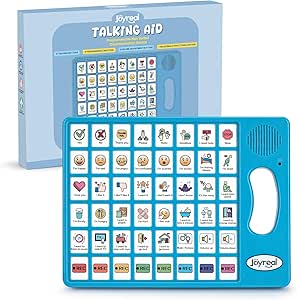
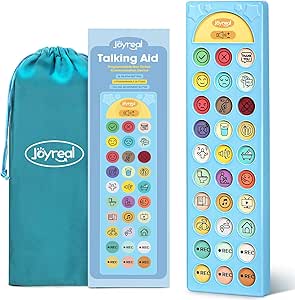
Joyreal AAC Device for Autism – Non‑Verbal Communication Tool with 8 Programmable Buttons and Adjustable Volume
For a nonverbal adult or child who benefits from hearing a message spoken aloud, the Joyreal offers a step up from picture-only boards such as the 6 pcs Communication Boards for Non‑Verbal Adults. It combines 37 pre-installed picture buttons with eight recordable keys, so caregivers can add familiar names or specific requests that a fixed chart may not cover. Male and female voice options and adjustable volume give the device flexibility across users and environments. The cost of that extra functionality is a reliance on three AAA batteries, plus the need to record and maintain custom messages. It is described as lightweight and includes a storage bag, though the product data does not provide dimensions. This is a stronger fit for spoken button-based requests than for spelling open-ended messages.
Pros:- 37 pre-installed picture buttons offer ready-made choices
- Eight recordable buttons allow custom messages
- Male and female voice options provide flexibility
- Adjustable volume can help in noisier environments
Cons:- Requires three AAA batteries and has no built-in rechargeable option
- Eight custom keys may not cover users who need extensive personalized vocabulary
- Button selection may not suit users with limited hand movement
Best for: Nonverbal adults or children who can select buttons and need both picture prompts and a small set of spoken custom messages
Not ideal for: People who need open-ended spelling, extensive personalized vocabulary, or a rechargeable device
- Pre-installed buttons:37 picture and color buttons
- Programmable buttons:8 user-recorded buttons
- Voice options:Male and female
- Power source:3 AAA batteries
- Volume:Adjustable
- Portability:Lightweight; storage bag included
- Intended users:People with autism, stroke recovery, apraxia, aphasia, and other speech challenges
Our verdict“Choose the Joyreal when spoken picture-button messages and a few personalized recordings are more useful than a silent board.”
Adult Non‑Slip Portable Communication Board – QWERTY/ABC Letter Chart for Non‑Verbal Users and Stroke Recovery
Adults who can spell or indicate letters may get more flexibility from this QWERTY or ABC chart than from picture boards built around preset needs. The rubber backing helps keep the 9.5” x 8” board stable on a lap or table, a useful difference from the large Spanish Visually Speaking board, which gives more room but is less compact. Its vinyl surface supports finger sliding, and the size is described as suitable for a wheelchair pocket or backpack. That portability comes with a letter-based communication limit: users must be able to identify and select letters, and the board is limited to English letters and preset common words. It has no voice output or customization, so the Joyreal AAC device may suit users who need spoken button messages instead.
Pros:- Non-slip rubber backing helps stabilize the board on laps or tables
- QWERTY or ABC layout supports letter-based communication
- Compact 9.5” x 8” size fits a wheelchair pocket or backpack
- Vinyl surface allows fingers to slide across the chart
Cons:- English letters and preset words limit language and vocabulary
- Requires the user to select letters rather than choose ready-made spoken messages
- No customization or electronic speech output
Best for: Adults recovering from stroke or living with aphasia, ALS, or dementia who can indicate letters and need a stable portable chart
Not ideal for: Users who cannot reliably select letters, need another language, or benefit from picture choices and spoken output
- Dimensions:9.5” x 8”
- Surface material:Vinyl
- Backing:Non-slip rubber
- Layouts:QWERTY or ABC
- Additional content:Common words
- Portability:Fits wheelchair side pocket or backpack
- Intended users:Adults, nonverbal patients, and people in stroke recovery, dementia, or ALS care
Our verdict“Choose this compact chart for an adult who can spell by pointing and needs a stable board for use on the go.”
Plastic Communication Board for Non Verbal Adults, Picture Symbol Communication Cards for Aphasia, Stroke Patients, Hospital and Care Home Use
For adults who communicate most easily by pointing, this set offers four reusable picture boards suited to common care needs and preferences. Its plastic construction and roughly letter-size footprint make it easier to move between a bedside, wheelchair, or home than a large fixed board. Compared with the 60-word plastic card set, these boards keep symbols together for quick scanning, while the cards offer a broader range of basic words in a compact ring-bound format. The tradeoff is limited choice: the supplied details do not specify the symbols or show that users can add messages, so people with more individual or complex needs may outgrow the set. I would choose it for familiar, practical requests rather than open-ended conversation.
Pros:- Four boards provide grouped picture choices for pointing
- Plastic construction suits repeated handling
- Portable dimensions support use across care locations
- Picture symbols offer a low-literacy way to express basic needs
Cons:- Only four boards are included, limiting the range of choices
- The provided details do not identify the symbols or confirm customization options
Best for: Care teams and families supporting nonverbal adults who need reusable picture choices across hospital, care home, and home settings
Not ideal for: People who need personalized vocabulary, detailed sentence building, or a specific symbol layout that has not been confirmed
- Number of boards:4
- Material:Plastic
- Listed dimensions:11.81 x 8.27 inches
- Intended users:Adults with aphasia, stroke recovery, or other communication challenges
- Suggested settings:Hospitals, care homes, and daily life
- Model number:98584
Our verdict“Choose this set for portable, reusable picture-based requests, but pick the 60-word cards if a wider basic vocabulary matters more.”
Communication Board for Adults – Non-Slip, Portable Letter Chart for Non-Verbal Patients, Stroke Recovery, and Visual Aids (ABC or QWERTY)
This board suits adults who can spell or recognize letters and need a steady surface for choosing them. The rubber backing helps keep the chart in place on a lap, table, or wheelchair, reducing the need to hold it still while pointing. Buyers can choose ABC or QWERTY, which matters when familiarity with one layout makes letter selection easier. Compared with the four picture boards from Albidaya, this chart supports spelling names and less predictable messages, but it asks the user to know letters and form words. Its 9.5-by-8-inch size is portable, though it may take up too much room for some users. This is a practical nonverbal adult aid when alphabet access fits the person’s abilities.
Pros:- Non-slip backing helps stabilize the board while pointing
- Choice of ABC or QWERTY layouts supports different letter preferences
- Letter chart can support messages beyond a fixed set of phrases
- Portable size works across laps, tables, and wheelchairs
Cons:- Requires letter recognition and spelling to communicate
- May be too large for users with limited tray or lap space
- No speech output or electronic assistance
Best for: Nonverbal adults recovering from stroke who recognize letters and need a stable spelling chart at bedside or in a wheelchair
Not ideal for: Users who cannot reliably identify letters, need picture-based choices, or have very limited lap or tray space
- Size:9.5 x 8 inches
- Format options:ABC or QWERTY
- Surface material:Vinyl
- Backing:Rubber
- Quantity:5 pack
- Intended use:Nonverbal communication and stroke recovery
Our verdict“Pick this chart for a letter-literate adult who needs flexible spelling and a stable board; choose picture symbols for simpler selection.”
AAC Device for Autism, Non-Verbal Communication Tool with Programmable Buttons and Adjustable Volume
For users who benefit from hearing a spoken message after selecting a button, this device adds voice output to picture-based communication. It has 23 pre-installed buttons and six programmable keys, giving caregivers a starting set of prompts alongside room for personal messages. Adjustable volume and a male/female voice switch offer some flexibility across settings. Compared with Joyreal’s similar device, which lists 24 pre-installed buttons, this model has one fewer ready-made choice; the supplied information does not establish a broader advantage in customization or portability. Both require three AAA batteries, and this one may need caregiver setup for recordings. Its basic preloaded vocabulary may not cover complex needs, so I would match the programmed messages to the user’s routine before relying on it as their only aid.
Pros:- Pre-installed picture buttons provide ready-made spoken choices
- Six programmable buttons allow personalized recordings
- Adjustable volume supports different environments
- Male/female voice switch provides a choice of voice
Cons:- Three AAA batteries are required and not included
- Preloaded instructions may not cover complex communication needs
- Personalized messages require someone to record them
Best for: Adults or older users who benefit from spoken prompts and have a caregiver able to record a small set of personalized messages
Not ideal for: Users who need extensive vocabulary, independent text generation, or a device that does not rely on replaceable batteries
- Pre-installed talking buttons:23
- Programmable buttons:6
- Voice options:Male/female switch
- Volume:Adjustable
- Power:3 AAA batteries, not included
- Included accessory:Storage bag
Our verdict“Choose this device when spoken output and a few personalized messages matter more than a broad, flexible vocabulary.”
Joyreal AAC Device for Autism – Non-Verbal Communication Tool with 6 Programmable Buttons and Adjustable Volume
Joyreal gives users 24 pre-installed picture buttons plus six keys for recorded messages, making it a compact option for people who can select a symbol and benefit from hearing the choice spoken aloud. The storage bag and lightweight design make it easier to bring between home and care settings than a larger board. Compared with the other programmable device in this batch, it lists one additional pre-installed button, but both offer six customizable messages and use three AAA batteries. That small difference will matter less than whether the ready-made pictures match the user’s needs. The built-in phrase range is limited unless someone records extra prompts, and there is no rechargeable option listed. I would favor it when its picture set fits the routine and portability matters.
Pros:- 24 pre-installed picture and color buttons offer ready-made choices
- Six programmable keys support personal voice prompts
- Adjustable volume suits different environments
- Lightweight design includes a storage bag
Cons:- Requires disposable AAA batteries with no rechargeable option listed
- Built-in phrases may be insufficient without custom recordings
- Customizing messages depends on someone recording them
Best for: Adults with autism or speech challenges who need a portable set of picture-based spoken choices and a few caregiver-recorded messages
Not ideal for: Users who need a large vocabulary, frequent message changes without caregiver help, or rechargeable power
- Pre-installed buttons:24 picture/color buttons
- Programmable buttons:6 user-recorded messages
- Power source:3 AAA batteries
- Volume:Adjustable
- Portability:Lightweight
- Included accessory:Storage bag
Our verdict“Choose Joyreal if its picture choices suit the user’s routine and portable spoken prompts are a priority.”
Plastic Communication Cards, 60 Basic Words, Special Needs & Autism Support
This ring-bound set provides 60 basic words across 30 double-sided cards, offering more vocabulary than the four-board Albidaya set while keeping the choices in a compact format. The cards may suit nonverbal adults who can point to familiar pictures and need everyday needs or feelings available across locations. Their small 75 mm square size makes them easy to carry, though the tradeoff is that each card offers less viewing space than a full-size board. Unlike Joyreal’s AAC device, the cards do not speak selected messages aloud or offer programmable prompts; they rely on the communication partner seeing the chosen word. The vocabulary is also limited to basic words, so I would treat this as a portable aid for routine exchanges rather than a tool for complex conversation.
Pros:- 60 basic words provide more listed vocabulary than the four-board picture set
- Ring binder keeps the cards together for quick access
- Plastic cards are suited to frequent handling
- Compact cards are easy to carry between settings
Cons:- Vocabulary is limited to 60 basic words
- Small card dimensions may be harder to see or point to
- No electronic voice output or programmable messages
Best for: Families and care staff who need a small, ring-bound set of basic picture words for everyday communication with a nonverbal adult
Not ideal for: Users who need large, high-visibility symbols, spoken output, or vocabulary for complex and personalized messages
- Vocabulary:60 words
- Card count:30 double-sided cards
- Dimensions:75 x 75 mm
- Material:Plastic
- Binding:Ring binder
- Listed audience:Nonverbal individuals, special needs, autism, toddlers, and seniors
Our verdict“Choose these cards for a portable set of basic picture words, and choose an AAC device when spoken output is needed.”

How We Picked
I ranked these aids by how directly they support communication for nonverbal adults and patients: whether a person can point, spell, select pictures, or play a programmed message, and how practical the aid appears for bedside, home, or care-facility use. I gave weight to adult-oriented layouts, portability, legibility, the range of communication methods, and details such as multiple boards, Spanish text, or adjustable device volume.
The ranking favors options with a clear role and useful flexibility for common care situations. Letter charts lead for adults who can spell because they allow open-ended messages without preselecting every phrase; picture boards suit users who communicate more readily through symbols. Programmable devices rank well for audible messages but sit below broadly usable boards when the product details provide less information about setup or message capacity. Products with overlapping formats rank according to their distinguishing details, and I treat unknowns as limits rather than assuming a feature is present.
Factors to Consider When Choosing Communication Aids For Non Verbal Patients
Start with the person’s reliable way to express a choice, need, or question, then match the aid to the people and places where it will be used. A board can be a better everyday tool than a more advanced device if it is easier for the user to access and for partners to interpret.
Match the format to the user’s strongest communication method
Ask whether the person can point accurately, recognize pictures, read words, or spell; the answer may vary with fatigue or illness. Letter charts support original messages, but require the user to spell and the partner to follow the selections patiently. Picture symbols can make common needs easier to indicate quickly, though a limited vocabulary may not cover a specific symptom or question. A combined approach can help when a person uses pictures for routine requests and letters for details. Avoid choosing by diagnosis alone, since two people with the same condition may have different vision, literacy, movement, and language needs.
Check access, positioning, and visibility
Consider how the user will reach and point to the aid from a bed, wheelchair, or chair at home. A portable board can move between settings, while a larger layout may be easier to see but harder to place on a tray or carry. Check symbol size, contrast, glare, and whether the person can point with a finger or needs a partner to scan choices aloud. A non-slip backing may help keep a chart in place, but it does not solve limited reach or inaccurate movement. Before settling on a format, try it in the position where communication will actually happen.
Plan for communication partners and changing caregivers
An aid works only when the partner knows how to present choices and confirm what the user selected. A board with many symbols can offer breadth but may slow down a rushed interaction if staff or family members do not recognize its layout. Agree on a simple confirmation routine, such as repeating the selected message and waiting for a yes or no. In hospitals and care homes, a familiar, consistently placed board can be easier to use across shifts than loose cards that move around. Include the user’s regular communication partners when choosing symbols and wording.
Weigh low-tech reliability against recorded speech
Boards and cards do not need batteries, charging, or programming, which can matter during travel or an unexpected power interruption. A device that plays recorded messages can make a request audible to someone across a room, but the user must be able to reach its buttons and the messages must be set up appropriately. Button count alone does not tell you whether a device can express the range of messages someone needs. Check who will record or update phrases and how volume and access work in the intended setting. Some households may find a board useful as a backup even when they primarily use a speech output device.
Choose vocabulary for real situations, not just a product category
Generic boards often cover basic needs, but the most important words can be personal: pain location, a preferred name, a specific routine, or a way to refuse. Before buying, write down the messages the person most needs to express and compare them with the board’s visible vocabulary or programmable capacity. Spanish-language materials can reduce a language mismatch, but caregivers should still check that the words and symbols are familiar to the user. When vocabulary is limited, a letter chart can fill gaps if spelling is accessible. Review the list periodically as health, routines, and communication abilities change.
Frequently Asked Questions
Should I choose a letter chart or a picture communication board for an adult?
Choose based on what the adult can use comfortably and consistently, rather than assuming one format is more appropriate for adults. A letter chart may offer more flexible expression for someone who can spell and point, while picture symbols can make common requests quicker for someone who finds spelling difficult. Vision, fatigue, literacy, and movement can all change what works. If possible, try both formats during ordinary conversations and note which produces clearer selections with less effort. Some people benefit from access to both.
Are programmable AAC buttons useful if someone already has a communication board?
They can add a different kind of access by playing a recorded message aloud, which may help when pointing to a board is difficult or a partner cannot see the selection. A board can still support messages that are not programmed and provide a simple option when the device is unavailable. Compare the device’s button count with the person’s actual everyday phrases, and find out who will record and update them. Also check that the buttons are reachable and distinct enough for the user to select reliably. The two formats can complement each other rather than requiring an either-or choice.
What should I check before using a communication aid in a hospital or care home?
Check that the aid can stay with the patient, be positioned within reach, and be recognized by different staff members. A familiar layout and a short explanation of how the patient indicates a choice can reduce confusion during shift changes. For loose cards or multi-board sets, decide where they will be stored so they do not get separated. If the patient uses a device, plan for charging, volume, and access to programmed messages. Ask the care team to confirm selections with the patient instead of treating a guessed response as certain.
How can I tell whether a communication board has enough vocabulary?
List the messages the person needs most, including ways to ask for help, indicate discomfort, make choices, and say no. Compare that list with the symbols or words shown on the board, rather than judging by the total number of pictures alone. A board can cover routine needs and still omit an important personal or medical message. Consider whether a letter chart or another method can fill the gaps. Revisit the list after routines or communication abilities change.
Does a Spanish-language communication board make sense if caregivers mainly speak English?
It may help when Spanish is the language the patient understands or prefers, but the board needs to match how that individual reads or recognizes symbols. A language mismatch can make even a clear, large board difficult to use. Caregivers should learn the labels and agree on how to confirm a selection, especially when a message concerns pain or care. If the person communicates in more than one language, consider what they need to say in each setting. A Spanish version is a practical starting point, not a substitute for checking the user’s familiarity with its vocabulary.
Conclusion
For most adult patients who can spell or point, I recommend the Adult Communication Board 3 Pack as the best overall starting point because it combines a familiar letter-chart approach with multiple portable boards. For a lower-tech picture option, compare the Vidak EZ Board with the Fuyoooo multi-board sets; the sets suit buyers who want more than one board, while a single board may be simpler to manage. Beginners and care partners new to AAC can start with a clear, familiar letter chart or basic picture board and observe which the user selects reliably. The Joyreal 8-button AAC device is the premium-style pick for users who benefit from recorded speech, while the Visually Speaking Spanish board is the specific choice for Spanish-speaking patients who need a larger layout. If the user cannot reliably point, spell, see the symbols, or reach buttons, ask a speech-language pathologist to help match access method and vocabulary before choosing.
Cold & flu season Picks
humidifiers
As an affiliate, we earn on qualifying purchases.