For most seniors choosing a stationary bike, I would start with the 400-pound-capacity recumbent bike with an adjustable seat: its supportive riding position and clear resistance range make it the strongest all-around fit on paper. The MERACH recumbent with Bluetooth adds app connectivity, while the GOIMU 5-in-1 folding bike suits homes where storage space matters. The main tradeoff is between the back support and step-through access of a recumbent bike and the smaller footprint and extra riding positions of a folding model. Features such as app controls and arm exercisers can be useful, but they do not replace a stable frame, comfortable fit, and easy mounting. Read on for the full comparison and guidance on matching a bike to your space, mobility, and exercise goals.

Turn quiet afternoons into listening time
- Thousands of audiobooks, podcasts and originals
- Listen on your phone, tablet or Echo — also offline
- Cancel anytime
Complete the kit


Key Takeaways
- Recumbent models lead for seated support: The roundup’s strongest all-around candidates include the adjustable 400-pound-capacity recumbent and several MERACH, YOSUDA, and Pooboo recumbent options.
- Capacity and comfort are separate questions: A listed 400-pound capacity may offer more headroom, but buyers still need to check seat dimensions, reach, and ease of getting on and off.
- Folding bikes solve a space problem: GOIMU, Caromix, and Barwing offer folding designs and multiple configurations, trading the more supported reclined posture of a recumbent for storage flexibility.
- Bluetooth is a bonus, not a fit measure: The MERACH smart model and Pooboo app-compatible bike add connected features, while comfort and controls should guide the choice first.
- Resistance ranges are similar across many picks: Several models list 16 magnetic resistance levels, so frame stability, seat adjustment, and access may distinguish them more than the level count.




| stationary bikes for senior | Resistance levels | Resistance | Maximum weight capacity |
|---|---|---|---|
| Recumbent Exercise Bike for Ho | 16 | — | — |
| MERACH Recumbent Exercise Bike | 8 | — | — |
| GOIMU 5-in-1 Foldable Stationa | 16 | — | — |
| MERACH Recumbent Exercise Bike | 8 | — | — |
| Caromix Folding Exercise Bike | 16 | — | — |
| YOSUDA Recumbent Exercise Bike | — | 16 magnetic levels | 350 lb |
| Recumbent Exercise Bike for Ho | — | 16 magnetic levels | 400 lb |
| GOIMU 5-in-1 Foldable Exercise | — | 16 magnetic levels | 330 lb |
| Barwing Stationary Exercise Bi | — | 16 magnetic levels | 350 lb |
| Pooboo Recumbent Exercise Bike | — | 8 levels | 400 lb |
More Details on Our Top Picks
Recumbent Exercise Bike for Home, 16-Level Resistance, Adjustable Seat, Supports 400LB, LCD Display, Pulse Sensors
For seniors who want a recumbent riding position and need a higher stated weight limit, this bike stands apart from the MERACH S08, which supports up to 300 pounds. Its 400-pound capacity, padded seat, and backrest make it a plausible fit for home workouts where seated support matters. The 16 resistance levels also give riders more adjustment steps than either MERACH recumbent model, which each list eight; that can help when building up gradually or varying effort. Pulse sensors and an LCD cover basic workout tracking without requiring an app. The tradeoff is that the listing gives few details about dimensions or rider height fit, so buyers should check the available space and fit information before ordering. Some assembly is still required, and it is intended for indoor use.
Pros:- 400-pound stated weight capacity exceeds the 300-pound limit listed for the MERACH S08.
- Padded seat and backrest support a seated riding posture.
- Sixteen magnetic resistance levels offer more adjustment steps than the eight-level MERACH recumbent bikes.
- LCD and pulse sensors provide basic workout and heart-rate tracking.
Cons:- Some assembly is required despite the setup being described as easy.
- The supplied product details do not specify dimensions or recommended rider height.
- Indoor use only; no folding feature is listed for compact storage.
Best for: Seniors who want a supported recumbent position and need a bike rated for a user weighing up to 400 pounds.
Not ideal for: Buyers who need confirmed fit dimensions, a folding frame, or app-based workout tracking.
- Resistance levels:16
- Weight capacity:400 lbs
- Seat adjustment:Lever-based, adjustable
- Display:LCD
- Heart-rate tracking:Pulse sensors
- Resistance type:Magnetic
- Frame:Steel
Our verdict“Choose this recumbent model if its 400-pound stated capacity and broad resistance range fit your needs, and confirm the bike’s dimensions before buying.”
MERACH Recumbent Exercise Bike for Home with Smart Bluetooth App
The MERACH S08 suits seniors who want a recumbent bike with connected workout records, rather than the greater resistance range offered by the 16-level, 400-pound-capacity recumbent model. Its Bluetooth app connection syncs workout data, while the LCD and heart-rate handle provide on-bike feedback. The wide seat and joint-friendly design support a low-impact routine, and eight magnetic resistance levels keep adjustments straightforward. At 57.3 pounds, it is lighter than the other MERACH recumbent bike listed here, which weighs 84.9 pounds, though moving it may still take effort. Its 300-pound capacity is lower than both that MERACH model and the 400-pound option. This is a better match for buyers who value app tracking and a simpler setup than extra resistance steps or a higher weight limit.
Pros:- Bluetooth syncs workout data with the MERACH app.
- Wide seat and recumbent position suit low-impact home workouts.
- LCD with heart-rate handle gives on-bike workout feedback.
- Listed weight is lower than the 84.9-pound MERACH recumbent model.
Cons:- 300-pound maximum user weight is below the other two recumbent bikes in this batch.
- Eight resistance levels offer fewer adjustment steps than the 16-level models.
- At 57.3 pounds, relocation can still be difficult despite the transport wheels.
Best for: Seniors under the stated 300-pound capacity who want to sync recumbent workouts to the MERACH app.
Not ideal for: Riders who need a higher weight capacity, more than eight resistance levels, or a particularly light bike to move.
- Brand and model:MERACH S08
- Resistance levels:8
- Resistance type:Magnetic
- Maximum user weight:300 lbs
- Weight:57.3 lbs
- Dimensions:49.6 x 24.8 x 50.98 in
- Display and heart-rate tracking:LCD with heart-rate handle
- Connectivity:Bluetooth; MERACH app
Our verdict“Pick the MERACH S08 if app-synced tracking matters more to you than a higher capacity or finer resistance adjustment.”
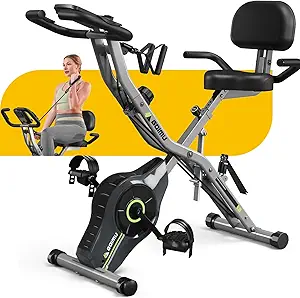
GOIMU 5-in-1 Foldable Stationary Exercise Bike with Magnetic Resistance
The GOIMU is the most varied option here: its upright and semi-recumbent positions add flexibility that the dedicated recumbent MERACH models do not offer, and arm bands and leg pull cords extend workouts beyond pedaling. For a senior who wants one machine for light cardio and seated strength work, that range may be more useful than app tracking. The foldable frame and transport wheels also help when a bike must share living space. It supports up to 330 pounds, between the 300-pound MERACH S08 and the 400-pound recumbent model. That versatility comes with a compromise: the product details do not specify rider-height fit, and a folding multiposition design may feel less purpose-built for someone seeking only a stable, supported recumbent ride. Assembly is required, and some components are plastic.
Pros:- Multiple riding positions provide more workout variety than either dedicated MERACH recumbent bike.
- Arm resistance bands and leg pull cords add seated strength exercises.
- Folds for storage and includes transport wheels.
- 330-pound stated capacity is higher than the MERACH S08’s 300-pound limit.
Cons:- The provided specs do not state a recommended rider-height range.
- Plastic components may feel less substantial than the steel frame.
- Assembly is required.
Best for: Seniors with limited storage space who want multiple riding positions plus light upper- and lower-body resistance work.
Not ideal for: Riders who need a dedicated recumbent setup, documented height fit, or the 400-pound capacity of the first recumbent model.
- Bike type:Foldable stationary bike
- Workout modes:5-in-1
- Resistance levels:16
- Resistance type:Magnetic
- Maximum user weight:330 lbs
- Flywheel weight:5.5 lbs
- Frame material:Heavy-duty steel
- Storage and movement:Foldable; transport wheels
Our verdict“Choose the GOIMU if storage and workout variety matter more than a dedicated recumbent fit or a higher weight limit.”
MERACH Recumbent Exercise Bike for Home
This MERACH model puts comfort and a clearly described fit range ahead of the lighter, app-connected S08. Its thicker seat and breathable mesh backrest are aimed at longer seated sessions, while the listing gives an extended seated leg length of 28.35 to 35.43 inches and recommends riders from 5 feet 2 inches to 5 feet 10 inches. That guidance can make fit easier to judge than on the GOIMU folding bike, whose supplied details do not give a height range. The eight magnetic resistance levels and silent dual-belt drive suit steady, low-impact workouts; the LCD, iPad holder, and app add ways to follow a session. The cost of that feature set is a large, heavy frame: at 84.9 pounds, it is much harder to move than the S08, and it supports 330 pounds rather than the first recumbent’s 400.
Pros:- Thicker seat and breathable mesh backrest are designed for supported seated sessions.
- Listed rider-height and seated-leg-length ranges help buyers assess fit.
- Silent dual-belt drive and magnetic resistance support quiet workouts.
- LCD, iPad holder, heart-rate tracking, and app provide several ways to follow exercise.
Cons:- At 84.9 pounds, the bike is substantially heavier than the MERACH S08.
- Its listed dimensions require more floor space than a foldable model.
- 330-pound capacity is lower than the first recumbent model’s 400-pound limit.
Best for: Seniors within the listed 5-foot-2 to 5-foot-10 range who prioritize a breathable backrest and guided app workouts.
Not ideal for: People with limited floor space, users above 330 pounds, or anyone who needs to move the bike frequently.
- Dimensions:48.03 x 23.62 x 46.46 in
- Product weight:84.9 lbs
- Weight capacity:330 lbs
- Recommended height:5 ft 2 in to 5 ft 10 in
- Extended seated leg length:28.35 to 35.43 in
- Resistance levels:8
- Flywheel weight:6.6 lbs
- Color:Black
Our verdict“Choose this MERACH if the stated fit range and supportive backrest match you and you have room to leave the bike in place.”
Caromix Folding Exercise Bike – 5-in-1 Stationary Bike with 16-Level Adjustable Magnetic Resistance, 330 lb Capacity
For seniors who need to reclaim floor space after a workout, the Caromix pairs a folding steel frame and transport wheels with five riding positions. Its semi-reclining mode and arm resistance band add some seated variety, while the LCD tracks time, speed, distance, calories, and heart rate. Compared with the GOIMU 5-in-1, it offers a stated rider-height range of 5 feet 1 inch to 6 feet 6 inches, which gives buyers more information for judging fit. Both list 16 magnetic resistance levels and a 330-pound capacity, so the Caromix does not raise the weight limit over the GOIMU or compete with the 400-pound recumbent. The supplied data also identifies only an arm band among the extra strength features. Some assembly remains despite the bike arriving mostly pre-assembled.
Pros:- Folds and includes transport wheels for easier storage than the full-size MERACH recumbent.
- Five positions include a semi-reclining option and an arm resistance band.
- Sixteen magnetic resistance levels allow graduated adjustment.
- Listed rider-height range helps buyers compare fit.
Cons:- 330-pound capacity may not suit heavier riders and is below the first recumbent’s 400-pound limit.
- Some assembly is needed despite being mostly pre-assembled.
- The supplied workout attachments are less extensive than the GOIMU’s arm bands and leg pull cords.
Best for: Seniors who need a foldable bike, want basic heart-rate tracking, and fall within the listed 5-foot-1 to 6-foot-6 rider range.
Not ideal for: People who need a dedicated recumbent frame, a capacity above 330 pounds, or multiple included strength attachments.
- Model:gear (BW-FNBT01)
- Maximum user weight:330 lbs
- Rider height range:5 ft 1 in to 6 ft 6 in
- Workout positions:5-in-1
- Resistance levels:16
- Resistance type:Magnetic
- Flywheel:5.5 lb aluminum
- Monitor:LCD; time, speed, distance, calories, heart rate
- Storage:Foldable; transport wheels included
Our verdict“Pick the Caromix if folding storage and a stated rider-height range are priorities and its 330-pound limit suits you.”
YOSUDA Recumbent Exercise Bike for Home, Magnetic Stationary Bike for Seniors
The YOSUDA is a strong fit for seniors who want a straightforward seated ride with a broad range of resistance. Its recumbent position and adjustable seat can suit riders from about 4’9″ to 6’2″, while the magnetic, belt-driven system keeps pedaling quiet enough for a shared living room. Compared with the Pooboo Recumbent Exercise Bike, YOSUDA offers twice as many resistance levels, which gives riders more gradual steps as fitness changes. Pooboo adds moving arm exercise and app connections, so it may suit someone seeking a more involved routine. YOSUDA’s steel frame supports up to 350 lb, but its 26.5 kg weight and 45-inch depth make it harder to move and less suitable for tight rooms. Choose it for simple, adjustable seated cycling; skip it if frequent relocation or arm workouts matter.
Pros:- Recumbent seating supports a relaxed posture during low-impact rides
- Sixteen magnetic resistance levels allow gradual workout changes
- Seat range accommodates users from about 4’9″ to 6’2″
- Steel frame supports up to 350 lb
Cons:- At 26.5 kg, it can be difficult to relocate
- Its 45-inch depth takes substantial floor space
- It lacks the arm exerciser and app connections offered by the Pooboo
Best for: Seniors who want quiet, seated cycling, a wide resistance range, and an adjustable fit for different heights
Not ideal for: People who need to move their bike often, have limited floor space, or want arm exercise and app connectivity
- Resistance:16 magnetic levels
- Drive system:Belt
- Maximum weight capacity:350 lb
- User height range:Approximately 4’9″ to 6’2″
- Weight:26.5 kg
- Dimensions:45″ x 20″ x 39″
- Monitor:LCD with pulse sensors
- Frame:Alloy steel
Our verdict“Choose the YOSUDA for quiet, adjustable recumbent cycling with many resistance steps, provided you have room to leave it set up.”
Recumbent Exercise Bike for Home Use with 16-Level Magnetic Resistance, LCD Monitor, and 400LB Capacity
This recumbent bike’s main distinction is its stated 400 lb capacity, higher than the YOSUDA Recumbent Exercise Bike at 350 lb. That may make it the more suitable choice for riders who need the higher listed limit and a supportive padded seat. Both models offer 16 magnetic resistance levels and an LCD monitor, so this bike’s case rests on capacity and a simpler assembly claim: it arrives 90% pre-assembled. The supplied details do not give a seat adjustment range or user height range, though, which makes fit harder to judge than YOSUDA’s stated range. It is intended for indoor use and still may need extra tools to finish assembly. I would favor it when the higher capacity is the deciding factor; riders who need clear fit guidance should compare the dimensions and adjustment range before choosing.
Pros:- Stated 400 lb capacity exceeds the YOSUDA’s 350 lb limit
- Sixteen magnetic resistance levels support gradual workout changes
- Soft padded seat and quiet operation suit home exercise
- Arrives 90% pre-assembled
Cons:- Seat adjustment and user height range are not specified
- Some buyers may need extra tools to complete assembly
- Limited to indoor use
Best for: Seniors who need a recumbent bike with a stated 400 lb capacity and want most of the assembly completed
Not ideal for: Buyers who need a confirmed seat adjustment or height range, or who want a bike they can use outdoors
- Resistance:16 magnetic levels
- Maximum weight capacity:400 lb
- Seat:Soft padded
- Monitor:LCD fitness tracker
- Assembly:90% pre-assembled
- Operation:Quiet magnetic system
Our verdict“Pick this model if its stated 400 lb capacity is your priority and its unspecified fit range suits your needs.”
GOIMU 5-in-1 Foldable Exercise Bike – 16-Level Magnetic Resistance, 330 lb Capacity, Comfortable Seat & Backrest
The GOIMU 5-in-1 is aimed at seniors who want more than a seated pedaling routine and need to store the bike between sessions. Its folding frame, transport wheels, and five workout modes bring flexibility that the fixed YOSUDA recumbent lacks. Magnetic resistance and a 5.5 lb aluminum flywheel are described as quiet and smooth, while the seat and backrest provide support for cycling. That added versatility involves a fit tradeoff: the supplied details do not state a seat adjustment range or user height range, so I cannot compare its fit as confidently with YOSUDA’s stated range. Its 330 lb capacity is also lower than the 350 lb YOSUDA and 400 lb Pooboo. Folding helps with storage, but the bike can still take up space when folded.
Pros:- Folding frame and transport wheels make it easier to store between rides
- Five workout modes offer more variety than the YOSUDA recumbent
- Sixteen magnetic resistance levels support changing workout intensity
- Seat and backrest add support for cycling
Cons:- 330 lb capacity is below the YOSUDA and Pooboo models
- It can remain bulky even when folded
- Seat adjustment and user height range are not specified
Best for: Seniors with limited storage who want a folding bike that offers several workout modes
Not ideal for: Riders who need a recumbent layout with a documented height fit range or a capacity above 330 lb
- Resistance:16 magnetic levels
- Maximum weight capacity:330 lb
- Flywheel:5.5 lb aluminum
- Workout modes:5
- Frame:Alloy steel
- Foldable:Yes
- Transport wheels:Included
Our verdict“Choose the GOIMU if storage and workout variety matter more than a documented fit range or a higher weight capacity.”
Barwing Stationary Exercise Bike – 5-in-1 Foldable Indoor Cycling Bike, 350 lb Capacity, 16-Level Magnetic Resistance, Adjustable Seat and Backrest
The Barwing stands out among the folding options for giving buyers more explicit ways to adjust their riding position. Its eight seat-height positions and two seat-angle positions make fit easier to tailor than on the GOIMU, whose supplied details do not specify seat adjustments. It also folds to a stated 1.8 sq ft footprint, a useful advantage for homes where exercise equipment must be put away. The 350 lb capacity matches the YOSUDA, while its 16 magnetic levels offer a similar range for changing workout effort. Those adjustments require assembly, and the supplied specs do not list a pulse sensor or app connection; the Pooboo offers a pulse sensor and app compatibility. I would choose Barwing for adaptable posture and storage, but riders who rely on heart-rate tracking should look at Pooboo.
Pros:- Eight seat-height and two seat-angle positions help tailor the fit
- Folds to a stated 1.8 sq ft footprint and includes transport wheels
- Sixteen magnetic resistance levels offer a broad range
- 350 lb capacity matches the YOSUDA
Cons:- Several components still require assembly
- No built-in heart-rate monitor or advanced connectivity is specified
- Folded dimensions do not show how much clearance is needed to move or store it
Best for: Seniors who want a folding bike with several seat and posture adjustments for a more tailored fit
Not ideal for: Buyers who need built-in pulse tracking or app connectivity, or who want a bike with little assembly work
- Maximum weight capacity:350 lb
- Resistance:16 magnetic levels
- Flywheel:6.6 lb
- Seat height:8 positions
- Seat angle:2 positions
- Posture settings:Upright, recline, folding
- Folded footprint:1.8 sq ft
- Display metrics:Time, speed, distance, calories, odometer
Our verdict“Choose the Barwing if seat adjustment and compact storage are priorities, and you do not need built-in pulse tracking.”
Pooboo Recumbent Exercise Bike with Arm Exerciser, Adjustable Resistance, and Smart App Compatibility
The Pooboo is the most feature-rich recumbent option here for seniors who want to work their arms while pedaling. Its dual-motion arm exerciser, pulse sensor, and app connections make it a broader home workout station than the YOSUDA, which focuses on quiet cycling and offers 16 resistance levels. Pooboo’s stated 400 lb capacity is also higher than YOSUDA’s 350 lb, and its seat range reaches a listed maximum user height of 6’3″. The tradeoff is a shorter resistance range: eight levels give fewer steps for fine-tuning effort than either YOSUDA or the 16-level folding bikes. App use also depends on smartphone compatibility, and assembly remains a task despite the 80% pre-assembled claim. Choose it for arm-and-leg sessions and connected tracking; skip it if gradual resistance changes matter most.
Pros:- Arm exerciser adds upper-body movement to seated cycling
- Stated 400 lb capacity is higher than the YOSUDA’s 350 lb limit
- Pulse sensor and app compatibility offer more tracking options
- Belt drive and backrest support a quiet, seated workout
Cons:- Eight resistance levels offer fewer adjustment steps than YOSUDA’s 16
- App features depend on smartphone compatibility
- Assembly may take time despite being 80% pre-assembled
Best for: Seniors who want seated cycling with arm exercise, pulse sensing, and app-based workout tracking
Not ideal for: Riders who want many small resistance adjustments, or who do not want to rely on a compatible smartphone for app features
- Maximum weight capacity:400 lb
- Resistance:8 levels
- Flywheel:15 lb
- Seat adjustment range:0 to 18.5 inches
- Maximum user height:6’3″
- Connectivity:KinoMap, Zt APP
- Assembly:80% pre-assembled
- Additional features:Arm exerciser, pulse sensor, transport wheels
Our verdict“Choose the Pooboo if you want a stable recumbent bike that combines arm and leg exercise with connected tracking.”
How We Picked
I ranked these stationary bikes for the needs that can shape a senior’s day-to-day use: a comfortable riding position, stable support, straightforward resistance changes, readable basic feedback, and a setup that fits the rider and home. I gave recumbent designs an advantage for their backrest-supported posture, while giving folding bikes credit for storage flexibility and multiple riding configurations. Listed weight capacity, seat adjustability, resistance range, and features such as pulse sensors or app connections informed the comparison, but a higher capacity or longer feature list did not automatically move a bike up the ranking.
The ranking favors practical fit and usability over extras. A model with an adjustable seat and a broad stated capacity ranks ahead of a bike whose main distinction is connectivity when the goal is a straightforward home workout. Folding and 5-in-1 designs place well for readers with limited space or varied exercise preferences, though they are not interchangeable with recumbent bikes for riders who prioritize back support. Product names and supplied specifications do not establish real-world stability, seat comfort, noise, or ease of assembly, so I treat those as points buyers should verify before choosing.
Factors to Consider When Choosing Stationary Bikes For Seniors
Before choosing a model, I would work from the rider’s routine and home setup rather than the longest feature list. These decisions can help narrow the field even when several bikes share similar resistance settings.
Choose a riding position that is easy to enter
Think through the full motion of using the bike: approaching it, sitting down, placing both feet, and standing again. A recumbent design puts the rider in a supported, leaned-back position, while a folding upright-style bike usually asks for a more direct step-over and seated posture. The exact frame geometry and access height vary, so the category label alone cannot tell you whether mounting will feel manageable. If balance or joint movement is a concern, compare product images and dimensions with the rider’s range of motion, and ask a clinician for guidance when needed. A common mistake is choosing for the workout position while ignoring how the rider gets into it. Prioritize an easy, repeatable entry and exit over an extra exercise mode.
Check fit beyond the seat’s adjustability
An adjustable seat helps only if it can place the pedals within comfortable reach. Check the stated rider height range when available, along with the seat’s travel, pedal position, and the distance to the handlebars. Seat width and cushioning matter too, especially if sessions will be longer or frequent. Product listings may say “adjustable” without explaining whether adjustments are tool-free or whether they suit a particular rider. A buyer can avoid a poor fit by measuring the rider’s seated leg reach and comparing it with the seller’s dimensions or support information. If specifications are missing, treat that uncertainty as a reason to ask before ordering.
Treat weight capacity as one part of stability
A higher stated capacity provides more allowance for the rider’s weight, but it does not by itself describe how planted a bike feels during use. Frame footprint, floor contact, assembly quality, and the rider’s motion all affect perceived stability. Compare the bike’s assembled dimensions and check that the floor space can accommodate its base without forcing it close to walls or furniture. Folding designs may be easier to store, yet buyers should confirm how the bike locks into its exercise position and whether it is practical to fold and move. Avoid assuming that a model with the largest capacity is automatically the most stable or comfortable choice. Use capacity as a basic fit requirement, then verify the frame and setup details.
Pick resistance you can use consistently
Many bikes here advertise 16 magnetic resistance levels, but the number does not tell you how light the first setting is or how smoothly resistance changes. For gentle exercise or a gradual return to activity, easy control at the low end may matter more than a challenging maximum. Magnetic systems are commonly selected for controlled adjustments, but product pages may not provide enough detail to compare noise or feel. Look for clear controls that can be reached without leaning awkwardly, and decide whether a simple manual dial is easier than an app-based setup. If the rider’s exercise plan has medical constraints, ask their clinician what intensity and progression are appropriate. The best range is the one the rider can adjust safely and use regularly.
Plan for the space and storage routine
Measure both the bike’s footprint while in use and the route it must take to reach its storage spot. A folding frame can help in a shared room, but folding adds steps and may require enough strength and balance to handle the bike. Check folded dimensions, weight, transport wheels, and whether the intended storage area is accessible. A recumbent bike usually claims a more permanent spot, so measure the full length and leave room to approach the seat. Buyers sometimes focus on the stored footprint and forget the clearance needed around pedals and frame during a workout. Choose a design that can stay ready to use if frequent folding would discourage exercise.
Decide whether connected features add real value
Bluetooth apps can provide guided sessions or activity tracking, while a basic LCD may be enough for time, speed, or distance feedback. Consider who will set up the connection and whether the rider is comfortable using a phone or tablet during exercise. App compatibility can change, and product titles alone do not explain which functions require an account, subscription, or specific device. Pulse sensors can offer a convenient reading, but they are not a substitute for medical monitoring or advice. If another person will help with setup, connected features may be worthwhile; otherwise, simple controls can make the bike easier to start each day. Pay for connectivity only when the rider has a plan to use it.
Frequently Asked Questions
Should I choose a recumbent bike or a folding stationary bike for an older adult?
I would choose based on how the rider gets seated and what posture they can maintain comfortably. A recumbent bike provides a backrest and a reclined position, while the folding picks prioritize a smaller storage footprint and may offer several configurations. Neither design guarantees easy access, so check frame height, step-over clearance, and seat position for the specific model. If the rider has balance, mobility, or pain concerns, a clinician can help assess which posture is appropriate. In a shared or small room, a folding model may be the practical choice if its setup and storage steps are manageable.
Is a 400-pound weight capacity enough to choose one bike over another?
Capacity is a useful starting filter, but it cannot answer whether the bike fits or feels stable for a particular rider. Compare it with the rider’s weight and leave reasonable headroom rather than selecting a model at its stated limit. Then review seat size, adjustment range, base dimensions, and the bike’s placement on the floor. A listed capacity does not confirm comfort, ease of mounting, or frame steadiness during pedaling. If those details are absent from the listing, ask the seller before relying on the capacity figure alone.
Do seniors need Bluetooth or an exercise app on a stationary bike?
No; connected features are helpful only when they support a routine the rider wants to follow. An app may add guided workouts or activity records, but it also introduces pairing, device, and setup questions. A clear display and simple resistance control can be a better match for someone who wants to sit down and pedal without using a phone. Check what the app actually does and whether it requires ongoing fees or a compatible device. I would treat Bluetooth as a secondary feature after fit, access, and ease of adjustment.
How much room should I leave around a stationary bike?
Plan for more than the bike’s listed footprint: the rider needs space to approach, mount, pedal, and get off safely. Check the assembled dimensions and leave clearance around the pedals and the side used for entry. For a folding model, confirm its folded dimensions as well as the room needed to unfold it without moving heavy furniture. A recumbent bike may take more permanent floor space, while a folding bike still needs a usable exercise area when open. Measure the route from the storage location too, especially if the bike will be moved between rooms.
What should I check before ordering a stationary bike for someone with limited mobility?
Start with the rider’s ability to approach the frame, sit down, reach the pedals, and stand up after exercise. Verify seat height and travel, step-over clearance, handle placement, and whether adjustments can be made without tools. Confirm the bike’s dimensions and weight so setup or repositioning will not create a separate obstacle. Product descriptions may not explain how the bike feels to mount, so contact the seller about access measurements and return terms. For a health condition or uncertainty about exercise safety, ask a clinician to review the planned activity and bike position.
Conclusion
For best overall, I’d begin with the adjustable recumbent bike rated for 400 pounds, based on its supportive design, seat adjustment, and broad capacity. The best value direction is a straightforward recumbent with the features the rider will use, such as the standard MERACH or YOSUDA models, rather than paying for app tools without a plan to use them. For a premium feature set, compare the MERACH Bluetooth model and Pooboo with arm exerciser and app compatibility, checking setup needs before choosing. Beginners may prefer a recumbent with simple resistance controls and a clear LCD over a multi-mode folding bike. For limited space, GOIMU, Caromix, or Barwing folding models merit a look; choose among them by checking folded dimensions, capacity, and ease of setup for the person who will use it.
Halloween Picks

Vexalify 11-Inch Halloween Pumpkin Fog Machine with 12-Color Lights

HOPOCO Halloween Pumpkin Fog Machine with 12 LED Colors & Remote Control

Spirit Halloween 54-Inch Sitting Scarecrow Animatronic
As an affiliate, we earn on qualifying purchases.