
For most older adults who need a caregiver to push, I’d start with the Medline Ultra Lightweight Folding Transport Wheelchair: its transport-chair design and 19-inch seat make it a practical all-around option. The Drive Medical Expedition adds hand brakes for caregiver control, while the Drive Medical Blue Streak is a better fit for someone who can propel a standard wheelchair independently. The main tradeoff is between a lighter chair that is easier to lift and a more substantial model with features such as larger wheels, adjustable leg support, or desk-length arms. Seat fit, total chair weight, and who will push it matter as much as the word “lightweight.” Read on for the full comparison and advice on choosing for your situation.

Turn quiet afternoons into listening time
- Thousands of audiobooks, podcasts and originals
- Listen on your phone, tablet or Echo — also offline
- Cancel anytime
Complete the kit

Key Takeaways
- Transport chairs and self-propelled wheelchairs serve different users. Most picks here have small rear wheels and require a caregiver to push; the Blue Streak has larger rear wheels for users who can propel themselves.
- Caregiver control separates several standouts. The Expedition and Medline foldable models with hand brakes offer added braking control, while the simpler transport chairs have fewer controls to manage.
- A 19-inch seat appears across several transport models, but it is not a universal fit. Medline’s chairs with 18-inch or 20-inch seats give buyers alternatives, so measure the user and check the manufacturer’s fit guidance.
- Elevating leg rests and swing-back arms solve specific access needs. They can help with leg positioning or transfers, but they add complexity and may not suit someone who needs a simpler chair.
- “Lightweight” does not tell the whole lifting story. Compare the chair’s listed weight, folded dimensions, and handling requirements against the caregiver’s ability to lift it into a vehicle.




| lightweight wheelchair for elderly | Weight Capacity | Seat Dimensions | Frame | Weight |
|---|---|---|---|---|
| Medline Ultra Lightweight Fold | 300 lbs | 19" W x 16" D | — | 19 lbs |
| Medline Folding Steel Transpor | 300 lbs | 19 in. wide x 16 in. deep | Steel | — |
| Drive Medical Folding Transpor | — | — | — | — |
| Drive Medical Expedition Light | — | — | Aluminum | 19 lbs |
| Invacare Lightweight Folding T | — | 19 × 16 inches | — | — |
| Medline Folding Wheelchair wit | 300 lbs | 20"W x 16"D | — | 38 lbs |
| Medline Folding Steel Transpor | 250 lbs | 19"W x 16"D | Steel | — |
| Drive Medical Blue Streak Ligh | — | — | Steel | — |
| Medline Lightweight Foldable T | 300 lbs | 19"W x 16"D | — | 23.5 lbs |
| Medline Lightweight Wheelchair | 300 lbs | 18"W x 16"D | — | — |
| Medline Lightweight Foldable T | 300 lb | 19 in W × 16 in D | Aluminum | 26 lb |
| Drive Medical Silver Sport 1 F | 250 lb | — | Powder-coated steel | 37.6 lb |
| Medline Ultra-Lightweight Fold | 300 lb | 19 in W × 16 in D | Aluminum | 15 lb in item details; 19 lb in product description |
| Medline Folding Wheelchair wit | 300 lb | — | High-strength hammertone finish | — |
More Details on Our Top Picks
Medline Ultra Lightweight Folding Transport Wheelchair, 19-Inch Seat, Blue
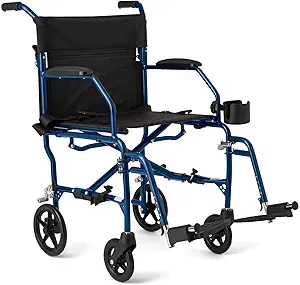
This option stands out for the rare combination of a 19 lb aluminum frame and everyday comfort features that cheaper transport chairs leave out. Compared with the Medline Folding Steel Transport Wheelchair, it sheds roughly 13 lbs while keeping the same 300 lb capacity and 19-inch seat — a difference any caregiver lifting it into a trunk several times a day will feel in their back and shoulders. The cushioned desk-length armrests let a user pull up to a table for meals, and the included cup holder is a small convenience most competitors skip. The tradeoff is fundamental, though: the 8-inch rear wheels mean this is a transport-only chair, so anyone who wants even occasional self-propulsion should look elsewhere.
Pros:- Ultra light 19 lb aluminum frame is easy to lift into a car
- Cushioned desk-length arms allow sitting at tables and desks
- Swing-away locking footrests simplify standing transfers
- Arrives fully assembled with a cup holder included
Cons:- Transport-only design — no large rear wheels for self-propulsion
- 19-inch seat may feel too wide for smaller-framed users
Best for: Caregivers who frequently load a wheelchair into a car and need the lightest possible lift for errands and appointments
Not ideal for: Users who want any self-propulsion ability — the small 8-inch rear wheels make it companion-push only
- Weight:19 lbs
- Weight Capacity:300 lbs
- Seat Dimensions:19″ W x 16″ D
- Frame Material:Aluminum
- Rear Wheel Size:8 inches
- Upholstery:Nylon, easy-clean
- Assembly Required:No
Our verdict“The best all-around choice for elderly users who will always be pushed by a companion and whose caregiver values a truly light load.”
Medline Folding Steel Transport Wheelchair with 19-Inch Seat, 12-Inch Rear Wheels, and Teal Upholstery
This model makes the most sense for buyers who want the smoother ride of 12-inch rear wheels without paying the premium that aluminum-framed chairs like the Drive Medical Expedition command for the same wheel size. The steel frame is what keeps the cost down, and that shows up immediately at 32 lbs — 13 lbs heavier than the Medline Ultra Lightweight. That extra weight buys real capability: larger rear wheels roll more comfortably over thresholds, door tracks, and uneven pavement than the 8-inch wheels on most budget transport chairs. The Microban antimicrobial upholstery is a thoughtful touch for a chair that may see spills and daily use. The honest tradeoff is portability: lifting this into a trunk regularly is genuinely harder work.
Pros:- 12-inch rear wheels handle thresholds and uneven outdoor surfaces better than 8-inch wheels
- Microban antimicrobial upholstery resists bacteria, mold, and mildew
- Detachable swing-away footrests make side transfers easier
- Locking brakes secure the chair during transfers
Cons:- At 32 lbs, it’s one of the heaviest chairs in this lineup to lift
- Steel frame is more prone to long-term rust if used outdoors in damp climates
Best for: Budget-conscious families who mostly push the chair around home or a facility and only occasionally travel with it
Not ideal for: Caregivers with limited upper-body strength who need to lift the chair in and out of a car frequently — 32 lbs gets tiring fast
- Frame:Steel
- Weight Capacity:300 lbs
- Product Weight:32 lbs
- Seat Dimensions:19 in. wide x 16 in. deep
- Rear Wheel Size:12 in.
- Front Wheel Size:8 in. swivel
- Upholstery:Teal with Microban antimicrobial protection
- Assembly:No assembly required
Our verdict“A smart buy if ride quality and durability matter more to you than lift weight.”
Drive Medical Folding Transport Wheelchair with Swing-Away Footrests
Where the Invacare Lightweight Folding Transport Wheelchair folds down to a 9-inch profile, this Drive Medical chair counters with a fold-flat backrest that collapses in two directions, making it one of the slimmest packages here for a closet shelf or behind a car seat. The 17-inch seat is the narrower fit in a lineup dominated by 19-inch seats — a genuine advantage for smaller seniors who slide around or feel swallowed by wider chairs, but a dealbreaker for larger users. Its padded nylon seat wipes clean in seconds, which matters for anyone managing incontinence or meal spills. The compromise is a no-frills feature set: no cup holder, no hand brakes, and the same 8-inch wheels that limit it to smooth, companion-pushed use.
Pros:- Fold-flat backrest creates one of the most compact storage footprints in this lineup
- 17-inch seat fits smaller seniors more securely than 19-inch models
- Padded seat and armrests add comfort for longer outings
- Nylon seat wipes clean easily after spills
Cons:- Bare-bones feature set — no cup holder, hand brakes, or storage pocket
- 8-inch wheels limit outdoor performance on grass, gravel, or cracked pavement
Best for: Smaller-framed seniors and apartment dwellers who need a chair that stores flat in tight spaces
Not ideal for: Broader users who need a wider seat — the 17-inch width will feel restrictive for anyone over roughly 200 lbs
- Frame Material:Steel
- Wheel Size:8 inches
- Seat Width:17 inches
- Seat Material:Nylon
- Footrests:Swing-away
- Backrest:Fold-flat
Our verdict“Choose this if storage space is scarce and the user fits comfortably in a narrower seat.”
Drive Medical Expedition Lightweight Transport Wheelchair with Hand Brakes, Red
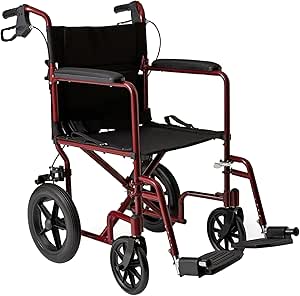
This model is better suited than nearly anything else in this roundup for active seniors who leave the house often. It pairs a 19 lb aluminum frame — matching the Medline Ultra Lightweight — with 12-inch rear wheels, a curb-assist bar, and companion-activated loop-lock hand brakes. Those hand brakes are the defining difference: models like the standard Medline Ultra Lightweight rely on push-to-lock rear brakes, which are fine for parking but give the pushing caregiver no speed control on a hill or ramp. The Expedition’s brakes work like a stroller’s, letting a companion slow the chair mid-motion. The tradeoffs are modest — fold-down footrests don’t swing away for lateral transfers as cleanly as the Medline’s swing-away design, and the red frame shows scuffs more than darker finishes.
Pros:- Loop-lock hand brakes give the caregiver speed control, not just parking
- Curb assist makes lifting the front wheels over bumps far easier
- 12-inch rear wheels roll smoothly over outdoor terrain
- 19 lb aluminum frame stays competitive on portability
Cons:- Fold-down footrests are less transfer-friendly than swing-away alternatives
- Bright red finish shows wear and scuffs over time
Best for: Seniors and caregivers who walk hilly neighborhoods, ramps, or busy sidewalks and need real speed control
Not ideal for: Users who make frequent side transfers — fold-down footrests are less convenient than swing-away designs
- Frame:Aluminum
- Weight:19 lbs
- Rear Wheel Size:12 in.
- Armrests:Padded
- Footrests:Fold-down
- Brakes:Companion-activated loop-lock hand brakes
- Folding System:Rear-lever
Our verdict“The pick for outdoor-heavy lifestyles where braking control and larger wheels matter more than anything else.”
Invacare Lightweight Folding Transport Wheelchair with 19-Inch Seat
What separates this Invacare from the crowd is what comes standard: a 3-year frame warranty, an included seatbelt, and a backrest storage pocket — three things almost no other chair in this roundup bundles together. The one-handed folding mechanism collapsing to a 9-inch width is a genuine plus compared with the Drive Medical Fold-Flat chair, which folds flat but takes more fiddling. Its TPU casters are marketed as floor-safe, a real consideration for anyone worried about hardwood or vinyl flooring at home. Two honest concerns temper the enthusiasm: the steel frame will make it heavier than the aluminum Medline Ultra Lightweight, and the manufacturer doesn’t publish a weight or capacity rating, which is frustrating for buyers sizing the chair against a specific user.
Pros:- 3-year frame warranty offers longer protection than typical transport chairs
- One-handed fold collapses to just 9 inches wide for storage
- Included seatbelt and backrest storage pocket add safety and convenience
- TPU casters are gentle on hardwood and vinyl floors
Cons:- Steel frame likely makes it heavier than aluminum rivals like the Medline Ultra Lightweight
- No published product weight or weight capacity — buyers are left guessing on fit
Best for: Buyers who value warranty protection and built-in safety features like a seatbelt for a senior living at home
Not ideal for: Anyone who needs a confirmed weight capacity before buying — the missing published spec makes sizing a gamble
- Seat Dimensions:19 × 16 inches
- Folded Width:9 inches
- Backrest Height Folded:28.75 inches
- Backrest Height Unfolded:39.5 inches
- Caster Size:8 inches (TPU)
- Frame Material:Steel (reinforced)
- Seat Material:Breathable nylon
- Footrests:Swing-away
- Warranty:3-year frame warranty
Our verdict“A sensible pick if warranty coverage and floor-safe casters matter more to you than a verified lightweight spec.”
Medline Folding Wheelchair with Swing-Back Desk-Length Arms and Elevating Footrests, 20″W x 16″D Seat
This option stands out as the only chair in this batch with a 20-inch-wide seat, which matters more than almost any other spec for seniors who find standard 18- and 19-inch seats confining. The swing-back desk-length arms make lateral transfers from a bed or sofa far less awkward than fixed arms, and the elevating leg rests position it above the Medline 18-inch model below for anyone with swelling or circulation issues in the legs. Compared with the transport-style chairs here, this is a true self-propel wheelchair, so the occupant retains independence. The tradeoff is weight: at 38 pounds, it is the heaviest pick in the lineup, and lifting it into a trunk single-handedly is a real chore.
Pros:- Extra-wide 20-inch seat accommodates larger riders comfortably
- Swing-back desk-length arms simplify lateral transfers and table access
- Elevating leg rests support better positioning for swollen legs
- Flat-free tires handle both indoor and outdoor surfaces
Cons:- Heaviest chair in this lineup at 38 lbs
- Bulky even when folded at 11.5 inches wide
Best for: Larger seniors up to 300 lbs who want to self-propel and need elevating leg rests for circulation comfort
Not ideal for: Caregivers who frequently lift the chair into a car — 38 lbs makes it the heaviest option here
- Seat Dimensions:20″W x 16″D
- Weight:38 lbs
- Weight Capacity:300 lbs
- Folded Dimensions:32.5″L x 11.5″W x 36.5″H
- Armrests:Swing-back, desk-length
- Footrests:Elevating leg rests
- Tires:Flat-free
Our verdict“This pick makes the most sense for bigger-framed seniors who propel themselves and need leg elevation, provided someone strong is available for lifting.”
Medline Folding Steel Transport Wheelchair with Swing-Away Footrests, 19-Inch Seat
For families who need a dependable chair for occasional outings rather than daily use, this model keeps things simple and affordable. It arrives ready to use with no assembly, and the detachable swing-away footrests clear the way for standing transfers — a genuine safety benefit the fixed-footplate designs lack. Where it falls short of the Medline red-frame model is terrain and capacity: the small 8-inch wheels roll fine on smooth floors and sidewalks but struggle on gravel or thick carpet, and the 250-pound weight limit is the lowest in this batch. At 30 pounds of steel, it also splits the difference between the ultralight aluminum chairs and the heavier self-propel models.
Pros:- No assembly required — usable straight out of the box
- Detachable swing-away footrests make transfers safer
- Folds compactly for car trunks and storage closets
- Manual rear wheel locks secure the chair during transfers
Cons:- Lowest weight capacity of this lineup at 250 lbs
- Small 8-inch wheels perform poorly on rough terrain
Best for: Budget-minded families needing a no-frills chair for mall trips, appointments, and other occasional outings
Not ideal for: Users over 250 lbs or anyone regularly traversing grass, gravel, or uneven ground
- Frame:Steel
- Product Weight:30 lbs
- Weight Capacity:250 lbs
- Seat Dimensions:19″W x 16″D
- Wheels:8-inch front and rear
- Footrests:Swing-away, detachable
- Upholstery:Easy-clean nylon
Our verdict“A sensible budget pick for light, occasional use on smooth surfaces — skip it if the rider is heavier or the terrain is rough.”
Drive Medical Blue Streak Lightweight Wheelchair with Footrests, 18″ Seat
The Blue Streak earns its place by folding down to just 12.5 inches wide, one of the slimmest folded profiles among the self-propel chairs in this roundup, which makes trunk storage and closet stashing far easier. Its flip-back desk arms offer the same table-access benefit as the Medline swing-back arms, but with a simpler one-motion operation many caregivers prefer. The 18-inch seat is the narrowest here — a plus for smaller seniors who swim in wider seats, but a dealbreaker for broader riders who should step up to the Medline 20-inch model. Being a full self-propel chair, it gives the occupant independence that transport chairs cannot, at the cost of a steel frame that is heavier than aluminum alternatives.
Pros:- Folds to a slim 12.5-inch width for easy storage
- Flip-back desk arms allow effortless table access and transfers
- True self-propel design preserves rider independence
- Solid maintenance-free tires and reliable push-to-lock brakes
Cons:- Steel frame is heavier than comparable aluminum chairs
- Solid tires limit performance to indoor and level outdoor terrain
Best for: Smaller-framed seniors who want to self-propel daily and need a chair that stores compactly
Not ideal for: Broader riders — the 18-inch seat is the tightest fit in this batch
- Seat Width:18 inches
- Frame:Steel
- Folded Width:12.5 inches
- Arms:Flip-back desk arms
- Footrests:Swing-away, removable
- Brakes:Push-to-lock rear brakes
- Tires:Solid, maintenance-free
Our verdict“The right choice for petite seniors who propel themselves and value compact folding over a roomy seat.”
Medline Lightweight Foldable Transport Wheelchair with Handbrakes and 12-Inch Wheels, Red Frame, Black Upholstery
This is the standout pick when caregiver safety is the priority. Unlike the basic Medline steel transport chair, it pairs easy-squeeze hand brakes at the handles with rear-wheel locks, so a companion can slow the chair on ramps and hills rather than just locking it at a standstill. The aluminum frame at 23.5 pounds makes it one of the lightest chairs in this lineup despite carrying a full 300-pound capacity, and the 12-inch rear wheels roll over threshold bumps and sidewalk cracks that stop 8-inch wheels cold. The tradeoff is fundamental: as a transport chair, the rider cannot self-propel, so it suits seniors who rely entirely on a companion.
Pros:- Hand brakes give caregivers speed control on slopes, not just parking locks
- Light aluminum frame at 23.5 lbs with a full 300 lb capacity
- 12-inch rear wheels handle uneven pavement and thresholds smoothly
- Arrives fully assembled and folds to 12 inches wide for trunk storage
Cons:- Cannot be self-propelled by the occupant
- Still noticeably heavy for caregivers who lift it multiple times daily
Best for: Seniors pushed by a caregiver who needs downhill speed control and easier lifting into a car
Not ideal for: Seniors who want to wheel themselves — the small front wheels rule out self-propulsion
- Weight:23.5 lbs
- Weight Capacity:300 lbs
- Seat Dimensions:19″W x 16″D
- Rear Wheel Size:12 inches
- Frame Material:Aluminum
- Folded Dimensions:30.25″L x 12″W x 37.5″H
- Brakes:Hand brakes plus rear-wheel locks
- Assembly Required:No
Our verdict“The safest choice for companion-driven use, with the best combination of light weight, capacity, and brake control in this batch.”
Medline Lightweight Wheelchair with Swing-Back Desk-Length Arms and Elevating Leg Rests, 18″W x 16″D Seat
This model is better suited to seniors whose needs may change over time, because it offers a seat depth adjustment from 18 to 20 inches — the only chair in this batch that adapts its fit rather than forcing the rider to adapt to it. Like its 20-inch-wide Medline sibling, it includes swing-back desk-length arms and elevating leg rests, but in a slimmer 18-inch seat and a lighter 34-pound package, folding to just 10.5 inches wide — the narrowest fold here. Compared with the Blue Streak, it trades a few pounds of weight for elevating leg rests and adjustable depth, which matters for anyone with edema or changing posture needs. It is not truly lightweight by transport-chair standards, though, and the 300-pound capacity caps its ceiling.
Pros:- Adjustable seat depth (18″–20″) accommodates changing needs
- Elevating leg rests relieve swelling and improve positioning
- Folds to the narrowest width in this lineup at 10.5 inches
- Swing-back desk arms simplify transfers and table access
Cons:- At 34 lbs, heavier than genuine lightweight transport chairs
- 300 lb weight capacity may exclude larger riders
Best for: Seniors with leg circulation issues whose positioning needs may evolve and who still self-propel
Not ideal for: Riders over 300 lbs or caregivers who cannot manage 34 pounds of lifting
- Seat Dimensions:18″W x 16″D
- Seat Depth Adjustment:18″ to 20″ D
- Chair Weight:34 lbs
- Weight Capacity:300 lbs
- Folded Dimensions:30″L x 10.5″W x 38″H
- Armrests:Swing-back, desk-length
- Leg Rests:Elevating
- Upholstery:Breathable nylon
Our verdict“A smart pick for self-propelling seniors who want adaptable seat depth and leg elevation in a compact-folding frame.”
Medline Lightweight Foldable Transport Wheelchair with Handbrakes, 12-Inch Wheels, Blue
For an older adult who needs an attendant to guide and brake the chair, this Medline pairs a 26 lb aluminum frame with hand brakes and rear-wheel locks. The hand controls give the person pushing it a way to slow the chair, while the 12-inch rear wheels are larger than the 8-inch wheels on the Medline Ultra-Lightweight Folding Transport Wheelchair. That difference may suit routes with uneven patches, though wheel size alone does not make it a self-propelled chair. Its 300 lb capacity also exceeds the 250 lb limit listed for the Drive Medical Silver Sport 1. The tradeoff is a 19-inch-wide seat and a 26 lb lift: manageable for some caregivers, but potentially awkward to load repeatedly or for users who need more room.
Pros:- Aluminum frame weighs 26 lb
- Hand brakes and rear-wheel locks provide attendant braking and parking control
- 12-inch rear wheels are larger than the 8-inch wheels on the Medline Ultra-Lightweight transport chair
- Folds to 12 inches wide and requires no assembly
Cons:- 19-inch seat may feel narrow for some users
- At 26 lb, it may be difficult for some caregivers to lift into a car
- Transport design requires an attendant to push
Best for: Older adults who need an attendant for outings and caregivers who want hand-operated braking and a 300 lb capacity.
Not ideal for: People who need a self-propelled chair, a wider seat, or a very light chair to lift into a vehicle frequently.
- Weight:26 lb
- Weight capacity:300 lb
- Frame:Aluminum
- Seat dimensions:19 in W × 16 in D
- Rear wheels:12 in
- Folded dimensions:30.25 × 12 × 37.5 in
- Brakes:Hand brakes and rear-wheel locking brakes
- Assembly:None required
Our verdict“Choose this Medline if an attendant needs hand brakes and a 300 lb capacity, and can manage its 26 lb folded-chair lift.”
Drive Medical Silver Sport 1 Folding Transport Wheelchair, Black
The Silver Sport 1 is the comfort-oriented choice in this group, with full-length padded armrests and breathable nylon upholstery for users who spend time seated during assisted trips. Its foldable back helps with storage, and a carry pocket keeps small outing essentials close. Compared with the Medline Lightweight Foldable Transport Wheelchair with Handbrakes, this model has urethane tires and a steel frame but is substantially heavier at 37.6 lb; the Medline also lists a higher 300 lb capacity. The Silver Sport 1 supports up to 250 lb, so it fits a narrower range of users. Push-to-lock brakes provide a simple parking control, though there are no attendant hand brakes described for slowing during movement. It makes most sense when padded arm support matters more than minimizing lift weight.
Pros:- Full-length padded armrests support the arms during seated outings
- Breathable nylon upholstery
- Foldable back helps with storage and travel
- Carry pocket holds small essentials
Cons:- At 37.6 lb, it is heavier than the 26 lb Medline handbrake model
- 250 lb capacity is lower than the 300 lb capacity of several Medline options
- Requires an attendant to push
Best for: Older adults within the 250 lb capacity who want padded armrests for assisted trips and a folding back for storage.
Not ideal for: Caregivers who need to lift a chair often, users above 250 lb, or anyone seeking attendant hand brakes for slowing while moving.
- Weight:37.6 lb
- Weight capacity:250 lb
- Frame:Powder-coated steel
- Upholstery:Breathable nylon
- Tires:Urethane on composite wheels
- Brakes:Push-to-lock
- Back:Foldable
- Storage:Carry pocket
Our verdict“Pick the Silver Sport 1 when padded armrests and a foldable back matter more than low carry weight or a higher capacity.”
Medline Ultra-Lightweight Folding Transport Wheelchair for Adults, 19-Inch Seat, Red Frame
This Medline is the strongest fit when folded storage space is the main concern: its listed folded dimensions are 24 × 10 × 30 inches, notably smaller in width and height than the 30.25 × 12 × 37.5-inch fold of the Medline Lightweight Foldable Transport Wheelchair with Handbrakes. Swing-away footrests can clear the way for transfers, while a seat belt and locking rear brakes add basic security when stationary. The listing gives two different weights, 15 lb in item details and 19 lb in the description, so I would not rely on the lower figure when planning lifts. Its 8-inch rear wheels are smaller than the handbrake Medline’s 12-inch wheels, a tradeoff for compactness that may matter on rougher paths. Like the other transport chairs, it needs someone to push.
Pros:- Compact listed folded size of 24 × 10 × 30 in
- Aluminum frame with 300 lb capacity
- Swing-away footrests aid transfers
- Seat belt and locking rear brakes are included
Cons:- Listed weight conflicts: 15 lb in item details and 19 lb in the description
- 8-inch rear wheels are smaller than the 12-inch wheels on the Medline handbrake model
- Requires a caregiver to push
Best for: Caregivers with limited vehicle or closet space who need a compact-folding chair for assisted trips and transfers.
Not ideal for: Buyers who need a confirmed carry weight, larger rear wheels, or a chair the user can propel independently.
- Weight:15 lb in item details; 19 lb in product description
- Weight capacity:300 lb
- Frame:Aluminum
- Seat dimensions:19 in W × 16 in D
- Rear wheels:8 in
- Folded dimensions:24 × 10 × 30 in
- Transfer and safety features:Swing-away footrests, seat belt, locking rear brakes
- Assembly:None required
Our verdict“Choose this model for its compact listed fold and transfer features if you can confirm which weight figure applies before buying.”
Medline Folding Wheelchair with Swing-Back Desk-Length Arms and Swing-Away Footrests
For an older adult who needs to sit close to a dining or work surface, this Medline’s swing-back, desk-length arms are its clearest advantage. They can move out of the way for side access and table positioning, while swing-away footrests help caregivers with transfers. The 20-inch seat is wider than the 19-inch seats on both Medline transport chairs in this batch, but it also makes the chair larger: assembled width is 26.5 inches. Its 300 lb capacity matches those Medline options, and flat-free tires avoid punctures during everyday use. The cost of those useful daily-chair features is that no chair weight is provided, and the design relies on foot-powered movement rather than an attendant push handle setup described for the transport models. Buyers focused on easy car lifting may prefer the compact-folding 19-inch Medline.
Pros:- Swing-back, desk-length arms allow closer access to tables
- Swing-away footrests support transfers
- 20-inch seat and 300 lb capacity
- Flat-free tires suit everyday use without puncture concerns
Cons:- No chair weight is provided, making lifting effort hard to judge
- 26.5-inch assembled width may be challenging in narrow spaces
- Requires foot-powered movement
Best for: Older adults who use a wheelchair around the home and need side access to tables or help with transfers.
Not ideal for: Caregivers prioritizing a verified low lift weight for frequent car loading, or users who need an attendant-propelled transport chair.
- Seat width:20 in
- Seat depth:16 in
- Weight capacity:300 lb
- Frame:High-strength hammertone finish
- Armrests:Padded, swing-back, desk-length
- Footrests:Swing-away
- Tires:Smooth-rolling, flat-free
- Folded dimensions:32.5 × 11.5 × 36.5 in
Our verdict“Choose this Medline for table access and transfer flexibility if its wider daily-chair format suits the user and home.”

How We Picked
I compared these 14 chairs by how well their design matches common mobility needs for older adults: caregiver-pushed transport, independent self-propulsion, easier transfers, leg positioning, and loading for outings. I gave weight and folding practicality close attention, then considered seat width, wheel layout, footrest options, arm design, and caregiver braking features. A lightweight frame only helps if the chair fits the user and the person assisting can manage it.
The ranking gives priority to versatile, caregiver-friendly transport chairs, then distinguishes models with useful features such as hand brakes or a self-propelling wheel setup. Chairs with specialized arm or leg supports rank for the users who need those functions, rather than as universal choices. Similar models remain separate where their wheel, seat, or support configurations change who they suit; buyers should verify current specifications and fit before choosing.
| lightweight wheelchair for elderly | Frame | Footrests |
|---|---|---|
| Medline Ultra Lightweight Fold | — | — |
| Medline Folding Steel Transpor | Steel | — |
| Drive Medical Folding Transpor | — | Swing-away |
| Drive Medical Expedition Light | Aluminum | Fold-down |
| Invacare Lightweight Folding T | — | Swing-away |
| Medline Folding Wheelchair wit | — | Elevating leg rests |
| Medline Folding Steel Transpor | Steel | Swing-away, detachable |
| Drive Medical Blue Streak Ligh | Steel | Swing-away, removable |
| Medline Lightweight Foldable T | — | — |
| Medline Lightweight Wheelchair | — | — |
| Medline Lightweight Foldable T | Aluminum | — |
| Drive Medical Silver Sport 1 F | Powder-coated steel | — |
| Medline Ultra-Lightweight Fold | Aluminum | — |
| Medline Folding Wheelchair wit | High-strength hammertone finish | Swing-away |
Factors to Consider When Choosing Lightweight Wheelchair For Elderly
Before choosing a model, I’d match the chair to the user’s mobility, the caregiver’s lifting capacity, and the places it needs to go. These checks can prevent a common mismatch: buying a chair that folds easily but does not fit through the home or support the user’s daily routine.
Choose transport or self-propelled based on who will move the chair
A transport wheelchair has small rear wheels and is designed for a caregiver to push. A standard wheelchair with larger rear wheels can let the user propel themselves, if their strength, reach, and coordination allow it. The Blue Streak is the clear self-propelling style in this group; most of the other picks are transport chairs. Don’t assume a transport chair can serve as an independent chair just because it has wheels. If the user sometimes moves alone, discuss whether a self-propelled chair fits their abilities and routine with a qualified clinician. For mixed needs, plan who will assist and where the chair will be used before prioritizing low weight.
Measure the person, the doorways, and the vehicle
Seat width is only one part of fit: the user also needs enough depth, room for clothing or cushions, and support that suits their posture. Measure the user while seated and compare those measurements with the manufacturer’s guidance; do not pick a chair from the seat label alone. Then check the chair’s overall width against the narrowest doorway and bathroom route it must pass through. For car trips, compare folded dimensions with the available cargo space and account for room to lift and handle the chair. A model that fits the vehicle but cannot pass through the home will create daily friction. Ask a clinician or mobility specialist for help if the user has complex positioning needs.
Judge portability by more than the word lightweight
Look up the complete chair weight and, where available, the weight of removable parts; product names alone do not tell you what a caregiver must lift. Folded size, balance, and how the chair is carried can matter just as much as a small difference in listed weight. Think through the actual routine: lifting it from a closet, placing it in a trunk, and taking it out again. If the caregiver has back, shoulder, or grip limitations, a chair they cannot safely handle is not portable in practice. Ask whether the model has removable footrests or other parts that affect loading, and check how those parts need to be stored. Compare the handling task with the caregiver’s capacity before buying.
Match footrests and armrests to transfers and leg support
Swing-away footrests can clear space beside the chair for getting in and out, while elevating leg rests may suit users who need their legs raised. Those features have different purposes, so one is not automatically an upgrade over the other. Swing-back or desk-length arms can help the chair approach a table or support certain transfers, but their usefulness depends on the user’s setup and habits. Extra adjustment points may also take more time to position and check. Consider which transfers happen most often and whether a caregiver can manage the hardware reliably. If swelling, pain, or a prescribed positioning plan is involved, ask a clinician which leg support is appropriate.
Account for terrain, braking, and caregiver control
Small-wheel transport chairs are generally aimed at indoor use and smoother paths, so regular trips over rough ground call for careful attention to wheel design and manufacturer guidance. Hand brakes can give a caregiver more control, particularly when stopping or managing slopes, but they do not replace safe technique or supervision. Check how the brakes operate and whether the person pushing can reach and use them comfortably. Also consider where the chair will be used: a crowded clinic, a home with tight turns, or outdoor paths each place different demands on maneuvering. Avoid choosing based on wheel size alone; ask the supplier about terrain limits and safe operation. If the user needs independent braking or propulsion, confirm that the chair is designed for that use.
Know when a lighter chair is not the right priority
Weight matters most when the chair is lifted often, but fit, stability, comfort, and positioning may matter more during long periods of sitting. A chair with elevating leg rests or a wider seat can serve a specific need even if it is not the easiest to carry. Conversely, added features are not useful if the user does not need them and they make folding or transfers harder. Ask how long the user will sit in the chair and whether a cushion or prescribed support is needed. Confirm the chair’s stated user weight limit and care instructions with the manufacturer. When needs are changing or difficult to define, a seating assessment can help avoid choosing by convenience alone.
Frequently Asked Questions
Can an older adult push a transport wheelchair themselves?
Usually not in the same way they can push a standard wheelchair: transport chairs have small rear wheels intended for a caregiver to control. The Drive Medical Blue Streak is the self-propelling style among these picks, with larger rear wheels. Whether an older adult can use it independently depends on arm strength, reach, balance, and the surfaces they travel over. If independent mobility is a goal, ask a clinician or mobility specialist to assess the user and confirm the chair type. A transport chair can still be useful for outings where a caregiver is available.
How do I know whether an 18-inch, 19-inch, or 20-inch seat will fit?
Measure the user while seated and compare the result with the manufacturer’s instructions; the seat label by itself does not establish a safe or comfortable fit. Allow for clothing and any cushion the user will regularly use, and check seat depth and overall posture as well as width. Too narrow a seat can press against the user, while too much width may make positioning and control harder. The listed Medline options include 18-, 19-, and 20-inch seat widths, but their other dimensions may differ too. If the user has a prescribed seating setup or spends long periods in the chair, seek a professional fitting.
Are hand brakes worth prioritizing for a caregiver-pushed chair?
They may be useful when the caregiver needs more direct control while stopping or positioning the chair, and several Medline foldable models and the Drive Expedition include them. Their value depends on the route, the caregiver’s ability to operate them, and how the specific brake system works. Hand brakes do not make a chair safe for every slope or replace training in handling it. Ask the supplier to demonstrate operation and explain the manufacturer’s limits. If most use is on level indoor floors, fit and ease of lifting may matter more to your decision.
Should I choose elevating leg rests or swing-away footrests?
Choose based on the user’s positioning needs and transfer routine. Elevating leg rests support a different leg position and may be appropriate when a clinician recommends elevation; swing-away footrests are designed to move out of the way, which can make some transfers easier. Several models in this roundup offer one feature or the other, so check the exact configuration before ordering. These options are not interchangeable, and more hardware can add setup steps. If pain, swelling, or limited joint movement is involved, get guidance from the user’s clinician.
What should I check before buying a wheelchair for car trips?
Check the chair’s listed weight, folded dimensions, and the caregiver’s ability to lift and store it safely. Measure the vehicle’s cargo opening and interior space, since a chair can fit in the trunk yet be awkward to load through the opening. Ask whether footrests or other parts can be removed and how they are secured during transport. Practice the folding and lifting steps with the supplier if possible, especially if one person will handle the chair. Also confirm that the user has a safe way to get into the vehicle; the wheelchair itself does not determine the safest transfer method.
Conclusion
For a broad caregiver-pushed use case, my best overall choice is the Medline Ultra Lightweight Folding Transport Wheelchair with a 19-inch seat, subject to confirming fit and handling weight. For a best value pick based on practical simplicity, I’d compare the Drive Medical Silver Sport 1 with the Medline steel transport models and choose by seat fit and folding needs. The best for beginners is a straightforward transport chair without specialized positioning hardware, provided a caregiver will push it. For caregivers who want added braking control, look at the Drive Medical Expedition or a Medline foldable model with hand brakes. The best for specific needs depends on the user: choose the Blue Streak for potential self-propulsion, or a Medline chair with elevating leg rests when that support is appropriate. Verify measurements, weight, and safe use with the supplier before deciding.
Halloween Picks
halloween
As an affiliate, we earn on qualifying purchases.