

For most older adults who need a caregiver to push them, the Medline Ultra Lightweight Transport Wheelchair is my best overall pick for balancing portability with a familiar 19-inch seat. The Medline Lightweight Foldable Transport Wheelchair with Handbrakes is a stronger fit when caregiver control on slopes matters, while the Medline Durable Folding Steel Transport Wheelchair suits buyers who prioritize a steel frame and larger rear wheels. The main tradeoffs are chair weight, ease of folding, seating fit, and how much control the attendant needs. Transport chairs are pushed by a companion, so they are not a substitute for a self-propelled wheelchair. Read on for the full comparison, buying criteria, and recommendations by need.

Turn quiet afternoons into listening time
- Thousands of audiobooks, podcasts and originals
- Listen on your phone, tablet or Echo — also offline
- Cancel anytime
Complete the kit

Key Takeaways
- The lineup includes many 19-inch-seat models, but the 18-inch Drive Medical Blue Streak is a self-propelled wheelchair rather than a standard attendant-pushed transport chair.
- The Medline Ultra Lightweight models stand out for easier lifting and folding, while the steel Medline models put more emphasis on frame construction and, in one case, 12-inch rear wheels.
- Handbrakes on select Medline and EconoHome chairs give the attendant more control, a feature worth prioritizing for routes with slopes or frequent stops.
- Swing-away footrests on the Medline and Drive Medical models can make transfers easier, but they add parts to position and manage.
- The 18-pound travel chair and Vive model focus on portability, while Invacare, Drive Medical, and Medline options offer alternatives for buyers who value familiar brand lines or specific configurations.






| transport chairs for elderly | Footrests | Weight capacity | Frame | Weight |
|---|---|---|---|---|
| Medline Durable Folding Steel | — | 300 lbs | — | — |
| Medline Ultra Lightweight Tran | Swing-away | 300 lbs | Aluminum | 15 lbs |
| Medline Ultra Lightweight Fold | Swing-away and locking | 300 lbs | Aluminum | 19 lbs |
| Medline Folding Steel Transpor | Swing-away and detachable | 250 lbs | Carbon steel with chip-resistant chrome plating | — |
| Drive Medical Lightweight Expe | Fold-down | 300 lbs | Aluminum | 19 lbs |
| Medline Lightweight Foldable T | Swing-away and detachable | 300 lb | Aluminum | — |
| Drive Medical Folding Transpor | Swing-away | — | Steel | — |
| 18LBS Ultra Lightweight Wheelc | Flip-up | — | — | 18 lb |
| Invacare Lightweight Folding T | — | — | — | — |
| Vive Lightweight Transport Whe | Adjustable and swing-away | 250 lb | — | — |
| EconoHome Lightweight Wheelcha | Swing-away | 300 lbs | Aluminum | 22 lbs |
| Drive Medical Lightweight Expe | Fold-down | 300 lb | Aluminum | 19 lb |
| Drive Medical Silver Sport 1 F | Removable swing-away | 250 lb | Powder-coated steel | 37.6 lb |
| Drive Medical Blue Streak Ligh | Swing-away, removable | — | Alloy steel | 41.3 pounds |
| Medline Lightweight Folding Tr | Swing-away and detachable | 300 lb | Aluminum | 26 lb |
More Details on Our Top Picks
Medline Durable Folding Steel Transport Wheelchair with 12-Inch Wheels, 19-Inch Seat Width, Gray Frame, Microban, Teal Upholstery
The 12-inch rear wheels give this steel Medline chair a different emphasis from the brand’s ultra-lightweight models: they’re better suited to rolling across uneven outdoor paths, while the chair’s 32-pound weight makes lifting it into a car more work. Its 19-inch seat and 300-pound capacity match the Medline Ultra Lightweight Red, but this model trades that chair’s 15-pound aluminum frame and compact folded size for larger wheels and steel construction. Microban protection may help inhibit microbial growth on the upholstery, a practical consideration when the chair sees frequent use. Rear-wheel brakes add a basic safety measure for stops and transfers. I’d choose it for caregivers who prioritize outdoor rolling and a sturdy frame; skip it if frequent lifting or personalized comfort adjustments matter most.
Pros:- 12-inch rear wheels are suited to outdoor paths
- Steel frame supports up to 300 pounds
- Microban protection helps inhibit microbial growth
- Folds for storage and transport
Cons:- At 32 pounds, it is heavier to lift than the 15-pound Medline Ultra Lightweight Red
- No adjustable comfort features are listed
Best for: Caregivers who take an older adult on outdoor outings and can manage a 32-pound chair.
Not ideal for: People who frequently lift a chair into a car or need adjustable seating features.
- Weight capacity:300 lbs
- Product weight:32 lbs
- Seat width:19 inches
- Seat depth:16 inches
- Rear wheels:12 inches
- Front wheels:8 inches
- Folded dimensions:34 × 8 × 37.5 inches
- Frame and upholstery:Gray frame; teal upholstery
Our verdict“Choose this Medline for larger rear wheels and a sturdy steel frame if lifting weight is a manageable tradeoff.”
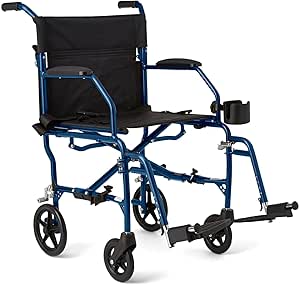
Medline Ultra Lightweight Transport Wheelchair for Adults, Foldable, 19-Inch Seat Width, Red Frame, Black Upholstery
At 15 pounds, this Medline is the easiest chair in this batch to lift into a trunk, making it a strong fit for families who drive an older relative to appointments or outings. It folds to 24 × 10 × 30 inches, more compactly than the steel Medline with 12-inch rear wheels, though its 8-inch rear wheels are less suited to rough outdoor surfaces. The 19 × 16-inch seat, cushioned armrests, swing-away footrests, and seat belt give caregivers useful everyday basics without assembly. A cup holder is a small convenience on trips. The tradeoff is a 19-inch seat and 300-pound limit, so it may not fit larger users; its transport-chair design also means someone else must push.
Pros:- 15-pound aluminum frame is easy to lift
- Folds compactly for trunk storage
- Swing-away footrests and a seat belt support transfers
- Cushioned armrests and cup holder add practical comfort
Cons:- 19-inch seat and 300-pound capacity may not suit larger users
- 8-inch rear wheels are less suited to uneven outdoor terrain
- Requires a companion to push
Best for: Caregivers who regularly load a transport chair into a car and want a lightweight option with basic transfer features.
Not ideal for: Users who need a wider seat, a higher weight capacity, or a chair they can propel themselves.
- Weight:15 lbs
- Weight capacity:300 lbs
- Seat dimensions:19 × 16 inches
- Frame:Aluminum
- Rear wheels:8 inches with locking brake
- Folded dimensions:24 × 10 × 30 inches
- Footrests:Swing-away
- Upholstery and frame color:Black nylon upholstery; red frame
Our verdict“Pick this Medline if car loading is a frequent task and its seat width and capacity fit the user.”
Medline Ultra Lightweight Folding Transport Wheelchair, 19-Inch Seat, Blue Frame
This blue Medline combines a 19-pound aluminum frame with swing-away, locking footrests, which makes transfers easier to manage than with a chair whose footrests stay in place. Its 19 × 16-inch seat and compact folded size mirror the red Medline Ultra Lightweight, but it weighs four pounds more; that difference may matter if a caregiver lifts it often. Like the red model, it has a seat belt, rear locking brakes, and no-assembly setup. Easy-clean nylon upholstery suits routine use, while the transport-chair format calls for a companion to push. The 300-pound capacity and 19-inch seat may rule it out for some users. I’d favor it when transfer access is the priority, and the red version when minimizing lift weight matters more.
Pros:- Swing-away and locking footrests help clear the transfer area
- Aluminum frame folds for storage and transport
- Rear locking brakes support stationary transfers
- Easy-clean nylon upholstery and seat belt
Cons:- At 19 pounds, it weighs more than the red Medline Ultra Lightweight
- 19-inch seat and 300-pound capacity may not fit every user
- Requires another person to push
Best for: Caregivers who need footrests that move out of the way for assisted transfers and want a foldable chair.
Not ideal for: People who need a wider seat or want the lightest possible chair for repeated car loading.
- Weight:19 lbs
- Weight capacity:300 lbs
- Seat dimensions:19 × 16 inches
- Frame:Aluminum
- Wheels:8-inch rear wheels; swivel front wheels
- Folded dimensions:24 × 10 × 30 inches
- Footrests:Swing-away and locking
- Brakes and upholstery:Rear-wheel locking brakes; black nylon
Our verdict“Choose this model for transfer-friendly footrests if a 19-pound chair and 19-inch seat suit your needs.”
Medline Folding Steel Transport Wheelchair with Swing-Away Footrests, 19-Inch Seat
The detachable swing-away footrests are the main reason to choose this steel Medline: they let a caregiver clear the front of the chair for entry and exit, and can be removed when that helps. Its 19 × 16-inch seat is comparable to the lightweight Medline models, but the 250-pound capacity is lower than their 300-pound limits. At 30 pounds, it is also much heavier to lift than either aluminum option. In return, the chip-resistant chrome-plated carbon-steel frame, push-to-lock brakes, and seat belt provide a straightforward setup for assisted trips. The backrest folds, and its folded dimensions are compact. I’d favor it over the 12-inch-wheel Medline for transfer access and storage; choose that model for larger rear wheels and a higher capacity.
Pros:- Detachable swing-away footrests clear the transfer area
- Backrest folds for storage
- Push-to-lock brakes and seat belt support assisted use
- Easy-clean nylon seat and back
Cons:- 250-pound capacity is lower than the other Medline chairs in this batch
- 30-pound steel chair is heavy to lift
- 8-inch wheels offer less help on uneven outdoor surfaces than 12-inch wheels
Best for: Caregivers who assist with frequent transfers and need detachable footrests and a folding backrest.
Not ideal for: Users above 250 pounds or caregivers who need to lift the chair often.
- Weight capacity:250 lbs
- Product weight:30 lbs
- Seat dimensions:19 × 16 inches
- Frame:Carbon steel with chip-resistant chrome plating
- Wheels:8 inches front and rear
- Footrests:Swing-away and detachable
- Folded dimensions:22.24 × 10.43 × 29.13 inches
- Brakes:Push-to-lock
Our verdict“Pick this Medline when transfer access and a folding backrest matter more than low chair weight or a higher capacity.”
Drive Medical Lightweight Expedition Folding Transport Wheelchair, Blue
The Drive Medical Expedition stands out here for its 12-inch rear wheels paired with a 19-pound aluminum frame. That combination aims for easier rolling across varied surfaces than the 8-inch wheels on the Medline Ultra Lightweight chairs, without the 32-pound lift of the steel Medline with 12-inch wheels. Padded armrests and fold-down footrests add basic comfort, and the chair folds for storage. Its 300-pound capacity is stated, but the supplied product details don’t give seat dimensions or folded measurements, so fit and car-storage planning are harder than with the Medline options. Like other transport chairs, it depends on a companion to push and has no listed reclining feature. I’d shortlist it for assisted outdoor outings, while checking seat fit before choosing it.
Pros:- 12-inch rear wheels are suited to varied surfaces
- 19-pound aluminum frame is lighter than the steel Medline with 12-inch wheels
- Folds for transport and storage
- Padded armrests and fold-down footrests
Cons:- Seat dimensions and folded measurements are not provided
- Requires another person to push
- No reclining feature is listed
Best for: Caregivers seeking larger rear wheels for outdoor trips while keeping chair weight lower than a steel model.
Not ideal for: Buyers who need confirmed seat dimensions, compact folded measurements, or reclining support.
- Weight:19 lbs
- Weight capacity:300 lbs
- Rear wheels:12 inches
- Frame:Aluminum
- Color:Blue
- Armrests:Padded
- Footrests:Fold-down
- Storage:Folding frame
Our verdict“Choose the Expedition for larger rear wheels and moderate lift weight, after confirming its seat will fit the user.”
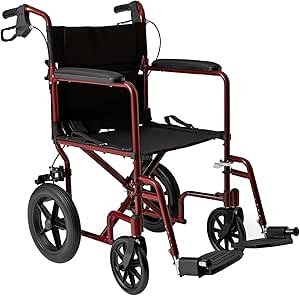
Medline Lightweight Foldable Transport Wheelchair with Handbrakes, 12-Inch Wheels, Red Frame
The 12-inch rear wheels and hand brakes make this Medline a practical choice for families who expect to move between indoor spaces and smoother outdoor paths. Its attendant hand brakes offer control while moving, while the rear-wheel locks help keep the chair in place during transfers. Compared with the Drive Medical Folding Transport Wheelchair, which has 8-inch wheels and a narrower 17-inch seat, this model offers a wider 19-inch seat and larger rear wheels. It also folds to 12 inches wide for storage. The tradeoffs are its listed weight, which differs between the product description and item details, and the fact that it is a transport chair that requires someone to push it. I’d shortlist it for assisted trips where the larger wheels matter.
Pros:- 12-inch rear wheels suit smooth outdoor paths better than the 8-inch wheels on several compact models
- Hand brakes and rear-wheel locks support controlled stops and transfers
- Swing-away, detachable footrests make entry and exit easier
- Folds to 12 inches wide for storage
Cons:- Product description and item details list different weights
- Requires an attendant to push
- At 23.5 to 26 pounds as listed, it is heavier than the 18-pound travel chair in this roundup
Best for: Caregivers who want a 19-inch seat, attendant hand brakes, and larger rear wheels for trips on smooth outdoor paths
Not ideal for: People who need to propel themselves or families who need a verified exact chair weight before lifting it into a vehicle
- Frame:Aluminum
- Listed weight:23.5 lb in product description; 26 lb in item details
- Weight capacity:300 lb
- Seat dimensions:19 in wide × 16 in deep
- Rear wheel size:12 in
- Assembled dimensions:30.25 × 19 × 37.25 in
- Folded dimensions:30.25 × 12 × 37.5 in
- Upholstery:Black nylon
- Footrests:Swing-away and detachable
Our verdict“Choose this Medline for attendant-assisted outings where larger rear wheels and hand brakes matter more than the lightest possible lift.”
Drive Medical Folding Transport Wheelchair with Swing-Away Footrests
This Drive Medical is a straightforward pick for caregiver-assisted trips where a fold-flat backrest and simple storage matter more than a wide seat or larger wheels. Its 17-inch padded nylon seat is narrower than the 19-inch seats on the Medline Lightweight Foldable Transport Wheelchair and the Vive, so it may fit more easily through tighter spaces, though it offers less room for the user. Padded armrests add comfort during short appointments, and the swing-away footrests clear the way for transfers. The steel frame and 8-inch wheels suit level indoor floors and smooth paths; the supplied description specifically limits outdoor use to level paths. I’d skip it for rougher routes or anyone expecting to self-propel. It is a compact, practical option, but its smaller wheels constrain where it feels suitable.
Pros:- Fold-flat backrest helps reduce storage bulk
- Padded seat and armrests support comfort on short trips
- Swing-away footrests ease transfers
- Nylon upholstery wipes clean easily
Cons:- 17-inch seat is narrower than the 19-inch seats on the Medline and Vive options
- 8-inch wheels and stated level-path use limit rough-ground suitability
- Designed for caregiver-assisted transport
Best for: Caregivers seeking a compact folding chair for appointments, indoor trips, and level outdoor paths
Not ideal for: Users who need a wider seat, independent propulsion, or frequent travel over uneven ground
- Frame:Steel
- Wheel size:8 in
- Seat width:17 in
- Seat material:Padded nylon
- Armrests:Padded
- Footrests:Swing-away
- Backrest:Folds flat
Our verdict“Pick this Drive Medical for compact, attendant-assisted trips on smooth routes if its narrower seat fits the user.”
18LBS Ultra Lightweight Wheelchair with Foldable Footrest and Armrests, Travel Transport Chair for Adults, Seniors, Kids
At 18 pounds, this chair is the standout for caregivers who regularly lift a transport chair into a car or carry it between locations. That makes it easier to handle than the Medline, listed at 23.5 to 26 pounds, though the Medline supports up to 300 pounds while this model is rated for 220. The aluminum alloy frame, quick fold, and upright folded storage are geared toward portability; padded armrests and a breathable seat add comfort for shorter journeys. Its PVC wheels are a limitation on rough terrain, so I’d keep it to smooth indoor floors and paved routes. Buyers should also check the 220-pound capacity against the intended user’s needs. Compared with the more fully specified Vive, this chair is lighter but provides less capacity information about support features.
Pros:- 18-pound listed weight eases lifting and carrying
- Quick folding and upright storage support travel
- Padded armrests and breathable seat are suited to shorter journeys
- Aluminum alloy frame keeps the chair lightweight
Cons:- 220-pound capacity is lower than the Medline’s 300-pound rating
- PVC wheels may struggle on rough terrain
- The description does not specify seat dimensions
Best for: Caregivers who frequently lift a chair into a vehicle and whose intended user is within the 220-pound capacity
Not ideal for: Users above 220 pounds or families who regularly travel over rough outdoor surfaces
- Weight:18 lb
- Maximum support weight:220 lb
- Frame material:Aluminum alloy
- Wheel type:PVC
- Brake system:Two-stage brake
- Folded storage:Compact, upright storage
- Armrests:Padded
- Footrests:Flip-up
Our verdict“Choose this model when carrying weight is the priority and the user fits its capacity and smooth-route limits.”
Invacare Lightweight Folding Transport Wheelchair with 19-Inch Seat
The Invacare earns its place for buyers who want a fully assembled chair with a roomy 19 × 16-inch seat and a one-handed folding design. Its folded width of 9 inches is narrower than the Medline’s 12-inch folded width, which can help when storage space is tight. The breathable nylon seat and storage pocket suit appointment days, while the fold-down backrest makes the chair easier to put away. Unlike the Vive Lightweight Transport Wheelchair, the supplied product data gives no weight capacity or product weight, leaving two key fit and lifting questions unanswered. I’d choose it when the specified folded dimensions and no-assembly arrival are the main advantages, but I’d seek the missing capacity details before matching it to a user.
Pros:- Arrives fully assembled
- 19 × 16-inch breathable nylon seat
- 9-inch folded width and fold-down backrest support compact storage
- Storage pocket and non-marring TPU casters suit everyday appointments
Cons:- Product data does not provide chair weight or weight capacity
- Steel frame may be less convenient to lift than the 18-pound aluminum travel chair
- 8-inch casters are not presented as suited to rough terrain
Best for: Caregivers who want an assembled transport chair with a 19-inch seat and narrow folded profile for appointments
Not ideal for: Buyers who need confirmed weight capacity or chair weight before choosing a chair for a specific user or vehicle
- Seat dimensions:19 × 16 in
- Folded width:9 in
- Backrest-folded height:28.75 in
- Caster size:8 in front and rear
- Frame material:Steel
- Seat material:Breathable nylon
- Warranty:3 years on frame
- Assembly:Fully assembled
Our verdict“Consider this Invacare for a narrow storage footprint and ready-to-use setup after confirming its capacity for the intended user.”
Vive Lightweight Transport Wheelchair for Seniors – Portable, Folding, 19” Seat, Travel Wheel Chair for Adults
The Vive pairs a 19-inch seat with adjustable, swing-away footrests, giving caregivers room to tailor lower-leg support and clear the sides for transfers. Its steel frame supports up to 250 pounds, between the 220-pound travel chair and the Medline’s 300-pound capacity. Built-in wheel locks support stable stops, while the flat-folding design suits errands and appointment trips. The tradeoffs are a seat width that may not fit larger users, no stated seat cushioning for longer outings, and a potentially challenging assembly process. Compared with the Invacare Lightweight Folding Transport Wheelchair, the Vive supplies a weight capacity but does not offer a listed folded width or chair weight. I’d favor it when footrest adjustment and a defined capacity matter more than fully assembled arrival.
Pros:- 19-inch seat and stated 250-pound capacity
- Adjustable swing-away footrests support fit and transfers
- Built-in wheel locks help keep the chair stationary during transfers
- Folds flat for travel and storage
Cons:- 19-inch seat may not suit larger users
- No seat cushioning or padding is specified for extended use
- Assembly may be challenging, and chair weight is not provided
Best for: Caregivers who need adjustable swing-away footrests and a stated 250-pound capacity for appointment and errand trips
Not ideal for: Larger users who need more than a 19-inch seat, or families who prioritize cushioned seating and a chair that arrives assembled
- Seat width:19 in
- Weight capacity:250 lb
- Frame material:Steel
- Folded design:Folds flat in seconds
- Footrests:Adjustable and swing-away
- Safety:Built-in wheel locks
- Eligibility:FSA/HSA
Our verdict“Choose the Vive when adjustable footrests and a documented capacity are more useful than a confirmed low lifting weight or padded seat.”
EconoHome Lightweight Wheelchair – Folding Transport Wheelchair for Adults with Hand Brakes – Portable, Fully Assembled, 300 lb Capacity
The EconoHome suits families who want a transport chair they can take out of the box and use without assembly. At 22 pounds, its aluminum frame is lighter to lift than the Medline Lightweight Folding Transport Wheelchair at 26 pounds, which may matter when loading it into a car regularly. A seat belt, padded armrests, swing-away footrests, and hand brakes add practical support for caregiver-assisted outings. It also includes a waterproof cover, a useful extra for storage or travel. The tradeoff is its small front wheels: the description points to errands and home use, but they may feel less composed on uneven ground. The available information also does not specify extra seat cushioning, so buyers prioritizing a more cushioned ride may prefer the Medline model.
Pros:- 22-pound aluminum frame is easier to lift than the 26-pound Medline transport chair
- Ships fully assembled, so it is ready to use without tools
- Hand brakes, a seat belt, and swing-away footrests support caregiver-assisted use
- Included waterproof cover adds protection during storage or travel
Cons:- Small front wheels may be less stable on uneven terrain
- Seat cushioning is not described as extra padded
- Requires a companion to push
Best for: Caregivers who want a lightweight, fully assembled chair for home use, errands, and car trips
Not ideal for: People who regularly travel over rough or uneven paths, or users who need notably plush seat cushioning
- Weight:22 lbs
- Weight capacity:300 lbs
- Frame:Aluminum
- Folding:Yes
- Brakes:Hand brakes
- Footrests:Swing-away
- Included accessory:Waterproof cover
Our verdict“Choose the EconoHome for a light, ready-to-use chair for routine outings, and look elsewhere if uneven routes or extra cushioning are priorities.”
Drive Medical Lightweight Expedition Folding Transport Wheelchair, Red
For caregiver-pushed trips that include curb cuts or small bumps, the Expedition has a useful advantage over the EconoHome Lightweight Wheelchair: its 12-inch rear wheels and curb assist are specifically described as helping with those obstacles. At 19 pounds, its aluminum frame is also the lightest of these five options, which helps when a companion needs to lift it into a vehicle. Padded armrests and fold-down footrests make the basic setup practical for outings, while companion-operated loop-lock brakes provide stopping and parking control. That same arrangement defines its limits: the rider cannot propel the chair or operate the brakes independently. The description only supports use on mildly uneven surfaces, so this is a better fit for modest obstacles than rough paths.
Pros:- 19-pound aluminum frame is lighter than the other chairs in this batch
- 12-inch rear wheels and curb assist help with small bumps
- Companion-activated loop-lock brakes offer stopping and parking control
- Folds for storage and transport
Cons:- Requires a companion to push and operate the brakes
- Described for mildly uneven surfaces, not rough terrain
- No seat width or cushioning details are provided
Best for: Caregivers who need a light chair for paved outings with occasional small bumps or curb transitions
Not ideal for: Riders seeking independent propulsion or families who regularly travel across rough, uneven terrain
- Weight:19 lb
- Weight capacity:300 lb
- Frame:Aluminum
- Rear wheel size:12 inches
- Brakes:Companion-activated loop-lock hand brakes
- Footrests:Fold-down
- Color:Red
Our verdict“Pick the Expedition when low lifting weight and help over small bumps matter more than rider independence or rough-terrain use.”
Drive Medical Silver Sport 1 Folding Transport Wheelchair, Black
The Silver Sport 1 is a sensible choice for buyers who value breathable nylon upholstery and padded, full-length armrests in a straightforward folding chair. Its removable swing-away footrests can clear space for transfers, and the foldable back and carry pocket add useful storage and packing flexibility. Compared with the Drive Medical Lightweight Expedition, this chair gives up a lot in carry weight: it weighs 37.6 pounds and has a 250-pound capacity, while the Expedition weighs 19 pounds and supports 300 pounds. The Silver Sport 1’s appeal is its seating setup and practical details, not easy lifting or higher capacity. Its steel frame and limited capacity make it a less suitable match for caregivers who frequently load a chair into a car or for users who need more weight capacity.
Pros:- Breathable nylon upholstery and full-length padded armrests support everyday comfort
- Removable swing-away footrests make transfers easier
- Foldable back and carry pocket add storage and transport convenience
- Push-to-lock brakes provide a manual parking control
Cons:- At 37.6 pounds, it is much heavier than the 19-pound Expedition
- 250-pound weight capacity is lower than the 300-pound capacity of several alternatives
- Steel frame adds to the lifting burden
Best for: Riders who want breathable upholstery, full-length padded armrests, and footrests that can be removed for transfers
Not ideal for: Caregivers who regularly lift a chair into a vehicle, or riders needing a capacity above 250 pounds
- Frame:Powder-coated steel
- Weight:37.6 lb
- Weight capacity:250 lb
- Upholstery:Breathable nylon
- Armrests:Full-length padded
- Footrests:Removable swing-away
- Brakes:Push-to-lock
- Foldable back:Yes
- Carry pocket:Yes
Our verdict“Choose the Silver Sport 1 for its breathable seating and transfer-friendly footrests if its heavier frame and 250-pound limit suit your needs.”
Drive Medical Blue Streak Lightweight Wheelchair, Footrests, 18″ Seat
The Blue Streak is the pick here for users who need to get close to a table or counter: its flip-back desk arms clear the side, while the 18-inch padded seat and swing-away footrests support everyday seated use and transfers. Compared with the caregiver-focused Medline Lightweight Folding Transport Wheelchair, this model is described as a manual wheelchair with push handles, so the product information points more toward user propulsion than companion-only transport. Its solid tires are described for indoor and level outdoor use, which fits smoother routes. The main compromise is carrying weight: at 41.3 pounds, it is heavier than every other chair in this batch. That can make regular vehicle loading difficult for one person. Its alloy steel frame and 18-inch seat also make fit and lifting ability worth checking before choosing it.
Pros:- Flip-back desk arms make it easier to approach tables and counters
- Padded 18-inch seat and swing-away footrests support everyday use and transfers
- Push-to-lock rear brakes provide a clear manual stopping control
- Folds for storage and transport
Cons:- At 41.3 pounds, it is the heaviest chair in this batch
- Solid tires are described for indoor and level outdoor use
- The 18-inch seat may not fit every rider comfortably
Best for: Users who need a manual wheelchair with side access to tables, counters, or desks on mostly level routes
Not ideal for: Caregivers who need a light chair for frequent car loading, or buyers seeking a companion-operated transport chair
- Weight:41.3 pounds
- Seat width:18 inches
- Seat height:18 inches
- Seat depth:16 inches
- Frame:Alloy steel
- Brakes:Push-to-lock
- Wheel type:Solid
- Folding:Yes
- Footrests:Swing-away, removable
Our verdict“Choose the Blue Streak when table access and a manual wheelchair setup matter more than easy lifting or travel over uneven ground.”
Medline Lightweight Folding Transport Wheelchair with Hand Brakes
The Medline stands out for buyers who want a wider seat than the EconoHome offers on the available product details: its 19-inch-wide cushioned seat is clearly specified, alongside a 16-inch depth. At 26 pounds, it is still foldable and lighter than the Drive Medical Silver Sport 1 at 37.6 pounds, while supporting up to 300 pounds. Hand brakes and rear-wheel locking brakes give the companion both stopping control and a way to secure the chair during transfers. Its 12-inch rear wheels and swivel front wheels are described for indoor and outdoor maneuverability. The tradeoff is that this remains a companion-pushed transport chair; the rider cannot propel it independently. Also, a 19-inch seat is not a guarantee of fit, so buyers should compare the dimensions with the intended rider.
Pros:- 19-inch-wide, 16-inch-deep cushioned seat gives buyers specific fit dimensions
- Hand brakes and rear-wheel locking brakes support stopping and secure transfers
- 12-inch rear wheels and swivel front wheels aid maneuvering
- Folds for storage and needs no assembly
Cons:- Requires a caregiver to push
- A 19-inch seat will not fit every rider
- At 26 pounds, it is heavier than the EconoHome and Expedition
Best for: Caregivers seeking a foldable transport chair with a specified 19-inch cushioned seat and 300-pound capacity
Not ideal for: Riders who need to propel themselves, or buyers for whom a 19-inch seat may be too wide or too narrow
- Frame:Aluminum
- Weight:26 lb
- Weight capacity:300 lb
- Seat dimensions:19 in. wide x 16 in. deep
- Rear wheel size:12 in.
- Brakes:Hand brakes and rear-wheel manual locking brakes
- Footrests:Swing-away and detachable
- Folded dimensions:30.25 x 12 x 37.5 in. (L x W x H)
- Assembly:No assembly required
Our verdict“Choose the Medline for its specified cushioned 19-inch seat and dual brake setup if a caregiver will push and the dimensions fit the rider.”

How We Picked
I compared these chairs on the factors that shape daily use for older adults and their attendants: whether the chair is designed for attendant propulsion, stated seat width, portability, frame and wheel features, braking, and transfer access. I gave more weight to details that can change whether the chair fits a person or a routine, such as the 18-inch versus 19-inch seat, handbrakes, swing-away footrests, and larger rear wheels. The ranking favors a broadly useful combination of manageable handling and practical access, then gives specialized picks their place where a feature addresses a distinct need.
Several listings provide limited specifications, so I avoid treating missing details as proof of quality or performance. Product names alone do not establish a chair’s full weight, folded size, comfort, or ease of maintenance; buyers should confirm those details and the manufacturer’s fit guidance before purchase. I also distinguish transport chairs from the Drive Medical Blue Streak, which is listed as a lightweight wheelchair with footrests and an 18-inch seat rather than an attendant-only transport chair.
| transport chairs for elderly | Frame |
|---|---|
| Medline Durable Folding Steel | — |
| Medline Ultra Lightweight Tran | Aluminum |
| Medline Ultra Lightweight Fold | Aluminum |
| Medline Folding Steel Transpor | Carbon steel with chip-resistant chrome plating |
| Drive Medical Lightweight Expe | Aluminum |
| Medline Lightweight Foldable T | Aluminum |
| Drive Medical Folding Transpor | Steel |
| 18LBS Ultra Lightweight Wheelc | — |
| Invacare Lightweight Folding T | — |
| Vive Lightweight Transport Whe | — |
| EconoHome Lightweight Wheelcha | Aluminum |
| Drive Medical Lightweight Expe | Aluminum |
| Drive Medical Silver Sport 1 F | Powder-coated steel |
| Drive Medical Blue Streak Ligh | Alloy steel |
| Medline Lightweight Folding Tr | Aluminum |
Factors to Consider When Choosing Transport Chairs For Elderly
Choosing a transport chair starts with the person, the attendant, and the route they will use together. I would check fit and transfer needs before prioritizing color, brand, or a small difference in listed weight. These broader checks can prevent a chair that folds neatly but is hard to load, uncomfortable for the user, or unsuitable for the attendant’s route.
Match the Chair to the User’s Fit and Transfers
Seat width is only one part of fit: clothing, posture, arm support, and the space needed to reposition all matter. Measure the user while seated in typical clothing, then compare that measurement with the chair’s seat width and the maker’s fit guidance. A seat that is too narrow can feel restrictive, while one that is too wide may make stable positioning harder. Check seat depth and back support as well, since a width number alone cannot describe comfort. If the user transfers from a bed or vehicle, consider whether removable or swing-away footrests and armrests leave enough clearance. When the listing omits dimensions, ask the seller or manufacturer before choosing based on a product name.
Plan for the Attendant’s Route and Braking Needs
Transport chairs depend on an attendant to push and steer, so the route matters as much as the chair itself. Door thresholds, ramps, uneven pavement, and tight turns place different demands on control and maneuverability. Handbrakes can help the attendant manage stops, particularly on a slope, but buyers should confirm how the brakes work and whether they are intended for slowing, parking, or both. Larger rear wheels may suit some outdoor routes, though they do not by themselves make a chair appropriate for rough terrain. For frequent outdoor use, check the maker’s surface and slope guidance instead of assuming a transport chair can handle every path. If the user needs to move independently, compare a self-propelled wheelchair rather than expecting an attendant chair to serve both roles.
Think Beyond Chair Weight When You Travel
A lightweight chair can reduce the effort of lifting it into a car, but the advertised chair weight is not the whole travel equation. Folded dimensions, lifting points, vehicle trunk height, and whether the footrests fold or detach affect how manageable loading feels. Before buying, measure the storage space and consider who will lift the chair and how often. A compact model may be easier to store yet provide fewer details about fit or adjustment, so verify the dimensions and capacity. Test the folding sequence at home if possible, and learn whether loose parts need separate storage. For regular travel, convenience comes from the whole pack-and-load routine, not a low weight figure alone.
Choose Transfer Features for the User’s Routine
Footrests and armrests affect how a person gets into and out of the chair, not just how the chair looks when assembled. Swing-away footrests can clear space for a side transfer, but the attendant must remember to move them and position them again before travel. Ask whether the user can bear weight, needs help pivoting, or transfers with a board, then match the chair’s access features to that method. A feature that helps one transfer style may be inconvenient for another. Also check whether the chair has a seat belt and how it should be used; a belt is not a replacement for attentive positioning or supervision. When transfers are complex, get guidance from a clinician or mobility specialist who can assess the person and routine.
Set a Capacity and Maintenance Check Before Buying
Confirm the chair’s stated weight capacity and compare it with the user’s current weight, clothing, and carried items while leaving a sensible margin. Do not infer capacity from a steel frame, brand, or product name when the listing does not state it clearly. Ask about replacement parts, tire or wheel maintenance, upholstery cleaning, and the warranty, especially if the chair will be used every day. Simple folding hardware is useful only if it stays in working order and parts are available when needed. Read care instructions before using disinfectants, since some materials can be damaged by products not approved by the maker. A clear support path can matter more over time than a feature that is rarely used.
Frequently Asked Questions
Can an older adult propel a transport chair without an attendant?
Usually, a transport chair is designed for an attendant to push, and its small rear wheels are not meant for the user to propel like a standard wheelchair. If the older adult needs to move independently, compare self-propelled models and confirm that the chair’s dimensions and controls suit their strength and mobility. In this lineup, the Drive Medical Blue Streak is described as a lightweight wheelchair with footrests and an 18-inch seat, so it is a different type of option from the attendant-focused transport chairs. Ask a mobility professional if the user’s needs are changing or uncertain.
Is a 19-inch seat wide enough for my family member?
A 19-inch label is a starting point, not a guarantee of a comfortable or safe fit. Measure the seated user’s widest point in their usual clothing and compare it with the chair’s usable seat width and the manufacturer’s fit instructions. Also check seat depth, armrest spacing, and whether the user can sit in a stable posture without pressure or excessive side-to-side space. The listed models vary, including an 18-inch-seat Drive Medical Blue Streak, but the width alone does not determine which chair is suitable. If fit is close or the user has specific positioning needs, get an in-person assessment.
Are handbrakes worth prioritizing for a transport chair?
They can be useful when an attendant regularly manages slopes, frequent stops, or situations where a more controlled stop matters. The Medline handbrake models and the EconoHome listing call out handbrakes, making them candidates to examine for those routes. Confirm whether the controls are reachable and comfortable for the attendant, and ask the maker what each brake is designed to do. Handbrakes do not make it safe to leave an occupied chair unattended on a slope. For steep or uneven routes, check the manufacturer’s limits and consider professional advice about the route.
Should I choose swing-away footrests if transfers are difficult?
Swing-away footrests can open space in front of or beside the chair, which may help with some pivot transfers. They are not automatically the right choice for every user: a transfer board, limited leg movement, or a particular caregiver technique may call for a different setup. The Medline and Drive Medical swing-away models provide options to investigate, but the product description does not establish how well a specific transfer will work. Ask the user’s clinician or mobility specialist to review the transfer method and chair configuration. Have the attendant practice positioning the footrests before relying on the chair outside the home.
What should I verify before using a transport chair for car trips?
Check the folded dimensions against the vehicle’s actual cargo opening and storage space, not only the trunk’s advertised volume. Confirm the chair’s weight, how it folds, whether footrests detach, and who can lift it safely. A travel-focused description or low listed weight does not confirm that the chair will fit your car or be manageable for your attendant. Also plan how the user will transfer into the vehicle and how the chair will be secured during driving. If the chair will be used as a vehicle seat, follow the vehicle and chair manufacturers’ instructions and do not assume a standard transport chair is crash tested.
Conclusion
My best overall recommendation is the Medline Ultra Lightweight Transport Wheelchair for buyers seeking a portable, broadly useful 19-inch-seat option. For best value, compare the Medline steel models and EconoHome against your needs for larger wheels, handbrakes, and clearly stated capacity; the available product names alone do not establish which costs less or offers better value. I would treat the Drive Medical Expedition listings and Medline ultra-light models as beginner-friendly candidates for people who want a folding attendant chair, after confirming fit and folded dimensions. For a premium-style feature priority, the Medline handbrake model makes more sense when attendant control is the deciding factor, though the lineup does not provide enough information to rank price tiers. Choose swing-away footrests for transfer access, consider the 18-pound chair for frequent lifting only after checking its fit and specifications, and look at the Blue Streak if the user needs a self-propelled wheelchair rather than a transport chair. The right choice is the one that fits the user, the attendant, and the actual route.”