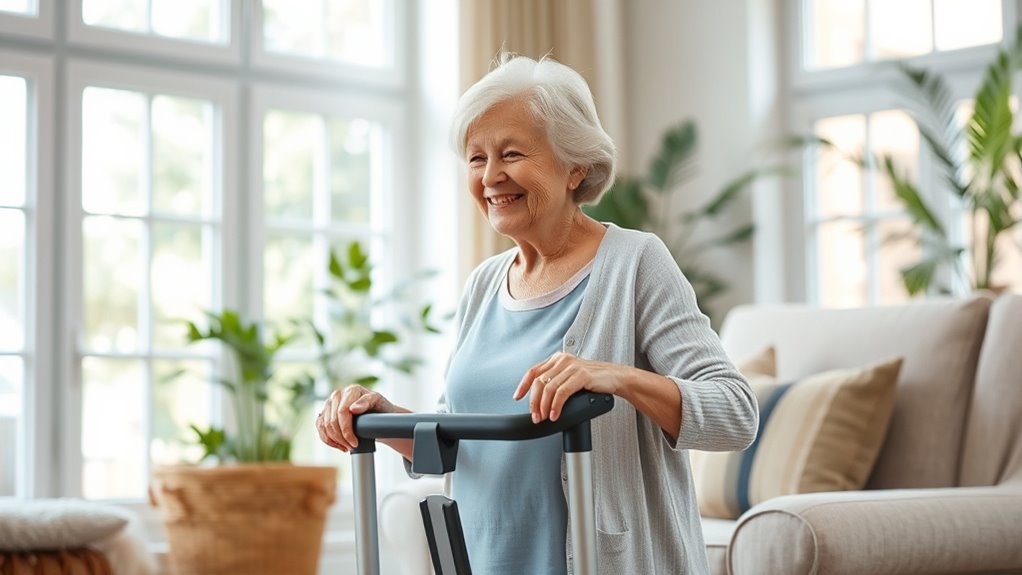

Stand assist devices for elderly adults range from compact chair rails to caregiver-operated patient lifts, so the right choice depends on how much weight the user can bear. I rank the Vive Stand Assist as the best overall device because its furniture-based design suits common daily transfers without occupying the space of a wheeled lift. The L1 Stand Assist Rail is my value pick, while the VOCIC Sit to Stand Patient Lift offers more substantial caregiver support for users with greater mobility limits. The central tradeoff is simplicity versus assistance: rails cost less and remain accessible, but patient lifts handle more demanding transfers. Readers should also weigh furniture compatibility, grip position, floor space, and whether the device will be used independently or with help. Continue reading for the full breakdown and buyer-specific recommendations.
Complete the kit


Key Takeaways
- Chair rails and patient lifts serve different users: the Vive, L1, and Able Life models support people who can still rise, while the VOCIC and Vive Mobility lifts are aimed at assisted transfers.
- The Vive Stand Assist leads the ranking because its everyday chair-focused format offers the most useful balance of access, simplicity, and manageable size.
- The VOCIC lift earns the premium position for caregiver-supported transfers, but its wheels, larger footprint, and more involved setup make it excessive for mild balance problems.
- SPECILITE is the clearest heavy-duty option because it states a 450-pound capacity, though buyers still need to confirm that the furniture and installation method suit the user.
- The Grey, Black, and White support-handle variants add little functional separation: fit, anchoring, and handle geometry matter more than color when choosing among them.
| Vive Stand Assist |  | Best Overall Chair and Couch Rail | Weight Capacity: 300 pounds | Frame Material: Aluminum | Handle Material: Soft foam | VIEW ON AMAZON | See Our Full Breakdown |
| Couch Stand Assist for Seniors, Grey |  | Best for Measured Sofa Fit | Material: Metal | Color: Grey | Height Range: 23.5–30.25 inches | VIEW ON AMAZON | See Our Full Breakdown |
| Couch Stand Assist for Seniors, Black |  | Best Stable-Base Sofa Support | Frame Material: Reinforced metal | Handle Type: Foam grip | Height Range: 23.5–30.25 inches | VIEW ON AMAZON | See Our Full Breakdown |
| Standing Assist Device for Getting Up from the Floor |  | Best for Floor-Level Activities | Intended Users: Older adults and people with back, knee, or mobility difficulties | Primary Function: Assistance rising from the floor or ground | Height Adjustment: Adjustable | VIEW ON AMAZON | See Our Full Breakdown |
| L2 Stand Assist Aid for Elderly |  | Best Lightweight Adjustable Rail | Weight Capacity: 300 pounds | Primary Frame Material: Aircraft-grade aluminum | Secondary Material: Stainless steel | VIEW ON AMAZON | See Our Full Breakdown |
| VOCIC Sit to Stand Patient Lift with Wheels |  | Best Adjustable Transfer Device | Device Type: Wheeled sit-to-stand patient lift | Weight Capacity: 400 lbs | Frame Material: High-grade reinforced steel | VIEW ON AMAZON | See Our Full Breakdown |
| Adjustable Stand Assist Aid for Elderly with Night Light |  | Best for Nighttime Use | Device Type: Stationary stand assist aid | Height Settings: 6 adjustable levels | Weight Capacity: 300 lbs | VIEW ON AMAZON | See Our Full Breakdown |
| L1 Stand Assist Rail for Couch, Chair |  | Best Lightweight Chair Rail | Device Type: Couch and chair stand assist rail | Support Weight: 300 lbs | Primary Material: Aircraft-grade aluminum | VIEW ON AMAZON | See Our Full Breakdown |
| Adjustable Stand Assist for Elderly |  | Best Multipurpose Support | Device Type: Stand assist and walking cane | Height Levels: 10 | Handle Spacing Levels: 3 | VIEW ON AMAZON | See Our Full Breakdown |
| Vive Mobility Sit to Stand Patient Lift for Handicapped |  | Best Overall Transfer Device | Device Type: Wheeled sit-to-stand transfer aid | Weight Capacity: 400 lbs | Base Width: 26 inches | VIEW ON AMAZON | See Our Full Breakdown |
| Stand Assist Aid for Elderly, Portable Walking Support, Gray |  | Best for Walking Support | Color: Gray | Device Type: Portable walking support | Intended Use: Walking support and balance assistance | VIEW ON AMAZON | See Our Full Breakdown |
| SPECILITE Couch Stand Assist Aid for Elderly with Wide Handle |  | Best High-Capacity Couch Aid | Weight Capacity: 450 lbs | Height Adjustment: 24-28.74 inches | Width Adjustment: 16-19.96 inches | VIEW ON AMAZON | See Our Full Breakdown |
| Couch Stand Assist for Seniors, Standing Support Handle, White |  | Best for Taller Seats | Height Range: 23.5-30.25 inches | Width Range: 22.6-24.75 inches | Weight Capacity: 300 lbs | VIEW ON AMAZON | See Our Full Breakdown |
| Able Life Universal Stand Assist with Legs |  | Best for Cushion-Based Furniture | Weight Capacity: 300 pounds | Handle Height: 7-10 inches above horizontal frame | Compatible Cushion Height: 12-21 inches above ground | VIEW ON AMAZON | See Our Full Breakdown |
| stand assist devices for elderly | Weight Capacity | Frame Material |
|---|---|---|
| Vive Stand Assist | 300 pounds | Aluminum |
| Couch Stand Assist for Seniors | 300 pounds | — |
| Couch Stand Assist for Seniors | 300 pounds | Reinforced metal |
| Standing Assist Device for Get | — | — |
| L2 Stand Assist Aid for Elderl | 300 pounds | — |
| VOCIC Sit to Stand Patient Lif | 400 lbs | High-grade reinforced steel |
| Adjustable Stand Assist Aid fo | 300 lbs | High-strength carbon steel |
| L1 Stand Assist Rail for Couch | — | — |
| Adjustable Stand Assist for El | — | Carbon steel |
| Vive Mobility Sit to Stand Pat | 400 lbs | Steel |
| Stand Assist Aid for Elderly | — | — |
| SPECILITE Couch Stand Assist A | 450 lbs | High-quality carbon steel |
| Couch Stand Assist for Seniors | 300 lbs | Reinforced metal |
| Able Life Universal Stand Assi | 300 pounds | — |
More Details on Our Top Picks
Vive Stand Assist
I rank the Vive Stand Assist first because it balances recognizable construction details, broad furniture compatibility, and a 300-pound support rating. The aluminum frame fits around cushion bases or beneath removable cushions, giving an older adult two padded handles for controlled leverage while rising. Compared with the L2 Stand Assist, the Vive is the more straightforward all-around choice, while the L2 offers more explicit width adjustment and anti-slip feet. The tradeoff is furniture fit: unusual cushion bases and tightly upholstered seats may not accommodate the frame. It also needs assembly and careful positioning before use. This is a stable everyday standing device, rather than a powered lift, so the user must still be able to push through the arms and legs.
Pros:- Two soft foam handles provide comfortable, bilateral support
- Adjustable aluminum frame balances strength with manageable weight
- Works with several common chair, couch, and sofa configurations
- 300-pound rating suits many older adults
Cons:- Frame compatibility depends on the furniture dimensions and cushion design
- Assembly and adjustment are required before safe daily use
- Provides leverage only and cannot lift a user who lacks sufficient arm or leg strength
Best for: Older adults up to 300 pounds who can rise under their own power but need two-handed leverage from a conventional chair, couch, or sofa
Not ideal for: People who need powered lifting or whose furniture has fixed cushions, an unusual base, or too little clearance for a support frame
- Weight Capacity:300 pounds
- Frame Material:Aluminum
- Handle Material:Soft foam
- Installation Method:Fits around cushion bases or beneath cushions
- Compatible Seating:Chairs, couches, sofas, and compatible recliners
- Frame Adjustment:Adjustable
- Color:Black
Our verdict“This is my leading stand assist device for an older adult who needs reliable daily leverage without moving to a patient-lift system.”
Couch Stand Assist for Seniors, Grey
I would choose the Grey Couch Stand Assist when exact adjustment ranges matter more than broad placement claims. Its height changes from 23.5 to 30.25 inches, while the width spans 22.6 to 24.75 inches, so buyers can measure a sofa before ordering instead of relying on guesswork. It shares a 300-pound rating and foam handles with the Black Couch Stand Assist, but the black model adds documented wide support legs and anti-slip feet, making that option stronger for buyers focused on base stability. The grey version earns its place as a simple, leave-in-position rail for natural sit-to-stand movement. It will not work well with floor-level seating or reclining sofas, and it cannot substitute for a caregiver-operated lift. Careful sofa measurement is part of the purchase.
Pros:- Published height and width ranges support a more predictable sofa fit
- 300-pound capacity covers many senior users
- Foam handles offer a more secure and comfortable handhold
- Can remain installed for repeated daily use
Cons:- Does not accommodate floor-level or reclining sofa designs
- Requires accurate furniture measurements before purchase
- Supplies leverage but no mechanical or powered lifting
Best for: Buyers with a standard non-reclining sofa who want published height and width ranges they can check before ordering
Not ideal for: Users with floor-level couches, reclining sofas, or too little independent strength to complete a natural sit-to-stand movement
- Material:Metal
- Color:Grey
- Height Range:23.5–30.25 inches
- Width Range:22.6–24.75 inches
- Weight Capacity:300 pounds
- Handle Type:Soft foam grip
- Supported Movement:Natural sitting and standing assistance
Our verdict“This device makes the most sense when a buyer can measure a conventional sofa and wants a fixed daily support handle.”
Couch Stand Assist for Seniors, Black
The Black Couch Stand Assist stands apart through its reinforced metal construction, wide support legs, and anti-slip feet. Those details make it my stability-focused choice for a senior who tends to pull firmly on a handle while rising. Its adjustment ranges and 300-pound rating match the Grey Couch Stand Assist, but the documented base design gives the black model a clearer advantage on suitable flooring. That added footing does not solve every compatibility problem: buyers still need to measure the sofa, and neither version is intended for floor-level or reclining seating. This device supports balance and leverage rather than lifting the user, so it fits someone who retains meaningful arm and leg strength. The foam grip improves hand comfort, though the freestanding footprint may occupy more space beside the sofa than a cushion-mounted rail.
Pros:- Wide support legs offer a broader base than less clearly specified alternatives
- Anti-slip feet help resist unwanted movement on compatible floors
- Reinforced metal frame supports up to 300 pounds
- Adjustable height and width accommodate multiple standard sofa sizes
Cons:- Wide floor-standing base may be awkward in a cramped room
- Does not fit floor-level or reclining sofas
- Cannot provide the lifting action of a sit-to-stand patient lift
Best for: Seniors who can stand actively but want a reinforced sofa handle with wide legs and anti-slip floor contact
Not ideal for: Tight seating areas, recliners, low couches, or people who need a patient lift to bear most of their body weight
- Frame Material:Reinforced metal
- Handle Type:Foam grip
- Height Range:23.5–30.25 inches
- Width Range:22.6–24.75 inches
- Weight Capacity:300 pounds
- Base Design:Wide support legs
- Foot Design:Anti-slip feet
Our verdict“I favor this device for independently mobile seniors who prioritize a broad, anti-slip base over compact placement.”
Standing Assist Device for Getting Up from the Floor
I include this Standing Assist Device because it addresses a different problem from sofa rails: getting upright after gardening, household work, or other floor-level activities. Its adjustable height and portable design let the user reposition the aid for several tasks, whereas the Vive Stand Assist is meant to remain attached to compatible seating. That flexibility is valuable for someone with knee or back discomfort who still has enough strength and balance to pull or push upward. It is less reassuring for a person at high risk of falling because the supplied data gives no weight-capacity figure and describes it only as a standing aid, not a full mobility device. The non-slip materials improve contact, but technique still matters. I would treat it as portable leverage for planned activities, not as rescue equipment after a fall.
Pros:- Designed for floor and ground tasks that furniture rails do not address
- Adjustable height can accommodate different activities and user positions
- Portable format supports use around the home or garden
- Non-slip materials provide added contact security
Cons:- User still needs enough strength and balance to rise actively
- No numerical weight-capacity rating is supplied
- Cannot replace a full mobility aid or powered floor-lift system
Best for: Mobile older adults with knee or back discomfort who garden, perform floor tasks, or need portable leverage at several locations
Not ideal for: People with severe weakness, frequent falls, or a need for powered floor recovery and a verified weight-capacity rating
- Intended Users:Older adults and people with back, knee, or mobility difficulties
- Primary Function:Assistance rising from the floor or ground
- Height Adjustment:Adjustable
- Portability:Portable and lightweight
- Safety Surface:Non-slip materials
- Construction:Sturdy construction
- Usage Scenarios:Gardening, floor tasks, stairs, sofa use, and picking up objects
Our verdict“This is my portable device pick for capable older adults who need leverage during planned floor-level tasks rather than assistance from a chair.”
L2 Stand Assist Aid for Elderly
The L2 Stand Assist Aid is my pick for buyers who want a lighter frame without giving up a 300-pound support rating. Aircraft-grade aluminum keeps the main structure manageable, while stainless-steel components, flat tubing, and anti-slip feet add support where it meets the seating area and floor. Compared with the Vive Stand Assist, the L2 provides clearer width-and-height adjustment details in concept, but it has narrower furniture compatibility: the cushions must be removable, and recliners are excluded. That makes the L2 better suited to a conventional upholstered chair or sofa that has already been checked for installation. Soft foam handles offer comfortable two-handed leverage when sitting or standing. Some users may need help fitting the frame, and the device still depends on active participation rather than supplying a mechanical lift.
Pros:- Aircraft-grade aluminum offers a lighter alternative to all-steel frames
- Width and height adjustments support a tailored furniture fit
- Flat-tube base and anti-slip feet promote stable placement
- 300-pound rating and padded handles suit repeated daily assistance
Cons:- Installation requires removable furniture cushions
- Not compatible with recliners
- Initial fitting may require help from another person
Best for: Families fitting a conventional cushioned chair or sofa who want a relatively lightweight, adjustable rail with anti-slip feet
Not ideal for: Recliner owners, people with fixed seat cushions, or users who cannot contribute enough strength to stand with arm support
- Weight Capacity:300 pounds
- Primary Frame Material:Aircraft-grade aluminum
- Secondary Material:Stainless steel
- Width Adjustment:Adjustable
- Height Adjustment:Adjustable
- Handle Padding:Soft foam
- Base Design:Flat-tube base with anti-slip feet
- Furniture Requirement:Cushioned seating with removable cushions
Our verdict“I recommend this adjustable device for a standard cushioned seat when low frame weight matters and removable cushions permit secure installation.”
VOCIC Sit to Stand Patient Lift with Wheels
I rank the VOCIC Sit to Stand Patient Lift highly for assisted transfers because its reinforced steel frame, adjustable knee pad, and 400-pound capacity accommodate a broad range of users. Its 6 cm base may also slide beneath furniture that blocks taller transfer devices. Compared with the Vive Mobility Sit to Stand Patient Lift, the VOCIC offers documented knee-pad adjustment, making it better suited to households where more than one person may use the device. The tradeoff is a less complete restraint setup: no safety belt is included, while the Vive provides hooks for side support straps. This is also an active transfer aid, not a full-body lift. I would choose it only for someone who can support their upper body and participate throughout the move.
Pros:- Reinforced steel frame supports users up to 400 lbs
- Adjustable knee pad accommodates different body proportions
- Dual-lock casters add stability during assisted transfers
- Padded grips and cushions reduce pressure on hands and legs
Cons:- User must be able to support their upper body
- No safety belt restraint is included
- Requires caregiver guidance and enough floor space for maneuvering
Best for: Caregivers transferring a cooperative older adult who has upper-body control and needs adjustable knee support
Not ideal for: Completely immobile or paralyzed users who need a full-body lift and built-in restraint system
- Device Type:Wheeled sit-to-stand patient lift
- Weight Capacity:400 lbs
- Frame Material:High-grade reinforced steel
- Knee Pad Range:51–56 cm
- Base Height:6 cm
- Caster Design:Dual-lock casters
- Grip Type:Padded handgrips
- Safety Belt:Not included
Our verdict“I recommend this adjustable transfer device for caregivers assisting an older adult who can actively participate but needs substantial support.”
Adjustable Stand Assist Aid for Elderly with Night Light
The integrated night light gives this adjustable stand assist aid a clear purpose: helping an older adult locate stable support beside a bed or chair after dark. Six height levels make the handle easier to position than a fixed rail, while the carbon steel frame and extra horizontal bars provide support up to 300 pounds. Compared with the L1 Stand Assist Rail, this device adds lighting, a storage pocket, and a rubber base rather than relying on installation beneath removable cushions. I see it as the better bedside choice, especially during post-surgery recovery. It is less appealing in a cramped room, however, because the reinforced structure can feel bulky. It also arrives requiring assembly, whereas shoppers seeking a quick, portable aid may prefer the tool-free Adjustable Stand Assist for Elderly.
Pros:- Built-in night light makes the support easier to locate in darkness
- Six height settings accommodate different users and furniture
- Carbon steel frame supports up to 300 lbs
- Extra stability bars and a rubber base reduce unwanted movement
Cons:- Reinforced frame may occupy too much space in a small room
- Assembly is required before use
- Does not provide wheeled caregiver-assisted transfers
Best for: Older adults who frequently rise beside a bed or chair at night and want an illuminated, height-adjustable support
Not ideal for: People furnishing a tight room or anyone unable to complete the required assembly
- Device Type:Stationary stand assist aid
- Height Settings:6 adjustable levels
- Weight Capacity:300 lbs
- Frame Material:High-strength carbon steel
- Lighting:Integrated night light
- Handle:Ergonomic foam grip
- Storage:Mesh pocket
- Base:Rubber base with horizontal stability bars
Our verdict“I would pick this device for an older adult who needs a visible, stable standing handle near a nighttime seating or sleeping area.”
L1 Stand Assist Rail for Couch, Chair
The L1 Stand Assist Rail is my chair-focused pick for buyers who want adjustable leverage without bringing a large floor-standing frame into the room. Its aircraft-grade aluminum and stainless steel construction supports 300 pounds, while width and height adjustment help align the padded handles with both the user and the seat. Compared with the Adjustable Stand Assist Aid with Night Light, the L1 is simpler and better centered on sofa or chair use, but it omits lighting and storage. Furniture compatibility is its major limitation. The rail needs removable cushions more than four inches thick, and it is not intended for recliners or powered chairs. I would verify the seat design before buying; when the fit is right, this device offers focused assistance without the bulk of the VOCIC or Vive wheeled transfer lifts.
Pros:- Adjustable width and height allow a more tailored furniture fit
- Aircraft-grade aluminum and stainless steel balance strength with manageable construction
- Soft foam handles provide a more secure and comfortable grip
- Supports users up to 300 lbs
Cons:- Cannot be used with recliners or electric chairs
- Requires removable cushions for correct placement
- Cushions must be more than four inches thick for stable support
Best for: Seniors using a conventional sofa or chair with removable cushions thicker than four inches
Not ideal for: Recliner and electric-chair owners, or households with fixed or thin seat cushions
- Device Type:Couch and chair stand assist rail
- Support Weight:300 lbs
- Primary Material:Aircraft-grade aluminum
- Secondary Material:Stainless steel
- Width Adjustment:Adjustable
- Height Adjustment:Adjustable
- Handle Padding:Soft foam
- Cushion Requirement:Removable and more than 4 inches thick
- Furniture Exclusions:Recliners and electric chairs
Our verdict“I recommend this lightweight device only when the buyer has compatible removable-cushion furniture and wants a dedicated chair rail.”
Adjustable Stand Assist for Elderly
This dual-function stand assist and walking cane earns its place by supporting both the initial rise and short-distance indoor movement. Ten height levels, three handle-spacing positions, and seven base adjustments offer more setup flexibility than the Adjustable Stand Assist Aid with Night Light, which has six height settings. The tool-free five-step assembly also suits households that want to set up the device without extra equipment. That versatility carries compromises: carbon steel may feel heavy to an older user, and the aid is designed mainly for indoor use. It also cannot replace the VOCIC Sit to Stand Patient Lift when caregiver-controlled transfers are needed. I would select this model for someone who can stand and walk with modest assistance, not for a person who needs a wheeled frame, knee support, or substantial weight-bearing help.
Pros:- Functions as both a standing aid and an indoor walking cane
- Ten height levels provide broad positional adjustment
- Handle spacing and base adjustment allow a more personalized setup
- Five-step tool-free assembly simplifies initial setup
Cons:- Carbon steel construction may be heavy for users with limited arm strength
- Designed mainly for indoor use
- Preset adjustment levels may not align perfectly with every user
Best for: Independently mobile seniors who need one adjustable aid for rising and supported indoor walking
Not ideal for: Frail users who cannot bear weight or anyone seeking a lightweight outdoor cane or caregiver-operated lift
- Device Type:Stand assist and walking cane
- Height Levels:10
- Handle Spacing Levels:3
- Base Adjustment Levels:7
- Frame Material:Carbon steel
- Assembly:Tool-free
- Assembly Steps:5
- Primary Setting:Indoor use
Our verdict“I favor this multipurpose device for a mobile older adult who wants adjustable help rising and walking around the home.”
Vive Mobility Sit to Stand Patient Lift for Handicapped
I place the Vive Mobility Sit to Stand Patient Lift first among these transfer-focused devices because it combines a 400-pound limit, cushioned contact points, four swivel casters, and hooks for side support straps. Those features make repeated moves between a bed, wheelchair, toilet, and sofa more manageable for both the user and caregiver. Compared with the VOCIC Sit to Stand Patient Lift, the Vive lacks a documented adjustable knee-pad range but offers a clearer restraint-ready design and a two-year guarantee. Its main cost is space: the 26-inch-wide base may not clear narrow doorways or fit easily beside crowded furniture. Like the VOCIC, it is not a full-body hoist. I would reserve it for someone who retains enough upper-body control to participate safely in each transfer.
Pros:- Steel frame supports users up to 400 lbs
- Four swivel casters improve positioning between common household surfaces
- Dual locking brakes and strap hooks strengthen the transfer setup
- Cushioned handrails and seat improve comfort during repeated moves
Cons:- The 26-inch base may not pass through narrow doorways
- Requires adequate turning and storage space
- User still needs enough physical control to participate in transfers
Best for: Home or facility caregivers making frequent transfers for an older adult who can participate and weighs up to 400 lbs
Not ideal for: Homes with doorways narrower than the 26-inch base or users who require a passive full-body hoist
- Device Type:Wheeled sit-to-stand transfer aid
- Weight Capacity:400 lbs
- Base Width:26 inches
- Frame Material:Steel
- Casters:4 swivel casters
- Brakes:Dual locking brakes
- Strap Support:Hooks for side support straps
- Contact Surfaces:Cushioned handrails and seat
- Guarantee:2 years
Our verdict“I rank this as the best overall transfer device for caregivers who need high capacity, restraint-ready support, and have room for its wide base.”
Stand Assist Aid for Elderly, Portable Walking Support, Gray
I rank this as the best walking-support option because its lightweight, height-adjustable design helps older adults steady themselves while upright. Unlike the SPECILITE Couch Stand Assist Aid, it is meant to move with the user rather than remain beside a sofa. That makes it more useful for maintaining balance during everyday movement and easier for a caregiver to reposition. The adjustable height can promote a more natural posture, while the solid, balanced structure offers a reassuring contact point. Its narrower purpose is also its main limitation: this is not a sit-to-stand lifting device and cannot replace a couch rail or patient lift. I would choose it for ambulatory users who need modest stabilization, but skip it when substantial weight-bearing help or transfers are required.
Pros:- Stable structure supports balance and walking confidence
- Height adjustment encourages a more natural upright posture
- Lightweight construction is easy to handle and reposition
- Portable design can accompany the user during daily movement
Cons:- Does not provide leverage for rising from a seated position
- Cannot perform patient lifting or transfers
- Less supportive than a fixed furniture rail for substantial weight-bearing
Best for: Ambulatory older adults who can stand independently but want lightweight, height-adjustable support while walking
Not ideal for: People who need help rising from a chair, lifting from the floor, or transferring between surfaces
- Color:Gray
- Device Type:Portable walking support
- Intended Use:Walking support and balance assistance
- Height Adjustment:Adjustable
- Structure:Solid, well-balanced construction
- Handling:Lightweight and portable
Our verdict“I recommend this portable device for older adults who need walking stability, not mechanical or seated lifting assistance.”
SPECILITE Couch Stand Assist Aid for Elderly with Wide Handle
The 450-pound capacity earns the SPECILITE my high-capacity role, offering 150 pounds more rated support than the Couch Stand Assist for Seniors in White. Its carbon-steel frame and broad PU-covered handle give heavier users a sturdy place to push from when rising naturally from a sofa or chair. Height and width adjustments also make the fit less restrictive than a fixed rail, while the waterproof, nonslip grip can help users maintain control. At 12 pounds, however, it is portable only in the sense that it can be moved—not carried casually throughout the day. Furniture compatibility is the bigger drawback: it needs at least 1.5 inches of ground clearance and will not suit electric sofas, recliners, or floor sofas. I rank it highly for capacity, provided the furniture measurements match.
Pros:- 450-pound capacity offers the strongest stated support in this batch
- Adjustable height and width accommodate different users and furniture
- Carbon-steel construction provides a stable push-off point
- Waterproof, nonslip PU handle supports a secure grip
Cons:- Incompatible with electric sofas, recliners, and floor sofas
- Requires at least 1.5 inches of clearance beneath the furniture
- Twelve-pound frame is less convenient to move than lightweight walking aids
Best for: Heavier adults who need a high-capacity push-off handle beside a compatible standard sofa or chair
Not ideal for: Owners of electric recliners, floor sofas, or furniture with less than 1.5 inches of underside clearance
- Weight Capacity:450 lbs
- Height Adjustment:24-28.74 inches
- Width Adjustment:16-19.96 inches
- Frame Material:High-quality carbon steel
- Handle Material:PU
- Product Weight:12 pounds
- Minimum Ground Clearance:1.5 inches
- Furniture Restrictions:Not for electric sofas, recliners, or floor sofas
Our verdict“I recommend this device for buyers prioritizing high weight capacity who have a standard sofa with enough underside clearance.”
Couch Stand Assist for Seniors, Standing Support Handle, White
This white couch aid stands out for its 23.5-to-30.25-inch height range, giving it more vertical adjustment than the SPECILITE Couch Stand Assist Aid, which tops out at 28.74 inches. I see it as the better match for users who need a higher hand position beside a compatible seat under 22 inches tall. The soft foam handles may feel more forgiving during repeated push-offs, and anti-slip feet help keep the reinforced frame planted. Its 300-pound rating is adequate for many households but falls well short of SPECILITE’s 450-pound capacity. The 22.6-to-24.75-inch width range is also relatively narrow, so careful measurement matters. This device supports a user’s own sit-to-stand motion; it is not a patient lift and cannot safely raise someone who cannot contribute to the movement.
Pros:- Height adjusts up to 30.25 inches for a higher gripping position
- Soft foam handles cushion the hands during push-offs
- Reinforced metal frame supports up to 300 pounds
- Anti-slip feet improve stability on the floor
Cons:- Lower capacity than the 450-pound SPECILITE model
- Narrow width range demands careful furniture measurement
- Cannot be used with floor-level or reclining sofas
Best for: Adults up to 300 pounds who need a relatively high, foam-covered handle beside a compatible sofa under 22 inches tall
Not ideal for: Users over 300 pounds or anyone who cannot actively participate in standing and needs powered or caregiver-operated lifting
- Height Range:23.5-30.25 inches
- Width Range:22.6-24.75 inches
- Weight Capacity:300 lbs
- Frame Material:Reinforced metal
- Handle Material:Soft foam
- Minimum Floor Clearance:Over 1.4 inches
- Compatible Seat Height:Under 22 inches
- Furniture Restrictions:Not for floor-level or reclining sofas
Our verdict“I recommend this device for users who need a taller cushioned grip and fit within its 300-pound limit and furniture dimensions.”
Able Life Universal Stand Assist with Legs
I place the Able Life Universal Stand Assist in the cushion-based furniture role because its compatibility guidance covers cushion height, width, and depth rather than relying only on frame clearance. Compared with the Couch Stand Assist for Seniors in White, it offers a different fitting approach: the frame works around compatible cushions, while padded handles sit 7 to 10 inches above the horizontal frame. That positioning gives users two comfortable leverage points when sitting down or rising under their own power. The 300-pound rating matches the white model but trails SPECILITE’s 450-pound limit. Despite “Universal” in the name, it is not universally compatible; buyers still need to measure three cushion dimensions, and installation around the furniture may take effort. I favor it for conventional chairs and sofas whose cushions fall squarely inside the stated ranges.
Pros:- Detailed cushion compatibility ranges make furniture matching more predictable
- Handles adjust from 7 to 10 inches above the frame
- Padded dual grips provide comfortable leverage on both sides
- Supports users weighing up to 300 pounds
Cons:- Universal branding may overstate compatibility with nonstandard furniture
- Requires three cushion measurements before purchase
- Installation around the furniture may be less convenient than a portable aid
Best for: Adults up to 300 pounds whose removable or fixed furniture cushions fit the stated height, width, and depth ranges
Not ideal for: Households with unusually narrow, deep, low, or high furniture that falls outside the specified cushion dimensions
- Weight Capacity:300 pounds
- Handle Height:7-10 inches above horizontal frame
- Compatible Cushion Height:12-21 inches above ground
- Compatible Cushion Width:19-26 inches
- Compatible Cushion Depth:24-27 inches
- Grip Style:Padded dual handles
- Color:Brown
- Intended Use:Sitting and standing support from furniture
Our verdict“I recommend this device for buyers who want dual padded handles and have furniture cushions that match every stated dimension.”
How We Picked
I ranked these products by how well each design addresses a specific transfer problem rather than treating every model as interchangeable. My main criteria were level of assistance, stability, furniture or floor compatibility, grip accessibility, and the amount of physical effort still required from the user. I also compared whether each device supports independent use or requires a caregiver. Products moved higher when their format had a clear everyday role and fewer barriers to routine use.
I then weighed build configuration, stated weight capacity, adjustability, footprint, portability, cleaning needs, and value for the intended user. A lower-priced rail scored well only when its simpler design still matched a common need; a patient lift had to justify its higher cost through greater transfer support. I placed specialized products lower when they solved a narrower problem, even if they could be the better purchase for that particular situation. Cosmetic variants ranked behind models with a more meaningful difference in function, while features such as a night light counted as secondary conveniences rather than substitutes for sound support.
Factors to Consider When Choosing Stand Assist Devices For Elderly
I would begin by identifying the exact moment when help is needed: rising from a chair, completing a caregiver-assisted transfer, or getting up from the floor. That distinction separates support rails, floor-rise aids, and wheeled patient lifts. Price alone is a poor guide because an inexpensive handle is wasted if the user cannot generate enough leg strength to stand. The best purchase matches the user’s current ability, home layout, furniture, and available help.
Match the Device to the Transfer
I separate these products by the transfer they are built to support. A chair-mounted rail gives the user something firm to push or pull against but does not lift body weight. A floor-rise aid addresses a different problem and should not be treated as a substitute for a daily sofa handle. Wheeled sit-to-stand models provide more assistance, yet they usually need a caregiver, open floor space, and a suitable path between surfaces. A common mistake is buying the strongest-looking product without checking whether it supports the actual movement causing difficulty. If the user’s abilities vary through the day, I favor a device that remains safe during the person’s weaker periods rather than one matched only to their best moments.
Check Furniture Fit Before Buying
A chair rail can only work well when its frame, straps, base, or legs fit the intended seat. I would measure the seat width, cushion depth, floor clearance, arm placement, and the distance from the user’s hip to a comfortable gripping point. Deep sofas may place a narrow handle too far forward, while thick loose cushions can interfere with some under-seat frames. Recliners deserve extra care because moving sections may contact or dislodge an incompatible rail. Freestanding legs reduce reliance on the cushion area, but they add floor contact points that may interfere with foot placement or nearby furniture. Buyers often focus on handle height and miss the larger question of whether the device stays aligned with the chair through repeated use.
Match Assistance to Strength and Balance
I view the user’s ability to bear weight as the dividing line between a rail and a patient lift. Someone with useful leg strength but poor balance may benefit from a fixed handhold, while someone who cannot initiate standing may need caregiver-operated lifting support. Grip strength matters too because a narrow or distant handle can be hard to use with arthritis, weakness, or limited shoulder movement. The user should be able to place both feet securely, lean forward, and reach the handle without twisting. A device that encourages pulling sideways can shift the user’s balance even when the product itself feels sturdy. An occupational or physical therapist can help identify the safer device class when ability is declining or transfers have already caused falls.
Read Weight Ratings in Context
A stated capacity, such as the 450-pound rating listed for the SPECILITE model, is only one part of stability. The chair, sofa, floor surface, mounting method, and direction of force all affect how secure the setup feels. I would reject any option whose capacity is below the user’s weight, but I would not assume that a higher number automatically makes it the best device. Wider handles can improve hand placement, while a broad base or well-positioned legs can reduce unwanted movement. Soft upholstery, uneven flooring, and lightweight furniture may create problems even when the rail itself carries a generous rating. Allowing a sensible capacity margin is wiser than choosing a product rated exactly at the user’s current weight.
Balance Footprint, Upkeep, and Price
Compact rails stay near one chair and require little storage, which suits users who make the same transfer many times each day. Wheeled lifts demand turning room, doorway clearance, accessible storage, and regular checks of moving parts. Portable supports sound flexible, but carrying a device between rooms can create another fall risk if the user needs both hands for balance. I would also compare grip cleaning, fastener checks, fabric or sling care, and access to replacement parts before paying more. Premium pricing makes sense when it buys a genuinely higher level of assistance, not merely extra accessories. For mild needs, a properly fitted value rail can be more practical than a complex device that caregivers find cumbersome.
Frequently Asked Questions
Should I Choose a Chair Rail or a Wheeled Sit-to-Stand Lift?
I recommend a chair rail when the user can bear weight, initiate standing, and hold a handle without losing balance. A wheeled sit-to-stand lift makes more sense when a caregiver must control the transfer or the user cannot rise with arm and leg effort alone. The lift also needs clearance around beds, chairs, and doorways. A rail is usually easier to leave ready for frequent use, but it provides much less physical assistance. When the user’s ability sits between these categories, a clinician-led transfer evaluation can prevent buying a device that is either inadequate or unnecessarily complex.
Will a Couch Stand-Assist Rail Work With a Recliner?
Some rails can fit certain recliners, but I would never assume compatibility from the word universal alone. The reclining mechanism must move without striking the rail, straps, base, or support legs. Measure the seat and inspect the space beneath and beside it in both upright and reclined positions. A model with independent floor-standing legs may fit differently from one that slides beneath a cushion. If the furniture maker or device maker excludes recliners, choose another setup rather than improvising the attachment.
How Much Extra Weight Capacity Should a Stand-Assist Device Have?
I prefer a rating comfortably above the user’s current weight rather than an exact match. Standing can place force on a handle at an angle, so dynamic loading differs from simply resting weight on the device. The SPECILITE model’s 450-pound stated capacity gives heavier users a clearer reference point than products whose titles provide no rating. Capacity does not correct poor furniture fit, loose hardware, or an unstable floor surface. Check the complete product instructions because the rating may depend on proper installation and an approved use position.
Can a Floor-Rise Device Be Used After a Fall?
A floor-rise device may help with a planned, practiced recovery when the person is uninjured and has enough strength to follow the required movement. I would not treat it as an automatic solution after every fall. Pain, head impact, dizziness, deformity, or an inability to move normally calls for medical help rather than an attempted lift. The user and caregiver should learn a safe recovery sequence before an incident occurs. A floor-focused aid also does not replace a chair rail or patient lift used for routine daily transfers.
Can a Portable Stand-Assist Aid Replace a Walker?
I would only use a product for walking if its manufacturer specifically identifies it as a mobility support for that purpose. Many stand-assist rails are designed for stationary transfers and may become unstable when pushed forward or loaded from the side. A portable model can be useful across several seating areas, but portability alone does not make it a walker. Buyers should compare the device’s approved uses, grip layout, base design, and walking stability. If both standing and ongoing ambulation require help, separate purpose-built devices may offer a safer arrangement.
Conclusion
For most buyers, my best overall choice is the Vive Stand Assist because its chair-focused format balances everyday support with a manageable footprint. The L1 Stand Assist Rail is my best value pick for someone who wants a straightforward handhold without paying for a full transfer system. For a first-time user who still has useful leg strength, I favor the Able Life Universal Stand Assist with Legs as the beginner-oriented option because its grab-bar format presents a clear, furniture-based use case.
The VOCIC Sit to Stand Patient Lift is my premium recommendation for caregiver-supported transfers, while the Vive Mobility lift is another full-size option for buyers comparing patient-lift formats. For specific needs, I would choose SPECILITE for a stated 450-pound capacity, the adjustable model with a night light for low-light access, and the floor-focused standing aid for planned recovery practice. The portable gray walking-support model suits buyers who need approved mobility support beyond one chair, though it should not be assumed to replace a walker. The Grey, Black, and White couch-handle variants make the most sense only when their fit and configuration match the furniture better than the higher-ranked rails.