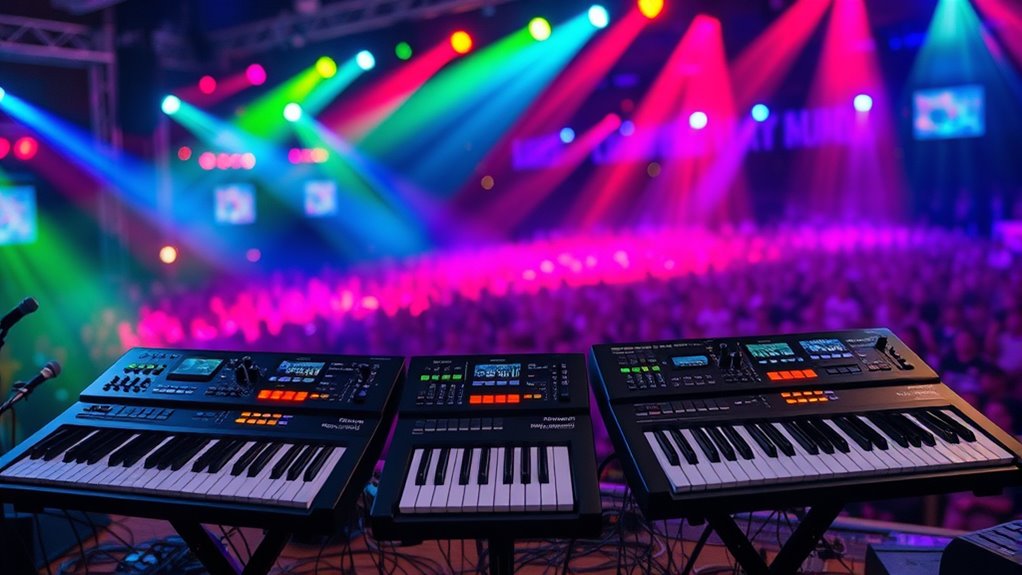
Choosing the right stage keyboard for live performance involves balancing sound quality, portability, and versatility. The Yamaha MODX M6 stands out as the best overall due to its powerful synthesis engine and lightweight design, ideal for gigging musicians. The Roland V-STAGE 88 offers premium weighted keys perfect for performers needing realistic piano feel, while the Yamaha CK88 provides built-in speakers for ease of setup on the go. As you explore options, you’ll face tradeoffs between weight, features, and price, making it essential to prioritize your specific performance needs. Keep reading for a detailed breakdown of each model and what makes them suitable for different types of live performers.
Complete the kit


Key Takeaways
- The top models balance sound quality and portability, with the Yamaha MODX M6 leading for its lightweight design and versatile sound engine.
- Weighted keys significantly impact playing feel, with Roland V-STAGE 88 excelling in realism for pianists.
- Built-in speakers, like those in the Yamaha CK88, simplify setup but often come with tradeoffs in power and sound clarity.
- Arranger keyboards such as the Korg PA600 are better suited for performers needing extensive onboard styles and accompaniment features.
- Price and build quality vary widely; investing more often yields better durability and advanced features, especially for frequent gigging.
| Yamaha 61-Key Music Synthesizer MODX M6 |  | Best Overall for Versatile Performance and Sound Quality | Number of Keys: 61 | Keyboard Action: Semi-weighted | Sound Engines: 3 (analog, FM, realistic instruments) | VIEW ON AMAZON | See Our Full Breakdown |
| Roland V-STAGE 88 Premium 88-Key Weighted Digital Keyboard |  | Best for Professional-Grade Sound and Extensive Customization | Number of Keys: 88 | Sound Engines: 4 (Acoustic Piano, Electric Piano, Organ, ZEN-Core Synthesizer) | Connectivity: XLR, 1/4-inch outputs, stereo line inputs, XLR microphone input | VIEW ON AMAZON | See Our Full Breakdown |
| Yamaha CK Series 88-Key Stage Keyboard with Built-In Speakers (CK88) |  | Best for Versatility and Built-In Monitoring | Number of Keys: 88 | Built-In Speakers: Yes | Split Points: Two | VIEW ON AMAZON | See Our Full Breakdown |
| Alesis 88-Key Digital Piano with 480 Sounds, Stand, Headphones, Carry Bag, Pedal, and Lessons |  | Best for Beginners and Mobile Practice | Number of Keys: 88 | Sounds: 480 | Built-in Features: Reverb, 160 Rhythms, 140 Demo Songs, Split, Lesson, Record Modes | VIEW ON AMAZON | See Our Full Breakdown |
| Yamaha 61-Key Arranger Keyboard PSRSX720+ |  | Best for Creative Live Arrangements and Genre Variety | Number of Keys: 61 | Voices: 1,300 | Styles: 450 | VIEW ON AMAZON | See Our Full Breakdown |
| Yamaha MX88 88-Key Weighted Action Synthesizer |  | Best Overall for Authentic Piano Feel and Versatility | Number of Keys: 88 | Weighted Action: GHS weighted keys | Polyphony: 128 notes | VIEW ON AMAZON | See Our Full Breakdown |
| Korg PA600 61-Key Professional Arranger Keyboard Bundle |  | Best for Portability and All-in-One Live Setup | Number of Keys: 61 | Touch Display: 7 inches | Built-in Amps: 2 x 15 watts | VIEW ON AMAZON | See Our Full Breakdown |
| stage keyboard for live performance | Number of Keys | Connectivity |
|---|---|---|
| Yamaha 61-Key Music Synthesize | 61 | Stage and studio integration with Softsynth Plugin (ESP) |
| Roland V-STAGE 88 Premium 88-K | 88 | XLR, 1/4-inch outputs, stereo line inputs, XLR microphone input |
| Yamaha CK Series 88-Key Stage | 88 | — |
| Alesis 88-Key Digital Piano wi | 88 | USB-MIDI, Aux In, Headphone Out |
| Yamaha 61-Key Arranger Keyboar | 61 | — |
| Yamaha MX88 88-Key Weighted Ac | 88 | Class-compliant USB audio/MIDI |
| Korg PA600 61-Key Professional | 61 | — |
More Details on Our Top Picks
Yamaha 61-Key Music Synthesizer MODX M6
The Yamaha MODX M6 stands out for its exceptional sound quality and flexible performance controls, making it a top choice for live performers who need a portable yet powerful synth. Compared to the Yamaha PSRSX720+, which offers a broader range of styles but less focus on real-time control, the MODX provides a more hands-on experience with its 8 faders and Super Knob. While the semi-weighted keys may not satisfy pianists seeking authentic feel, this model excels in expressive, studio-quality sound shaping in a stage setting. Its lightweight design enhances portability, but some players might find the keyboard action a bit limited for expressive piano playing. This pick makes the most sense for performers who prioritize sound quality and intuitive control over piano-like feel.
Pros:- Exceptional sound quality with multiple engines
- Intuitive performance controls including faders and Super Knob
- Lightweight and easily portable for stage use
Cons:- Semi-weighted keys may limit expressive dynamics for pianists
- Limited detailed specifications in raw data without extensive custom controls
Best for: Musicians who need a portable, high-quality synthesizer with versatile sound engines for live performance
Not ideal for: Pianists who require fully weighted keys for classical playing or studio pianists needing ultra-precise keyboard feel
- Number of Keys:61
- Keyboard Action:Semi-weighted
- Sound Engines:3 (analog, FM, realistic instruments)
- Performance Controls:8 faders, Super Knob
- Display:Color touch screen with 6 display knobs
- Connectivity:Stage and studio integration with Softsynth Plugin (ESP)
Our verdict“This synthesizer is perfect for performers seeking a portable, high-quality sound engine with flexible control features.”
Roland V-STAGE 88 Premium 88-Key Weighted Digital Keyboard
The Roland V-STAGE 88 offers a suite of four independent sound engines, including acoustic and electric pianos, organs, and ZEN-Core synths, making it ideal for performers needing a wide palette of sounds. In comparison to the Yamaha CK88, which emphasizes versatile live sound with split points, the V-STAGE provides deeper sound customization and a broader onboard library, appealing to more advanced performers. Its extensive connectivity options and scene management system are designed for complex live setups, though the tradeoff is increased weight and a steeper learning curve for setup. This model suits professional musicians who prioritize sound depth and connectivity over portability or simplicity.
Pros:- Four independent sound engines for versatile live use
- Extensive onboard sounds and expansion support
- Professional connectivity options for complex setups
- Scene management for quick sound switching
Cons:- Heavy weight impacts portability
- Complex setup may be intimidating for less experienced users
- No specific price details available
Best for: Experienced performers and sound designers who require a versatile, professional-grade stage keyboard with deep customization
Not ideal for: Beginner musicians or performers needing a lightweight, straightforward keyboard with minimal setup
- Number of Keys:88
- Sound Engines:4 (Acoustic Piano, Electric Piano, Organ, ZEN-Core Synthesizer)
- Connectivity:XLR, 1/4-inch outputs, stereo line inputs, XLR microphone input
- Storage:512 Scenes, 128 Scene Chains
- Sound Libraries:Over 400 onboard sounds
- Effects:Total effects including delay, reverb, multi-effects, compressor, EQ
Our verdict“This keyboard delivers professional-level sound versatility and connectivity, making it ideal for seasoned live performers who want customization freedom.”
Yamaha CK Series 88-Key Stage Keyboard with Built-In Speakers (CK88)
The Yamaha CK88 provides a comprehensive set of sounds, including authentic piano, organ, strings, and synth options, making it a flexible choice for live performance. Its built-in speakers offer the convenience of portable sound without external amplification, unlike the Roland V-STAGE 88, which requires external amplification for full stage volume. The split points allow for layered sounds on the fly, enhancing live versatility. However, the weight of the 88-key model and limited connectivity details mean it may be less suited for performers needing to integrate with complex sound systems. This keyboard is ideal for gigging musicians who prioritize convenience, onboard sounds, and portability.
Pros:- Versatile sound options including piano, organ, strings, and synth
- Built-in speakers for easy portability and practice
- Split points for playing multiple sounds simultaneously
- Good for quick setup and on-stage versatility
Cons:- Limited detailed specifications on connectivity
- Potentially heavy for extended portability
- Less advanced sound editing features compared to higher-end models
Best for: Gigging musicians seeking a versatile, all-in-one stage keyboard with onboard sound and integrated speakers
Not ideal for: Performers needing extensive external connectivity or advanced sound editing capabilities
- Number of Keys:88
- Built-In Speakers:Yes
- Split Points:Two
- Sound Types:Piano, Organ, Strings, Brass, Synth
Our verdict“This keyboard offers a great balance of sound versatility and portability, perfect for live gigs where onboard sound matters most.”
Alesis 88-Key Digital Piano with 480 Sounds, Stand, Headphones, Carry Bag, Pedal, and Lessons
The Alesis 88-Key Digital Piano provides a full-size, touch-sensitive keyboard with a broad array of 480 sounds, making it a solid choice for beginners or mobile players needing a comprehensive practice setup. Compared with the Yamaha CK88, which offers more professional features, the Alesis emphasizes affordability and portability, bundling accessories for immediate use. Its educational features like lesson modes and recording make it especially suitable for learners. The main tradeoff is its limited advanced control options, which are less suitable for seasoned performers seeking detailed sound shaping or live performance control. This model is best for students or hobbyists who want a full-featured portable keyboard.
Pros:- Full-size, touch-sensitive keys for realistic feel
- Wide variety of sounds and educational features
- Includes a full accessory bundle for versatile practice
Cons:- Batteries sold separately, reducing portability
- Limited onboard editing and live control options
- Less suitable for complex live performance setups
Best for: Beginner musicians or students who need an affordable, all-in-one practice instrument for stage or home use
Not ideal for: Professional performers or advanced musicians looking for detailed sound editing or live control features
- Number of Keys:88
- Sounds:480
- Built-in Features:Reverb, 160 Rhythms, 140 Demo Songs, Split, Lesson, Record Modes
- Connectivity:USB-MIDI, Aux In, Headphone Out
- Includes:Stand, Headphones, Carry Case, Sustain Pedal, Power Supply
Our verdict“This digital piano is perfect for beginners and students needing a portable, feature-rich keyboard for practice and small gigs.”
Yamaha 61-Key Arranger Keyboard PSRSX720+
The Yamaha PSRSX720+ offers an impressive 1,300 voices and 450 styles, making it an excellent choice for performers who want to craft rich, genre-specific arrangements on stage. Its 7-inch touchscreen and assignable live control knobs provide a hands-on approach for quick adjustments, surpassing the simplicity of the Yamaha MODX M6 for live arrangement flexibility. However, the absence of built-in speakers limits its portability and requires external amplification, unlike the CK88 with onboard speakers. This keyboard is ideal for touring musicians and entertainers who rely on a vast sound library and real-time control to deliver expressive performances.
Pros:- Large collection of 1,300 voices and 450 styles
- Professional controls including assignable knobs and touchscreen
- Supports expressive features like Super Articulation+ and chord looper
- Ideal for creating complex arrangements on stage
Cons:- No built-in speakers, requiring external amp
- Highly feature-rich, which may be overwhelming for beginners
- Complex interface might need time to master
Best for: Experienced live performers and arrangers needing extensive voices and styles with advanced control features
Not ideal for: Beginners or casual players who do not require a large library or complex live controls
- Number of Keys:61
- Voices:1,300
- Styles:450
- Live Control Knobs:2
- Touchscreen:7-inch
- Tracks:16
Our verdict“This arranger keyboard is best suited for seasoned performers demanding a vast sound palette and detailed live controls for expressive stage performances.”
Yamaha MX88 88-Key Weighted Action Synthesizer
The Yamaha MX88 stands out for its authentic GHS weighted keys, delivering a piano-like experience that surpasses lighter synth-action options like the Korg PA600, which, despite its portability and extensive features, prioritizes versatility over realism. Compared to the Roland V-STAGE 88, the MX88 offers a more traditional piano feel, though it lacks built-in speakers, requiring external amplification. Its 128-note polyphony and Motif sound engine ensure smooth, expressive performances, making it ideal for serious live performers who need both realism and sound quality. The interface, with its 3-digit LED and backlit LCD, offers great control but can require some learning curve for new users. This model is best suited for musicians who prioritize realistic piano touch combined with versatile sounds, but less so for those who need onboard amplification or a simplified interface.
Pros:- Weighted GHS keys provide an authentic piano feel
- High polyphony ensures smooth, complex performances
- Plug-and-play USB audio/MIDI connectivity for easy setup
Cons:- No built-in speakers, requiring external amplification
- Complex interface may be challenging for new users
Best for: Professional keyboardists and performers seeking authentic piano feel with versatile sound options
Not ideal for: Beginner performers or those needing a portable, all-in-one setup with built-in speakers
- Number of Keys:88
- Weighted Action:GHS weighted keys
- Polyphony:128 notes
- Connectivity:Class-compliant USB audio/MIDI
- Display:3-digit LED + 20×2 backlit LCD
- Sound Engine:Motif
Our verdict“This keyboard is perfect for performers who demand realistic piano touch and extensive sound capabilities, but less suited for those prioritizing portability and simplicity.”
Korg PA600 61-Key Professional Arranger Keyboard Bundle
The Korg PA600 excels as an all-in-one live performance solution, combining 61 velocity-sensitive keys, a vibrant 7-inch touch display, and built-in 15-watt stereo amps, making it more portable than the Yamaha MX88’s 88 keys and external requirements. While the 61 keys might be limiting for players who need a full-range keyboard, the PA600 compensates with a rich sound engine, extensive effects, and a user-friendly SongBook feature that simplifies live arrangements. Compared to the MX88, it sacrifices some realism for portability and ease of use, but its bundled accessories—bench, stand, headphones, sustain pedal—offer a complete setup right out of the box. This makes it ideal for gigging musicians who want a comprehensive, portable keyboard, though it’s less suited for those who need the full range of an 88-key instrument or more advanced sound editing tools.
Pros:- Rich, natural sound with extensive effects
- Portable design with a complete bundle of accessories
- User-friendly 7-inch touch display and SongBook for quick setup
Cons:- Limited to 61 keys, which may be restrictive for some styles
- Heavier than smaller portable controllers, potentially cumbersome for some users
- Complex features can require a learning curve for new users
Best for: Performers needing a portable, all-in-one arranger with quick setup and versatile sounds
Not ideal for: Pianists or keyboardists requiring full 88-key range and ultra-realistic piano action
- Number of Keys:61
- Touch Display:7 inches
- Built-in Amps:2 x 15 watts
- Included Accessories:Bench, Sustain Pedal, Headphones, Stand
Our verdict“This keyboard suits live performers who prioritize portability, quick setup, and a broad sound palette over full-range playability, but isn’t ideal for demanding pianists needing full 88 keys.”
How We Picked
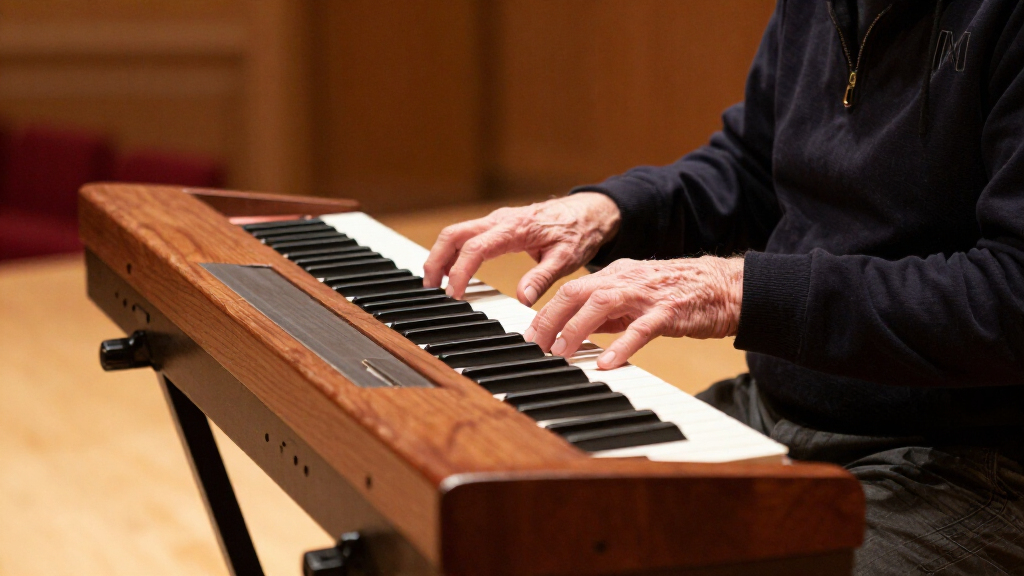
Our evaluation focused on key performance factors that matter for live stage use, including sound versatility, keyboard action, portability, durability, and onboard features. We considered how each model balances these elements, especially in real-world gig scenarios where ease of setup and reliable performance are vital. Models were ranked based on their ability to deliver professional sound, ease of use, and value for different skill levels and performance styles. We also factored in user reviews and industry reputation to ensure these options meet the demands of live performers across various genres and settings.| stage keyboard for live performance | Connectivity |
|---|---|
| Yamaha 61-Key Music Synthesize | Stage and studio integration with Softsynth Plugin (ESP) |
| Roland V-STAGE 88 Premium 88-K | XLR, 1/4-inch outputs, stereo line inputs, XLR microphone input |
| Yamaha CK Series 88-Key Stage | — |
| Alesis 88-Key Digital Piano wi | USB-MIDI, Aux In, Headphone Out |
| Yamaha 61-Key Arranger Keyboar | — |
| Yamaha MX88 88-Key Weighted Ac | Class-compliant USB audio/MIDI |
| Korg PA600 61-Key Professional | — |
Factors to Consider When Choosing Stage Keyboard For Live Performance
Selecting a stage keyboard for live performance requires understanding several critical factors that influence your overall experience. Beyond basic features, you should consider how the keyboard’s weight affects transport, the feel of the keys for your playing style, and the range of sounds available to match your musical needs. Additional considerations include durability for frequent gigging, onboard features like speakers or MIDI connectivity, and budget constraints. Making the right choice involves balancing these elements to suit your specific performance environment and personal preferences.Keyboard Action and Feel
The feel of the keys can dramatically influence your performance, especially if you play piano or synth-heavy styles. Weighted keys offer a more realistic piano experience, which is essential for pianists or those seeking expressive control. Semi-weighted or synth-action keys are lighter and better suited for fast, intricate playing or multifunctional sounds. Choosing the right action depends on your playing style and the genres you perform, but avoid sacrificing feel for features if expressiveness is your priority.
Portability and Weight
Live performance often demands carrying your gear across venues, so weight matters. Lighter models like the Yamaha MODX M6 provide excellent portability without compromising sound quality, making setup easier. Heavier models, such as the Roland V-STAGE 88, offer premium weighted keys but can be cumbersome if you frequently move between gigs. Consider your transport options and whether features like built-in handles or lightweight construction align with your performance routine.
Sound Versatility and Tone Quality
The range and realism of sounds directly impact your performance. A keyboard with a broad palette of tones—such as pianos, organs, strings, and synths—gives you flexibility on stage. High-quality sound engines also ensure clarity and richness, crucial for engaging live audiences. However, more sounds often mean larger file sizes and increased complexity, so match the sound library to your musical style and performance needs.
Built-in Features and Connectivity
Features like onboard speakers, MIDI/USB connectivity, and audio outputs can simplify your setup. Built-in speakers, like in the Yamaha CK88, are convenient but typically lack volume and clarity for larger venues. MIDI and audio connectivity allow integration with other gear or recording setups, providing expanded creative options. Be mindful of what features you need versus what adds unnecessary complexity or cost.
Budget and Long-Term Value
Higher-priced models often offer better build quality, more features, and longer durability, making them worthwhile investments for frequent performers. Cheaper options may suffice for beginners or infrequent gigging but could fall short in reliability or sound quality over time. Consider your performance frequency and whether spending more now will save you money and hassle down the line, especially when durability is a concern.
Frequently Asked Questions
How do weighted keys impact live performance?
Weighted keys provide a more realistic piano feel, which can significantly improve expressiveness and control during live playing. For performers who primarily rely on piano sounds or want a more authentic touch, weighted keys create a better tactile response. However, they often add weight and cost, making the keyboard less portable. If your focus is on synth sounds or rapid playing, semi-weighted or synth-action keys might be more practical, but for piano-centric gigs, weighted keys tend to be worth the tradeoff.
Is it better to choose a keyboard with built-in speakers for live shows?
Built-in speakers can be a real convenience for quick setups or small venues, eliminating the need for external amplification. However, their power and sound quality are generally limited, which can be a drawback in larger or louder settings. For most live performances, connecting to external PA systems ensures better sound projection and clarity. If portability and simplicity are your priorities, a keyboard with decent onboard speakers can be sufficient, but in bigger venues, external amplification remains essential.
Should I prioritize lightweight design over advanced features?
Choosing a lightweight keyboard makes transport and setup easier, especially if you perform regularly at multiple venues. However, lighter models may sacrifice some features, like extensive sound libraries or robust build quality. If you perform frequently or in demanding environments, investing in a slightly heavier, more feature-rich model can be more cost-effective long-term. Balance your need for portability with the features that directly enhance your performance, rather than defaulting to the lightest option if it lacks essential sounds or durability.
How important is the number of keys for live performance?
The key count influences the range of sounds and the playing style you can adopt. A 61-key setup is more portable and often sufficient for most gigs, especially if you use split or layered sounds. Full 88-key models like the Roland V-STAGE 88 are better suited to pianists or performers who need a complete keyboard range without compromises. Consider your genre and playing technique—if you need full range access, a full-sized keyboard is worth the extra weight and cost.
Can I rely on arranger keyboards for live performance?
Arranger keyboards like the Korg PA600 are designed with built-in accompaniment styles, making them ideal for solo performers or bands needing automatic backing. They excel at providing a full band sound with minimal setup. However, they may lack the raw sound quality or depth of dedicated synth or stage pianos. If your performance relies heavily on live improvisation or nuanced sound control, an arranger might be limiting. For more control and flexibility, combining an arranger with a separate synth or piano module is often better.
Conclusion
For most live performers, the Yamaha MODX M6 offers an excellent balance of lightweight portability, versatile sound engine, and professional features, making it the best overall choice. Beginners or casual players may prefer the Yamaha CK88 for its built-in speakers and straightforward interface, while pianists needing realistic feel will find the Roland V-STAGE 88 to be the best premium option. For those on a budget, the Korg PA600 provides ample features at a lower price point, especially for performers who value onboard styles. Ultimately, your ideal choice depends on your specific needs, performance environment, and budget.