
Choosing a nanny cam for elderly parents is a balance between visibility and discretion: you want enough clarity to spot a fall or a missed medication, without installing gear that makes a parent feel surveilled in their own home. The Smart Caregiver Video Monitor with Call Button takes the top spot because it pairs video with a physical call button — turning a camera into an actual caregiving tool rather than a passive viewer. For pure image quality without a subscription, the eufy Security 4K Indoor Camera E30 stands out, while the Kasa EC70 keeps things simple and affordable for first-time users. The main tradeoffs in this category are resolution versus ease of use, visible cameras versus hidden ones, and cloud fees versus local storage. Read on for the full breakdown of all 14 models and who each one suits best.

Turn quiet afternoons into listening time
- Thousands of audiobooks, podcasts and originals
- Listen on your phone, tablet or Echo — also offline
- Cancel anytime
Complete the kit


Key Takeaways
- Only one product in the lineup — the Smart Caregiver Video Monitor — includes a physical call button, which makes it the only pick that functions as a two-way caregiving device rather than just a viewing device.
- The hidden options (the clock cameras and picture frame cam) record at 1080p, which is adequate for checking on a parent but noticeably behind the 4K clarity of the eufy E30 or Funstorm — a real tradeoff between discretion and detail.
- Subscription-free local storage was rare: the eufy E30 leads here, while most Wi-Fi cameras in the roundup push you toward recurring cloud plans to review footage.
- Pan/tilt models like the GNCC 2K and Kasa EC70 cover far more of a room per camera, which matters in open living spaces where a fixed mini camera would only see one corner.
- The 60-day battery mini camera trades constant monitoring for placement freedom — best as a backup or for rooms without outlets, not as the primary caregiver camera.
| 1080p Wi-Fi Indoor Camera for Pets and Children |  | Best Budget Starter Pick | Resolution: 1080p | Night vision: Infrared, no visible red glare | Wi-Fi: 2.4 GHz only | VIEW ON AMAZON | See Our Full Breakdown |
| Aidowocam 4K Mini Indoor Security Camera with Night Vision and Motion Detection |  | Best for Discreet, Wire-Free Placement | Resolution: 4K | Night vision range: Up to 16 ft (8 m) | Battery capacity: 2,800 mAh | VIEW ON AMAZON | See Our Full Breakdown |
| Kasa EC70 1080p Indoor Pan/Tilt Security Camera |  | Best Overall for Daily Check-Ins | Resolution: 1080p Full HD | Connectivity: 2.4 GHz Wi-Fi | Storage: MicroSD card up to 256 GB (sold separately) | VIEW ON AMAZON | See Our Full Breakdown |
| aosu 2K Indoor Security Camera with Motion Tracking and Two-Way Audio | 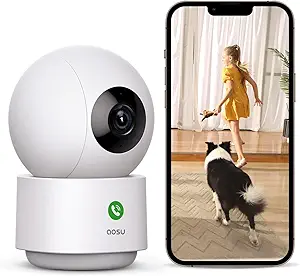 | Best for Staying Connected and Talking Back | Resolution: 2K QHD | Wi-Fi: 2.4 GHz only | Rotation: 360° horizontal | VIEW ON AMAZON | See Our Full Breakdown |
| Smart Caregiver Video Monitor with Night Vision and Call Button |  | Best for Seniors Who Hate Technology | Screen size: 2.8 inches | Video resolution: 720p | Night vision: Infrared | VIEW ON AMAZON | See Our Full Breakdown |
| eufy Security 4K Indoor Camera E30 |  | Best for Continuous 24/7 Monitoring | Resolution: 4K | Recording: 24/7 continuous | Field of View: 360° panoramic | VIEW ON AMAZON | See Our Full Breakdown |
| Funstorm Upgraded 4K HD Mini Security Camera |  | Best Battery Life for Discreet Placement | Resolution: 4K (4000p effective) | Battery: 2600mAh rechargeable, up to 100 days standby | Field of View: 110° (listed up to 150°) | VIEW ON AMAZON | See Our Full Breakdown |
| Canary View Indoor Home Security Camera 1080p HD WiFi |  | Easiest Setup for Non-Technical Families | Resolution: 1080p HD | Field of View: 147° wide-angle | Zoom: 10x | VIEW ON AMAZON | See Our Full Breakdown |
| GNCC 2K Indoor Security Camera with 5G WiFi, Pan/Tilt, Motion Tracking |  | Best Value Pan/Tilt Coverage | Resolution: 2K Full HD | Rotation: 340° horizontal, 80° vertical | Night Vision: 10 meters | VIEW ON AMAZON | See Our Full Breakdown |
| 4K Mini Indoor Wireless Security Camera (C12) with 60-Day Battery |  | Best Compact Cordless Placement | Resolution: 4K | Battery: 1200mAh; 8 hrs continuous or 60 days standby | Charging: USB-C, 3–4 hours full | VIEW ON AMAZON | See Our Full Breakdown |
| Clock Camera – Nanny Cam with 1080P HD Video, AI Motion Detection & Night Vision |  | Best Discreet Clock Design | Video resolution: 1080p HD | Wi-Fi: Dual-band 2.4GHz and 5GHz | Setup: Bluetooth-assisted via mobile app | VIEW ON AMAZON | See Our Full Breakdown |
| WiFi Hidden Camera Clock with 140° Wide-Angle Lens, Color Night Vision, and Motion Detection |  | Best for a Wide Room View | Video: Full HD 4K live streaming, as stated in the product data | Lens: 140° in description; 145° in title | Night vision: Color night vision in low light | VIEW ON AMAZON | See Our Full Breakdown |
| Hidden Spy Security Camera Picture Frame – Mini Nanny Cam Indoor, 1080p, Motion Detection, Loop Recording |  | Best Without Wi-Fi | Resolution: 1080p HD; 2 MP effective video resolution | Wi-Fi: Not required | Storage: MicroSD up to 128GB (not included) | VIEW ON AMAZON | See Our Full Breakdown |
| 1080p Full HD Indoor Wi-Fi Security Camera |  | Best Straightforward Indoor Camera | Video resolution: 1080p | Connectivity: Wi-Fi | Night vision: Infrared LEDs | VIEW ON AMAZON | See Our Full Breakdown |
| nanny cam for elderly parent | Resolution | Night vision | Storage |
|---|---|---|---|
| 1080p Wi-Fi Indoor Camera for | 1080p | Infrared, no visible red glare | — |
| Aidowocam 4K Mini Indoor Secur | 4K | — | MicroSD up to 128 GB; cloud storage trial |
| Kasa EC70 1080p Indoor Pan/Til | 1080p Full HD | — | MicroSD card up to 256 GB (sold separately) |
| aosu 2K Indoor Security Camera | 2K QHD | — | — |
| Smart Caregiver Video Monitor | — | Infrared | — |
| eufy Security 4K Indoor Camera | 4K | Color and infrared with built-in spotlight | Local SD card (sold separately); optional cloud |
| Funstorm Upgraded 4K HD Mini S | 4K (4000p effective) | Yes | — |
| Canary View Indoor Home Securi | 1080p HD | — | — |
| GNCC 2K Indoor Security Camera | 2K Full HD | 10 meters | Cloud (14-day trial) or SD card 16–128GB (not included) |
| 4K Mini Indoor Wireless Securi | 4K | — | Micro SD up to 128GB (not included) or cloud |
| Clock Camera | — | Infrared | TF card up to 256GB (not included) or cloud |
| WiFi Hidden Camera Clock with | — | Color night vision in low light | — |
| Hidden Spy Security Camera Pic | 1080p HD; 2 MP effective video resolution | — | MicroSD up to 128GB (not included) |
| 1080p Full HD Indoor Wi-Fi Sec | — | Infrared LEDs | microSD up to 256GB (not included) |
More Details on Our Top Picks
1080p Wi-Fi Indoor Camera for Pets and Children
For families who want a first camera in a parent’s home without a big commitment, this option covers the basics: 1080p video, infrared night vision without red glare, and flexible placement thanks to the omnidirectional stand and magnetic base. Compared with the Kasa EC70, it lacks pan and tilt, but the magnetic mount lets you reposition it by hand in seconds — a practical workaround for a fixed lens. The Bluetooth-assisted pairing also makes initial setup less painful than app-only cameras. The catch is the tiny 1000 mAh battery: four hours of cordless runtime means it functions as a wired camera in practice, so plan for an outlet near the bedside or living room chair.
Pros:- Magnetic base and adjustable stand allow creative placement
- Infrared night vision with no visible red glow that might confuse or disturb a parent
- Bluetooth-assisted setup simplifies first-time pairing
- Clear 1080p footage suitable for checking on daily activity
Cons:- No 5 GHz Wi-Fi support, which can cause connection issues on newer routers
- Battery-only operation is unrealistic for around-the-clock monitoring
Best for: Families trying their first elderly-care camera who want simple setup and flexible placement on a small budget
Not ideal for: Anyone needing continuous battery-powered monitoring — 4 hours of runtime means it needs constant power anyway
- Resolution:1080p
- Night vision:Infrared, no visible red glare
- Wi-Fi:2.4 GHz only
- Setup:Bluetooth-assisted pairing
- Mounting:Omnidirectional stand and magnetic base
- Battery capacity:1000 mAh
- Cordless runtime:Up to 4 hours
Our verdict“A sensible low-cost entry point for occasional check-ins, as long as you treat it as a plugged-in camera.”
Aidowocam 4K Mini Indoor Security Camera with Night Vision and Motion Detection
Where most picks in this roundup need a permanent outlet, the Aidowocam runs on a 2,800 mAh battery, so you can tuck it on a bookshelf or bedside table with no cables running across a parent’s room. The 4K resolution is sharper than the Kasa EC70’s 1080p, which genuinely matters when you’re trying to read a medication bottle or see facial detail from across a room. Compared with the aosu 2K model, though, you give up remote pan/tilt and two-way audio for the sake of portability. Be realistic about the 100-day battery claim — that applies to sleep-mode standby, not active recording, so expect far more frequent charging if motion triggers are frequent.
Pros:- 4K resolution captures fine detail like labels and faces at distance
- Truly wire-free design allows placement anywhere in the home
- Motion alerts and remote viewing from Android or iOS
- Dual storage options with microSD up to 128 GB plus cloud trial
Cons:- Advertised 100-day battery life only applies to sleep-mode standby
- No water resistance, strictly indoor use
- Fixed lens with no remote pan or tilt
Best for: Caregivers who want crisp 4K detail and a wire-free camera that can be moved room to room or hidden from view
Not ideal for: Continuous 24/7 monitoring or outdoor/doorway placement — it’s indoor-only and drains quickly with active recording
- Resolution:4K
- Night vision range:Up to 16 ft (8 m)
- Battery capacity:2,800 mAh
- Advertised standby battery life:Up to 100 days in sleep mode
- Wi-Fi:2.4 GHz
- Storage:MicroSD up to 128 GB; cloud storage trial
- Dimensions:1.97 x 2.36 x 1.57 in
- App control:Android and iOS
Our verdict“The pick when you need maximum image clarity without running power to the camera, provided you accept regular recharging.”
Kasa EC70 1080p Indoor Pan/Tilt Security Camera
This is the pick I’d point most families toward first. The remote pan and tilt solves the single biggest frustration with fixed cameras like the Aidowocam or the basic 1080p Wi-Fi camera — you can follow a parent moving from bed to chair to kitchen from your phone. Motion and sound detection up to 30 feet at night means you’ll know about a fall, a coughing fit, or a confused 3 a.m. wandering, not just visual movement. Local recording to a microSD card up to 256 GB avoids the monthly fees that subscription cameras push, and Smart Actions can trigger other Kasa devices. The resolution is only 1080p, but for monitoring a room rather than reading fine print, it’s plenty.
Pros:- Remote pan and tilt covers an entire room from one camera
- Local microSD storage up to 256 GB with no monthly fee
- Combined motion and sound detection catches non-visual events
- Smart Actions integrate with other Kasa devices
Cons:- Requires 2.4 GHz Wi-Fi
- MicroSD card sold separately
- 1080p resolution trails the 2K and 4K picks in this lineup
Best for: Families who want one reliable, app-controlled camera for round-the-clock room monitoring without subscription fees
Not ideal for: Homes without a stable 2.4 GHz network, or anyone needing 4K-level detail for identifying small objects
- Resolution:1080p Full HD
- Connectivity:2.4 GHz Wi-Fi
- Storage:MicroSD card up to 256 GB (sold separately)
- Detection:Motion and sound, up to 30 ft at night
- Pan/Tilt:Remote pan and tilt via app
- App:Tapo or Kasa
Our verdict“The most balanced choice for everyday elderly monitoring — full room coverage, sound alerts, and no recurring costs.”
aosu 2K Indoor Security Camera with Motion Tracking and Two-Way Audio
What separates the aosu from the Kasa EC70 is smart motion tracking — the camera follows your parent automatically instead of waiting for you to pan manually, and touch-to-talk two-way audio lets you say “Mom, sit down, I’m calling for help” the moment you see trouble. The 2K QHD feed sits noticeably sharper than Kasa’s 1080p, and the 360° rotation with 155° tilt means essentially no blind spots in a room. Alexa compatibility lets you pull the feed up on a Show device without opening your phone. The tradeoff is storage flexibility: unlike the Kasa, there’s no mention of large local microSD support here, so check the recording options against your needs before committing.
Pros:- Smart motion tracking follows a moving parent without manual control
- Two-way audio with touch-to-talk enables immediate reassurance
- 2K QHD resolution is noticeably sharper than 1080p alternatives
- 360° rotation and 155° tilt eliminate blind spots
Cons:- 2.4 GHz Wi-Fi only
- Local storage options are more limited than the Kasa EC70
Best for: Caregivers who want to actively communicate with their parent through the camera and have it track movement automatically
Not ideal for: Anyone needing extensive onboard local storage or 5 GHz network support
- Resolution:2K QHD
- Wi-Fi:2.4 GHz only
- Rotation:360° horizontal
- Tilt:155° vertical
- Audio:Two-way with touch-to-talk
- Tracking:Smart motion tracking
- Compatibility:Alexa
Our verdict“The best choice when conversation and automatic tracking matter more than subscription-free local archive.”
Smart Caregiver Video Monitor with Night Vision and Call Button
Every other camera in this lineup assumes the caregiver has a smartphone and the home has Wi-Fi. This one doesn’t. The dedicated 2.8-inch monitor works over a direct wireless link, so it functions in a rural house with poor internet — and a caregiver sitting in the next room can see and talk to their parent instantly, no app involved. The standout feature is the wireless call button with five assistance options, which flips the dynamic: instead of you watching your parent, they can summon you. Resolution is only 720p, well below the aosu or Aidowocam, and the call button needs to stay near the camera for a reliable connection. Automatic get-up alerts require extra hardware sold separately.
Pros:- Works entirely without Wi-Fi, apps, or accounts
- Wireless call button gives the senior five ways to request assistance
- Dedicated monitor with two-way audio is ideal for non-technical caregivers
- Rechargeable camera and monitor with USB-C charging
Cons:- 720p resolution is the lowest in this lineup
- Call button must be kept near the camera for reliable connection
- Get-up alerts require separately purchased accessories
Best for: Live-in or nearby caregivers of tech-averse seniors, especially in homes without reliable Wi-Fi
Not ideal for: Remote long-distance monitoring — there’s no app or cloud access, so you must be within the monitor’s wireless range
- Screen size:2.8 inches
- Video resolution:720p
- Night vision:Infrared
- Connectivity:Wireless; no Wi-Fi required
- Audio:Two-way audio
- Power:Rechargeable camera and monitor; USB-C charging
- Call button:Wireless, five assistance options
- Zoom:Digital
Our verdict“Purpose-built for in-home caregiving where simplicity and a call button beat resolution and remote access.”
eufy Security 4K Indoor Camera E30
For families checking on aging parents around the clock, continuous recording matters more than almost anything else — motion-only cameras miss the quiet moments, like a parent who wandered into the kitchen at 3 a.m. without triggering anything. This eufy stands out for true 4K clarity combined with 24/7 recording, a pairing that none of the battery-powered picks in this roundup, like the 4K Mini Indoor Wireless Security Camera, can match since batteries can’t sustain all-day capture. The 360° panoramic view with auto-tracking means one unit can cover an entire open living space, reducing the number of cameras needed. Footage stays on a local SD card, so there’s no mandatory subscription — unlike the Canary View, which locks person detection behind a paid plan. Tradeoffs: the SD card is sold separately, and HomeKit users are capped at 1080p.
Pros:- 4K resolution with genuine 24/7 continuous recording
- 360° panoramic view with AI auto-tracking covers whole rooms
- No mandatory subscription; local SD card storage
- AI detection distinguishes people, pets, and crying sounds
Cons:- SD card for local storage is sold separately
- HomeKit streaming is limited to 1080p
- Optional cloud and premium AI features still cost extra
Best for: Families who want one plugged-in camera recording a parent’s main living area continuously, without monthly fees
Not ideal for: Anyone wanting a discreet or hidden setup — this is a visible, plugged-in camera that needs to stay mounted near an outlet
- Resolution:4K
- Recording:24/7 continuous
- Field of View:360° panoramic
- Night Vision:Color and infrared with built-in spotlight
- Storage:Local SD card (sold separately); optional cloud
- Smart Home:HomeKit (1080p), Alexa, Google Assistant
- Two-Way Audio:Yes
- Subscription Required:No
Our verdict“The pick for families who need a single always-on camera that never misses a moment and never demands a monthly bill.”
Funstorm Upgraded 4K HD Mini Security Camera
When a parent would be unsettled by a camera on the mantle, a small cordless unit placed on a bookshelf is far easier to introduce. This Funstorm model’s calling card is its 2600mAh battery rated for up to 100 days of standby — double the standby rating of the 4K Mini Indoor Wireless Security Camera, which manages 60 days and only 8 hours of continuous recording. That extra capacity translates to fewer recharging trips, which matters if the camera sits in a parent’s home you only visit monthly. 4K capture, night vision, and a wide 110° lens cover a room adequately, and motion alerts reach your phone instantly. The compromises are real, though: it’s indoor-only, not water resistant, the power adapter isn’t included, and screw-in wall mounting means you can’t just set it and forget it.
Pros:- Up to 100 days of standby battery life on a single charge
- 4K video with night vision and wide-angle coverage
- Instant motion alerts and remote live viewing via free app
- Compact cube design that’s easy to place discreetly
Cons:- Power adapter not included in the box
- Requires screw-in wall mounting
- Indoor only; not water resistant
Best for: Long-distance caregivers who need a camera they can place discreetly and recharge only a few times a year
Not ideal for: Renters or anyone unwilling to drill — mounting requires screws, and there’s no true always-on recording
- Resolution:4K (4000p effective)
- Battery:2600mAh rechargeable, up to 100 days standby
- Field of View:110° (listed up to 150°)
- Night Vision:Yes
- Mounting:Screw-in wall mount
- Dimensions:2 x 2.7 x 0.7 inches
- Alerts:Motion detection with phone notifications
Our verdict“A sensible choice when you can’t run power to the camera and won’t be visiting often enough to recharge frequently.”
Canary View Indoor Home Security Camera 1080p HD WiFi
Not every caregiver is comfortable pairing devices, fiddling with dual-band routers, or formatting SD cards — and if you’re setting this up remotely for a parent over the phone, simplicity is worth more than resolution. The Canary View is the friendliest setup in this lineup: plug it in, connect to WiFi, and it’s live in minutes with no installation. Compared with the GNCC 2K Indoor Camera, which leans on an app, Bluetooth pairing, and separate storage decisions, this model removes nearly every setup decision. Its 147° wide-angle lens and 10x zoom let you confirm details like whether a parent took their medication, and AES 256-bit encryption on US-based servers is a genuine plus when the footage is of someone’s home. The tradeoff is the paywall: 30-day video history and person detection require a Premium subscription, and resolution tops out at 1080p.
Pros:- Setup in minutes with zero installation required
- 147° wide view with 10x zoom and night vision
- Strong data security with AES 256-bit encryption and US-based servers
- Privacy mode and automatic arm/disarm
Cons:- Cloud history and person detection require a paid Premium plan
- 1080p resolution trails the 2K and 4K alternatives
- Indoor use only
Best for: Non-technical caregivers or adult children setting up a camera remotely for a parent with minimal fuss
Not ideal for: Budget-conscious buyers who refuse recurring fees — meaningful features sit behind a subscription
- Resolution:1080p HD
- Field of View:147° wide-angle
- Zoom:10x
- Features:Two-way audio, night vision, privacy mode, auto arm/disarm
- Cloud Storage:30-day history (Premium plan)
- Encryption:AES 256-bit, TLS, SSL
- Compatibility:Alexa, Google Assistant
Our verdict“The right call when getting a camera working quickly and securely matters more than having the sharpest picture.”
GNCC 2K Indoor Security Camera with 5G WiFi, Pan/Tilt, Motion Tracking
Parents who move between the living room, kitchen, and hallway defeat fixed cameras — and this is where pan/tilt earns its keep. The GNCC rotates 340° horizontally and 80° vertically with AI motion tracking, following a parent as they move rather than losing them at the edge of frame. Compared with the eufy E30, it lacks 4K and true 24/7 local recording out of the box, but it delivers comparable room coverage for less. Dual-band 2.4G/5GHz WiFi with Bluetooth pairing solves the connectivity headaches that plague budget cameras in homes with older routers, and 10-meter night vision with customizable detection zones lets you monitor a doorway while ignoring a flickering TV. The catches: the SD card isn’t included, and after the 14-day cloud trial ends, playback requires either paid cloud or your own card.
Pros:- 340°/80° pan-tilt with AI motion tracking
- 2K resolution with 10-meter night vision
- Dual-band WiFi plus simple Bluetooth pairing
- Two-way audio with Alexa support
Cons:- SD card not included
- Cloud storage requires a subscription after the 14-day trial
- Detection zone customization depends entirely on the Osaio app
Best for: Budget-minded families covering a parent who moves around a lot and needs a camera that follows them
Not ideal for: Those wanting continuous archived footage from day one — you’ll need to buy an SD card before it can record around the clock
- Resolution:2K Full HD
- Rotation:340° horizontal, 80° vertical
- Night Vision:10 meters
- WiFi:Dual-band 2.4G/5GHz with Bluetooth pairing
- Audio:Two-way (built-in mic & speaker)
- Storage:Cloud (14-day trial) or SD card 16–128GB (not included)
- Compatibility:Alexa, Osaio app
Our verdict“The best way to get full-room, follow-the-parent coverage without paying 4K money.”
4K Mini Indoor Wireless Security Camera (C12) with 60-Day Battery
The C12’s pitch is placement freedom: at 80% smaller than traditional cameras, with magnetic stick-and-go mounting, it attaches to a shelf edge, cabinet side, or picture rail without drilling — a real advantage over the Funstorm, which needs screws. For caregivers who can’t alter a parent’s home permanently, that no-drill flexibility is the whole point. It streams 4K video over dual-band WiFi, pairs via Bluetooth Smart-link in about ten seconds, and offers a 150° wide-angle view with 33-foot night vision. But the small body forces compromises the bigger cameras don’t face: the 1200mAh battery delivers only 8 hours of continuous recording, so it’s a check-in camera, not an always-on one. The 60-day figure applies only to power-save standby. Compared with the eufy E30, you trade continuous monitoring for portability.
Pros:- Tiny cordless body with no-drill magnetic mounting
- 4K streaming over dual-band 2.4GHz/5GHz WiFi
- 10-second Bluetooth Smart-link setup
- USB-C fast charging in 3–4 hours
Cons:- Only 8 hours of continuous recording per charge
- Micro SD card not included
- Marketing claims like ‘zero dropouts’ depend heavily on network quality
Best for: Caregivers who need a tiny, repositionable camera for spot checks rather than all-day surveillance
Not ideal for: Anyone expecting round-the-clock footage — 8 hours of continuous recording per charge makes true monitoring impossible without frequent recharging
- Resolution:4K
- Battery:1200mAh; 8 hrs continuous or 60 days standby
- Charging:USB-C, 3–4 hours full
- WiFi:Dual-band 2.4GHz/5GHz
- Night Vision Range:33 ft
- Viewing Angle:150° wide-angle
- Mounting:Magnetic, no drilling required
- Storage:Micro SD up to 128GB (not included) or cloud
Our verdict“A flexible spot-check camera for families who value repositionable, drill-free placement over nonstop recording.”
Clock Camera – Nanny Cam with 1080P HD Video, AI Motion Detection & Night Vision
For families who want a camera that blends into a room, this digital clock design is less conspicuous than the tabletop 1080p Full HD Indoor Wi-Fi Security Camera. Its 1080p video, infrared night vision, and motion alerts can help you check whether there is activity in a shared living space, while remote access lets you view the feed away from home. Bluetooth-assisted setup and dual-band Wi-Fi offer a more flexible connection setup than a camera with Wi-Fi support alone. The main limit for elder care is video-only recording: it cannot capture speech or let you hear a call for help. Local recording also requires a separately purchased TF card, though cloud storage is listed as another option. I’d choose it for visual check-ins where discretion matters more than audio.
Pros:- Clock-style housing blends into indoor spaces.
- Infrared night vision supports viewing in the dark.
- AI motion detection sends smartphone alerts.
- Supports dual-band Wi-Fi and TF card or cloud storage.
Cons:- No audio recording, limiting its usefulness for listening for calls for help.
- TF card for local recording is sold separately.
Best for: Families who want a clock-style camera for visual check-ins in a parent’s shared living space and can use phone alerts.
Not ideal for: Caregivers who need to hear conversations, calls for help, or other sounds, since this model records video only.
- Video resolution:1080p HD
- Wi-Fi:Dual-band 2.4GHz and 5GHz
- Setup:Bluetooth-assisted via mobile app
- Night vision:Infrared
- Storage:TF card up to 256GB (not included) or cloud
- Recording:Loop recording
- Audio:Video only; no audio
- Date format:MM/DD/YYYY
Our verdict“Choose this clock camera for discreet, remote visual checks when audio monitoring is not required.”
WiFi Hidden Camera Clock with 140° Wide-Angle Lens, Color Night Vision, and Motion Detection
This clock camera is the pick here for caregivers who want to see more of a room at once: its listed 140° wide-angle lens (the title says 145°) is broader than a typical fixed view, and color night vision in low light may make scenes easier to distinguish than the infrared-only view of the Clock Camera with 1080P HD Video. It streams to iOS and Android devices and can send motion alerts with captured images, which gives a family a quick visual cue when something changes. The product data claims 4K live streaming, but gives no consistent lens angle, so I would treat both details cautiously. A microSD card is required for local recording and is not included. Like the other disguised clock, it is a visual monitor rather than a way to hear a parent.
Pros:- Wide-angle lens is intended to cover more of a room.
- Color night vision is specified for low-light viewing.
- Motion alerts can include captured images.
- Supports local recording to a microSD card up to 256GB.
Cons:- The lens angle differs between title and description, and the stated 4K stream is not further clarified.
- MicroSD card is not included.
- No audio recording or listening feature is listed.
Best for: Caregivers who want a broad, low-light color view of a room on an iOS or Android phone.
Not ideal for: Families who need dependable, clearly documented specifications or audio monitoring; lens angle is inconsistent and no audio feature is listed.
- Video:Full HD 4K live streaming, as stated in the product data
- Lens:140° in description; 145° in title
- Night vision:Color night vision in low light
- Motion detection:Phone alerts and captured images
- Connectivity:Wi-Fi and Bluetooth
- Compatibility:iOS and Android
- Local storage:MicroSD card up to 256GB (not included)
Our verdict“Pick this clock model for a wider color view in low light if you can accept unclear specifications and video-only monitoring.”
Hidden Spy Security Camera Picture Frame – Mini Nanny Cam Indoor, 1080p, Motion Detection, Loop Recording
Among these four, this picture-frame camera is the clearest fit for a household that cannot or does not want to use Wi-Fi: it records to a microSD card and needs no network connection, unlike the two clock cameras and the 1080p Full HD Indoor Wi-Fi Security Camera. That also changes what remote care looks like: there is no stated phone streaming or alert system, so someone must retrieve the card to review footage. Motion detection and five-minute loop-recorded clips can conserve storage, while recording during charging helps extend coverage past its stated four-hour battery life. The hidden frame may suit a room where visible hardware would feel intrusive, but it records neither audio nor a continuous remote view. Its unusually listed 50-inch dimension also warrants checking before choosing a spot.
Pros:- Records without Wi-Fi using a microSD card.
- Picture-frame design conceals the camera in indoor settings.
- Motion detection and loop recording help manage card storage.
- Can record while charging for longer sessions.
Cons:- No stated remote viewing or smartphone alerts, so footage is not available as a live check-in.
- No audio recording.
- Battery lasts four hours during continuous recording without charging, and the listed dimensions are unusual.
Best for: Families seeking local, Wi-Fi-free video recording in a room where a picture frame fits naturally.
Not ideal for: Caregivers who need remote live viewing, phone alerts, audio, or long battery-powered sessions without charging.
- Resolution:1080p HD; 2 MP effective video resolution
- Wi-Fi:Not required
- Storage:MicroSD up to 128GB (not included)
- Battery life:4 hours continuous recording
- Clip length:5 minutes
- Audio:No audio recording
- Power:Rechargeable battery; can record while charging
- Dimensions:10 x 2 x 50 inches, as listed
Our verdict“Choose this frame for local recording without Wi-Fi, but skip it if you need to check on a parent remotely.”
1080p Full HD Indoor Wi-Fi Security Camera
If you prefer a visible camera to a disguised clock or frame, this straightforward indoor model offers 1080p phone streaming, infrared night vision, and app motion alerts for remote visual check-ins. Those basics make its role easy to understand: it can show activity in a parent’s room and notify a caregiver when motion is detected. Compared with the Hidden Spy Security Camera Picture Frame, it supports Wi-Fi access instead of relying on card retrieval, though the listing does not specify two-way audio or sound recording. It also lacks the clock models’ concealed styling. MicroSD storage supports cards up to 256GB, but a card is not included. The product is described as battery powered and tabletop mounted, with no battery runtime provided, so I would not assume it can cover extended outages or uninterrupted monitoring.
Pros:- Streams 1080p video to a smartphone.
- Infrared night vision supports viewing in darkness.
- App alerts can flag detected motion.
- Supports microSD cards up to 256GB.
Cons:- MicroSD card is sold separately.
- No audio feature is specified, so it may not meet needs for hearing a parent.
- Battery runtime is not provided.
Best for: Caregivers who want a simple tabletop Wi-Fi camera for app-based visual check-ins and motion alerts.
Not ideal for: Families who need audio, discreet placement, or a clearly stated battery runtime for extended monitoring.
- Video resolution:1080p
- Connectivity:Wi-Fi
- Night vision:Infrared LEDs
- Motion detection:App alerts
- Storage:microSD up to 256GB (not included)
- Usage:Indoor
- Power:Battery
- Mount:Tabletop
Our verdict“Choose this visible Wi-Fi camera for basic remote video and motion alerts when audio and battery-runtime details are not priorities.”

How We Picked
I evaluated each camera through one specific lens: does it help an adult child care for an aging parent? That meant prioritizing two-way audio quality (so you can actually talk to Mom, not just watch her), dependable motion alerts (so you know when she’s up and moving), night vision (since falls happen most often overnight), and placement flexibility — because a camera that clashes with a parent’s sense of privacy will get unplugged within a week. Resolution mattered, but only up to the point where you can clearly see faces, posture, and whether someone is moving normally.
Ranking then came down to practical caregiving value. Cameras that added features a family would genuinely use — call buttons, pan/tilt coverage, subscription-free storage — ranked above raw image specs alone. Hidden cameras were judged more cautiously: they solve a privacy problem but raise an ethical one, so I ranked them as situational tools rather than primary picks. Finally, I discounted anything that felt fragile, overly app-dependent, or hard for a non-technical family member to set up, because a camera nobody can operate is worse than no camera at all.
Factors to Consider When Choosing Nanny Cam For Elderly Parents
Before picking a specific model, it helps to step back and think about how the camera will actually fit into daily life — whose home it sits in, who checks the footage, and what your family’s boundaries are.Openly Discussed or Discreetly Placed?
The single biggest decision — bigger than resolution or brand — is whether your parent knows about the camera. Most geriatric care professionals strongly favor open, consented monitoring: it preserves trust, avoids legal gray areas around recording, and often makes parents feel safer rather than watched. Visible cameras like the eufy E30 or Kasa EC70 support this approach. Hidden options such as the clock camera or picture frame cam exist for genuine edge cases — a parent with dementia who dismantles visible devices, or a caregiver you’re evaluating — but using one secretly in a shared household can damage the relationship if discovered. Also note that audio recording laws vary by state; some require all-party consent, which is a bigger factor with covert devices than with an agreed-upon camera. When in doubt, choose transparency first and reach for hidden models only when open placement has already failed.
Coverage Area Per Camera
Families often overbuy resolution and underbuy coverage. A fixed wide-angle camera sees one slice of a room well, which is fine for a bedroom or a favorite chair, but struggles in an open living-dining space where a parent moves around. Pan/tilt models like the GNCC 2K and aosu 2K can sweep the whole room or follow motion, meaning one camera replaces two or three fixed units. The mistake I see most often is placing a single fixed camera in a hallway where it captures nothing but transitions. Sketch the parent’s daily route — bed, bathroom approach, kitchen, sitting chair — and match camera coverage to those zones. If the route is spread out, a pan/tilt unit or multiple cheap fixed units usually beats one expensive stationary camera.
Subscription Costs vs. Local Storage
This is where long-term cost quietly accumulates. Many Wi-Fi cameras feel inexpensive upfront but are designed to funnel you into monthly cloud plans to unlock playback history, and those fees compound year after year across multiple cameras. Models with local storage — microSD slots or onboard storage like the eufy E30 — cost more initially but let you review footage indefinitely with no recurring charge. The practical question to ask: do you actually need 30 days of history, or just the last clip of a fall or unusual event? For most families, a week of local storage plus reliable live viewing covers 95% of real needs. If you’re outfitting three rooms, subscription math can double your first-year cost, so factor that in before checkout.
Night Vision and Fall Detection Reality
Statistically, nighttime is when seniors are most vulnerable, so infrared night vision is non-negotiable — but quality varies widely. Standard IR produces grainy black-and-white footage that’s fine for seeing movement but poor for detail; the color night vision on some hidden clock models preserves more usable information. Be skeptical of marketing that promises “fall detection” from generic indoor cameras: most simply flag motion, and a person slowly sliding from a chair may not trigger anything. What genuinely helps is smart motion zones (alert only when someone enters the bathroom corridor at 3 a.m., not when a curtain moves) combined with a physical call button like the Smart Caregiver’s. If fall detection is your top concern, budget for a dedicated medical alert device and treat the camera as a complementary layer.
Who Actually Sets It Up and Watches It?
Think honestly about the human workflow. If you’re the tech-savvy adult child installing remotely and your sibling checks in daily, app polish and multi-user access matter most — the Kasa and eufy ecosystems handle shared access cleanly. If a less technical sibling or the parent themselves needs to operate it, complicated mini cams with fiddly pairing become a liability. Battery-powered models like the 60-day mini camera sound convenient but require someone to physically recharge them, which fails exactly when you forget. Also decide who responds to alerts: a camera that pings you all day creates alert fatigue, and desensitized caregivers ignore notifications. Choose one or two cameras with well-tuned alerts over a house full of cameras nobody monitors.
Audio, Dignity, and Daily Check-Ins
Two-way audio transforms a surveillance device into a connection tool — a quick “hey Mom, did you take your pills?” through the speaker replaces a phone call your parent may not hear. Models with clear two-way talk (the aosu 2K and GNCC 2K both handle this well) earn their place in living spaces. But think about dignity too: constant recording in a bedroom or bathroom-adjacent hallway can feel humiliating even with consent. A common best practice is cameras in common areas only, with privacy zones or scheduling that disables recording at agreed times. Some families use scheduled monitoring (on during the day, off overnight) as a compromise. The right camera is one your parent would describe as helpful if a neighbor asked about it.
Frequently Asked Questions
Is it legal to put a hidden camera in my elderly parent’s home?
Laws vary, but the general rule in the US is that video recording in common areas of a home you or a consenting family member occupy is usually legal, while audio recording is regulated separately and some states require all-party consent. Recording in bathrooms or bedrooms where privacy is expected is illegal nearly everywhere regardless of consent. If your parent has dementia and cannot meaningfully consent, or if you’re monitoring paid caregivers inside a home you don’t own or share, the legal picture gets murkier and it’s worth a quick consultation or at least checking your state’s statutes. Practically, the hidden clock and picture-frame models in this roundup are best reserved for evaluating suspected caregiver abuse, not routine monitoring. An openly placed camera avoids nearly all of these problems and keeps family trust intact.
Do I need a camera with a call button, or is two-way audio enough?
Two-way audio lets you reach your parent, but it only works in one useful direction if your parent can’t or won’t use an app or phone to reach you. A physical call button like the Smart Caregiver’s gives your parent a way to initiate contact — one press and you get notified — which matters enormously for parents with limited mobility, arthritic hands, or mild cognitive decline. If your parent is comfortable with a phone and mentally sharp, standard two-way audio cameras like the aosu 2K are usually sufficient and cheaper. But if falls or confusion are realistic risks, the call button fills a gap no amount of camera quality can. Think of it this way: audio lets you check on them; a button lets them summon you.
Will a nanny cam actually detect if my parent falls?
Mostly, no — and this is the most common misconception in the category. Standard indoor cameras detect motion, not falls, so a sudden collapse may register as just another motion event, and a slow slide out of a chair may not register at all. What cameras do well is let you visually verify wellbeing, notice changes in routine (not moving all morning, wandering at night), and check the scene after an alert. Some higher-end models offer AI person detection that reduces false alarms, but none of the consumer cams in this roundup are certified fall detectors. If fall response is your primary worry, pair your camera with a wearable medical alert pendant, and use the camera as the visual verification layer. That combination works far better than expecting any camera alone to catch every incident.
Can I monitor my parent’s camera remotely from another city?
Yes — that’s the core function of every Wi-Fi model here, but the experience varies. Cameras tied to mature apps like Kasa, eufy, and Canary offer the smoothest remote experience: reliable connections, multi-user sharing so siblings can all view, and push notifications that work across time zones. The generic no-name minis (the 1080p Wi-Fi basic and Funstorm) often depend on clunkier third-party apps with slower streams and occasional dropped connections, which is frustrating when you’re a thousand miles away and can’t reboot the device. One practical tip: have whoever is local keep the camera on a smart plug so it can be power-cycled remotely. Also confirm the camera supports adequate security features like two-factor authentication, since a camera into your parent’s home is not something you want loosely secured.
What’s the minimum video quality I should accept for checking on a parent?
1080p is the practical floor, and it’s genuinely sufficient for answering the core questions: is Mom upright, is she moving normally, did someone come to the door. Stepping up to 2K (the GNCC or aosu) or 4K (the eufy E30, Aidowocam, or Funstorm) mainly helps with detail at distance — reading a pill bottle label on a table, or clearly seeing facial expression across a large living room. For a small bedroom or a single-chair view, the difference between 1080p and 4K is modest; for an open-plan space, higher resolution earns its keep. Just don’t buy resolution at the expense of the features that matter more — reliable alerts, good night vision, and audio you can actually hear. A crystal-sharp image of a corner of the room helps less than a slightly softer image of the whole room.
Conclusion
The right choice depends on what your family actually needs from monitoring. For the best overall setup, the Smart Caregiver Video Monitor is the clear pick — the call button turns it from a watcher into a communication tool, which is what elder care really demands. The eufy Security 4K Indoor Camera E30 is the best premium choice for families who want top-tier image quality and no subscription fees, while the Kasa EC70 takes best value and best for beginners thanks to its dead-simple app and reliable pan/tilt coverage at a modest price. For specific needs: choose the GNCC 2K or aosu 2K for large open rooms with motion tracking, the 60-day battery mini for rooms without outlets, and the hidden clock or picture-frame cameras only for the narrow case of evaluating a suspected caregiving problem. Whatever you pick, place it openly where possible, tell your parent what it does, and treat the camera as one layer of care — not a substitute for visits and a proper medical alert plan.
Cold & flu season Picks
humidifiers
As an affiliate, we earn on qualifying purchases.