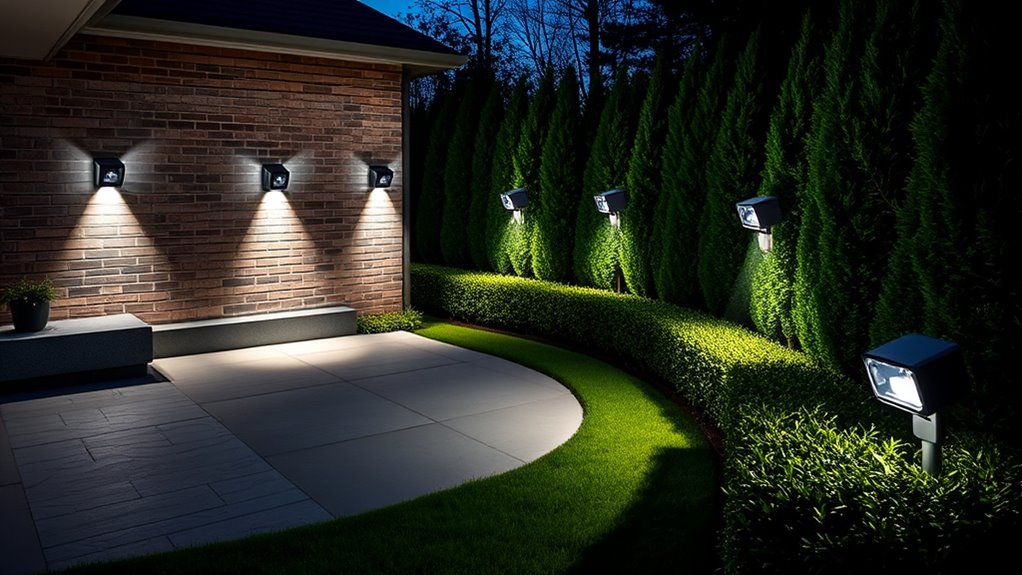

Outdoor motion sensor lights fall into two camps that shape every buying decision here: solar models that install anywhere but depend on sunlight, and hardwired flood lights that deliver serious, reliable brightness but require wiring and an electrical connection. My top pick overall is the LUTEC 72W 7500LM three-head flood light, because it pairs brute-force illumination with dusk-to-dawn automation and an IP65 housing that holds up through weather. For buyers who want to skip an electrician entirely, the Tuffenough 2500LM solar lights with remote control offer the best mix of brightness and convenience in the solar group, while the HMCITY 120 LED six-pack is the easiest way to cover a fence line or driveway on a budget. The main tradeoffs to weigh are brightness consistency versus installation freedom, detection range, and whether you need one powerful fixture or many smaller ones. Read on for the full breakdown.

Turn quiet afternoons into listening time
- Thousands of audiobooks, podcasts and originals
- Listen on your phone, tablet or Echo — also offline
- Cancel anytime
Complete the kit


Key Takeaways
- Hardwired LED flood lights (LUTEC 72W, 45W dual-head models) consistently outperform solar picks on raw brightness and reliability, but they demand electrical work — that tradeoff drives most of the ranking.
- The solar group splits sharply between small 120-LED wall lights meant for multi-pack coverage and 2500LM three-head solar flood lights (Tuffenough, MIHANI, Daphino) that compete with wired output on sunny days.
- Duplicate and near-identical listings appeared in this category — two LUTEC 72W entries and two 45W 5500LM dual-head models — a sign to verify seller and warranty details before ordering.
- Dusk-to-dawn capability showed up on every hardwired pick but only some solar picks; buyers who want lights that stay dimly active all night should check mode options, not just lumens.
- Multi-packs (HMCITY, Aootek, generic 6-packs) win on per-fixture value for perimeter coverage, while single high-output fixtures win for targeted zones like garage doors and dark side yards.






| motion sensor lights outdoor | Brightness | Color Temperature | Detection Angle |
|---|---|---|---|
| Nipify Solar Lights Outdoor Wa | 1000 lumens | — | — |
| LEPOWER Hardwired LED Security | 4000 lumens | — | 180° |
| LUTEC 72W 7500LM LED Security | 7500 lumens | 5000K daylight | — |
| 45W 5500LM PIR Motion Sensor O | — | 5000K daylight | 180° |
| LUTEC 32W 3500 Lumen LED Secur | 3500 lumens | 5000K daylight | — |
| HMCITY 120 LED Outdoor Solar L | — | — | — |
| Aootek Solar Motion Sensor Lig | — | — | 120 degrees |
| Tuffenough Solar Outdoor Light | 2500 lumens | — | 270° |
| 6 Pack Solar Motion Sensor Out | — | 6500 Kelvin | 120° |
| LEPOWER LED Security Light wit | 7000 lumens | 5700 Kelvin | 180° |
| 45W 5500LM PIR Motion Sensor O | 5500LM | 5000K daylight | 180° |
| LUTEC 72W 7500LM LED Security | — | 5000K daylight | — |
| HMCITY Solar Lights Outdoor 12 | — | — | — |
| MIHANI Solar Flood Lights Outd | 2500LM per light | 6500K | — |
| Daphino 2500LM Solar Lights | 2500LM per light | 6500K | 130° |
More Details on Our Top Picks
Nipify Solar Lights Outdoor Waterproof Motion Sensor Spot Landscape Light
This option stands out for one reason above all: zero wiring and zero electricity cost. With 56 LEDs, three lighting modes, and both ground-stake and wall mounting, it covers garden paths, driveways, and side yards without an electrician. Compared with the LEPOWER 40W hardwired model, it cannot match raw brightness — 1000 lumens versus 4000 — but it installs in minutes where LEPOWER requires a junction box and wiring knowledge. The tradeoff is weather dependence: cloudy days mean weaker nighttime output, and the cool white light is fixed with no color options. Unlike the HMCITY 120 LED wall lights in this roundup, the spotlight beam here is better for highlighting specific areas than washing a whole wall. This pick makes the most sense for renters and anyone who wants security lighting without touching their electrical system.
Pros:- Solar charging eliminates wiring and electricity costs
- Flexible ground-stake or wall mounting in minutes
- Three lighting modes adapt to security or ambient needs
- Waterproof housing survives year-round outdoor exposure
Cons:- Output drops after cloudy or short winter days
- 1000 lumens is modest compared with hardwired flood lights
Best for: Renters and DIY-shy homeowners who want motion-activated path or accent lighting with no electrical work
Not ideal for: Anyone securing a large driveway or dark backyard who needs reliable, full-power output every night regardless of weather
- Power Source:Solar powered
- Brightness:1000 lumens
- Light Source:56 LEDs, cool white
- Lighting Modes:3 modes
- Water Resistance:Waterproof
- Mounting:Ground insertion or wall mount
- Switch Type:Motion sensor
Our verdict“Buy this if you want easy, wire-free motion lighting for paths and landscaping; skip it if you need dependable high-output security coverage.”
LEPOWER Hardwired LED Security Lights Motion Sensor Outdoor 40W 4000LM
This model earns the top spot because it balances brightness, coverage, and price of ownership better than anything else here. At 4000 lumens with a 72-foot detection range and adjustable heads, it handles the typical two-car driveway or backyard without the overkill — and electrical cost — of the LUTEC 72W unit at 7500 lumens. The aluminum housing and IP65 rating mean it shrugs off storms, a step up from the plastic-bodied solar options like the Nipify spotlight. The honest tradeoff: lighting duration is capped at 1, 5, or 10 minutes after activation, so it is a motion-only security light rather than an all-night porch light. Installation also assumes a junction box and basic wiring comfort. Compared with the dual-head 45W PIR model later in this list, this one offers longer reach (72 ft vs 69 ft max) and a longer track record in the category.
Pros:- 4000 lumens with energy-efficient LED technology
- 72-foot detection range with adjustable heads and sensor
- Durable weather-resistant aluminum build
- 50,000-hour rated LED lifespan
Cons:- Timer limited to 1, 5, or 10 minute bursts — no always-on mode
- Hardwired installation demands basic electrical skills
- Sensor sensitivity requires fine-tuning to avoid false triggers
Best for: Homeowners who want a dependable, bright hardwired security light for a driveway, garage, or large yard
Not ideal for: Renters or anyone without an existing junction box, since hardwiring is required
- Power:40W
- Brightness:4000 lumens
- Sensor Range:72 feet
- Detection Angle:180°
- Water Resistance:IP65
- Housing:Aluminum
- Lifespan:50,000 hours
Our verdict“The best all-around choice for a permanently installed, high-output motion light that most homes can actually use.”
LUTEC 72W 7500LM LED Security Lights Motion Sensor Light Outdoor, 5000K Daylight, IP65, Dusk to Dawn, 3-Head Flood Light
When a single flood light has to cover a long driveway, barn approach, or deep backyard, this is the one that delivers. At 7500 lumens across three adjustable heads, it nearly doubles the output of the LEPOWER 40W pick — the difference between seeing a visitor and identifying a face at distance. The dusk-to-dawn option also matters here: unlike LEPOWER’s 10-minute timer ceiling, this unit can run a low ambient mode all night and spike to full brightness on motion. The cost of that power is literal — a 72W draw when active — plus a bulkier fixture and an installation that leans technical. Like the 45W dual-head PIR light, it is hardwired and outdoor-only, and real-world detection range can fall short of the listed 69 feet when rain or fog interferes. Choose it when coverage area, not subtlety, is the priority.
Pros:- 7500 lumens from three adjustable heads for wide coverage
- Dusk-to-dawn mode plus motion-triggered full brightness
- IP65 waterproof housing rated for harsh weather
- Claims up to 88% energy savings versus halogen equivalents
Cons:- Highest power draw in this lineup when fully lit
- Installation is more involved than smaller two-head units
- Detection range varies with weather and environmental conditions
Best for: Owners of large rural or suburban properties who need serious, wide-area illumination and want dusk-to-dawn capability
Not ideal for: Small townhouse lots or anyone sensitive to glare — 7500 lumens will overpower neighbors and compact spaces
- Power:72W
- Brightness:7500 lumens
- Color Temperature:5000K daylight
- Sensor Detection Range:0–69 ft adjustable
- Water Resistance:IP65
- Voltage:120V hardwired
- Lifespan:50,000 hours
- Modes:Dusk to dawn, motion, multiple modes
Our verdict“The right pick when maximum, all-night-capable coverage matters more than size or energy frugality.”
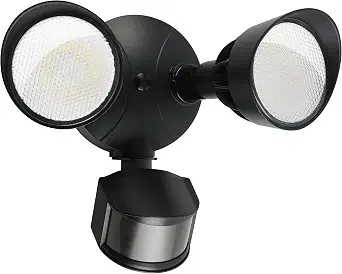
45W 5500LM PIR Motion Sensor Outdoor LED Flood Light, Dual Head, Daylight 5000K, IP65 Waterproof
This dual-head flood light occupies the sweet spot between the LEPOWER 40W and the LUTEC 72W: 5500 lumens is plenty for a two-car garage or side yard without paying the energy and glare penalty of the bigger unit. Its standout feature is tunable detection distance — 20, 39, or 69 feet — which lets you shrink the trigger zone so passing cars or the neighbor’s dog do not set it off constantly, a finer degree of control than LEPOWER offers out of the box. The three-year warranty is also the longest protection in this batch. The tradeoffs are familiar for hardwired units: you need a junction box and comfort with wiring, and the two heads cover less total area than LUTEC’s three-head design. For buyers who found 4000 lumens slightly light but 7500 excessive, this is the logical middle step.
Pros:- 5500 lumens balanced against efficient 45W draw
- Selectable detection distance of 20/39/69 ft cuts false triggers
- Dual adjustable heads aim light precisely where needed
- Three-year warranty is the longest in this lineup
Cons:- Hardwired installation may be complex for non-DIYers
- Two heads cover less area than three-head competitors
Best for: Homeowners upgrading a garage or yard who want more punch than a 40W light but not the cost of a 72W flagship
Not ideal for: Anyone unwilling to hardwire — there is no solar or plug-in option here
- Power:45W
- Lumen Output:5500LM
- Color Temperature:5000K daylight
- Detection Angle:180°
- Detection Distance:20 / 39 / 69 ft selectable
- Water Resistance:IP65
- Service Life:50,000 hours
- Warranty:3 years
Our verdict“The smart middle choice for buyers who want serious brightness with finer motion control than the category standard.”
LUTEC 32W 3500 Lumen LED Security Light with Motion Sensor, Waterproof, Dusk to Dawn, Black
At 9.21 by 6.5 inches and 3500 lumens, this is the most compact hardwired option in the roundup, built for spots where a big three-head fixture would look and feel wrong — a porch, side door, or narrow townhouse entry. Compared with its sibling, the LUTEC 72W 7500LM model, it trades half the brightness for a smaller footprint, lower energy use, and a less industrial appearance. It keeps the useful features: dusk-to-dawn mode, adjustable detection range, and an aluminum weatherproof body. The limitations are real, though — the sensor’s reach is shorter than large-area lights, so it should not be your first line of defense across a long driveway, and the manual override mode takes careful operation to engage correctly. Installation needs a junction box like the others here. This model is better suited to supplemental lighting around entries than primary perimeter security.
Pros:- Compact 9.21in x 6.5in footprint suits tight mounting spots
- Dusk-to-dawn and motion modes in one fixture
- Durable aluminum weatherproof construction
- Energy-efficient 32W draw with up to 88% claimed savings
Cons:- Detection range is limited for very large areas
- Requires a junction box for installation
- Manual override mode can be finicky to operate
Best for: Homeowners who want a discreet, tidy motion light for a porch, side door, or entryway where a large fixture won’t fit
Not ideal for: Covering large yards or driveways — the detection range and 3500 lumen output fall short at distance
- Wattage:32W
- Brightness:3500 lumens
- Color Temperature:5000K daylight
- Dimensions:9.21in x 6.5in
- Material:Aluminum
- Water Resistance:Waterproof
- Modes:Dusk to dawn, motion sensor, multiple modes
Our verdict“The pick for entryways and small spaces that need reliable motion lighting without a bulky flood light.”
HMCITY 120 LED Outdoor Solar Lights with Motion Sensor and 3 Lighting Modes, IP65 Waterproof, 6-Pack, Black
This six-pack earns its place as the go-to option for lining long pathways and garden borders, where you need coverage from several small fixtures rather than one powerful light. The three lighting modes — full brightness on trigger, dim-to-bright, and constant medium — give useful flexibility: the dim mode works well near bedrooms where sudden full-power flashes at night get annoying. Compared with the Tuffenough two-pack, each HMCITY unit is far less bright, but six mounting points spread light more evenly along a walkway than two concentrated floods ever could. The 30% efficient solar panels charge reasonably fast, though like all solar fixtures, shaded north-facing walls will leave you with weak winter performance. Build quality is ABS plastic rather than aluminum, so these feel lighter-duty than hardwired options like the LEPOWER flood light.
Pros:- Six fixtures cover long perimeters economically
- Three modes including dim-to-bright for bedroom-adjacent walls
- IP65 waterproofing handles rain and snow
- Screw-mount installation needs no wiring
Cons:- Plastic construction is less durable than aluminum hardwired lights
- Charging drops off sharply in cloudy weather or shade
Best for: Homeowners who want to illuminate a long driveway, fence line, or garden path with multiple evenly spaced lights
Not ideal for: Anyone needing serious security-grade brightness for a dark backyard — these are accent and wayfinding lights, not deterrents
- Number of LEDs:120
- Lighting Modes:3
- Material:ABS plastic
- Solar Panel Efficiency:30%
- Battery Type:Rechargeable
- Package Quantity:6
Our verdict“Buy this set if your priority is lighting a long stretch of outdoor space with several modest fixtures rather than blasting one area with a floodlight.”
Aootek Solar Motion Sensor Lights Outdoor 120 LEDs, Black, 6 Pack
The Aootek six-pack is the lowest-commitment way to try motion lighting across a whole property, and its compact 4.13 x 2.75-inch footprint means it disappears on fences and posts where bigger fixtures would look clunky. Its standout trick is smart brightness mode, which keeps a low glow all evening and surges when the 120-degree sensor catches movement — a behavior the HMCITY six-pack also offers, but Aootek’s monocrystalline silicon panel and lithium-ion battery pairing tends to hold output more consistently after short winter days. The tradeoff is modest overall brightness; the 149-LED generic six-pack claims 800 lumens per unit, which outpaces these small panels. A 26-foot detection range is fine for doorways but falls short for wide driveways. Plan on 6–8 hours of direct sun, so avoid mounting under eaves or heavy tree cover.
Pros:- Compact size mounts neatly on fences and posts
- Smart brightness mode balances ambiance and security
- Monocrystalline panel charges efficiently
- Six units allow whole-perimeter coverage
Cons:- Per-unit brightness trails larger solar fixtures
- Needs 6-8 hours of direct sun daily for reliable output
Best for: First-time buyers or renters who want to experiment with motion lighting on a fence, shed, or side gate without wiring or a big spend
Not ideal for: Properties with shaded mounting spots or large open areas — the small panels and modest range won’t keep up
- Number of LEDs:120
- Solar Panel:1.2W Monocrystalline silicon
- Detection Range:26 feet
- Detection Angle:120 degrees
- Battery Type:Rechargeable lithium-ion
- Dimensions:4.13 x 2.75 inches
- Pack Size:6
Our verdict“This is the sensible first purchase for anyone unsure where motion lighting will help most — cheap enough to place liberally, capable enough to matter.”
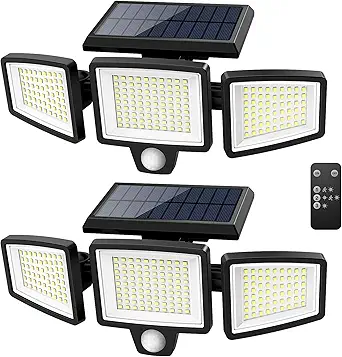
Tuffenough Solar Outdoor Lights 2500LM 210 LED Security Lights with Remote Control, 3 Heads Motion Sensor, IP65 Waterproof, 270° Wide Angle Flood Wall Lights (2 Pack)
For buyers who want real security-floodlight output without running wiring, this is the strongest solar option in the lineup. At 2500 lumens with three adjustable heads and a 270-degree detection arc, it covers corners and wide garages in a way the smaller Aootek and HMCITY six-packs simply cannot match — one of these does the work of several path lights. The included remote is a genuine convenience the competing MIHANI solar flood doesn’t offer, letting you switch modes from the ground instead of climbing a ladder. The catch is placement sensitivity: the sensor performs best mounted 6.5–8 feet up, and the 1800mAh battery needs several sunny days before it hits full stride. Compared with the hardwired LEPOWER 58W, brightness is still in a different league — but that one needs an electrician or confident DIY wiring.
Pros:- 2500 lumens rivals low-end hardwired floods
- 270° adjustable coverage handles corners and wide walls
- Remote control avoids ladder trips for mode changes
- Two fixtures in the box cover front and back of a house
Cons:- Sensor performance depends heavily on correct 6.5–8 ft mounting height
- Battery requires multiple sunny days to fully charge initially
Best for: Homeowners who need serious brightness over a garage, driveway, or dark side yard but can’t or won’t run electrical wiring
Not ideal for: Very shady properties or those wanting single-fixture whole-yard coverage — battery limits and solar dependence cap runtime
- Brightness:2500 lumens
- LED Count:210
- Detection Angle:270°
- Sensing Distance:26 feet
- Battery Capacity:1800mAh
- Remote Control:Yes
- Lighting Modes:3
- Pack Size:2
Our verdict“If wiring isn’t an option but floodlight-level brightness is non-negotiable, this two-pack is the most capable solar route here.”
6 Pack Solar Motion Sensor Outdoor Lights, Waterproof Security Wall Lights with 3 Modes for Yard, Fence, Garage, Deck, Garden
This six-pack sits in a useful middle ground: with 149 LEDs and a claimed 800 lumens per fixture at a crisp 6500K daylight tone, each unit is noticeably brighter than the 120-LED HMCITY and Aootek sets, yet the set still costs less per mounting point than buying floodlights. The daylight color temperature also does more for visibility and camera footage than the warmer tones some competitors default to. A two-year warranty is a meaningful confidence signal that most budget solar brands skip. The honest tradeoff: battery capacity isn’t published, which makes runtime claims hard to verify, and there’s no remote or smart features — everything is controlled by the mode button, unlike the Tuffenough with its remote. Detection tops out around 26 feet at 120 degrees, so space fixtures accordingly on long fences rather than expecting one to cover a wide yard.
Pros:- 800 lumens per unit outshines typical 120-LED six-packs
- 6500K daylight tone improves visibility and camera footage
- Two-year warranty exceeds most budget solar brands
- IP65 build with flexible mounting options
Cons:- Battery capacity is unspecified, so runtime is unverified
- No remote control or app connectivity
Best for: Buyers who want six mounting points with genuinely bright output — decks, garages, and fences where each light needs to pull real weight
Not ideal for: Anyone who wants remote control, smart home integration, or verified battery specs before buying
- Light Output:800 lumens
- LED Quantity:149
- Color Temperature:6500 Kelvin
- Detection Range:26 feet
- Detection Angle:120°
- Water Resistance:IP65
- Mounting Type:Wall Mount
- Warranty:2 Years
Our verdict“The strongest choice when you need a six-light layout but refuse to accept dim, decorative-level output at each point.”
LEPOWER LED Security Light with Motion Sensor, Waterproof Outdoor Flood Light
When solar simply isn’t serious enough, this 58W hardwired flood delivers 7000 lumens on demand, every time, regardless of weather — a reliability argument no solar option in this lineup can answer. The 72-foot sensor range dwarfs the 26-foot detection of the Tuffenough and every six-pack here, meaning it triggers before a visitor reaches your driveway, not after. Three adjustable heads let you aim light exactly where it’s needed, and the aluminum housing will outlast the plastic builds of the HMCITY and Aootek sets by years. The costs are equally clear: installation requires 120V wiring, which means an electrician for most people, the max lighting duration caps at 10 minutes per activation, and there’s no battery backup during power outages. Compared with the similar LUTEC 72W hardwired lights elsewhere in this guide, this LEPOWER holds its own on output and sensor reach.
Pros:- 7000 lumens with reliable output regardless of sunlight
- 72-foot detection range leads the entire lineup
- Durable aluminum construction with IP65 rating
- Three adjustable heads enable precise light aiming
Cons:- Hardwired installation may require an electrician
- No battery backup during power outages
Best for: Homeowners who want maximum, weatherproof-independent brightness for a driveway, garage, or yard and are comfortable with a wired installation
Not ideal for: Renters or DIY-averse buyers — the 120V hardwired requirement makes it impractical without professional help
- Brightness:7000 lumens
- Power:58W, 120V corded electric
- Sensor Range:72 feet
- Detection Angle:180°
- Color Temperature:5700 Kelvin
- Light Sources:3 adjustable heads
- Material:Aluminum
- Water Resistance:IP65
- Certifications:FCC Listed & ETL Listed
Our verdict“If you can handle the wiring, this is the set-and-forget choice for buyers who refuse to compromise on brightness or weather reliability.”
45W 5500LM PIR Motion Sensor Outdoor Lights, Dual Head LED Flood Light
This dual-head flood light hits a practical middle ground between the LEPOWER 40W hardwired model and the beefier LUTEC 72W. At 5500 lumens, it delivers enough punch to cover a two-car driveway or garage wall without the glare and energy draw of a 72W unit, and the three selectable detection distances (20, 39, or 69 feet) let you tune it so passing cars don’t trigger it constantly. The rotatable dual heads are the real selling point: unlike fixed single-head lights, you can aim one head at a walkway and the other at a side gate. The tradeoff is setup effort — the mode dip switches take some trial and error, and hardwiring means anyone uncomfortable with electrical work will need an electrician, whereas solar options like the HMCITY 2-pack mount in minutes.
Pros:- Adjustable detection distance prevents false triggers from street traffic
- Dual rotatable heads cover two zones from one fixture
- Aluminum housing with IP65 rating survives harsh weather better than plastic rivals
- Bright 5500 lumens with efficient 45W draw
Cons:- Mode settings require fiddly initial calibration
- Hardwired installation is a barrier for DIY beginners
Best for: Homeowners with an existing junction box who want serious, tunable coverage for a garage, driveway, or backyard without paying for 72W of output
Not ideal for: Renters or anyone without hardwiring experience — installation requires electrical work and mode calibration
- Power:45W
- Brightness:5500LM
- Color Temperature:5000K daylight
- Detection Angle:180°
- Detection Distance:20/39/69ft (adjustable)
- Material:Aluminum
- Service Life:50,000 hours
Our verdict“The sweet spot for buyers who want hardwired power and precision tuning without stepping up to the LUTEC 72W’s intensity.”
LUTEC 72W 7500LM LED Security Lights Motion Sensor Light Outdoor, 3-Head Flood Light
When brightness is the priority, this is the ceiling of the roundup. The 7500-lumen output outshines the 45W dual-head flood light by roughly 35%, and the third head fills the coverage gap that two-head designs leave directly beneath the fixture — a real advantage when mounting on a tall garage wall above a door. It also claims up to 88% energy savings versus halogen equivalents, which matters for a light this powerful running nightly. Compared with solar options like the MIHANI solar floods, it never dims on cloudy days, but that reliability comes at a cost: professional installation is recommended for optimal aiming and wiring, and sensitivity adjustments take patience to get right. Overkill for a porch; ideal for a large yard or dark driveway.
Pros:- Highest hardwired brightness in this lineup at 7500 lumens
- Three adjustable heads eliminate the dead zone under the fixture
- Reliable all-weather performance independent of sunlight
- Dusk-to-dawn modes give flexible security options
Cons:- May require professional installation for safe, well-aimed setup
- Motion sensitivity tuning can be finicky out of the box
Best for: Owners of large properties, long driveways, or poorly lit side yards who need industrial-strength, weatherproof illumination on demand
Not ideal for: Small patios or townhouse settings where 7500 lumens will annoy neighbors and feel excessive
- Wattage:72W
- Lumens:7500LM
- Color Temperature:5000K daylight
- Detection Range:Up to 69 feet
- Sensing Angle:180 degrees
- Lifespan:50,000 hours
Our verdict“Buy this if raw, grid-powered illumination across a wide area matters more than install convenience.”
HMCITY Solar Lights Outdoor 120 LED with 3 Lighting Modes, 2-Pack
For anyone new to motion-sensor lighting, this 2-pack is the easiest entry point in the roundup. There’s no wiring whatsoever — unlike the hardwired LUTEC 32W or the 45W flood lights — so it mounts with basic screws in under an hour. The monocrystalline solar panel at 20.5% efficiency outperforms the polycrystalline panels on budget solar lights, and the three modes (motion-only, always-on, and a dim-to-bright smart mode) give beginners a gentle learning curve. Compared with the MIHANI solar floods, coverage is broader per unit at 270°, but per-light brightness is lower, so it works best as ambient security along fences and pathways rather than primary flood lighting. Placement matters: a north-facing wall will leave these undercharged and dim by morning.
Pros:- Zero-wiring installation makes it the most accessible option here
- High-efficiency monocrystalline panel charges better in low light
- Three modes including a practical dim-to-bright smart option
- IP65 weather resistance holds up across seasons
Cons:- Brightness drops noticeably after cloudy days
- Finding the right sun-exposed placement takes some trial and error
Best for: Renters, DIY beginners, and anyone wanting low-commitment perimeter lighting along fences, sheds, and garden paths
Not ideal for: Anyone replacing a hardwired flood light — solar output here won’t match the 5500+ lumen hardwired options for driveways
- Number of LEDs:120 per light
- Lighting Modes:3 (motion sensor, always on, smart brightness)
- Solar Panel:Monocrystalline silicon, 20.5% efficiency
- Coverage Area:Up to 30㎡
- Lighting Angle:270° wide angle
- Material:High-impact ABS plastic
- Package:2-pack
Our verdict“The least intimidating way to add motion-triggered lighting around a property without touching a wire.”
MIHANI Solar Flood Lights Outdoor, 2500LM Motion Sensor Security Lights, 3 Heads, 2 Pack
This option stands out for bringing true flood-light output to a solar design. At 2500 lumens per unit, it delivers illumination that actually competes with lower-wattage hardwired lights, unlike the gentler HMCITY 2-pack, and the 270° three-head spread wraps light around corners that single-panel solar lights miss. The tempered-glass solar panel claims 30% energy conversion, which helps offset the higher output, and tool-free mounting keeps installation to a screwdriver job. Compared with the similar Daphino 2500LM 3-head lights, this one trades a longer 40-foot detection range for a shorter 30-foot range but gains the wider 270° coverage angle. The catch: no remote control, so mode changes mean climbing back up a ladder — a real annoyance versus the Tuffenough remote-equipped competitor.
Pros:- 2500 lumens rivals entry-level hardwired flood lights
- 270° coverage with three independently adjustable heads
- High-efficiency tempered glass solar panel
- Tool-free installation with included hardware
Cons:- No remote control, making mode changes inconvenient after mounting
- Requires direct sun exposure to sustain full brightness
Best for: Budget-conscious homeowners who want driveway or backyard flood coverage without paying an electrician
Not ideal for: Very large properties — two units won’t blanket a big yard, and buyers needing remote adjustments should look elsewhere
- Brightness:2500LM per light
- Color Temperature:6500K
- Number of Heads:3
- Illumination Angle:270° wide angle
- Sensor Range:30 feet
- Solar Panel:Tempered glass, 30% conversion efficiency
- Material:ABS
Our verdict“The strongest argument for skipping an electrician when you need real flood-light punch on a solar budget.”
Daphino 2500LM Solar Lights, 3-Head Outdoor Motion Sensor Lights, 2 Pack
What separates this pick from the nearly identical MIHANI 3-head solar floods is detection and endurance. The 40-foot sensor range reaches a full third farther, catching movement at the edge of a driveway before someone is already at your door, and the 12-hour runtime on its lithium-ion battery means it stays functional through long winter nights when shorter-lived solar lights fade by 2 a.m. The 156-LED array behind its 2500 lumens also produces a more even, less spotty beam than lower-LED-count rivals. Tradeoffs mirror the category: no remote for mode changes, and the 130° detection angle is narrower than the MIHANI’s 270° illumination spread, so aiming the sensor heads correctly at installation matters more here. Mounting height also affects how well the sensor performs — too high and range shrinks.
Pros:- 12-hour runtime outlasts most solar competitors overnight
- 40-foot detection range triggers earlier than typical solar lights
- 156 LEDs create even, consistent illumination
- Three modes including a dim ambient option with motion boost
Cons:- Narrower 130° detection angle demands precise aiming at installation
- No remote control for adjusting modes after mounting
Best for: Homeowners in northern climates or anyone needing security lighting that lasts through long nights without recharging gaps
Not ideal for: Buyers who want the widest possible detection zone — the 130° sensor angle requires more careful aiming than wider rivals
- Brightness:2500LM per light
- LED Count:156
- Color Temperature:6500K
- Number of Heads:3
- Detection Range:40 feet
- Detection Angle:130°
- Battery:3.7V rechargeable lithium-ion
- Runtime:Up to 12 hours
- Material:ABS + PC
Our verdict“The solar pick for buyers who prioritize long runtime and early detection over maximum coverage width.”

How We Picked
I evaluated these fifteen options against the factors that actually decide satisfaction with outdoor motion lighting: real brightness output measured in lumens, detection range and coverage angle, weatherproofing (IP65 was the baseline for anything mounted outdoors year-round), and installation burden. Hardwired and solar fixtures were judged on slightly different curves — a solar light can’t match a 7500-lumen flood light, so it had to earn its place through convenience, coverage flexibility, and how well it performs after a cloudy day.
Ranking logic was straightforward: fixtures that deliver dependable light where and when you need it rank highest, which favors the high-output wired LUTEC and dual-head models at the top. Solar picks are ordered by output and feature set, with the remote-controlled 2500LM three-head units ahead of the basic 120-LED wall lights. Multi-packs rank as value plays rather than overall winners, and near-duplicate models are grouped and differentiated so you can spot the actual differences instead of buying the same light twice.
Factors to Consider When Choosing Motion Sensor Lights Outdoor
Choosing between outdoor motion sensor lights comes down to matching the fixture to the space, your tolerance for installation work, and how much light the area actually needs. These are the factors that separate a satisfying purchase from a return.Solar vs. Hardwired: The Core Decision
Everything else in this category is secondary to the power source question. Hardwired fixtures deliver consistent output every night regardless of weather, and the 72W and 45W models in this lineup can light an entire yard — but they need an existing junction box, electrical knowledge, or an electrician, which adds real cost. Solar fixtures install in minutes with two screws and cost nothing to run, but their output drops after overcast days, and batteries degrade over a few seasons. A common mistake is buying solar for a north-facing wall or a shaded side yard that never gets the 6-8 hours of direct sun these panels need. If your mounting spot gets poor light, a low-lumen solar fixture will frustrate you no matter how good its features look on paper. Many households end up with a hybrid setup: one hardwired flood over the garage and solar wall lights along fences and walkways.
Lumens, Not LED Counts
Marketing in this category leans heavily on LED counts — “120 LEDs” sounds impressive but tells you almost nothing about actual light output. Lumens are the number that matters: a 120-LED solar wall light typically produces a fraction of the output of a single 3500-lumen wired security light. For context, a porch or pathway needs roughly 300-700 lumens, a driveway or side yard benefits from 1500-2500, and a large backyard or commercial-adjacent garage wall justifies 5500-7500. Overbuying is a real problem too — a 7500-lumen fixture pointed at a neighbor’s window or your own bedroom is a fast way to create conflict and sleepless nights. Match the output to the zone, and remember that adjustable heads let one fixture do the work of two by aiming light precisely where it’s needed.
Detection Range, Angle, and Sensor Quality
The sensor determines whether the light feels responsive or useless. Look at three specs: detection range (how far away movement triggers the light — 30-70 feet is typical), detection angle (wider angles catch activity from more directions, which is why three-head designs with 270° coverage outperform single-head units on corners), and adjustability, meaning whether you can aim the sensor independently of the light heads. Cheaper fixtures couple the sensor to the lamp head, forcing you to compromise between where light shines and where motion is detected. Also check whether the sensitivity and timeout are adjustable — a light that stays on for ten minutes every time a cat walks by will annoy you and drain a solar battery fast. Dusk-to-dawn modes add flexibility by keeping a low ambient glow all night and boosting to full brightness on motion.
Weatherproofing and Mounting Durability
An IP65 rating is the practical floor for anything facing rain, snow, and direct sun, and every pick in this roundup meets it — but ratings don’t tell the whole story. Build quality determines lifespan: sealed lens seams, UV-resistant plastic or metal housings, and gasketed battery compartments are what separate fixtures that last five years from ones that fog up after one winter. Solar models add a second vulnerability — the battery is usually the first component to fail, and not all brands use replaceable cells, which effectively makes the battery the lifespan of the whole unit. Check the mounting surface too: heavy three-head flood lights need solid backing on soffit, siding, or a junction box, while lightweight solar puck lights can go on almost any fence post or gutter line. If you live in a coastal area, metal fixtures and stainless hardware resist corrosion far better than painted steel.
Single Fixture vs. Multi-Pack Coverage
The biggest strategic mistake buyers make is thinking in fixtures instead of zones. One powerful flood light over the garage does nothing for a dark back gate 80 feet away, and six small solar lights spread thin can leave gaps that a single well-placed 270° fixture would cover. Map your property at night and note where you actually walk and where blind spots sit before deciding quantity. Multi-packs like the six-light solar sets work best for linear coverage — fences, deck perimeters, driveway edges — where each light handles a small radius. Single high-output fixtures excel at choke points: garage doors, side yards, and rear entries where one blast of 5000+ lumens covers everything. Mode flexibility matters more with packs, since you’ll want dim-all-night settings near bedrooms and motion-only settings on remote fence lines.
Watch for Duplicates and Price-Fluctuating Listings
This roundup surfaced an issue worth knowing about: identical or near-identical products listed under multiple brand names, a pattern common in the motion light category where generic factories sell the same housing to several sellers. The two 45W 5500LM dual-head entries and the repeated LUTEC 72W listing in this comparison are examples — before buying, compare warranty terms, return policies, and seller responsiveness, since those differ even when the hardware doesn’t. Solar listings in particular churn through this cycle, with products disappearing and reappearing under new names, which matters for replacement parts and support months later. Favor listings from established brands with consistent product pages, and screenshot the spec sheet when you order so you have a record if a listing changes. A slightly higher price from a stable seller usually beats the cheapest duplicate with no support behind it.
Frequently Asked Questions
Are solar motion sensor lights bright enough to actually secure my property?
It depends on the solar model and your expectations. The 2500LM three-head solar units in this roundup (Tuffenough, MIHANI, Daphino) produce enough light to startle intruders and illuminate a driveway, but they still trail hardwired 5500-7500LM fixtures — and their output drops noticeably after cloudy days or short winter daylight. The smaller 120-LED wall lights are better described as convenience and deterrence lighting than security lighting; they help you see the walkway, but they won’t flood a yard. If genuine security coverage is the priority, hardwired is still the answer. Solar works best as a complement — filling gaps along fences and gates where running wire isn’t practical.
Can I install a hardwired motion light myself, or do I need an electrician?
If you’re replacing an existing exterior light and the junction box is already there, swapping in a hardwired LED security light is a reasonable DIY job for anyone comfortable shutting off the breaker and wiring three connections — the LUTEC and dual-head models in this lineup include the mounting hardware and instructions for exactly this scenario. If there’s no existing wiring at the mounting spot, the calculus changes: running new cable through walls, adding a box, and meeting code typically justifies an electrician, and that cost can exceed the light itself. Old homes with degraded wiring or aluminum conductors are another situation where professional installation is the safer call. Budget for that possibility before committing to a high-output wired fixture.
Why do some of these listings look identical? Which one should I buy?
Several models in this category — including the duplicated 45W 5500LM dual-head lights and repeated LUTEC listing here — come from the same manufacturing runs sold under different brand labels. The hardware is often interchangeable, so the differentiators are the seller’s warranty length, return process, and whether customer support responds after the sale. Check who fulfills the order, whether the listing has remained stable over time, and what the warranty actually covers, since battery and LED failures after month three are where support quality shows. When two duplicates are otherwise equal, choose the one with the longer written warranty and established product page. Price alone is a poor tiebreaker on identical hardware.
What do the different lighting modes on solar lights actually do?
Most solar lights in this roundup offer three modes: motion-only (full brightness when triggered, otherwise off — best for battery life and remote areas), dim-to-bright (a low glow all night that jumps to full output on detection — best near entryways where you want constant orientation), and some variation of medium or constant output. The mode choice affects runtime more than most buyers expect: a light running dim-all-night mode may only reach partial brightness on triggered motion during winter, because the battery is already partially drained. Near bedrooms, motion-only avoids the glow that some homeowners find annoying through curtains. For fence lines and back gates far from outlets, motion-only maximizes reliability when you need it most.
How high and where should I mount outdoor motion sensor lights?
Most hardwired flood lights perform best mounted 8-10 feet high, which puts the sensor’s detection pattern at the right angle to catch people approaching rather than passing directly beneath — mounting too high shrinks effective detection range, and too low means the sensor triggers on raccoons and passing feet. Aim the sensor slightly away from paths where cars or pedestrians constantly pass, or you’ll get false triggers all night. For solar lights, sun exposure should override height concerns: a 6-foot fence post in full sun will outperform a shaded 9-foot wall mount every time. Avoid pointing any motion light directly at a neighbor’s property line, both to prevent disputes and because reflected light can cause feedback triggering on some models. Corner placements with wide-angle three-head fixtures give the best coverage per fixture.
Conclusion
The right pick here depends less on which light is objectively best and more on what your property and installation situation allow. For best overall, the LUTEC 72W 7500LM three-head flood light is the strongest combination of output, coverage, and durability in the lineup — provided you have wiring at the mounting spot. The best value goes to the HMCITY 120 LED six-pack, which covers an entire perimeter for the price of one wired fixture. For a premium setup, the Tuffenough 2500LM solar flood lights with remote control deliver near-wired performance with adjustable convenience and no electrician. Beginners should start with the Aootek or HMCITY solar wall lights — two screws, zero wiring, and an easy way to learn where your property actually needs light before investing in bigger fixtures. For targeted security at a garage or side yard, the 45W 5500LM dual-head wired models hit a sweet spot of focused power and simpler mounting than the three-head flagship. And if you’re covering long fence lines on a budget, the generic six-pack solar sets fill that role at the lowest per-fixture cost. Whichever route you take, map your dark zones first — the best fixture in the wrong location loses to a modest one placed well.
Evergreen bestsellers Picks

De'Longhi Classic Signature Espresso Machine with Adjustable Milk Frother

Ninja Foodi DZ401 DualZone XL Air Fryer, 10 Qt, 6-in-1, Grey

Hisense 43-Inch R6 Series 4K UHD Smart Roku TV (43R6G)
As an affiliate, we earn on qualifying purchases.