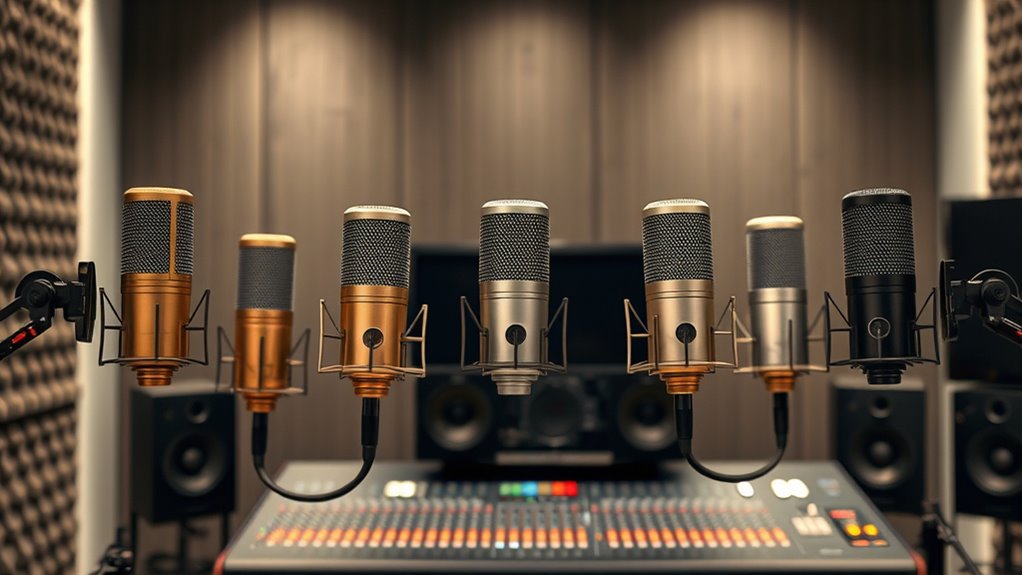

When selecting a condenser microphone for studio recording, the goal is to find a device that captures vocals and instruments with clarity and warmth. The RØDE NT1 Signature Series stands out as the best overall due to its quiet operation and detailed sound. For those on a budget, the MAONO A04 Gen2 offers impressive versatility with USB and XLR options, making it ideal for beginners. The main tradeoffs in this category revolve around budget constraints versus sound quality, durability, and ease of use. Keep reading for a detailed comparison of these top contenders and how they fit different recording needs.
Complete the kit

Key Takeaways
- The RØDE NT1 consistently delivers superior noise floor and clarity, making it ideal for professional studio work.
- Budget options like the MAONO A04 provide excellent value, especially for podcasters and home studio setups.
- Build quality and included accessories vary widely, influencing overall value and usability.
- Some microphones excel in versatility, offering both USB and XLR connections, which is great for multi-purpose use.
- Choosing the right polar pattern and frequency response depends heavily on the intended recording environment and application.
| RØDE NT1 Signature Series Large-Diaphragm Condenser Microphone with Shock Mount, Pop Filter, and XLR Cable (Black) |  | Best Overall for Professional Studio Quality | Type: Large-diaphragm condenser | Polar Pattern: Cardioid | Self-Noise: 4 dBA | VIEW ON AMAZON | See Our Full Breakdown |
| Mackie EM-Series Large-Diaphragm Condenser Microphone (EM-91C) |  | Best for Durable, Studio-Quality Sound on a Budget | Connectivity Technology: XLR | Polar Pattern: Unidirectional | Audio Sensitivity: 78 db | VIEW ON AMAZON | See Our Full Breakdown |
| MAONO A04 Gen2 XLR/USB Condenser Microphone Kit for PC Podcast Recording |  | Best for Versatile Content Creation and Streaming | Connectivity: XLR, USB, USB Type-C | Sampling Rate: 192kHz/24bit | Frequency Response: 30Hz-16kHz | VIEW ON AMAZON | See Our Full Breakdown |
| Studio Microphone, Professional Cardioid XLR Condenser Recording Mic Voice Over Kit with Desktop Stand for Music, Singing, Podcasting, and Vocal Streaming |  | Best for Desktop-Based Professional Voice Overs | Type: Condenser Microphone | Polar Pattern: Cardioid | Max SPL: 130dB | VIEW ON AMAZON | See Our Full Breakdown |
| AKG Pro Audio P120 Condenser Microphone |  | Best Budget-Friendly Studio-Ready Condenser | Polar Pattern: Cardioid | Frequency Bandwidth: 20 – 20,000 Hz | Equivalent Noise Level: 19 dB-A | VIEW ON AMAZON | See Our Full Breakdown |
| MAONO PM320S Condenser PC Microphone with XLR Cable, Boom Arm, Pop Filter |  | Best Value for Versatile Setup | Power Requirement: 48V phantom power | Capsule Size: 16 mm | Frequency Response: 20 Hz – 20 kHz | VIEW ON AMAZON | See Our Full Breakdown |
| Audio-Technica AT2020 Cardioid Condenser Studio XLR Microphone |  | Best for Studio Sound Quality | Frequency Response: 20-20,000 Hz | Max SPL: 144 dB | Impedance: 100 Ω | VIEW ON AMAZON | See Our Full Breakdown |
| condenser microphone for studio | Polar Pattern |
|---|---|
| RØDE NT1 Signature Series Larg | Cardioid |
| Mackie EM-Series Large-Diaphra | Unidirectional |
| MAONO A04 Gen2 XLR/USB Condens | Cardioid |
| Studio Microphone | Cardioid |
| AKG Pro Audio P120 Condenser M | Cardioid |
| MAONO PM320S Condenser PC Micr | Cardioid |
| Audio-Technica AT2020 Cardioid | — |
More Details on Our Top Picks
RØDE NT1 Signature Series Large-Diaphragm Condenser Microphone with Shock Mount, Pop Filter, and XLR Cable (Black)
The RØDE NT1 stands out for its exceptionally low self-noise of just 4 dBA, making it ideal for capturing vocals and instruments with pristine clarity. Compared to the AKG P120, it offers a quieter background, crucial for detailed studio recordings. While the NT1 requires phantom power and is bulkier, these tradeoffs are offset by its superior sound purity and included accessories like a shock mount and pop filter, which reduce unwanted noise and enhance usability. It’s best suited for professional environments where audio quality is the top priority.
Pros:- Exceptional low self-noise perfect for studio-quality recordings
- Includes comprehensive accessories like shock mount and pop filter
- High SPL handling up to 142 dB for versatile use
Cons:- Requires phantom power, adding complexity for beginners
- Bulkier size demands dedicated space
Best for: Professional musicians, sound engineers, and serious content creators needing studio-grade recordings.
Not ideal for: Budget-conscious beginners or those with limited space, since its size and higher price might be restrictive.
- Type:Large-diaphragm condenser
- Polar Pattern:Cardioid
- Self-Noise:4 dBA
- Maximum SPL:142 dB
- Included Accessories:Shock mount, pop filter, XLR cable
- Warranty:10 years
Our verdict“This microphone is best for those who prioritize professional sound quality and are willing to invest in a robust setup.”
Mackie EM-Series Large-Diaphragm Condenser Microphone (EM-91C)
The Mackie EM-91C offers a solid balance between affordability and professional sound, delivering warm, detailed vocals and instrument recordings. Unlike the RØDE NT1, it doesn’t come with extensive accessories, but its rugged stainless steel construction and included shock mount provide durability and noise isolation essential for studio use. While it requires external power and is less versatile for live settings, it excels in controlled environments where consistent sound quality is needed without breaking the bank.
Pros:- Warm, detailed sound ideal for vocals and instruments
- Durable construction with included shock mount
- Easy to connect via standard XLR cable
Cons:- Requires external power source, limiting portability
- Limited to studio environments, not suitable for live use
Best for: Budget-conscious home studio owners and podcasters seeking reliable, high-quality recordings.
Not ideal for: Mobile recording or live performances, due to its need for phantom power and fixed studio setup.
- Connectivity Technology:XLR
- Polar Pattern:Unidirectional
- Audio Sensitivity:78 db
- Weight:0.2 kg
- Enclosure Material:Stainless steel
- Dimensions:6.1 x 1.85 x 1.85 inches
Our verdict“This mic is a smart choice for budget-conscious users who need dependable studio-quality sound without extras.”
MAONO A04 Gen2 XLR/USB Condenser Microphone Kit for PC Podcast Recording
The MAONO A04 Gen2 provides remarkable flexibility with dual XLR and USB connections, making it suitable for a wide range of recording scenarios. Its 192kHz/24bit sampling ensures high-resolution sound, comparable to more expensive studio mics like the RØDE NT1. While it’s not compatible with Xbox and needs phantom power for XLR mode, its included accessories—pop filter, shock mount, boom arm—set it apart for streamers and podcasters seeking a comprehensive setup. However, some features are limited to USB mode, which could frustrate users looking for full XLR control.
Pros:- Dual XLR and USB connectivity for maximum flexibility
- High-resolution 192kHz/24bit audio quality
- Includes essential accessories for professional recordings
Cons:- Requires phantom power for XLR mode, adding setup complexity
- Limited features in USB mode may restrict advanced control
Best for: Streamers, podcasters, and content creators who need a versatile mic for both XLR and USB use.
Not ideal for: Dedicated studio engineers or those seeking solely XLR professional-grade mics, due to some USB-specific limitations.
- Connectivity:XLR, USB, USB Type-C
- Sampling Rate:192kHz/24bit
- Frequency Response:30Hz-16kHz
- Included Accessories:Pop filter, shock mount, boom arm
- Compatible Devices:Laptop, PC, mixer, PS4/PS5, mobile
- Polar Pattern:Cardioid
Our verdict“This microphone is ideal for creators who want a flexible, high-quality solution across multiple platforms without sacrificing ease of use.”
Studio Microphone, Professional Cardioid XLR Condenser Recording Mic Voice Over Kit with Desktop Stand for Music, Singing, Podcasting, and Vocal Streaming
The Studio Microphone excels in desktop setups for voice overs, streaming, and singing, featuring a stable platform with shock mount and pop filter that minimize vibrations and noise. Unlike the RØDE NT1, it relies on external audio interfaces with 48V phantom power, which can be less convenient for beginners but offers more control over sound. Its high SPL handling of 130dB makes it suitable for loud sources, though its XLR-only connection limits portability. This model suits those who prefer a dedicated desktop voice-over setup with stability and noise reduction.
Pros:- High SPL handling prevents distortion during loud recordings
- Stable desktop setup with shock mount and pop filter
- Ideal for voice-over, streaming, and high-quality recording
Cons:- Requires external audio interface with phantom power
- XLR connection less portable and beginner-friendly
Best for: Voice-over artists, streamers, and musicians with existing audio interfaces seeking a stable, professional desktop microphone.
Not ideal for: Mobile users or beginners without audio interfaces, due to its need for phantom power and XLR connection.
- Type:Condenser Microphone
- Polar Pattern:Cardioid
- Max SPL:130dB
- Power Requirement:48V phantom power
- Includes:Desktop stand, shock mount, pop filter
- Application:Voice over, streaming, music
Our verdict“Best suited for professionals who want a stable, noise-reduced desktop microphone for voice and vocal recordings.”
AKG Pro Audio P120 Condenser Microphone
The AKG P120 provides an accessible entry point into studio recording, handling high SPLs up to 150dB and delivering clear, natural sound across vocals and instruments. Its 2/3-inch cardioid capsule offers a straightforward solution for home studios and live setups, especially compared to the more feature-rich RØDE NT1. However, with a noise level of 19 dB-A, it may introduce some background hiss in very quiet recordings. Its simple design and affordability make it a compelling choice for those starting out or needing a versatile, reliable condenser.
Pros:- Affordable price for a condenser microphone
- Handles high SPLs up to 150dB without distortion
- Versatile for studio and live use
Cons:- Limited to cardioid pattern only
- Noise level of 19 dB-A may be noticeable in quiet recordings
Best for: Beginners and budget-conscious users seeking a versatile condenser for vocals and instruments.
Not ideal for: High-end professionals or those needing ultra-quiet, studio-grade recordings, due to higher self-noise.
- Polar Pattern:Cardioid
- Frequency Bandwidth:20 – 20,000 Hz
- Equivalent Noise Level:19 dB-A
- Sensitivity:24 mV/Pa
- Diaphragm Size:2/3 inch
- Includes:Stand adapter
Our verdict“This mic offers good value for beginners or budget setups needing reliable, versatile performance.”
MAONO PM320S Condenser PC Microphone with XLR Cable, Boom Arm, Pop Filter
The MAONO PM320S stands out for offering a comprehensive recording package at an accessible price point. Unlike the Audio-Technica AT2020, which focuses solely on sound quality, the PM320S includes a boom arm, shock mount, pop filter, and XLR cable, making it a more all-in-one solution for streamers and podcasters who want ease of setup. However, its reliance on 48V phantom power and the need for an external interface can be a hurdle for beginners accustomed to USB mics. Compared with the AT2020, which is slightly more straightforward but less bundled, the PM320S offers greater value for those willing to handle a more involved setup.
This pick makes the most sense for budget-conscious users who want a professional-grade setup without buying accessories separately, but it’s less suited for those seeking a quick plug-and-play experience.
Pros:- Includes comprehensive accessories like boom arm and pop filter for immediate use
- Large 16mm capsule delivers clear, detailed audio suitable for multiple applications
- Full metal construction ensures durability for long-term use
Cons:- Requires 48V phantom power and external interface, complicating setup for novices
- Not USB compatible, limiting plug-and-play options
Best for: Beginners or hobbyists looking for a complete, professional recording setup with minimal additional purchase.
Not ideal for: Users who prefer simple, USB-based microphones or those new to audio hardware who want an easy, quick setup.
- Power Requirement:48V phantom power
- Capsule Size:16 mm
- Frequency Response:20 Hz – 20 kHz
- Polar Pattern:Cardioid
- Sensitivity:82 dB
- Connectivity:XLR
- Material:Full metal construction
Our verdict“The MAONO PM320S is ideal for users seeking a bundled, professional condenser microphone with versatile accessories, despite a more involved setup process.”
Audio-Technica AT2020 Cardioid Condenser Studio XLR Microphone
The Audio-Technica AT2020 is a strong contender for those prioritizing pure sound quality in a studio setting. Its wide frequency response of 20-20,000 Hz and high SPL handling of 144 dB make it suitable for capturing both subtle vocals and loud instruments. Compared to the MAONO PM320S, which offers accessories and versatility, the AT2020 is a more streamlined choice focused on delivering excellent audio fidelity without extra clutter. Its reliance on phantom power and XLR connection can be a barrier for users without existing audio gear, and it lacks bundled accessories like a stand or pop filter, requiring additional purchases.
This microphone makes sense for dedicated home studio users who want top-tier sound but are prepared to invest in supporting equipment, unlike streaming newcomers who may prefer all-in-one solutions.
Pros:- Exceptional sound clarity suitable for vocals, instruments, and voice-over work
- High SPL handling allows recording of loud sources without distortion
- Solid cardioid pattern minimizes background noise effectively
Cons:- Requires external equipment like audio interface or mixer to operate
- No included accessories, meaning additional purchases are necessary
Best for: Serious home studio owners or musicians seeking professional-quality recordings with minimal fuss about bundled accessories.
Not ideal for: Beginners or casual users who prefer USB mics with all-in-one convenience, as they will need extra gear and setup knowledge.
- Frequency Response:20-20,000 Hz
- Max SPL:144 dB
- Impedance:100 Ω
- Phantom Power:48V
- Output:XLR
Our verdict“The AT2020 is perfect for those who need studio-grade audio quality and are willing to handle a more complex setup for professional results.”

How We Picked
The microphones in this roundup were evaluated based on sound quality, build durability, usability, and value for money. Priority was given to models that perform well in studio settings, with clear, detailed audio and low self-noise. We also considered ease of setup, included accessories, and adaptability across different recording scenarios. These factors ensure that the ranking reflects what most users need for professional or home studio use, balancing performance with affordability.| condenser microphone for studio | Polar Pattern |
|---|---|
| RØDE NT1 Signature Series Larg | Cardioid |
| Mackie EM-Series Large-Diaphra | Unidirectional |
| MAONO A04 Gen2 XLR/USB Condens | Cardioid |
| Studio Microphone | Cardioid |
| AKG Pro Audio P120 Condenser M | Cardioid |
| MAONO PM320S Condenser PC Micr | Cardioid |
| Audio-Technica AT2020 Cardioid | — |
Factors to Consider When Choosing Condenser Microphone For Studio
Selecting a condenser microphone for studio work involves considering several key factors to match your specific needs. Understanding the differences in polar patterns, frequency response, and connectivity can help you avoid common pitfalls like overpaying for unnecessary features or choosing a mic that doesn’t suit your environment. The right microphone should complement your recording space, voice, and instrument type while fitting your budget. Here are the primary considerations to guide your purchase.Sound Quality and Frequency Response
High-quality condenser microphones provide detailed and accurate sound reproduction, essential for professional vocals and instrument recording. Pay attention to the frequency response—wider ranges generally capture more nuances. However, extremely flat responses may sound clinical, so consider whether a slightly tailored response suits your style. Poor sound quality or limited frequency response can make your recordings sound dull or unbalanced, regardless of other features.
Polar Pattern and Pickup Range
The polar pattern determines how much of the sound around the microphone is captured. Cardioid patterns are most common in studio settings because they focus on the sound source and reject background noise. Omnidirectional or figure-8 patterns can be useful for specific applications but may pick up unwanted room reflections. Choosing the right pattern depends on your recording environment and whether you want isolation or a natural room sound.
Connectivity and Compatibility
Deciding between USB and XLR connections mainly depends on your setup and future needs. USB microphones are plug-and-play, perfect for beginners and quick setups. XLR mics typically require an audio interface but offer better sound quality and expandability for professional studios. Some models offer both, providing flexibility. Avoid mismatched connections that could limit your recording options or degrade audio quality.
Build Quality and Included Accessories
Durability and ease of use are influenced by build quality. Metal constructions tend to last longer and resist damage. Accessories like shock mounts, pop filters, and boom arms can significantly improve recording quality and convenience. Cheaper microphones often lack these extras, which can lead to additional costs or compromised sound if not properly isolated from vibrations.
Budget and Value for Money
Your budget will shape your options, but it’s important to consider long-term value. Cheaper microphones may suffice for casual use but can fall short in professional settings. Higher-end models provide cleaner sound and more durability, often with better included accessories. Balance your budget with your intended use, and remember that investing a bit more can yield noticeable improvements in sound quality and longevity.
Frequently Asked Questions
Is a condenser microphone better than a dynamic microphone for studio vocals?
Generally, condenser microphones are favored for studio vocals because they capture a wider frequency range and more detail, making voices sound more natural and present. Dynamic microphones tend to be more robust and less sensitive, which makes them better suited for live sound or loud sources but less ideal for capturing subtle vocal nuances in a controlled studio environment. For professional vocal recordings, a condenser mic typically offers superior clarity and finesse.
Do I need a preamp or audio interface for a condenser microphone?
Most condenser microphones require a preamp or audio interface because they need phantom power (usually +48V) to operate. An audio interface not only supplies power but also converts analog signals to digital for recording on a computer. This additional equipment can improve sound quality, reduce noise, and provide better control over your recordings. For simple setups, many USB microphones eliminate this need, offering direct connection to your computer.
Can I use a condenser microphone in a small home studio?
Absolutely, condenser microphones work well in small home studios, especially if the room is treated for sound. They excel at capturing vocals and acoustic instruments with clarity. However, because they are sensitive, you’ll want to minimize background noise and room reflections. Using a pop filter and positioning the mic correctly can greatly improve your recordings and prevent unwanted noise from being picked up.
What should I look for in a microphone for podcasting?
For podcasting, clarity and ease of use are key. A cardioid condenser mic that rejects room noise is ideal, along with features like a built-in pop filter or the ability to connect via USB for simplicity. You should also consider the microphone’s frequency response and whether it captures your voice naturally. Durability and included accessories are bonus points, as they add convenience and longevity to your setup.
Is it worth paying more for a high-end condenser microphone?
Investing in a higher-end condenser microphone usually results in better sound quality, lower self-noise, and more durability, which can be significant in professional or serious hobbyist contexts. Cheaper models may work for casual use but often lack the detail, clarity, and build quality of premium options. If your recordings are part of a professional portfolio or commercial work, paying more can be a worthwhile upgrade.
Conclusion
For most users, the RØDE NT1 Signature Series offers an excellent balance of sound quality, durability, and included accessories, making it the best overall choice. Budget-conscious beginners should consider the MAONO A04 Gen2 for versatile, plug-and-play performance without sacrificing too much quality. The Audio-Technica AT2020 is ideal for those seeking a reliable, professional-grade microphone without a premium price tag. For dedicated vocalists or professional studios, investing in a higher-end model like the RØDE or AKG can provide the nuanced sound and durability needed for high-end projects. Ultimately, your choice should reflect your recording environment, experience level, and budget to get the best results.