

For a social game with familiar rules and easier-to-read pieces, Pressman Rummikub Large Numbers Edition is my best overall pick among these board games for older adults. Yahtzee offers a straightforward dice option, while the matching domino puzzle game is better suited to players who want a quiet, guided activity. The main tradeoffs are between shared play and solo practice, familiar rules and cognitive challenge, and large, clear components versus compact activities. Some items in this roundup are activity books or card-based exercises rather than traditional board games, so the right choice depends on the player’s interests and support needs. Read on for how each option compares and what to look for before choosing.

Turn quiet afternoons into listening time
- Thousands of audiobooks, podcasts and originals
- Listen on your phone, tablet or Echo — also offline
- Cancel anytime
Complete the kit


Key Takeaways
- Rummikub Large Numbers stands out for combining familiar rummy-style play with larger numbers that can be easier to read across a table.
- Yahtzee and Tic Tac Toe have simple turn structures, while Sorry! adds more movement and changing fortunes for groups that enjoy a livelier game.
- The memory books, Quokka cards, and matching domino puzzle focus on guided cognitive activities; they may suit solo or supported play better than a conventional game night.
- A large board or pieces do not by themselves make a game accessible: players may also need high contrast, comfortable handling, clear instructions, and time to take turns.
- The lineup’s main divide is social play versus structured practice, so choose based on whether the older adult wants a shared family activity, a short familiar game, or an activity with caregiver support.



More Details on Our Top Picks
Pressman Rummikub Large Numbers Edition – The Original Rummy Tile Game
Large, bright number tiles make this Rummikub edition easier to scan than a standard small-print card game, while the four racks keep each player’s tiles organized. Its sets and runs call for planning and adapting, so it offers more sustained decision-making than the quick turns of Tic Tac Toe Board Game – Classic Family Edition. That added strategy can make it a better fit for older adults who enjoy a thoughtful challenge, though it may frustrate someone who needs very simple rules or has difficulty handling tiles. With room for just 2–4 players, it suits a small family table rather than a large gathering. I’d rank it as a strong choice for shared play when readable pieces and meaningful choices matter more than speed.
Pros:- Oversized, bright number tiles are easier to distinguish than standard small cards
- Four racks help keep tiles sorted and visible during play
- Sets and runs offer more strategic variety than Tic Tac Toe
- Works for mixed-age groups from age eight upward
Cons:- Tile placement and planning may be demanding for players seeking a relaxed, simple activity
- The four-player limit excludes larger gatherings
- Handling and arranging many individual tiles may be difficult for some players
Best for: Older adults who enjoy number patterns and small-group games with family or friends
Not ideal for: People who prefer very simple, low-decision activities or need a game for more than four players
- Players:2–4
- Recommended age:8 and up
- Tiles:106
- Included:4 plastic tile racks and instructions
- Edition feature:Large numbers
- Model year:2021
- Model number:0406-06
Our verdict“Choose Rummikub for a small group that wants readable tiles and a strategic challenge, provided players are comfortable handling and sorting them.”
Dementia Activities for Seniors
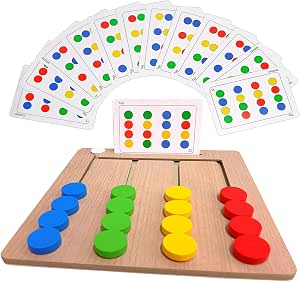
This sliding puzzle is the lineup’s clearest fit for a quiet, individual activity: its 7.7-inch square board and generously sized pieces keep the task contained, while bright colors may help make the pieces easier to distinguish. The included cards provide 24 challenges, adding some variety without requiring a group to learn rules or keep score. Compared with the social trivia of I Should Have Known That!, this puzzle is slower and more self-directed, which may suit someone who prefers working at their own pace. Its tradeoff is a finite set of puzzles and a single activity format; it offers less variety than a book of different exercises. I’d choose it for supported, low-pressure puzzle time, while checking that sliding pieces are comfortable for the intended player to move.
Pros:- Large sliding pieces are designed to be easier to move
- Bright colors make the board visually distinct
- Cards provide 24 challenges for repeated use
- Compact board is easy to place on a small table
Cons:- Only 24 challenges are included, limiting replay variety
- Single sliding-puzzle format may not appeal to players who want varied activities
- Solo play offers less social interaction than trivia or tile games
Best for: Caregivers seeking a colorful, low-difficulty solo activity for an older adult who enjoys sliding puzzles
Not ideal for: Players who want group conversation, many activity types, or a continuing supply of new puzzles
- Board dimensions:7.7 × 7.7 inches
- Cards:12
- Challenges:24
- Activity type:Sliding puzzle
- Piece design:Generously sized sliding pieces
- Visual design:Bright colors
- Intended audience:Seniors with dementia
Our verdict“Pick this puzzle for gentle, self-paced activity with large pieces, but choose another option for group play or broader variety.”
The Easy and Relaxing Memory Activity Book for Adults
For an older adult who would rather choose among different quiet exercises than follow one board-game format, this book combines memory activities, easy puzzles, and brain games. That variety gives it a different role from Dementia Activities for Seniors, which focuses on a set of sliding-puzzle challenges. A book can also be used independently and put away without sorting game pieces, but it does not create the shared turn-taking of Rummikub or trivia. The supplied information does not specify page count, activity count, print size, or difficulty range, so buyers should not assume it will suit someone with low vision or provide an advanced challenge. I’d place it among the flexible, low-pressure options for adults who enjoy paper activities and can comfortably read and write on a page.
Pros:- Combines memory exercises, puzzles, and brain games
- Offers a paper-based activity without game pieces to sort
- Described as suitable for a range of skill levels
- Can be completed at an individual pace
Cons:- Page count and number of activities are not specified
- Print size is not provided, so readability is uncertain
- May feel too easy for adults seeking a demanding challenge
Best for: Older adults who like choosing between different paper-based memory exercises and easy puzzles
Not ideal for: People who need large-print materials, tactile pieces, or a social game with shared turns
- Format:Activity book
- Intended audience:Adults
- Activity types:Memory exercises, easy puzzles, and brain games
- Difficulty description:Easy activities for varied skill levels
- ISBN:1988923182
- Page count:Not specified
Our verdict“Choose this book for flexible solo paper activities, while checking its print and challenge level suit the intended reader.”
I Should Have Known That! – Trivia Game About Things You Ought to Know (Green)
With more than 400 everyday-fact questions and a format where wrong answers cost points, this trivia game gives a group plenty to talk and laugh about. That scoring twist makes it more socially lively than the quiet, individual work of The Easy and Relaxing Memory Activity Book for Adults, but it can also make missed answers feel more exposed. I’d favor it for older adults who enjoy quick recall and playful competition with people they know; it is a weaker fit for anyone who finds trivia pressure uncomfortable or needs large, clear text. The paper cards keep the game straightforward to bring out, though the scoring may take a moment to explain and cards can wear with repeated handling. Its place in the roundup rests on conversation and group energy, not accessibility for every player.
Pros:- More than 400 questions support repeat group sessions
- Everyday topics invite conversation across generations
- Wrong-answer deductions create a distinctive competitive twist
- Paper cards are simple to bring to a gathering
Cons:- Recall pressure and point losses may discourage some players
- Scoring rules may take explanation for first-time players
- Card text size is not specified and paper cards can wear with use
Best for: Older adults who enjoy fast-paced trivia and lighthearted competition at family or friend gatherings
Not ideal for: Players who dislike being put on the spot, need large-print cards, or prefer calm individual puzzles
- Age range:14 years and up
- Players:More than 2
- Question count:More than 400
- Scoring:Players lose points for incorrect answers
- Color:Green
- Material:Paper
- Included components:Game
- Manufacturer:Hygge Games
Our verdict“Choose this for a group that enjoys lively recall and jokes, but skip it if wrong answers could make play stressful.”
Tic Tac Toe Board Game – Classic Family Edition
This compact tic-tac-toe set is the simplest option here: two players can start a familiar game with little explanation, and a typical round is listed at about five minutes. That makes it easier to bring out for a brief visit than Pressman Rummikub Large Numbers Edition, whose tile sets offer more strategic depth but take more setup and sustained attention. The tradeoff is that tic-tac-toe has limited strategic variety and may quickly feel repetitive for adults seeking a longer challenge. Its 5.91-inch square board and light 2.89-ounce weight make it portable, though the small size may be hard to see or handle for some older players, and pieces can be misplaced. I’d choose it for short, familiar face-to-face play rather than as a main game for extended sessions.
Pros:- Familiar rules make it quick to start
- Listed playing time of about five minutes suits brief visits
- Lightweight board is easy to carry
- Durable resin plastic is described as waterproof
Cons:- Simple play may become repetitive for adults wanting more strategy
- Small board and pieces may be difficult to see or handle
- Loose pieces can be lost during travel or storage
Best for: Older adults who want a familiar, brief two-person game that is easy to carry between visits
Not ideal for: Players seeking a sustained challenge, larger pieces, or a game for more than two people
- Players:2
- Board dimensions:5.91 × 5.91 inches (15 × 15 cm)
- Weight:2.89 ounces
- Material:Resin plastic
- Estimated playing time:5 minutes
- Minimum age recommendation:3 years
- Edition:Classic Edition
- Operation mode:Manual
Our verdict“Pick tic-tac-toe for quick, familiar two-person play, but choose Rummikub for more depth and a larger group.”
Dementia Activities for Seniors Matching Domino Puzzle Game
Color matching and a choice of difficulty levels give this puzzle a gentler, more focused feel than conventional family games. Its dominoes can be arranged alone or with a partner, so a caregiver can join in and adjust the challenge as needed. Compared with the Easy Memory Games for Dementia Patients board, this set uses domino tiles and activity cards rather than pegs, offering a different way to practice matching and hand movements. The compact board also takes little table space. Its narrow activity focus is a tradeoff: players looking for conversation, broad strategy, or a game for a larger group may prefer Sorry! or Yahtzee. Very advanced users may need supervision, and the small pieces may be harder to handle for some seniors.
Pros:- Multiple difficulty levels let a partner adapt the challenge
- Can be played alone or with another person
- Combines color matching with fine motor activity
- Compact board takes little table space
Cons:- Small dominoes may be difficult for some players to handle
- Focused on matching and motor activity rather than varied gameplay
- Some users may need supervision
Best for: Caregivers seeking a compact matching activity to play one-on-one with a senior who benefits from adjustable challenges
Not ideal for: Seniors who have difficulty handling small tiles or want a lively, open-ended group game
- Board dimensions:7.9 x 7.9 x 0.4 inches
- Activity cards:10
- Dominoes:28 plastic dominoes
- Colors:Six
- Play modes:Solo or partner play
- Difficulty:Multiple levels
Our verdict“Choose this for a compact, adjustable matching activity to share with a senior; choose a family game for broader group play.”
Connect 4 Classic Grid Game for Kids and Families
Connect 4 is quick to learn and built around visible choices: players drop discs into a grid and try to make a line of four. That makes it a more direct head-to-head option than the card-driven movement and setbacks in Sorry!, and a shorter choice for a pair than a full round of Yahtzee. The pop-out feature helps clear the grid for another match, while alternate ways to play add some variety. For older players who enjoy spotting patterns and blocking an opponent, the simple rules can make it easy to join in without a long explanation. The limits matter: it supports only two players, needs room for the upright grid, and its repeated pattern-building can feel samey over time. This is a general family game, not a dementia-specific activity.
Pros:- Simple rules make it quick to start
- Visible grid supports pattern spotting and blocking
- Pop-out feature makes resetting straightforward
- Short matches suit players who prefer brief games
Cons:- Limited to two players
- Grid requires setup space
- Repeated connect-four objective may feel repetitive
Best for: Two players who want a fast, visual strategy game with simple rules, including seniors who enjoy pattern spotting
Not ideal for: Families seeking a dementia-focused activity, a larger group game, or a compact game with varied rounds
- Players:2
- Recommended age:6+
- Game type:Strategy board game
- Objective:Connect four discs horizontally, vertically, or diagonally
- Gameplay options:Multiple ways to play
- Feature:Pop-out feature
Our verdict“Pick Connect 4 for brief, visual competition between two players; choose Sorry! when you need room for a larger group.”
Easy Memory Games for Dementia Patients, Color Matching Activities for Seniors, Wooden Alzheimer’s Products, Fidget Sensory Busy Board
A wooden board, colored pegs, and adjustable difficulty make this a tactile matching activity for as many as six players. That gives it a social edge over the domino puzzle, which is described for solo or partner play, while its compact footprint is easier to place on a table than a larger family setup such as Connect 4. The pegs also offer a hands-on task alongside the color matching, which may suit a group that enjoys taking turns with a shared board. Its scope stays narrow, though: the activity centers on matching colors rather than storytelling, trivia, or a changing strategy. Buyers should also consider the small 6.1-inch board and pieces, which may be awkward for some players. It is best suited to a group that can use the adjustable challenge with support as needed.
Pros:- Adjustable difficulty can accommodate different skill levels
- Supports play with two to six people
- Wooden board and pegs provide a tactile activity
- Small footprint is easy to place on a table
Cons:- Color matching offers limited variety
- Small board and pegs may be challenging to handle
- May need supervision depending on the players
Best for: Caregivers or families looking for a compact, tactile color-matching activity for a small group of seniors
Not ideal for: Players who need larger pieces, prefer word or strategy games, or want activities beyond color matching
- Material:Wood
- Dimensions:6.1 x 6.1 x 0.7 inches
- Peg pieces:24
- Colors:Six
- Players:2–6
- Recommended age:13+
- Activity:Color matching
Our verdict“Choose this for a small group that enjoys tactile color matching; choose the domino puzzle for a simpler partner activity.”
Sorry! Board Game for Kids Ages 6 and Up – Classic Hasbro Family Game, 4 Pawns per Player
Room for two to four players and simple turn choices make Sorry! a family-table option for seniors who enjoy a little unpredictability. Cards move pawns around the board, with slides and collisions that can change who is ahead; compared with the more head-to-head pattern challenge of Connect 4, Sorry! accommodates a group and creates more shared surprises. It also has a livelier mix of chance and basic decisions than the color-matching dementia activities in this roundup. That broader family appeal comes with tradeoffs: the card-driven reversals can frustrate players who prefer steady progress, and small pawns can be easy to lose or handle. Its strategy is fairly light, so a senior seeking a thoughtful, skill-led challenge may prefer Yahtzee or another strategy game.
Pros:- Supports two to four players
- Simple rules make it accessible to mixed-age groups
- Slides and collisions create lively changes in play
- Includes the board, pawns, cards, and instructions
Cons:- Card-driven setbacks may frustrate players who prefer predictable progress
- Small pawns can be easy to lose or difficult to handle
- Limited strategic depth may not satisfy experienced players
Best for: Families wanting a familiar, easy-to-explain game for two to four players across generations
Not ideal for: Seniors who dislike setbacks driven by chance, have trouble handling small pawns, or want deeper strategy
- Brand:Hasbro Gaming
- Players:2–4
- Minimum age:6+
- Included components:Gameboard, 12 pawns, 45 cards, instructions
- Language:English
- Edition:Standard Edition
- Model number:A5065
Our verdict“Choose Sorry! for casual multigenerational play with room for four; pick Connect 4 for a more direct two-player contest.”
Hasbro Gaming Yahtzee Classic Dice Game
Five dice and up to three rolls per turn give Yahtzee a compact routine: players choose whether to keep or reroll dice, then record a combination on a scorecard. That adds a personal decision to the luck of each roll, making it more engaging for players who want something beyond the color matching in the senior activity boards. Compared with Sorry!, it avoids pawns moving around a board and supports two or more players, though players need to be comfortable tracking a scorecard. The shaker lid stores the dice, and 100 scorecards support repeat play. The tradeoff is a game that depends heavily on chance and requires reading, writing, and scorekeeping. Seniors who prefer larger tactile pieces or help with recording scores may find the matching domino puzzle easier to manage.
Pros:- Choices about which dice to reroll add simple strategy
- Supports two or more players
- Shaker lid doubles as dice storage
- Includes 100 scorecards for repeated play
Cons:- Luck has a strong effect on results
- Players must track combinations and scores
- No warranty is listed in the product data
Best for: Seniors and family members who enjoy dice decisions, scorekeeping, and a repeatable game for two or more
Not ideal for: Players who find reading or writing scores difficult, dislike luck-based outcomes, or prefer tactile matching tasks
- Players:2 or more
- Recommended age:8 years and up
- Turns per player:13
- Rolls per turn:Up to 3
- Included components:5 dice, shaker with lid, 100 scorecards
- Material:Plastic
Our verdict“Choose Yahtzee for a repeatable dice game with scorekeeping; choose the matching domino puzzle if written scoring is a barrier.”
Quokka Elderly Memory Games for Seniors – 202 Cards for Alzheimer’s or Dementia Activities
The Quokka Elderly Memory Games set is aimed at seniors who benefit from visual prompts and structured recall activities. Its 202 cards, color-coded decks, and visual clues give players more ways to recognize and discuss what they see, while solo and group play let a caregiver adapt the activity to the player’s energy and company. Compared with Dementia Activities for Seniors Matching Domino Puzzle Game, this set centers on cards and memory cues rather than matching dominoes, so it may suit someone who enjoys talking through pictures more than handling tiles. The tradeoff is a narrower activity style: repeated card prompts may feel familiar over time, and the cardboard set has no electronic or digital support. I’d choose it for gentle, flexible sessions, not for players seeking a complex strategy game.
Pros:- Color-coded decks and visual clues can make prompts easier to recognize
- Solo and group play allow flexible participation
- 202 cards provide a substantial set of prompts
- Card format is simpler to set up than a board with multiple pieces
Cons:- Repeated prompts may become less engaging over time
- Cardboard components offer less tactile variety than wooden or tile-based activities
- The set does not include digital or electronic interaction
Best for: Caregivers and families looking for a visual, card-based activity that a senior can do alone or with a small group
Not ideal for: Players who prefer varied strategy or tactile tile play, or who tire of repeating familiar card activities
- Number of cards:202
- Intended age range:Adult
- Minimum age:12 years (144 months)
- Material:Cardboard
- Included components:202 playcards
- Model name:FiguresOS200
- Set name:Figures of Speech
Our verdict“Choose Quokka for flexible, visually guided memory sessions; pick a matching domino activity instead if tactile tile play is the better fit.”

How We Picked
I compared these 11 options through the needs implied by the search: legibility, ease of handling, clarity of rules, session length, and whether the activity encourages social play or can be used independently. I gave more weight to features that can reduce common barriers at a game table, such as larger numbers, familiar mechanics, and simple turn sequences. I also considered whether the item is actually a board game; activity books, card sets, and memory exercises can be useful, but they serve a different purpose and are ranked accordingly.
The order favors flexible options that can bring multiple players together, then simpler games for specific group preferences, followed by guided activities for targeted or supported use. A game’s suitability varies with vision, dexterity, memory, and personal interest, so no single pick fits every older adult. I treated dementia-related labeling as a cue to check the activity’s format and support needs, not as a promise of clinical benefit.
Factors to Consider When Choosing Board Games For The Elderly
Before choosing, I would start with the player and the setting rather than the age label on the box. A comfortable, enjoyable game can depend more on readability, pace, and company than on whether it is marketed to seniors.
Match the format to the kind of play they want
First decide whether the goal is a shared activity, a solo pastime, or something a caregiver can do alongside the player. A turn-based board or dice game gives people a reason to gather, but it asks everyone to follow the same rules and wait for turns. An activity book or prompt card set can be used in shorter bursts and adapted to the person’s pace. A frequent mistake is buying a cognitive activity when the person mainly wants company, or choosing a competitive game for someone who finds losing upsetting. Ask what kind of play feels enjoyable before treating a memory label as a sign of suitability. The best format is the one that fits the player’s routine and preference.
Check readability in the actual playing space
Look at the size and contrast of numbers, symbols, cards, and board spaces, then imagine them under the room’s usual lighting. Large print helps only if the colors and symbols remain distinct and the pieces are not crowded together. If vision varies, try reading a sample card or tile at the distance the person will sit from the table. Buying the largest box does not guarantee that every component is easy to see. Good lighting and a matte playing surface can also reduce glare. Choose a game whose information can be recognized without repeated squinting or prompting.
Test handling, reach, and table setup
Small pieces, slippery cards, and a crowded board can make a familiar game tiring for someone with reduced dexterity. Consider whether tiles can be picked up easily, whether the board stays steady, and whether players need to reach across one another. A card holder, tray, or larger table space may improve comfort without changing the game. Avoid assuming that a simpler rule set solves physical access problems. If hand movement is limited, activities with fewer pieces or larger components may be easier to manage. When possible, look at component dimensions and use a sample piece before buying.
Choose a pace and challenge that preserve enjoyment
Players differ in how much challenge they want, and a game that feels easy to one person may feel stressful to another. Familiar mechanics can help someone join quickly, while trivia or memory prompts may be more engaging for a player who wants recall practice. Short rounds make it easier to pause or stop without leaving a long game unfinished. A common mistake is choosing the hardest game as a way to make the activity more beneficial; difficulty alone does not make play more rewarding. Look for rules that can be explained in plain language and adjusted by agreement. Let the player set the pace, with breaks available as part of the plan.
Consider who will join and how often
A game bought for weekly family visits can work differently from one intended for daily independent use. Count the likely players, think about their ages and patience, and check whether the activity works with two people as well as a larger group. Games with simple turns can help mixed-age groups share a table, while activities designed around prompts may need one person to read aloud. If a caregiver will facilitate, consider how much explanation and setup each session requires. Also think about storage and cleanup if the game will be used often. Choosing for the real group makes it more likely the game will come out of the box.
Treat dementia-focused labels as a starting point
Products marketed for dementia or Alzheimer’s may contain matching, sorting, or memory activities, but their labels do not tell you how a particular person will respond. Check whether instructions are clear, whether an activity can be simplified, and whether it can be completed with support. Avoid using a game as a test of memory or correcting every mistake, since that can make leisure feel like an exam. A familiar theme or sensory component may be more inviting than a task framed around recall. If the person becomes frustrated, shorten the activity or switch to something they enjoy. For tailored guidance about cognitive changes, ask a qualified care professional.
Frequently Asked Questions
Which option is easiest to teach to someone who has not played board games recently?
I would start with a familiar game that has few steps per turn, such as Tic Tac Toe or a simple dice game, then see whether the player wants more challenge. Keep the first session short and demonstrate a turn instead of asking them to learn a full rule sheet at once. Rummikub may be a good next step for someone who already knows rummy-style play, though sorting and arranging tiles adds complexity. The easiest choice depends on familiarity as much as the written rules. Let the player decide whether to repeat the game or try another one.
Are dementia activity products suitable for someone with mild memory changes?
They may be suitable if the person enjoys matching, sorting, or answering prompts, but the diagnosis label alone cannot determine fit. Check the specific activity and try it together before leaving it as an independent task. Keep the tone recreational and offer help without turning mistakes into corrections. If the person finds the task frustrating, a familiar social game may be a more comfortable choice. A clinician or care professional can offer guidance for the person’s individual needs.
What should I choose if the player has limited vision or dexterity?
Look for clearly visible numbers and symbols, strong contrast, pieces that are easy to grip, and a board that does not require frequent reaching. In this roundup, the large-number Rummikub edition addresses readability more directly than the standard small components in many family games. Still, large numbers do not solve every access need, so inspect the tiles and playing surface as well. A tray, card holder, or better lighting can help with some games. If possible, let the player handle a sample piece before choosing.
Should I buy a competitive game or a cooperative-feeling activity?
Think about how the player responds to waiting, luck, and losing before choosing. Games such as Sorry! can create lively reversals, which some groups enjoy and others may find discouraging. A short turn-based game or matching activity may feel gentler, especially when participants can help one another. You can also adapt house rules to reduce pressure, such as playing for fun without keeping score. The aim is a pleasant shared activity, so follow the player’s reaction and change formats if needed.
Can an activity book or memory card set replace a board game?
It can replace one if the player prefers a quiet, flexible activity, but it will not provide the same group play as a board game. Books and prompt cards can be easier to use in brief sessions and may need another person to read or guide them. A board or dice game is often a better fit when the main goal is spending time with family or friends. Some households may find value in having both formats for different days and energy levels. Choose based on how the player likes to spend time, rather than the product category alone.
Conclusion
For the broadest mix of familiar rules, readable pieces, and shared play, I recommend Pressman Rummikub Large Numbers Edition as the best overall pick. Yahtzee is my best value-style choice for groups that want a straightforward dice game, while Tic Tac Toe is the easiest entry point for brief, low-pressure rounds. For a premium-feeling, more substantial tile game, Rummikub is also the strongest choice in this lineup, though it asks players to sort and arrange pieces. If the specific need is guided memory practice, compare the Quokka cards, activity books, and matching domino puzzle by format and support required. Choose the option the player is most likely to enjoy returning to; that matters more than an age-targeted label.
Halloween Picks
halloween
As an affiliate, we earn on qualifying purchases.