TL;DR
A November 18, 2026, Seniors Guide report recounts writer Terri L. Jones’s efforts to manage daily tasks after fracturing her dominant wrist. Her examples include using household objects and adaptive tools, while noting that some activities still require assistance or must wait.
Terri L. Jones, a Seniors Guide writer, has been learning to manage everyday tasks with one hand after a fall fractured her dominant right wrist and required surgery. In a report published November 18, 2026, she describes workarounds that helped with chores and personal care, while making clear that some tasks still require help or have to wait.

Give the gift of listening to someone you love
- Choose a 1-, 3-, 6- or 12-month membership
- They pick the audiobooks they love
- Easy to send by email
Jones said she fell during a step aerobics class one day before her 66th birthday. The fracture required surgery, and she was wearing a soft cast extending to her elbow when she wrote about the experience. She said the injury sharply limited what she could do, even though her husband was willing to help. The practical challenge was figuring out which activities she could manage with her left hand and which called for another approach.
Some solutions involved turning nearby objects into supports. To tear toilet paper, Jones used the elbow of her injured arm to hold the roll steady. For a pill organizer with a button-operated compartment, she followed her husband’s suggestion to press the organizer against a toaster oven while opening the compartment with her usable hand. Sticky coasters helped secure bottles and cans for opening; a one-handed cutting tool and a bagel slicer also helped with particular food and packaging tasks.
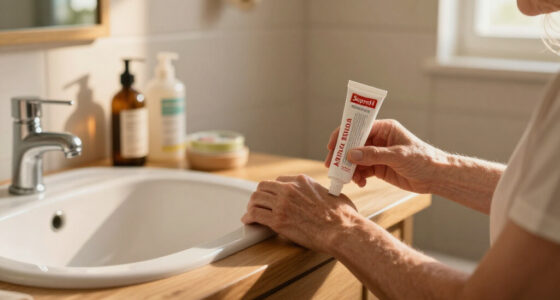
Other adaptations came from online demonstrations. Jones said she learned a method for opening a resealable bag by using different fingers of one hand to hold and pull its two flaps. She also watched a video from One Arm University on folding clothes one-handed: lay the item flat, smooth it, and fold one section at a time. She said the process takes longer but worked for her. For toothpaste, she put some on her tongue before transferring it to the toothbrush; for lotion, she used a cotton pad to apply it.
Small Adjustments, Real Independence
Jones’s account shows how ordinary activities can become a series of practical problems after an injury to the hand someone relies on most. A package, pill container or toiletry that is simple to handle with two hands may require a different grip, a stable surface or a purpose-made device when one hand is unavailable. The report offers specific examples rather than claiming that every workaround will suit every person or injury.
The story also draws a line between independence and safety. Jones said she could not manage some tasks, including opening a can, signing her name, putting backs on earrings, clipping her nails and using a hair dryer. She also chose not to shave her legs with her left hand because she felt it could be unsafe. Her experience underscores that asking for help or postponing a task can be part of adapting, not a failure to do so.
Jones connected her temporary injury to the challenges faced by people who have lasting limitations in arm or hand function. The report does not claim to represent their experiences in full. It does show how small changes and adaptive equipment may make certain daily activities more manageable, while needs vary from person to person.
Products Worth Considering

Oura Ring 5 Smart Ring, Silver, Size 7

Withings Body Smart Accurate Scale for Body Weight, Fat Percentage and Body Composition

OMRON Complete 2-in-1 Upper Arm Blood Pressure Monitor with EKG
As an affiliate, we earn on qualifying purchases.
How Jones Found One-Handed Workarounds
Jones presented the piece as a first-person account based on the period after her fall, not as a clinical guide or a review of rehabilitation methods. She said she searched online for practical advice and found videos demonstrating everyday activities with one hand. Her examples include techniques for opening packaging and folding laundry, as well as ideas she developed at home using her elbow, a cotton pad and kitchen appliances.
She also referred to adaptive dining utensils and dishware, which she knew about from earlier writing for Seniors Guide. The report does not name specific brands or provide a broad comparison of products. Its focus is how one person experimented with household items and accessible tools while temporarily unable to use her dominant hand.
Jones said she hoped to regain full use of her right hand and was also working to improve her left-hand skills. She described the recovery period as a reminder that other people may face similar adjustments for much longer. The source provides no medical timeline for her recovery, and the techniques described are her personal experience rather than medical advice.
““I am attempting to navigate the world without the use of my dominant hand.””
— Terri L. Jones, writing in Seniors Guide
Recovery and Individual Needs
The report does not say when Jones expects to regain full use of her right hand, or provide further details about the fracture, surgery or rehabilitation. It also does not establish whether the workarounds she tried would be appropriate for someone with a different injury, mobility level or long-term disability.
Jones said she was unsure whether dental floss picks were doing the job and planned to find out at her next dental appointment. She did not report a medical assessment of the techniques, and the article does not offer evidence comparing particular adaptive products. Her examples are personal observations, not a guarantee that a method is safe or effective for everyone.
The Next Steps in Jones’s Recovery
Jones said she hoped her right hand would become fully functional again and planned to keep practicing with her left hand in the meantime. She also identified tasks she would leave for later or ask someone else to handle, including activities she could not do reliably with one hand.
She gave no recovery date or further medical update in the report. For readers facing a similar limitation, the article’s next step is practical rather than clinical: identify which tasks can be adapted, use an appropriate tool or stable support when suitable, and seek help when a task cannot be done safely. Decisions about an injury and recovery remain matters for qualified health professionals.
Key Questions
What happened to Terri L. Jones?
Jones said she fell during a step aerobics class and fractured her right wrist, her dominant hand. The injury required surgery, and she was wearing a soft cast extending to her elbow when she wrote her account.
What workarounds did she describe?
Her examples included using her elbow to steady a toilet paper roll, pressing a pill organizer against a toaster oven to open its compartments, and using sticky coasters to hold bottles while opening them. She also described one-handed methods for folding clothes and applying lotion.
Could Jones do every task one-handed?
No. She said tasks such as opening a can, signing her name, clipping her nails and using a hair dryer remained difficult or impossible for her at the time. She planned to ask for help or wait on some activities.
Does the report give a recovery timeline?
No. Jones said she hoped to regain full use of her right hand, but the article does not provide a medical forecast or a date for recovery.
Are these techniques medical recommendations?
No. The methods are Jones’s personal workarounds, not medical advice or a guarantee of safety. A person with an injury or lasting hand limitation should discuss suitable activities and equipment with a qualified professional.
Source: seniorsguide.com