📊 Full opportunity report: Retirement Care Planner on IdeaNavigator AI — validation score, market gap, and execution plan.

Turn quiet afternoons into listening time
- Thousands of audiobooks, podcasts and originals
- Listen on your phone, tablet or Echo — also offline
- Cancel anytime
TL;DR
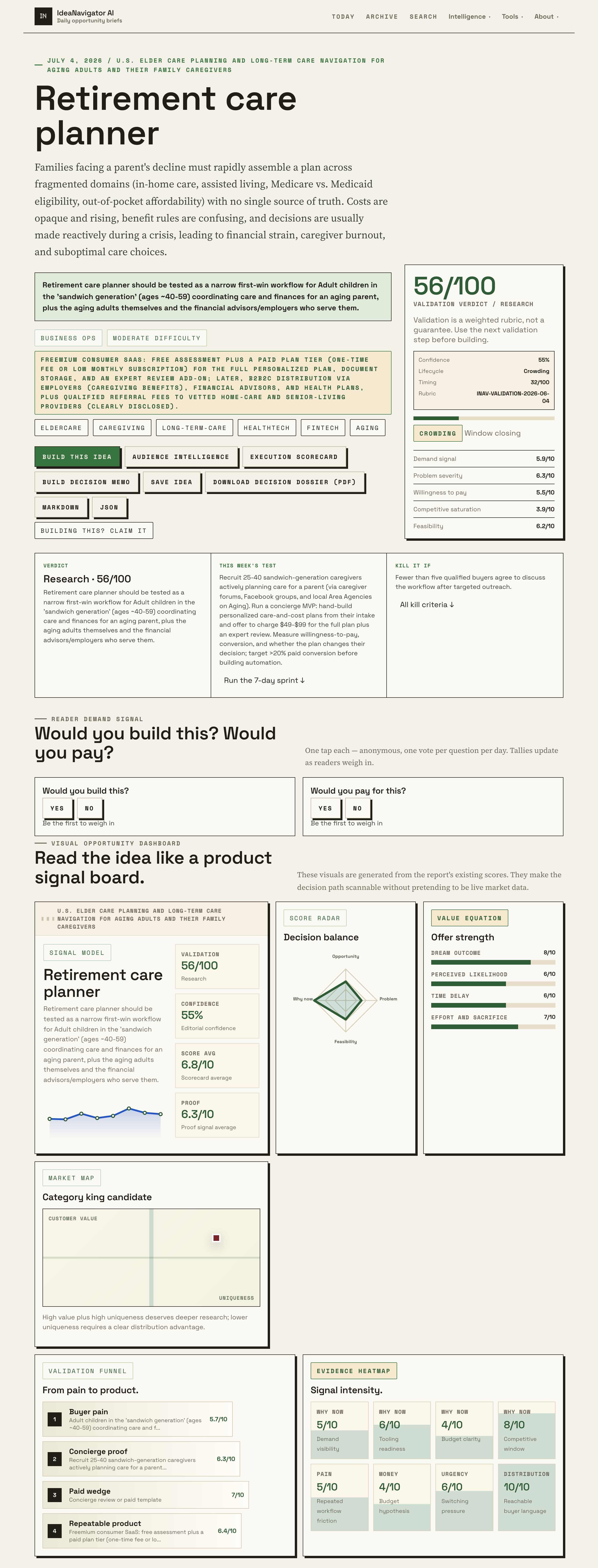
A retirement care planner prototype is being tested to assist middle-aged caregivers in planning care and costs for aging parents. It aims to simplify decision-making amid rising expenses and fragmented information. The initiative is in early validation stages with a focus on user willingness to pay and effectiveness.
A new retirement care planning web app prototype is being tested to assist adult children aged 40-59 in coordinating care and finances for their aging parents. This development responds to the rising costs and complexity of long-term elder care, offering a structured, personalized planning tool. The initiative aims to address a critical gap in fragmented information and reactive decision-making that often burdens families and caregivers.
The retirement care planner is designed as a guided web application that, after a brief intake process, generates a personalized care and cost plan for families. It provides localized cost comparisons between in-home care, assisted living, and nursing homes, along with explanations of Medicare and Medicaid eligibility. The tool also offers an affordability projection and a prioritized action checklist with vetted local provider links. The initial testing focuses on a single high-cost state to manage data complexity.
This prototype is currently in the validation phase, recruiting 25-40 caregivers actively planning for a parent. The goal is to measure willingness-to-pay, plan effectiveness, and whether the tool influences decision-making. The prototype offers a free assessment, with a paid tier for comprehensive plans, expert reviews, and document storage. Future revenue streams include partnerships with employers, financial advisors, health plans, and referral fees to local providers.
Impact on Family Caregiving and Elder Care Costs
This initiative addresses a pressing need as the U.S. approaches a peak demographic of approximately 73 million Americans aged 65 and older by 2030. With long-term care costs rising sharply—median assisted living costs now around $6,200 per month and nursing home stays exceeding $115,000 annually—the tool aims to reduce financial strain and caregiver burnout. By providing structured guidance, it could improve decision quality, reduce reactive crises, and make elder care planning more transparent and manageable for families.
medicare and medicaid eligibility guidebook
As an affiliate, we earn on qualifying purchases.
As an affiliate, we earn on qualifying purchases.
Growing Demand for Elder Care Planning Solutions
The market for elder care planning has expanded as costs increase and families face complex eligibility rules for Medicare and Medicaid. Currently, many families rely on fragmented sources of information, leading to reactive decisions during crises. The U.S. demographic shift, with a significant rise in the aging population, underscores the urgency for scalable, user-friendly planning tools. Early efforts in digital elder care navigation have shown interest, but structured, personalized solutions are still emerging.
“The rising costs and complexity of elder care make structured planning tools essential for families today.”
— an anonymous researcher
Uncertain Outcomes and Validation Challenges
It is not yet clear how many families will adopt the tool at scale or whether they will find it sufficiently valuable to pay for the full service. The effectiveness of the prototype in changing decision-making and reducing financial strain remains to be proven through ongoing testing. Additionally, regulatory and data privacy considerations could influence deployment and partnerships.
Next Steps in Prototype Validation and Market Testing
The project will continue recruiting participants and collecting data on willingness-to-pay and decision impacts. If initial results are promising, developers plan to refine the app, expand to additional states, and explore partnerships with employers and financial advisors. The goal is to reach a broader user base and validate the model before scaling automation and monetization strategies.
Key Questions
How does the retirement care planner determine costs and options?
The tool uses public benchmark data to compare costs of in-home care, assisted living, and nursing homes in the selected area, along with eligibility explanations for Medicare and Medicaid.
Is the app free to use?
The initial assessment is free, but a paid tier offers comprehensive plans, expert reviews, and document storage, with the goal of testing willingness-to-pay during early validation.
Will this tool replace professional elder care advisors?
Not necessarily; it aims to supplement professional advice by providing structured, personalized information that can help families make more informed decisions.
What are the main challenges for scaling this solution?
Key challenges include proving the value proposition to families, managing data privacy, expanding to multiple states, and establishing sustainable revenue models.
When will the full version of the app be available?
There is no fixed timeline yet; the project is in early testing, with future development depending on validation outcomes and market interest.
Source: IdeaNavigator AI
Cold & flu season Picks
humidifiers
As an affiliate, we earn on qualifying purchases.