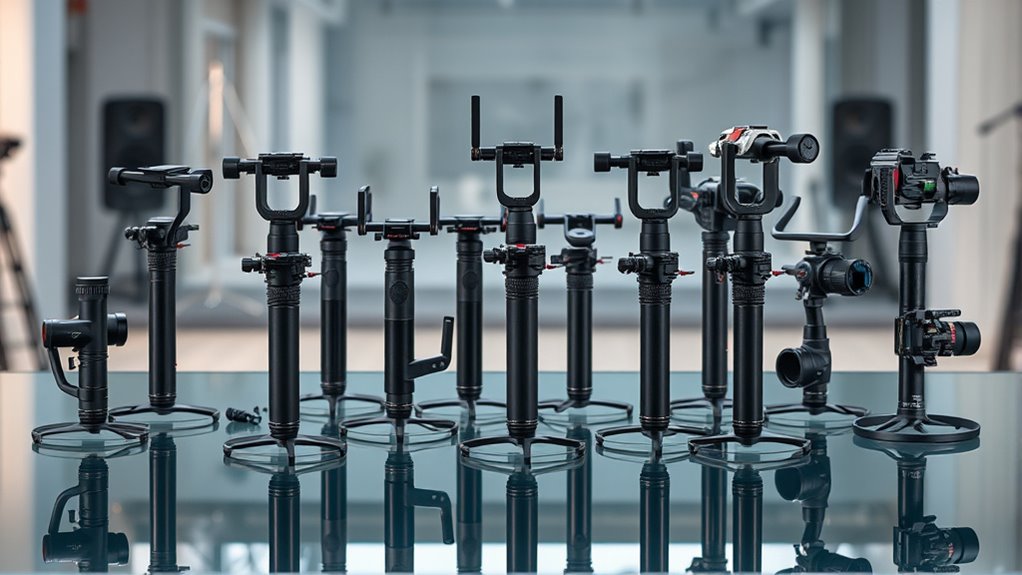

Camera stabilizers help smooth moving shots, but the right choice depends on whether you film with a phone, a compact mirrorless camera, or a heavier DSLR. For most mirrorless users, the DJI RS 4 Mini Combo is the strongest all-around pick, while the DJI Osmo Mobile 8 suits phone creators who want a dedicated mobile gimbal. The Zeadio Video Action Stabilizing Handle Grip offers a simpler, battery-free way to steady handheld footage. The main tradeoff is between active motorized stabilization and lighter grips or rigs that add mounting options without correcting movement in the same way. Read on for how all 14 options compare and which type of stabilizer fits your camera and shooting style.

Turn quiet afternoons into listening time
- Thousands of audiobooks, podcasts and originals
- Listen on your phone, tablet or Echo — also offline
- Cancel anytime
Complete the kit


Key Takeaways
- The lineup splits by camera type: DJI RS models target interchangeable-lens cameras, while the Osmo Mobile and Hohem models are made for phones.
- The DJI RS 4 Mini Combo earns the best overall role for creators seeking a capable camera gimbal in a more compact setup than the full-size RS 4.
- The full-size DJI RS 4 favors heavier or more demanding mirrorless setups, but its added capability comes with more bulk than the Mini options.
- Phone gimbals and action grips solve different problems: Osmo Mobile and Hohem models use motors to counter movement, while Zeadio and PULUZ rigs mainly add grip and accessory mounting.
- Accessory bundles are not a substitute for stabilization: lights, microphones, and cold-shoe mounts can simplify a rig, but they add weight and do not smooth motion on their own.
| FeiyuTech SCORP 2 3-Axis Gimbal Stabilizer for DSLR and Mirrorless Cameras |  | Best for Hands-Free Tracking | Axes: 3-axis | Payload capacity: 2.5 kg | Camera compatibility: Sony, Canon, Panasonic, and Nikon | VIEW ON AMAZON | See Our Full Breakdown |
| DJI RS 4 Mini Combo Gimbal Stabilizer |  | Best for Fast Setup | Payload capacity: 2 kg (4.4 lb) | Supported devices: Mirrorless cameras, vlog cams, and smartphones | Vertical switch time: 10 seconds | VIEW ON AMAZON | See Our Full Breakdown |
| DJI RS 3 Mini Camera Gimbal Stabilizer |  | Best Compact Camera Gimbal | Weight in portrait mode: 795 g (1.75 lb) | Weight with horizontal arm: 850 g (1.8 lb) | Payload capacity: 0.4–2 kg (0.8–4.4 lb) | VIEW ON AMAZON | See Our Full Breakdown |
| Zeadio Video Action Stabilizing Handle Grip Handheld Stabilizer with Cold-Shoe Mount for DSLR Cameras and Camcorders |  | Best for Simple Low-Angle Support | Mount type: Cold-shoe | Thread interface: Standard 1/4-20 | Compatibility: DSLR cameras and camcorders | VIEW ON AMAZON | See Our Full Breakdown |
| PULUZ U/C Shape Video Action Handheld Stabilizer with Triple Cold-Shoe Mount |  | Best Handheld Rig for Accessories | Brand: PULUZ | Model: U/C Shape | Manufacturer part number: PU3005 | VIEW ON AMAZON | See Our Full Breakdown |
| DJI RS 4 Mini Gimbal Stabilizer |  | Best for Lightweight Camera Rigs | Payload capacity: 2 kg (4.4 lbs) | Supported devices: Mirrorless cameras, vlogging cameras, smartphones | Vertical switch time: 10 seconds | VIEW ON AMAZON | See Our Full Breakdown |
| Zeadio Video Handheld Stabilizer Kit with LED Light, Microphone, and Phone Holder |  | Best All-in-One Handheld Kit | Brand: Zeadio | Model number: DV-HDE-UG28 | Included items: Handheld stabilizer, LED video light, video microphone, phone mount, action camera adapter | VIEW ON AMAZON | See Our Full Breakdown |
| Zeadio Handheld Camera Stabilizer with Triple Cold-Shoe Mount |  | Best for Low-Angle and Action Shots | Brand: Zeadio | Model number: DV-HDE-TG17 | Compatibility: DSLRs, action cameras, smartphones | VIEW ON AMAZON | See Our Full Breakdown |
| Hohem iSteady X3 SE 3-Axis Gimbal Stabilizer for iPhone & Android – Black |  | Best Compact Phone Gimbal | Weight: 0.79 lbs | Battery life: Up to 11 hours continuous | Charge time: 2 hours | VIEW ON AMAZON | See Our Full Breakdown |
| Ultimaxx Stabilizing Handheld Stabilizer Handle Grip with Accessory Mount |  | Best Simple Camera Handle | Compatibility: Compact cameras, camcorders, DSLRs, DV video equipment | Mount thread: 1/4-20 standard | Handle material: Padded NBR | VIEW ON AMAZON | See Our Full Breakdown |
| DJI Osmo Mobile 8 Gimbal Stabilizer for Phone |  | Best for Feature-Rich Phone Filming | Brand: DJI | Model: Osmo Mobile 8 | Stabilization: 3-axis | VIEW ON AMAZON | See Our Full Breakdown |
| DJI RS 4 Gimbal Stabilizer for Mirrorless Cameras |  | Best for Professional Vertical Shooting | Brand: DJI | Model: RS 4 | Payload capacity: 3 kg (6.6 lb) | VIEW ON AMAZON | See Our Full Breakdown |
| Zeadio Smartphone Camera Stabilizer Video Rig Kit with Phone Cage, RGB Light, and Microphone |  | Best All-in-One Accessory Rig | Included accessories: Stabilizer handle, phone cage, action-camera adapter, RGB LED light, shotgun microphone | Smartphone compatibility: 4.7- to 6.7-inch screens, with or without a case | Light LEDs: 102 total: 30 RGB and 72 high-CRI | VIEW ON AMAZON | See Our Full Breakdown |
| DJI Osmo Mobile 7 Gimbal Stabilizer for iPhone & Android |  | Best Lightweight Phone Gimbal | Brand: DJI | Model: Osmo Mobile 7 | Weight: 300 g | VIEW ON AMAZON | See Our Full Breakdown |
More Details on Our Top Picks
FeiyuTech SCORP 2 3-Axis Gimbal Stabilizer for DSLR and Mirrorless Cameras
The FeiyuTech SCORP 2 pairs three-axis camera stabilization with an integrated AI tracking sensor, giving solo shooters a way to keep a moving subject framed without a separate tracking accessory. Its 2.5 kg payload exceeds the DJI RS 4 Mini Combo and RS 3 Mini, which makes it a better fit for heavier DSLR or mirrorless builds. The upgraded L-shaped plate also speeds up vertical filming when switching to portrait content. A touchscreen and multifunction knob give direct access to axis and zoom adjustments, while Bluetooth and cable control offer flexibility across supported cameras. The tradeoff is a more involved setup: the included plates and cables take more configuring, and gesture controls may take practice. Choose it for heavier camera rigs and built-in tracking; the smaller DJI options suit buyers who put portability first.
Pros:- 2.5 kg payload supports heavier camera and lens combinations than the DJI RS 4 Mini Combo and RS 3 Mini.
- Integrated AI tracking can keep a subject framed without a separate tracking module.
- L-shaped mounting plate supports quick vertical filming setup.
- Bluetooth and wired camera control provide more than one connection option.
Cons:- Gesture-based tracking controls may take practice to use confidently.
- Multiple plates and cables make setup more involved than on the compact DJI options.
Best for: Solo filmmakers using a DSLR or mirrorless camera who want built-in subject tracking and support for a heavier setup.
Not ideal for: Travel creators with a lightweight camera who prioritize a compact, simple setup over higher payload capacity and tracking controls.
- Axes:3-axis
- Payload capacity:2.5 kg
- Camera compatibility:Sony, Canon, Panasonic, and Nikon
- Connectivity:Bluetooth and control cable
- Screen:1.3-inch touchscreen
- Included accessories:Tripod, control cables, mounting plates, and lens holder
- Warranty:1-year manufacturer warranty
Our verdict“Pick the SCORP 2 if your heavier camera rig and built-in tracking matter more than a quick, compact setup.”
DJI RS 4 Mini Combo Gimbal Stabilizer
The DJI RS 4 Mini Combo is the pick for creators who want a camera gimbal that is quick to ready between shots. Its auto axis locks speed setup, while the included Intelligent Tracking Module follows a subject without requiring a separate purchase. The stated vertical switch time of 10 seconds also suits creators moving between standard and portrait framing. Compared with the older DJI RS 3 Mini, the Combo’s tracking module and briefcase handle add shooting options; compared with the FeiyuTech SCORP 2, its 2 kg payload gives less headroom for a heavier camera build. It supports mirrorless cameras, vlog cams, and smartphones within that limit. One practical wrinkle is that the DJI Ronin app must be downloaded from DJI’s website on Android rather than installed through Google Play.
Pros:- Auto axis locks help speed up setup between shoots.
- Included Intelligent Tracking Module can keep a subject framed.
- Switches to vertical orientation in a stated 10 seconds.
- Supports mirrorless cameras, vlog cams, and smartphones within its payload limit.
Cons:- 2 kg payload offers less capacity than the FeiyuTech SCORP 2.
- Android users must download the DJI Ronin app from DJI’s website.
Best for: Mirrorless and vlog creators who frequently switch to vertical video and want quick setup with included subject tracking.
Not ideal for: Filmmakers with heavier DSLR and lens combinations above 2 kg, or Android users who require app installation through Google Play.
- Payload capacity:2 kg (4.4 lb)
- Supported devices:Mirrorless cameras, vlog cams, and smartphones
- Vertical switch time:10 seconds
- Axis locks:Automatic
- Tracking:Intelligent Tracking Module included
- Follow mode:Responsive Follow Mode
- Included accessories:Tripod, tracking module, and briefcase handle
Our verdict“Choose the RS 4 Mini Combo for quick setup and included tracking if your camera rig stays within its 2 kg payload.”
DJI RS 3 Mini Camera Gimbal Stabilizer
For creators who carry a mirrorless camera all day, the DJI RS 3 Mini keeps the stabilizer’s weight low: 795 g in portrait mode and 850 g with the horizontal arm. Its native vertical shooting mode avoids needing an extra bracket for portrait-oriented content, and the 1.4-inch touchscreen puts settings within reach on the gimbal. The 2 kg payload matches the DJI RS 4 Mini Combo, though the Combo adds an Intelligent Tracking Module and faster auto axis lock setup. The RS 3 Mini instead makes a straightforward case as a compact camera stabilizer with Bluetooth shutter control and support for several mirrorless brands. Its 2 kg limit rules out some heavier camera and lens combinations, and using the DJI Ronin app on Android requires a manual download from DJI’s site.
Pros:- Weighs 795 g in portrait mode for easier packing and carrying.
- Supports up to 2 kg, matching the DJI RS 4 Mini Combo’s payload.
- Native vertical shooting mode supports portrait video without an extra bracket.
- 1.4-inch touchscreen and Bluetooth shutter control provide direct camera operation.
Cons:- 2 kg payload may not suit heavier camera and lens combinations.
- The DJI Ronin app must be downloaded from DJI’s website on Android.
- Lacks the included Intelligent Tracking Module provided with the RS 4 Mini Combo.
Best for: Travel and social-video creators using a supported mirrorless camera who want a lightweight gimbal with native portrait shooting.
Not ideal for: Owners of heavier camera builds or Android users who prefer to install camera apps through Google Play.
- Weight in portrait mode:795 g (1.75 lb)
- Weight with horizontal arm:850 g (1.8 lb)
- Payload capacity:0.4–2 kg (0.8–4.4 lb)
- Touchscreen:1.4-inch full-color
- Compatibility:Canon, Sony, Nikon, and Fujifilm mirrorless cameras and lenses
- Stabilization algorithm:3rd-Gen RS Stabilization
- Shooting orientation:Native vertical shooting mode
Our verdict“Choose the RS 3 Mini for a light mirrorless setup and native vertical filming; pick the RS 4 Mini Combo if tracking is a priority.”
Zeadio Video Action Stabilizing Handle Grip Handheld Stabilizer with Cold-Shoe Mount for DSLR Cameras and Camcorders
The Zeadio Video Action Stabilizing Handle Grip is a basic handheld support for shooters who want a steadier grip and a lower camera angle without carrying a powered gimbal. Its padded NBR handle is suited to longer handheld sessions, and the cold-shoe mount and standard 1/4-20 thread let it pair with compatible DSLRs and camcorders. This is a different kind of stabilizer from the DJI RS 3 Mini: it has no electronic axes to smooth walking footage, but also avoids batteries, balancing, and gimbal controls. The PULUZ U/C Shape offers three cold-shoe mounts for a larger accessory setup; the Zeadio is the simpler choice when a single handle is enough. Buyers should treat it as a grip for low-angle and action shots, not a substitute for electronic stabilization.
Pros:- Padded NBR handle supports a comfortable grip during longer shoots.
- Standard 1/4-20 thread fits compatible cameras and camcorders.
- Cold-shoe mount provides a place for an accessory.
- Simple handheld design avoids powered gimbal setup.
Cons:- No electronic stabilization to smooth movement while walking.
- Single cold-shoe mount provides less accessory capacity than the PULUZ U/C Shape.
Best for: DSLR and camcorder users who want a lightweight grip for low-angle shots and handheld filming without powered gimbal setup.
Not ideal for: Creators who need walking footage stabilized electronically or want to mount several accessories at once.
- Mount type:Cold-shoe
- Thread interface:Standard 1/4-20
- Compatibility:DSLR cameras and camcorders
- Handle material:Cushioned NBR padding
- Electronic stabilization:None
- Accessory mount:Cold-shoe mount
Our verdict“Pick the Zeadio for a straightforward low-angle grip, and choose a powered gimbal if you need motion smoothing.”
PULUZ U/C Shape Video Action Handheld Stabilizer with Triple Cold-Shoe Mount
The PULUZ U/C Shape suits handheld shooters who need room for lights and microphones around a compact camera or phone. Its triple cold-shoe mounts let a simple rig carry several accessories, while the C-shaped handle supports low-angle and moving shots. The sliding 1/4-20 screw broadens compatibility across cameras, camcorders, action cameras, and smartphones. Compared with the Zeadio Video Action Stabilizing Handle Grip, PULUZ gives accessory-heavy setups more mounting points; the Zeadio is the more basic handle for shooters who need less rigging. Neither product stabilizes motion electronically, so neither will match the DJI RS 3 Mini for smoothing camera movement while walking. PULUZ is a grip and mounting platform, and the added accessories and rig components can make it less streamlined to hold.
Pros:- Triple cold-shoe mounts accommodate multiple accessories such as lights and microphones.
- C-shaped design supports low-angle and dynamic handheld framing.
- Standard sliding 1/4-20 screw works with cameras, camcorders, action cameras, and smartphones.
- Soft handle is intended to reduce fatigue during longer shoots.
Cons:- No electronic stabilization to smooth movement during walking shots.
- Accessory mounts can make the rig less streamlined than the single-handle Zeadio.
Best for: Action and mobile-video creators who want to attach a light and microphone to a handheld camera or phone rig.
Not ideal for: Filmmakers who need electronic stabilization for walking shots or want the lightest, least built-up handheld setup.
- Brand:PULUZ
- Model:U/C Shape
- Manufacturer part number:PU3005
- Mount type:Triple cold-shoe
- Screw type:1/4-20 standard sliding screw
- Compatibility:Cameras, camcorders, action cameras, and smartphones
- Unit count:1
Our verdict“Choose the PULUZ if accessory mounting matters more than electronic motion smoothing or a minimal grip.”
DJI RS 4 Mini Gimbal Stabilizer
The DJI RS 4 Mini suits creators moving between mirrorless cameras, vlogging cameras, and phones who want motorized stabilization without a larger rig. Its 2 kg payload gives it more room for camera setups than the phone-only Hohem iSteady X3 SE, while auto axis locks and a 10-second vertical switch help reduce setup friction when changing shots for social video. Intelligent tracking and responsive follow mode also suit moving subjects and handheld camera movement. The tradeoff is that it takes more planning than a simple handle stabilizer, and the DJI Ronin app requires manual installation on Android because it is no longer on Google Play. Choose it for compatible lightweight cameras; the Hohem is the simpler fit if you shoot only on a phone.
Pros:- Supports mirrorless cameras, vlogging cameras, and smartphones
- Auto axis locks make setup faster
- Switches to vertical orientation in about 10 seconds
- Intelligent tracking and responsive follow mode help keep moving subjects framed
Cons:- Android users must manually download the DJI Ronin app
- The 2 kg payload limits heavier camera and lens combinations
Best for: Creators using lightweight mirrorless or vlogging cameras who need motorized tracking and quick portrait orientation changes
Not ideal for: Android users who want app installation directly through Google Play, or filmmakers with rigs exceeding the 2 kg payload
- Payload capacity:2 kg (4.4 lbs)
- Supported devices:Mirrorless cameras, vlogging cameras, smartphones
- Vertical switch time:10 seconds
- Setup feature:Auto axis locks
- Tracking:Intelligent tracking
- Follow mode:Responsive follow mode
Our verdict“Choose the RS 4 Mini for a lightweight camera rig that needs motorized tracking and quick portrait shooting, and the Hohem iSteady X3 SE if you only need a phone gimbal.”
Zeadio Video Handheld Stabilizer Kit with LED Light, Microphone, and Phone Holder
The Zeadio DV-HDE-UG28 is a practical choice for creators who want a handheld support rig with lighting and audio accessories in one package. Its LED light, microphone, phone mount, and action camera adapter cover more of a basic filming setup than the simpler Zeadio Handheld Camera Stabilizer, which focuses on grip and accessory mounting. Three cold shoes and two 1/4-inch interfaces leave room to rearrange accessories, while the adjustable light supports varied color temperatures. This is a manual stabilizer, though, so it cannot electronically smooth walking footage or track a subject like the DJI RS 4 Mini. The 500 g recommended load also rules out many heavier camera builds. Check the microphone’s straight TRRS cable requirement, and charge the light before filming.
Pros:- Includes a light, microphone, phone mount, and action camera adapter
- Light brightness adjusts from 10% to 100% with 3000K–7000K color temperature
- Three cold shoes and two 1/4-inch interfaces support flexible accessory placement
- Ergonomic grip helps steady handheld shots
Cons:- The microphone requires a specific straight TRRS cable connection
- The light needs charging before first use
- 500 g recommended maximum limits camera and accessory combinations
Best for: Phone and action-camera creators who want a handheld support rig with a light and microphone included
Not ideal for: Filmmakers seeking motorized stabilization, or users planning a camera and accessory setup above the 500 g recommendation
- Brand:Zeadio
- Model number:DV-HDE-UG28
- Included items:Handheld stabilizer, LED video light, video microphone, phone mount, action camera adapter
- LED:100 beads, 120° beam angle, 800 lux maximum, CRI 95+
- Light adjustment:Brightness 10–100%; color temperature 3000K–7000K
- Mounting interfaces:3 cold shoes, 2 universal 1/4-inch screws
- Maximum recommended weight:500 g
- Warranty:1 year
Our verdict“Pick this kit for a ready-to-build phone or action-camera filming setup, but choose the DJI RS 4 Mini if motorized camera stabilization matters more than bundled accessories.”
Zeadio Handheld Camera Stabilizer with Triple Cold-Shoe Mount
The Zeadio DV-HDE-TG17 favors grip options and accessory flexibility over motorized control. Its dual side handles give the operator a stable two-handed hold for low-angle moves and action footage, while a removable grip allows different handling positions. Three cold shoes can hold accessories such as a light or microphone, and the included phone cage and action camera adapter broaden its use beyond DSLRs. Compared with the Zeadio DV-HDE-UG28 kit, this model is a simpler support rig without a bundled LED or microphone; that makes it less ready for recording out of the box but avoids making those accessories the center of the setup. It remains a manual grip, so it cannot match the DJI RS 4 Mini’s electronic stabilization or tracking. No load limit is provided.
Pros:- Dual side handles provide a stable two-handed grip
- Removable grip supports different filming positions
- Triple cold-shoe mounts accept lights and microphones
- Includes a phone cage and action camera adapter
Cons:- Manual grip does not provide motorized stabilization or tracking
- No specific weight capacity is listed
- Light and microphone are not included
Best for: Action-camera, smartphone, and DSLR users who film low-angle movement and want a two-handed grip with accessory mounts
Not ideal for: Solo creators who need motorized tracking, included lighting and audio, or a clearly specified load limit
- Brand:Zeadio
- Model number:DV-HDE-TG17
- Compatibility:DSLRs, action cameras, smartphones
- Mount type:1/4-20 thread
- Accessory mounts:Triple cold-shoe
- Included items:Handheld stabilizer, phone cage, action camera adapter
- Grip configuration:Dual side handles and removable grip
- Warranty:1 year
Our verdict“Choose the DV-HDE-TG17 for flexible handheld action and low-angle filming, while the DV-HDE-UG28 makes more sense if you want a light and microphone in the box.”
Hohem iSteady X3 SE 3-Axis Gimbal Stabilizer for iPhone & Android – Black
For phone-only shooting, the Hohem iSteady X3 SE offers a more portable approach than the camera-supporting DJI RS 4 Mini. Its foldable 0.79 lb design packs away easily, and three-axis stabilization helps smooth movement without the bulk of a camera gimbal. An 11-hour continuous battery life suits long days of recording, while the detachable magnetic remote and Hohem Joy app add options for framing yourself, gesture control, and AI tracking. The limit is the 0.66 lb payload: larger phones or accessory-heavy setups may not fit, and the remote’s roughly 33-foot range can constrain distant framing. Compared with the DJI RS 4 Mini, this is easier to carry for phone videos but cannot support a mirrorless camera.
Pros:- Foldable, 0.79 lb design is easy to carry
- 11-hour continuous battery life
- Detachable magnetic remote works from up to 32.81 feet
- Hohem Joy app offers AI tracking, gesture control, and creative modes
Cons:- 0.66 lb payload may not accommodate larger phones or accessories
- Remote range may be limiting for wider outdoor setups
Best for: Phone creators who want a foldable three-axis gimbal for travel, solo filming, and extended shooting sessions
Not ideal for: Users with larger phones or add-on lenses and lights, or anyone needing stabilization for a mirrorless camera
- Weight:0.79 lbs
- Battery life:Up to 11 hours continuous
- Charge time:2 hours
- Remote range:32.81 feet
- Payload capacity:0.66 lbs
- Stabilization:3-axis
- App:Hohem Joy
- Color:Black
Our verdict“Choose the iSteady X3 SE for portable, long-running phone video, and the DJI RS 4 Mini if your setup needs to support a camera.”
Ultimaxx Stabilizing Handheld Stabilizer Handle Grip with Accessory Mount
The Ultimaxx Stabilizing Handle Grip is the straightforward pick for camera owners who want a more comfortable handhold and a place to attach one accessory. Its padded NBR handle can reduce hand strain during longer shoots, and the removable shoe accepts a light, flash, or microphone. Compared with the triple-mount Zeadio DV-HDE-TG17, the Ultimaxx keeps the setup simpler but offers less room for multiple accessories and no listed phone cage or action camera adapter. It supports a range of compact cameras, camcorders, and DSLRs through a standard 1/4-20 thread. The key limitation is that it is a grip rather than a motorized gimbal, and the product details provide no weight capacity. Heavy professional rigs are a poor match.
Pros:- Padded NBR handle can reduce hand fatigue
- Removable shoe supports a light, flash, or microphone
- Impact-absorbent ABS body
- Standard 1/4-20 thread and broad camera brand compatibility
Cons:- No weight capacity is listed
- Not suited to heavy professional camera rigs
- Single accessory shoe offers less expansion than the Zeadio DV-HDE-TG17
Best for: Compact-camera and camcorder owners who want a padded handheld grip with a single removable accessory shoe
Not ideal for: Operators with heavy professional rigs, or buyers who need motorized stabilization or several accessory mounts
- Compatibility:Compact cameras, camcorders, DSLRs, DV video equipment
- Mount thread:1/4-20 standard
- Handle material:Padded NBR
- Body material:ABS impact-absorbent plastic
- Accessory mount:Removable shoe for lighting, flashes, or microphones
- Compatible brands:Canon, Nikon, Sony, Panasonic, Pentax, Olympus
Our verdict“Choose the Ultimaxx for a simple, comfortable grip on a compact camera or camcorder, and consider the Zeadio DV-HDE-TG17 if you need several accessory mounts.”
DJI Osmo Mobile 8 Gimbal Stabilizer for Phone
The Osmo Mobile 8 suits phone creators who want tracking, lighting, and audio support in a foldable 3-axis gimbal. Its 360° pan rotation and integrated tripod/extension rod give solo vloggers more framing options than the simpler Osmo Mobile 7, while its 10-hour battery can also charge a connected phone during filming. The Multifunctional Module adds tracking and audio and lighting features, which can help create polished clips without carrying as many separate accessories. Those features bring a setup tradeoff: Android users may need to download the DJI Mimo app from DJI’s website because it is unavailable on Google Play. The listing also gives no weight, so buyers who prioritize a known carry weight have less information than they do for the 300-gram Osmo Mobile 7.
Pros:- 3-axis stabilization with 360° pan rotation supports varied phone movements and framing.
- Multifunctional Module adds AI tracking plus audio and lighting features.
- Integrated tripod and extension rod simplify solo shots and higher or wider angles.
- 10-hour battery life and phone charging support longer filming sessions.
Cons:- Android users may need to install DJI Mimo manually from DJI’s website.
- The product data does not state the gimbal’s weight, making carry comparisons harder.
Best for: Phone vloggers and solo livestreamers who want tracking, lighting and audio features built into a foldable filming setup.
Not ideal for: Android users who want app installation through Google Play, or travelers choosing by a published gimbal weight.
- Brand:DJI
- Model:Osmo Mobile 8
- Stabilization:3-axis
- Battery life:10 hours
- Pan rotation:360°
- Included module:Multifunctional Module
- Included phone mount:Magnetic Phone Clamp
- Included accessories:USB-C charging cable (15 cm), power cable (50 cm), storage pouch
Our verdict“Choose the Osmo Mobile 8 for a feature-rich phone rig with tracking and built-in filming support; choose the Osmo Mobile 7 if a stated 300-gram weight and simpler setup matter more.”
DJI RS 4 Gimbal Stabilizer for Mirrorless Cameras
The DJI RS 4 is aimed at mirrorless-camera creators who need a payload and balancing range beyond phone gimbals or compact rigs. Its 3 kg payload, extended tilt axis, and Teflon-coated arms support heavier camera-and-lens combinations and smoother balancing. Native second-generation vertical shooting also makes portrait-format work more direct than adapting a camera rig after setup. Compared with the DJI RS 4 Mini, this standard RS 4 is the stronger fit when payload headroom and balancing flexibility matter more than keeping the rig compact. Its 12-hour runtime covers long shoots, and the optional BG70 grip can extend that figure, but the grip is sold separately. Buyers should also account for the DJI Ronin app’s manual-download requirement on Android.
Pros:- 3 kg payload capacity accommodates a broad range of mirrorless camera setups.
- Native vertical shooting supports portrait video without an added accessory.
- Extended tilt axis provides more clearance for larger camera and lens combinations.
- Teflon-coated axes reduce friction during balancing.
Cons:- The BG70 grip needed for the extended runtime is sold separately.
- Android users may need to download the DJI Ronin app manually from DJI’s website.
Best for: Mirrorless shooters using larger camera-and-lens combinations who regularly film vertical content and need a 3 kg payload capacity.
Not ideal for: Phone creators, casual travel shooters, or anyone prioritizing a compact kit over heavier-camera support.
- Brand:DJI
- Model:RS 4
- Payload capacity:3 kg (6.6 lb)
- Battery runtime:Up to 12 hours
- Runtime with optional BG70 grip:Up to 29.5 hours
- Compatible camera brands:Canon, Sony, Nikon, Fujifilm
- Axis coating:Teflon
- Included accessories:BG21 Battery Grip, Quick-Release Plate, Extended Grip/Tripod
Our verdict“Choose the RS 4 for heavier mirrorless setups and regular vertical filming; the RS 4 Mini is a better match when a smaller rig matters more.”
Zeadio Smartphone Camera Stabilizer Video Rig Kit with Phone Cage, RGB Light, and Microphone
The Zeadio kit is a handheld accessory rig for creators who want to add lighting and audio around a phone, action camera, or supported DSLR. Its phone cage, RGB LED light, and shotgun microphone make it more production-ready out of the box than a plain grip such as the Zeadio Video Action Stabilizing Handle Grip. Three cold-shoe mounts and five threaded holes leave room for extra accessories, though the listing describes a handle-based stabilizer rather than a motorized gimbal; it will not offer the powered three-axis correction of the DJI Osmo Mobile 8. The light’s adjustable output and high color rendering give creators control over fill, while the mic has a compatibility catch: it requires a straight TRRS cable. The light also needs charging before first use.
Pros:- Includes phone cage, action-camera adapter, RGB LED light, and shotgun microphone.
- Three cold-shoe mounts and five threaded holes support accessory-heavy setups.
- Light offers 102 LEDs, adjustable brightness, and CRI95+ output.
- Phone cage fits smartphones with 4.7- to 6.7-inch screens, with or without a case.
Cons:- Handle-based rig does not provide the motorized 3-axis correction of the DJI Osmo Mobile 8.
- Microphone requires a straight TRRS cable, which may not match a buyer’s existing cable.
- The light needs charging before first use.
Best for: New smartphone filmmakers who want a single handheld rig with a light, microphone, and mounting points for accessories.
Not ideal for: Creators seeking motorized stabilization for walking shots, or users unwilling to check cable compatibility and charge the light before filming.
- Included accessories:Stabilizer handle, phone cage, action-camera adapter, RGB LED light, shotgun microphone
- Smartphone compatibility:4.7- to 6.7-inch screens, with or without a case
- Light LEDs:102 total: 30 RGB and 72 high-CRI
- Light output:800 lm
- Light color rendering:CRI95+
- Light dimming:10% to 100%
- Mounting points:3 cold-shoe mounts and five 1/4-inch threaded holes
- Microphone cable requirement:Straight TRRS cable
Our verdict“Pick this Zeadio kit when bundled audio, lighting, and mounting flexibility matter more than motorized stabilization.”
DJI Osmo Mobile 7 Gimbal Stabilizer for iPhone & Android
At a stated 300 grams, the Osmo Mobile 7 is the clearest choice here for phone users who want a light, foldable gimbal with a built-in tripod. Its 3-axis stabilization and ActiveTrack 7.0 help solo creators keep subjects framed, while a 10-hour battery and USB-C phone charging suit longer outings. Against the Osmo Mobile 8, the Mobile 7 is easier to evaluate as a carry-first option because its weight is listed; the newer model adds a Multifunctional Module with audio and lighting features and 360° pan rotation. There is a catch for tracking: advanced features require the separately purchased DJI OM 7 Series Tracking Kit. Android users may also need to install DJI Mimo from DJI’s website.
Pros:- 300-gram weight makes it a clearly specified lightweight option.
- 3-axis stabilization and ActiveTrack 7.0 support smooth subject-following shots.
- Integrated foldable tripod simplifies filming without a second person.
- 10-hour battery supports phone charging over USB-C while filming.
Cons:- Advanced tracking features require the separately purchased DJI OM 7 Series Tracking Kit.
- Android users may need to download DJI Mimo manually from DJI’s website.
Best for: Travel vloggers and phone creators who value a lightweight, foldable gimbal with a built-in tripod for solo filming.
Not ideal for: Creators who need the advanced tracking kit included, or want the Osmo Mobile 8’s integrated audio and lighting features.
- Brand:DJI
- Model:Osmo Mobile 7
- Weight:300 g
- Stabilization:3-axis
- Battery life:10 hours
- Compatibility:iPhone and Android
- Tracking:ActiveTrack 7.0
- Charging:USB-C; supports phone charging
- Design:Foldable with built-in tripod
Our verdict“Choose the Osmo Mobile 7 for lightweight, solo phone filming with a built-in tripod; choose the Osmo Mobile 8 for its added module features and 360° pan rotation.”

How We Picked
I ranked these camera stabilizers by how well their design matches the camera and footage a buyer wants. Motorized gimbals received credit for active movement correction, camera compatibility, balancing demands, controls, and the practical value of included accessories. For handheld grips and cages, I focused on grip shape, mounting flexibility, portability, and whether their simpler setup makes sense for the footage they can support.
Ranking reflects fit, not a single feature count. The RS 4 Mini Combo leads as a versatile option for many mirrorless creators; the full-size RS 4 places higher for buyers who need a more substantial camera platform. Phone gimbals rank within their own use case, while low-cost action grips and accessory kits suit buyers who value simplicity or rigging over motorized correction. I also considered the tradeoffs: a stabilizer that is too heavy, difficult to balance, or mismatched to the camera can be less useful than a simpler model that fits the shoot.
Factors to Consider When Choosing Camera Stabilizers
Before choosing among these camera stabilizers, match the stabilizing method to your camera and the kind of movement you need to smooth. The points below address common buying mistakes that can matter more than a long feature list.
Match the Stabilizer to Your Camera
Start with the device you plan to mount: a phone gimbal, a mirrorless camera gimbal, and a handheld grip are different tools. Check the stabilizer’s supported payload and mounting method against your camera body, lens, plate, and any accessories you intend to keep attached. A body that falls within a stated payload limit can still be awkward if a long lens shifts the center of gravity or blocks controls. Phone models also differ in how they hold a phone and interact with its camera features. Buying for a future camera can backfire if the new setup exceeds the gimbal’s capacity or needs a different mounting system. Choose for the complete shooting setup you will carry, not the camera body alone.
Choose Active Motorized Correction or a Simple Grip
A motorized gimbal uses powered axes to counter some camera movement; a grip or cage gives you a more stable way to hold and mount a camera but does not provide the same active correction. This distinction affects the footage you can expect while walking, following a subject, or changing direction. A grip can be a sensible choice for static shots, short handheld takes, or a rig that needs accessory mounts. It may not solve visible bounce during a walk. Gimbals add setup steps, charging, balancing, and motors to carry. Decide which movement you need to correct before paying for a mechanism you may not use.
Account for Lens Balance and Setup Time
Interchangeable-lens camera gimbals need to be balanced around the actual camera and lens combination. A heavier or longer lens can affect clearance and balance even when the total setup appears to fit the payload specification. If you regularly swap lenses, check whether the mounting and adjustment process suits your pace on location. A carefully balanced setup can deliver smoother results, but frequent reconfiguration takes time. Beginners may prefer a combination they can leave assembled or a phone gimbal with fewer camera-specific adjustments. Factor setup time into the purchase, especially if you film quick moments rather than planned sequences.
Treat Accessories as Added Weight
Lights, microphones, phone holders, and cold-shoe mounts can make a kit more useful, but each accessory changes the rig’s weight and balance. A bundle may save you from sourcing compatible parts separately, yet it can be less flexible if its accessories are not the ones you need. On a motorized gimbal, added weight can reduce the room available for the camera and lens and may complicate balancing. On a handheld cage, extra mounts are useful only if the grip remains comfortable to hold. Make a short list of accessories you will actually use before selecting a bundle. A lighter setup is often easier to carry and faster to deploy.
Consider Portability and the Whole Shoot
Compare the stabilizer’s packed size and weight with the rest of your filming kit, not just with another stabilizer. A larger camera gimbal may suit planned shoots, while a phone gimbal or compact grip is easier to keep on hand for spontaneous clips. Also think about transport between shots: a quick-folding design or a simple handle may matter more than extra controls if you move frequently. Battery dependence is another practical difference, since powered gimbals need charging and a plan for long sessions. A stabilizer left behind because it is cumbersome cannot help your footage. Pick the setup you are likely to bring.
Prioritize the Controls You Will Use
Gimbal modes and controls can support pans, subject tracking, or changes in camera orientation, but more options can also add a learning curve. Consider whether you will operate the stabilizer solo and whether you can reach the controls while holding the camera. Phone users should check how the gimbal works with their phone’s camera app and features rather than assuming every function carries across. For camera gimbals, confirm that the controls you care about work with your camera model. If your shots are straightforward, simple operation may be more useful than a long list of modes. Choose controls around your real shooting habits.
Frequently Asked Questions
Can I use a phone gimbal with a DSLR or mirrorless camera?
No. The DJI Osmo Mobile and Hohem iSteady models in this roundup are designed to hold phones, while camera gimbals such as the DJI RS series and FeiyuTech SCORP 2 are made for camera setups. Their mounts, balancing systems, and supported loads differ. A phone holder or cage can mount a phone, but it does not turn a phone gimbal into a camera gimbal. Choose a model rated for the device and full setup you plan to use.
Is a handheld stabilizer grip enough for walking footage?
A grip can make a camera easier to hold and may help you keep a steadier posture, but it does not actively cancel movement like a motorized gimbal. Walking footage can still show vertical bounce and side-to-side motion. A grip is a better fit for stationary framing, short takes, or situations where mounting accessories matters more than powered correction. If smooth moving shots are the main goal, look at a motorized model that supports your camera. Your walking technique and camera settings also affect the result.
Should I choose the DJI RS 4 Mini or the full-size DJI RS 4?
The RS 4 Mini is the more compact direction for creators who want a camera gimbal that is easier to carry, while the full-size RS 4 is aimed at buyers with more demanding camera setups. Check the payload, lens clearance, and balance requirements against your complete rig before deciding. A smaller gimbal can be more convenient but may leave less flexibility for heavier setups or added accessories. The full-size model can make sense when capacity and room to grow matter more than compactness. For many buyers, camera and lens compatibility should settle the choice.
Do bundled lights and microphones improve stabilization?
No. Lights and microphones can improve what a rig captures, but they do not correct unwanted camera movement. They also add weight, which may make a handheld cage less comfortable or a motorized gimbal harder to balance. Check whether a bundled accessory fits your recording needs and whether the complete rig remains manageable. If stabilization is your main concern, prioritize the stabilizing mechanism and camera fit first. Add accessories only when they serve a clear role in your shoots.
What should I check before buying a gimbal for a camera I may upgrade?
Look at the future camera’s likely body and lens combination, then compare its total weight and shape with the gimbal’s supported payload and clearance. Payload alone does not tell you whether a long lens will balance or whether the camera’s ports and controls remain accessible. Also check whether the new camera will work with the gimbal’s control features. A compact model can be convenient now but limit later expansion. If you do not know your next setup, avoid choosing solely around a maximum payload number.
Conclusion
For the broadest mix of portability and mirrorless-camera capability, I recommend the DJI RS 4 Mini Combo as best overall. Buyers who want a full-size, more capable camera platform should look at the DJI RS 4 as the premium pick, while the DJI RS 3 Mini is a value-oriented camera-gimbal option for compatible lighter setups. Beginners filming on a phone can start with the DJI Osmo Mobile 7; choose the Osmo Mobile 8 if its particular features better match your phone workflow. For specific needs, the Hohem iSteady X3 SE is another phone-gimbal option, the FeiyuTech SCORP 2 suits camera users comparing an alternative gimbal design, and Zeadio or PULUZ grips and rigs make sense when simple handling and accessory mounts matter more than motorized correction. Confirm camera fit and the complete rig’s weight before making your choice.
Cold & flu season Picks
humidifiers
As an affiliate, we earn on qualifying purchases.