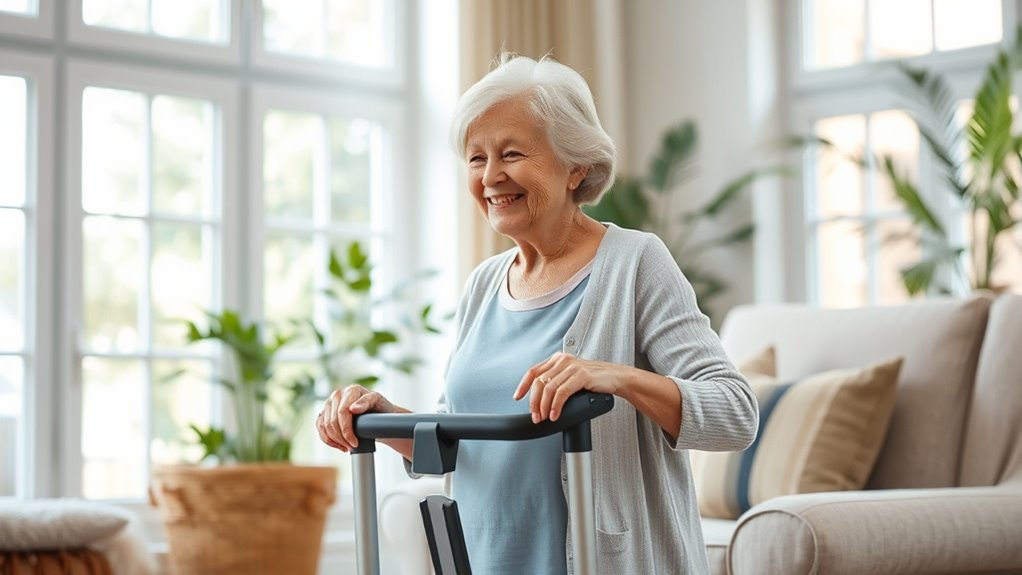

For a stand assist device for an older adult, my best overall pick is the Vive Stand Assist Mobility Standing Aid Rail, a chair and couch rail designed to provide a handhold during sit-to-stand movement. The SPECILITE wide-handle aid is a standout for buyers who need a wider grip and higher stated weight capacity, while the VOCIC wheeled transport chair serves a different need: assisted transfers for someone who cannot safely rise with a stationary rail alone. The main tradeoffs are how much support a person needs, whether the device fits the furniture, and whether a caregiver needs to help with transfers. I compare those differences across all 14 options below. Read on to match the device style to the user, chair, and level of assistance at home.

Give the gift of listening to someone you love
- Choose a 1-, 3-, 6- or 12-month membership
- They pick the audiobooks they love
- Easy to send by email
Complete the kit


Key Takeaways
- Device style determines the use: most picks are stationary rails for chairs or couches, while the VOCIC and Vive Mobility models are patient lifts for assisted transfers.
- The Vive Stand Assist Rail is the broadest starting point for buyers seeking a furniture-side handhold; it is not a substitute for a lift when the user cannot bear weight or follow transfer instructions.
- Grip and capacity separate the more specialized rail options: SPECILITE advertises a wide handle and support up to 450 pounds, features worth checking against the user’s grip and the manufacturer’s setup requirements.
- Adjustability appears across several models, including the NIMOOD L1 and multiple generic adjustable rails, but a range of adjustment only helps when the base can be secured to the actual chair or couch.
- Several listings have similar names and sparse distinguishing details, so buyers should compare dimensions, installation method, included supports, and intended transfer type before choosing among them.
| Vive Stand Assist Mobility Standing Aid Rail for Couch and Chair |  | Best Overall for Cushioned Seats | Weight capacity: 300 lbs | Frame material: Aluminum | Grip material: Soft foam covers | VIEW ON AMAZON | See Our Full Breakdown |
| Adjustable Stand Assist for Elderly |  | Best for Multi-Use Support | Height settings: 10 levels | Design: 2-in-1 stand assist and walking cane | Handle: Thick anti-slip foam | VIEW ON AMAZON | See Our Full Breakdown |
| Adjustable Stand Assist Aid with Night Light |  | Best for Added Stability Features | Height settings: 6 | Frame material: High-strength carbon steel | Weight capacity: 300 lbs | VIEW ON AMAZON | See Our Full Breakdown |
| SPECILITE Couch Stand Assist Aid for Elderly with Wide Handle, Supports Up to 450 lbs |  | Best for Higher Weight Capacity | Support weight: Up to 450 lbs | Height adjustment: 24 to 28.74 inches | Width adjustment: 16 to 19.96 inches | VIEW ON AMAZON | See Our Full Breakdown |
| Couch Stand Assist for Elderly, Adjustable Sofa Mobility Aid for Seniors |  | Best for Removable-Cushion Sofas | Minimum cushion length: 18 in | Minimum cushion width: 18 in | Cushion thickness range: 4–15 in | VIEW ON AMAZON | See Our Full Breakdown |
| Couch Stand Assist for Seniors, Standing Support Handle, Grey |  | Best for a Measured Sofa Fit | Material: Metal | Color: Grey | Height adjustment: 23.5–30.25 in | VIEW ON AMAZON | See Our Full Breakdown |
| VOCIC Sit-to-Stand Lift Patient Transport Chair with Wheels |  | Best for Assisted Transfers | Maximum weight capacity: 400 lb | Item weight: 58 lb | Dimensions: 31 × 17 × 43 in | VIEW ON AMAZON | See Our Full Breakdown |
| Couch Stand Assist for Seniors – Standing Support Handle (White) |  | Best for a Low, Fixed Sofa | Frame material: Reinforced metal | Handle material: Soft foam | Color: White | VIEW ON AMAZON | See Our Full Breakdown |
| Nimood L2 Stand Assist Aid for Elderly – Sitting and Standing Support |  | Best for Chairs and Sofas | Brand: Nimood | Model: L2 | Dimensions: 23 in W × 33.7 in H | VIEW ON AMAZON | See Our Full Breakdown |
| Able Life Universal Stand Assist with Legs – Chair Lift Assist for Elderly, Grab Bar Standing Aid, Brown |  | Best for Recliners | Weight capacity: 300 lb | Cushion height compatibility: 12–21 in above ground | Cushion width compatibility: 19–26 in | VIEW ON AMAZON | See Our Full Breakdown |
| Lift Assist for Elderly – No-Slip Grip Handles, Standing Aid & Support for Seniors, Bariatric Patients or Disabled (Blue) |  | Best Portable Stand Assist Device | Length: 9.6 inches | Width: 10.8 inches | Weight: 0.6 pounds | VIEW ON AMAZON | See Our Full Breakdown |
| NIMOOD L1 Adjustable Stand Assist Rail for Couch and Chair |  | Best for Cushioned Sofas | Brand: NIMOOD | Model: L1 | Materials: Stainless steel and aircraft-grade aluminum | VIEW ON AMAZON | See Our Full Breakdown |
| Stand Assist Aid for Elderly – Sit-to-Stand Mobility Assistance Device |  | Best Freestanding Support Frame | Weight capacity: 350 pounds | Adjustable height: 30–36 inches | Base: Four rubber feet | VIEW ON AMAZON | See Our Full Breakdown |
| Vive Mobility Sit to Stand Patient Lift |  | Best for Caregiver-Assisted Transfers | Maximum weight capacity: 400 pounds | Frame material: Steel | Base width: 26 inches | VIEW ON AMAZON | See Our Full Breakdown |
| stand assist devices for elderly | Frame material |
|---|---|
| Vive Stand Assist Mobility Sta | Aluminum |
| Adjustable Stand Assist for El | Carbon steel |
| Adjustable Stand Assist Aid wi | High-strength carbon steel |
| SPECILITE Couch Stand Assist A | Carbon steel |
| Couch Stand Assist for Elderly | — |
| Couch Stand Assist for Seniors | — |
| VOCIC Sit-to-Stand Lift Patien | Aluminum |
| Couch Stand Assist for Seniors | Reinforced metal |
| Nimood L2 Stand Assist Aid for | — |
| Able Life Universal Stand Assi | — |
| Lift Assist for Elderly | — |
| NIMOOD L1 Adjustable Stand Ass | — |
| Stand Assist Aid for Elderly | — |
| Vive Mobility Sit to Stand Pat | Steel |
More Details on Our Top Picks
Vive Stand Assist Mobility Standing Aid Rail for Couch and Chair
The Vive is my lead pick for someone seeking a straightforward stand assist device for a sofa or chair. Its dual handles give both hands a place to push while rising, and the adjustable aluminum frame fits around the base of many cushioned seats. Compared with the HeywoodCabin 2-in-1, it is dedicated to seated transfers rather than also serving as a cane, which makes its purpose clear but limits where it helps. The foam grips add comfort, and the 300-pound capacity is specified. Fit is the main tradeoff: non-cushioned or very low seats may not work, and a snug installation can mean removing cushions. I’d choose it for a compatible everyday chair, but check the seat before buying.
Pros:- Dual handles provide two points of leverage when standing
- Adjustable aluminum frame fits around many cushioned seats
- Soft foam grip covers support a more comfortable hold
- Specified 300-pound weight capacity
Cons:- May not fit non-cushioned or very low seats
- A snug setup may require removing seat cushions
Best for: Older adults who need two-handed leverage getting up from a compatible cushioned sofa, chair, or recliner
Not ideal for: People using non-cushioned or very low seats, or anyone who cannot remove cushions during installation
- Weight capacity:300 lbs
- Frame material:Aluminum
- Grip material:Soft foam covers
- Color:Black
- Adjustable:Yes
- Installation:Fits around the base of cushioned seats
Our verdict“Choose the Vive for two-handed support at a compatible cushioned seat; pick the HeywoodCabin if you also need a cane-style aid.”
Adjustable Stand Assist for Elderly
The HeywoodCabin stands apart in this group because it combines a standing rail and walking cane. Ten height settings give buyers more ways to set the support to their needs than the Vive’s seat-focused frame, while tool-free assembly makes it easier to move or set up. The wide non-slip base and foam handle are intended to support indoor use during everyday mobility. That versatility comes with a different fit: unlike the Vive, this is not described as a rail secured around a sofa cushion, so buyers should not assume it provides the same anchored seated-transfer support. Its main limitation is also stated plainly: it is primarily intended for indoors. I’d consider it for someone who wants one adjustable aid for standing and short indoor walking, but skip it if the priority is a seat-mounted rail.
Pros:- Combines a stand assist and walking cane in one device
- Ten height settings allow a tailored setup
- Wide non-slip base and anti-slip foam handle
- Tool-free assembly supports setup and portability
Cons:- Primarily intended for indoor use
- Does not provide the described cushion-fitting rail design of the Vive
Best for: Older adults who want one height-adjustable device for standing assistance and indoor cane use
Not ideal for: People who need a rail fitted around a sofa or regular outdoor walking support
- Height settings:10 levels
- Design:2-in-1 stand assist and walking cane
- Handle:Thick anti-slip foam
- Base:Wide non-slip
- Frame material:Carbon steel
- Assembly:Tool-free
- Brand:HeywoodCabin
- Intended use:Primarily indoors
Our verdict“Pick the HeywoodCabin for adjustable indoor standing and cane support, while the Vive better suits a fixed cushioned seat.”
Adjustable Stand Assist Aid with Night Light
This model adds a night light, mesh pocket, and extra horizontal bars to a freestanding stand assist format. Its wide rubber base and six height settings give buyers practical setup options, and the stated 300-pound capacity matches the Vive’s, though the two products suit different setups: the Vive fits around cushioned seats, while this model emphasizes base stability and added nighttime visibility. The light may be useful near a chair in a dim room, but the product data does not specify its range or power source, so I would not treat it as a substitute for room lighting. Assembly requires tools, making setup less simple than the HeywoodCabin’s tool-free design. I’d choose this for someone who values the extra features and can assemble it; skip it if easy setup is the priority.
Pros:- Six height settings allow adjustment
- Wide rubber base and two extra horizontal bars add stability features
- Includes a night light and mesh storage pocket
- Specified 300-pound weight capacity
Cons:- Requires tool-based assembly
- Light range and power details are not specified
- Does not have the Vive’s described cushion-fitting design
Best for: Older adults who want a height-adjustable stand aid with a night light and storage pocket
Not ideal for: Buyers who need tool-free setup or a rail specifically fitted around a sofa cushion
- Height settings:6
- Frame material:High-strength carbon steel
- Weight capacity:300 lbs
- Stability features:Two additional horizontal bars and a larger rubber base
- Additional features:Night light and mesh pocket
- Handle:Foam
- Assembly:Tools and accessories included
Our verdict“Choose this model for its added light and storage features if assembly is manageable; choose the HeywoodCabin for tool-free setup.”
SPECILITE Couch Stand Assist Aid for Elderly with Wide Handle, Supports Up to 450 lbs
The SPECILITE is the standout for buyers who need a stated 450-pound capacity and an adjustable fit at a sofa. Its height and width adjustments let shoppers match the frame to a wider range of seat dimensions than the cushion-size requirements listed for the Couch Stand Assist at the end of this batch. At 12 pounds, it is portable by the supplied product information, though heavier than a minimal rail might be. The PU handles are described as non-slip and waterproof. Fit remains restrictive: it is not suitable for electric sofas, recliners, or floor sofas, and the seat needs at least 1.5 inches of ground clearance. Compared with the Vive, it offers a higher stated capacity but has more explicit sofa exclusions. Measure first and choose it only if the sofa meets those requirements.
Pros:- Specified support weight of up to 450 lbs
- Adjusts in both height and width
- Non-slip, waterproof PU handles
- 12-pound construction is described as portable
Cons:- Not suitable for electric sofas, recliners, or floor sofas
- Requires at least 1.5 inches of ground clearance
- Fit is limited to sofas within its adjustment dimensions
Best for: Seniors who need a sofa stand aid with a higher stated weight capacity and adjustable frame dimensions
Not ideal for: People using electric sofas, recliners, floor sofas, or seats without at least 1.5 inches of ground clearance
- Support weight:Up to 450 lbs
- Height adjustment:24 to 28.74 inches
- Width adjustment:16 to 19.96 inches
- Frame material:Carbon steel
- Handle material:PU
- Weight:12 lbs
- Ground clearance required:At least 1.5 inches
Our verdict“Choose the SPECILITE when its sofa-fit requirements are met and the higher stated capacity matters more than broad seat compatibility.”
Couch Stand Assist for Elderly, Adjustable Sofa Mobility Aid for Seniors
This couch aid is a focused option for households with removable cushions that meet its minimum dimensions. Its thick steel frame and wrist-friendly grip are intended to give a user leverage while rising, and adjustable sizing accommodates different user heights and body types. Unlike the SPECILITE, whose stated fit depends on height, width, and ground clearance, this product specifies cushion length, width, and thickness; that makes checking sofa compatibility a key part of the choice. The tradeoff is a narrower fit: it is only for removable sofa cushions and is not suitable for recliners or electric lift chairs. Soft or incorrectly sized cushions can also compromise stability. I’d shortlist it for a conventional sofa that matches the measurements, but choose the Vive if a broader cushioned-seat fit is needed.
Pros:- Thick steel frame provides a sturdy support structure
- Wrist-friendly grip is designed to reduce hand strain
- Adjustable sizing accommodates different user heights and body types
- Cushion dimensions are specified for fit checking
Cons:- Only compatible with sofas that have removable cushions
- Not suitable for recliners or electric lift chairs
- Soft or incorrectly sized cushions may cause instability
Best for: Older adults who need extra leverage from a conventional sofa with removable cushions that meet the listed size requirements
Not ideal for: People using recliners, electric lift chairs, fixed-cushion sofas, or overly soft cushions
- Minimum cushion length:18 in
- Minimum cushion width:18 in
- Cushion thickness range:4–15 in
- Material:Thick steel
- Suitable seating:Removable sofa cushions
- Sizing:Adjustable
- Grip:Wrist-friendly
Our verdict“Choose this aid if your removable sofa cushions meet its measurements; the Vive is a better fit to investigate for broader cushioned-seat use.”
Couch Stand Assist for Seniors, Standing Support Handle, Grey
Height and width adjustment make this a practical choice for someone who wants a handhold beside a compatible sofa and can still rise using their own leg strength. Its 300 lb capacity and foam grips support everyday sit-to-stand use, while the ability to leave it in place avoids repeated setup. Compared with the Able Life Universal Stand Assist, this model gives buyers height and width ranges for fitting the frame, while Able Life also lists cushion depth compatibility and recliner use. The tradeoff is a narrower fit: this handle is not suited to floor-level or reclining sofas, and measurements matter before purchase. It offers standing support rather than a lift, so it will not help someone who cannot rise without substantial assistance.
Pros:- Adjustable height and width accommodate varied compatible sofas
- Foam handles provide a comfortable gripping surface
- 300 lb weight capacity
- Can remain set up for regular daily use
Cons:- Does not fit floor-level or reclining sofas
- Requires careful measurement to confirm compatibility
- Provides a handhold, not powered or lifting assistance
Best for: Older adults who can stand with a handhold and families able to measure a standard sofa before choosing a fixed support aid
Not ideal for: People using recliners, floor-level sofas, or needing a device to lift them into standing
- Material:Metal
- Color:Grey
- Height adjustment:23.5–30.25 in
- Width adjustment:22.6–24.75 in
- Weight capacity:300 lb
- Handle material:Foam
Our verdict“Choose this for a compatible sofa when the user can stand independently with a steady handhold.”
VOCIC Sit-to-Stand Lift Patient Transport Chair with Wheels
Wheels and dual-lock brakes set this apart from the stationary couch rails in this roundup: it is a transport chair for moving a person during transfers, not simply a handhold for standing from a sofa. The reinforced aluminum frame supports up to 400 lb, and the padded grips, shin pads, and split seat provide contact points for an appropriate sit-to-stand transfer. Compared with the Able Life Universal Stand Assist, VOCIC is aimed at caregiver-assisted movement between locations; Able Life is a lighter, fixed aid for a person who can rise at home. That broader transfer role comes with real limits: the user must sit upright and support their core, and the chair has no safety belt. At 58 lb, it also takes more effort to position than a rail.
Pros:- 400 lb maximum capacity with reinforced aluminum frame
- Dual-lock braking system on the casters
- Padded handgrips, shin pads, and split-seat cushion
- Low-profile base can slide under many furnishings
Cons:- User must sit up and support their own core
- No safety belt restraint is included
- 58 lb weight makes it less convenient to reposition than a stationary rail
Best for: Caregivers transferring an upright user who can support their core and needs a wheeled aid between nearby surfaces
Not ideal for: People who cannot sit up unaided, need a restraint belt, or want a simple fixed sofa handhold
- Maximum weight capacity:400 lb
- Item weight:58 lb
- Dimensions:31 × 17 × 43 in
- Frame material:Aluminum
- Seat material:Foam
- Adjustable knee pad range:51–56 cm
- Caster size:3 in rear; 4 in front
- Safety braking system:Dual-lock
Our verdict“Choose VOCIC for caregiver-assisted transfers with a user who can sit upright, rather than for independent sofa standing.”
Couch Stand Assist for Seniors – Standing Support Handle (White)
Seat-height and clearance limits make this a more specific sofa pick than the adjustable Nimood L2. It fits seats under 22 inches high and needs at least 1.4 inches of floor clearance beneath the sofa, so checking those measurements can help avoid a poor fit. Once adjusted, its reinforced metal frame and foam grips can stay in place for daily use, supporting users up to 300 lb. Like the grey Couch Stand Assist in this lineup, it is meant to provide a handhold for someone who can push up with their legs; it is not a lifting device. The white version spells out more compatibility boundaries, including problems with recliners and sofas with bottom support bars. That clarity helps buyers who have a suitable fixed sofa, but rules out many furniture setups.
Pros:- Height and width adjust to fit a range of sofas
- Foam grips offer a comfortable hold
- Reinforced metal frame supports up to 300 lb
- One-time adjustment is intended to stay set for everyday use
Cons:- Needs at least 1.4 in of clearance beneath the sofa
- Not compatible with recliners or sofas with bottom support bars
- User needs enough leg strength to stand without lifting assistance
Best for: Older adults with a fixed sofa under 22 inches high, adequate floor clearance, and enough leg strength to stand using a handhold
Not ideal for: People with recliners, floor-level seating, sofa support bars, or limited ability to rise using their own strength
- Frame material:Reinforced metal
- Handle material:Soft foam
- Color:White
- Adjustable height:23.5–30.25 in
- Adjustable width:22.6–24.75 in
- Maximum load:300 lb
- Minimum floor clearance:1.4 in
- Compatible seat height:Under 22 in
Our verdict“Choose this if your fixed sofa meets the stated height and clearance limits and the user can stand with a handhold.”
Nimood L2 Stand Assist Aid for Elderly – Sitting and Standing Support
Chair-and-sofa flexibility gives the Nimood L2 a broader everyday role than the white Couch Stand Assist, which specifies a minimum floor clearance and a seat-height limit. The L2 has dual handles and adjustable width and height, so it can suit different cushioned seats when its fit requirements are met. Its anti-slip feet are intended to steady the frame on uneven floors, while the 300 lb capacity suits buyers looking for a stationary support aid rather than a transport chair like the VOCIC Sit-to-Stand Lift. The tradeoff is setup: the listed installation may be cumbersome, and this model requires removable cushions and does not fit recliners. Its stainless-steel material listing also does not resolve the fit question; buyers should confirm their cushion arrangement before choosing it.
Pros:- Dual ergonomic handles provide two gripping points
- Adjustable width and height accommodate varied cushioned seats
- Anti-slip feet are designed to steady the frame
- 300 lb weight capacity
Cons:- Requires removable couch cushions
- Not compatible with recliners
- Installation may be cumbersome
Best for: Older adults who want a stationary dual-handle aid for compatible chairs or sofas with removable cushions
Not ideal for: People with recliners, fixed cushions, or who need a wheeled transfer aid or help lifting into standing
- Brand:Nimood
- Model:L2
- Dimensions:23 in W × 33.7 in H
- Material:Stainless steel
- Color:Deep black
- Weight capacity:300 lb
- Unit count:1
Our verdict“Choose the L2 for a stationary, adjustable handhold across compatible chairs and sofas when cushion removal is possible.”
Able Life Universal Stand Assist with Legs – Chair Lift Assist for Elderly, Grab Bar Standing Aid, Brown
Recliner compatibility is the Able Life’s clearest advantage among these stationary aids: its listed fit covers fixed, stitched, and removable cushions, and it works with couches or recliners. Cushion measurements are specific, spanning 12–21 inches high, 19–26 inches wide, and 24–27 inches deep; that detail makes it easier to judge fit than the grey Couch Stand Assist, which calls for measurement but does not list cushion dimensions. Padded handles adjust 7–10 inches above the frame, giving users some choice in grip position. Its 300 lb capacity matches several other rails here, but compatibility does not guarantee a fit for every chair. Careful positioning around or under the cushion may take effort, and this remains a standing support aid, not a lift for someone unable to rise.
Pros:- Compatible with couches and recliners
- Fits fixed, stitched, and removable cushions
- Adjustable cushion height, width, and depth ranges
- Padded handles adjust to suit grip preference
Cons:- Requires careful measurement and positioning during installation
- 300 lb capacity may not suit users who need a higher-capacity aid
- Provides a handhold but does not lift the user
Best for: Older adults who need a handhold at a recliner or couch with cushion dimensions inside the listed fit range
Not ideal for: People whose chair falls outside the cushion measurements or who need substantial lifting assistance to stand
- Weight capacity:300 lb
- Cushion height compatibility:12–21 in above ground
- Cushion width compatibility:19–26 in
- Cushion depth compatibility:24–27 in
- Handle adjustment:7–10 in above frame
- Color:Brown
Our verdict“Choose Able Life for a measured-fit couch or recliner when the user can stand with support from adjustable padded handles.”
Lift Assist for Elderly – No-Slip Grip Handles, Standing Aid & Support for Seniors, Bariatric Patients or Disabled (Blue)
For someone who needs a handhold they can bring between a chair, bed, and car seat, the Liberty Lift Assist is the most portable option in this group. At 0.6 pounds, it is far easier to carry than the NIMOOD L1 rail, which stays positioned around a chair. Its textured grip and stated 420-pound capacity make it a compact aid for users who can rise with a firm handhold. The tradeoff is leverage: at just 9.6 by 10.8 inches, it depends on a sturdy, straight surface to lean against, so it offers less frame support than the freestanding 350-pound stand assist aid. I would choose it for portability, but skip it when a user needs a broad, fixed support frame or has trouble gripping and pulling.
Pros:- At 0.6 pounds, it is easy to carry and reposition.
- Textured non-slip handle supports a steadier grip.
- Can be used beside chairs, beds, or car seats.
- Listed maximum load is 420 pounds.
Cons:- Compact size may provide limited leverage on larger or deep seating.
- Needs a sturdy, straight surface to lean against.
- A single blue color offers no color choice.
Best for: Seniors who can push up with a handhold and want a lightweight aid to carry between home, vehicle, and outdoor seating.
Not ideal for: People who need a wide, freestanding frame for balance or cannot reliably brace the device against a sturdy, straight surface.
- Length:9.6 inches
- Width:10.8 inches
- Weight:0.6 pounds
- Maximum load:420 pounds
- Handle:Textured, non-slip grip
- Frame:Lightweight composite
- Color:Blue
Our verdict“Choose the Liberty Lift Assist if portability matters and the user can rise using a handhold braced against a suitable surface.”
NIMOOD L1 Adjustable Stand Assist Rail for Couch and Chair
The NIMOOD L1 is aimed at a specific problem: getting up from a cushioned chair or sofa where there is room to fit a support rail. Its width-adjustable arms and height-adjustable padded handles let the setup adapt to different seating dimensions, while the flat-tube base is designed to help resist slipping. Compared with the Liberty Lift Assist, this rail gives the user a larger, chair-based support point, but it is much less portable and depends on the right cushion setup. The cushions must be firm, removable, and at least four inches thick; the product is also unsuitable for recliners and electric lifting chairs. I would favor it over the compact Liberty aid for a compatible sofa, but skip it if the seat cannot meet those requirements.
Pros:- Adjustable arms and handles can fit different seating dimensions.
- Soft foam padding makes the grip more comfortable.
- Flat-tube base is designed to help prevent slipping.
- Listed capacity is 300 pounds.
Cons:- Requires firm, removable cushions at least four inches thick.
- Not suitable for recliners or electric lifting chairs.
- Chair-based frame is less portable than the Liberty Lift Assist.
Best for: Older adults who need arm support rising from a sofa or chair with firm, removable cushions at least four inches thick.
Not ideal for: Households with recliners, electric lift chairs, or seating without suitable removable cushions.
- Brand:NIMOOD
- Model:L1
- Materials:Stainless steel and aircraft-grade aluminum
- Maximum weight capacity:300 pounds (136 kg)
- Dimensions:26 x 16.7 inches
- Item weight:2.42 kg
- Adjustability:Width-adjustable arms and height-adjustable handles
- Cushion requirement:Firm, removable cushions at least 4 inches thick
- Handle padding:Soft foam
Our verdict“Pick the NIMOOD L1 for a compatible cushioned sofa or chair when adjustable, padded handles matter more than portability.”
Stand Assist Aid for Elderly – Sit-to-Stand Mobility Assistance Device
When a user needs support that stands on the floor rather than attaching to a particular chair, this adjustable aid has a practical advantage over the NIMOOD L1. Its 30-to-36-inch height range, padded handles, and four rubber feet provide a freestanding handhold for sit-to-stand movements without permanent installation. The listed 350-pound capacity places it below the 400-pound Vive patient lift, but this frame does not have casters or claim to move a patient between surfaces. A storage pouch keeps small essentials nearby, though the key limitation is the user: they need enough arm strength to use the handholds safely. I would choose it for basic rising support across suitable seating, not for someone who needs walking assistance or substantial caregiver-assisted transfers.
Pros:- Height adjusts from 30 to 36 inches.
- Four rubber feet provide a non-slip base.
- Padded handles give the user a comfortable gripping surface.
- Portable design requires no permanent installation.
Cons:- Requires sufficient arm strength to use the handholds safely.
- Not intended as a walker or rollator.
- Its 350-pound capacity is lower than the Vive patient lift’s 400-pound capacity.
Best for: Adults with limited mobility who can use their arms to rise and want an adjustable, freestanding support frame without permanent installation.
Not ideal for: People who need a walker, rollator, full-body walking support, or caregiver-assisted transfer equipment.
- Weight capacity:350 pounds
- Adjustable height:30–36 inches
- Base:Four rubber feet
- Installation:No permanent installation required
- Handles:Padded
- Storage:Built-in pouch
Our verdict“Choose this frame for adjustable, freestanding help with standing when the user has enough arm strength and does not need walking or transfer support.”
Vive Mobility Sit to Stand Patient Lift
The Vive Mobility Sit to Stand Patient Lift serves a different need from the handheld Liberty aid or the floor-based stand assist frame: it is a mobile patient lift for transfers between surfaces. Its four swivel casters help a caregiver position it, while dual locking brakes, cushioned handrails, and shin rests support the transfer setup. With a 400-pound capacity, it is rated above the NIMOOD L1, though below the Liberty Lift Assist’s listed maximum load. The central tradeoff is user ability: the patient must support 60–70% of their body weight, so this is not a full-body lift for someone unable to bear weight. Its 26-inch base may also restrict access through narrow doorways. I would pick it for suitable caregiver-assisted transfers, not everyday chair-side standing alone.
Pros:- Four swivel casters help position the lift between surfaces.
- Dual locking brakes help hold it in place during transfers.
- Cushioned handrails and shin rests support user comfort.
- Listed maximum capacity is 400 pounds.
Cons:- Patient must support 60–70% of their body weight.
- The 26-inch base may not fit through narrow doorways.
- A mobile transfer lift is bulkier than the Liberty Lift Assist for simple standing support.
Best for: Caregivers supporting patients who can bear most of their weight and need help transferring between a bed, wheelchair, or other surface.
Not ideal for: Patients unable to support 60–70% of their body weight, or households where a 26-inch base cannot pass through doorways.
- Maximum weight capacity:400 pounds
- Frame material:Steel
- Base width:26 inches
- Mobility:Four swivel casters
- Brakes:Dual locking brakes
- User weight-bearing requirement:Must support 60–70% of their body weight
- Warranty:2-year guarantee
Our verdict“Choose the Vive lift for caregiver-assisted transfers when the patient can bear most of their weight and the base fits the home.”
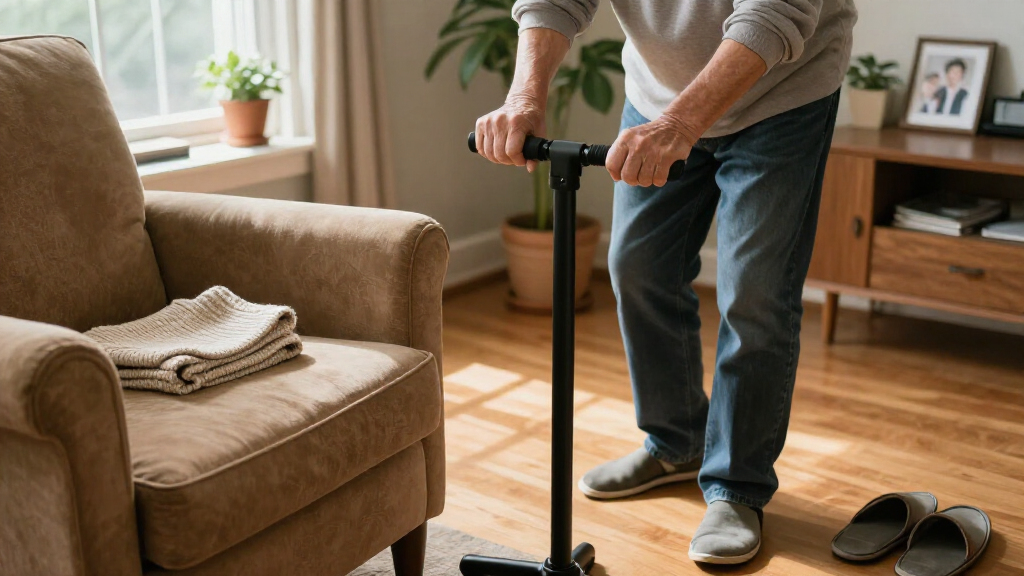
How We Picked
I ranked these devices by how clearly their described design matches common sit-to-stand needs, how much useful support the product information identifies, and how readily a buyer can assess fit and intended use. For stationary rails, I gave weight to adjustability, handle shape, stated capacity, and whether the product is presented for chair or couch use. For wheeled lifts, I considered their different role in caregiver-assisted transfers rather than treating them as interchangeable with a simple grab rail.
The Vive rail leads as a clear general-purpose furniture-side support option, while SPECILITE earns a distinct place for its wide handle and stated capacity. The Nimood and Able Life rails offer alternatives for buyers prioritizing sitting and standing support or a leg-supported frame. I placed patient lifts in their own use case, since they address transfers that a fixed rail may not. Many listings provide limited detail, so I do not infer safety, clinical suitability, or ease of installation from a product name alone; buyers should verify measurements, setup, and user requirements with the manufacturer or a qualified clinician.
| stand assist devices for elderly | Frame material |
|---|---|
| Vive Stand Assist Mobility Sta | Aluminum |
| Adjustable Stand Assist for El | Carbon steel |
| Adjustable Stand Assist Aid wi | High-strength carbon steel |
| SPECILITE Couch Stand Assist A | Carbon steel |
| Couch Stand Assist for Elderly | — |
| Couch Stand Assist for Seniors | — |
| VOCIC Sit-to-Stand Lift Patien | Aluminum |
| Couch Stand Assist for Seniors | Reinforced metal |
| Nimood L2 Stand Assist Aid for | — |
| Able Life Universal Stand Assi | — |
| Lift Assist for Elderly | — |
| NIMOOD L1 Adjustable Stand Ass | — |
| Stand Assist Aid for Elderly | — |
| Vive Mobility Sit to Stand Pat | Steel |
Factors to Consider When Choosing Stand Assist Devices For Elderly
Choosing a stand assist device starts with the movement the user needs help with and the furniture or transfer setup at home. These checks can prevent a mismatch that no feature list can fix.
Match the device to the transfer
First identify whether the user can stand by pushing through their legs and holding a stable rail, or whether they need a caregiver to support most of the transfer. A stationary rail is meant to provide a handhold beside suitable furniture; a wheeled lift is a different category with caregiver involvement and its own setup requirements. Do not assume that a device described as a “lift” will raise a person from every position or without assistance. If the user has fallen during transfers, cannot bear weight reliably, or has been advised against standing, ask a clinician or physical therapist which transfer method fits. Choosing by the word “stand assist” alone can lead to buying the wrong kind of device.
Measure the furniture and the user’s reach
Measure seat height, seat depth, armrest spacing, and the clearance around the chair or couch before ordering. Compare those figures with the device’s adjustment range and footprint, including the space needed for legs or a base to sit securely. A rail that fits one chair may be unstable or unusable on a deep, soft couch or a seat with an unusual frame. Check whether the user’s hand reaches the grip comfortably from sitting and whether the handle placement allows a natural push without twisting. If a listing omits dimensions, contact the seller or manufacturer before relying on a product image.
Check what the stated capacity covers
Weight capacity is only one part of fit: it does not by itself establish that a frame will suit a particular user, chair, or transfer technique. Compare the listed limit with the user’s weight and follow the manufacturer’s instructions for installation and use. A wide handle, such as the one described for SPECILITE, may suit someone who wants more gripping area, but it cannot make up for weak balance or a poor furniture fit. Look for clear information about where the device bears weight and how it is secured. When capacity or stability details are unclear, seek confirmation before purchase.
Plan for installation and daily use
Consider who will assemble the device, move it, and check it over time. A rail that must be positioned or secured around furniture can be a poor choice if the household cannot complete that setup as directed. Think through the routine: does the user need the support at one chair, several seats, or during transfers between rooms? A fixed rail can make sense for a consistent seating spot, while a wheeled transfer device introduces caregiver handling and storage needs. Read the manual for inspection, cleaning, and maintenance instructions, since loose fittings or worn components can change how the device performs.
Prioritize grip, balance, and supervision
Users differ in hand strength, dexterity, balance, and ability to follow step-by-step instructions. A firm grip on a handle does not guarantee a safe transfer if the user leans heavily, has one-sided weakness, or cannot control the descent to sitting. Ask whether the device’s handle shape and placement match the user’s stronger hand and normal movement pattern. Some people may need direct supervision or another mobility aid even with a rail installed. A therapist can assess the transfer and demonstrate where the user should place their hands and feet.
Know when added support is worth the complexity
Paying for a more involved device may make sense when a caregiver must assist with transfers that a stationary rail cannot support. That choice also brings more setup, storage, and operating considerations, so confirm that the home has room and the caregiver can use the equipment as directed. For someone who can stand independently with a stable handhold, a patient lift may add unnecessary complexity. For someone who cannot safely rise using their own strength, a basic rail may create false confidence. Base the decision on an observed transfer and professional guidance, not on the apparent size of the device.
Frequently Asked Questions
How do I know whether a chair rail or a patient lift is the right device?
Consider how much of the movement the user can perform independently. A chair rail provides a handhold for someone who can contribute meaningful leg strength and follow the transfer steps. A patient lift is intended for a different, caregiver-assisted transfer situation, and it requires suitable training and space. If the user cannot bear weight reliably or has had unsafe near-falls, ask a clinician to assess the transfer before buying. The product label alone cannot determine which device is appropriate.
Will a stand assist rail work with any couch or chair?
No; furniture shape and construction can affect whether a rail can be positioned and secured as directed. Measure the seat and check the device’s installation requirements, adjustment range, and base footprint. Soft cushions, deep seats, narrow frames, or unusual armrests may make a seemingly suitable rail a poor fit. Ask the manufacturer about compatibility when the instructions do not address your furniture type. Do not use a device if it cannot be installed in the specified way.
Is a higher weight capacity enough to decide which rail is safer?
No. Capacity is one specification, and it does not confirm that the device fits the chair, supports the user’s movement, or is installed correctly. Compare the user’s weight with the manufacturer’s stated limit, then check handle placement, frame design, and setup directions. A wide handle may be easier for some users to grasp, but a grip feature does not replace balance or leg strength. Ask a qualified professional if the user’s transfer ability is uncertain.
Can an older adult use a stand assist device alone?
That depends on the individual’s strength, balance, judgment, and the device’s instructions. A rail may suit someone who can stand and sit with control, but another person may need supervision or hands-on help. A wheeled patient lift has caregiver involvement and should be used according to its instructions and training requirements. Have a clinician or therapist observe the transfer if there is any doubt about independent use. Stop using a device that shifts, feels unstable, or causes pain.
What should I verify before ordering an adjustable stand assist device?
Check the full adjustment range, the furniture dimensions it accommodates, the installation method, and the stated weight capacity. Confirm whether the listed product is a fixed rail or a transfer lift, since those devices serve different needs. Look for clear instructions on assembly, inspection, and compatible seating; product titles alone can be too similar to distinguish models. Also consider whether the user can reach and grip the handle from their normal sitting position. If a key measurement or instruction is missing, request it before purchase.
Conclusion
For a general-purpose furniture-side handhold, I recommend the Vive Stand Assist Mobility Standing Aid Rail as the best overall starting point. The SPECILITE wide-handle rail is a better match for buyers who prioritize a larger grip and want to check its stated 450-pound capacity against their needs. For a beginner who can stand with a handhold, start by measuring the main chair and comparing adjustable stationary rails such as the NIMOOD L1; simple setup and a secure fit matter more than extra features. Buyers seeking a distinct sitting-and-standing support style can compare the Able Life Universal Stand Assist and Nimood L2 details, while the VOCIC or Vive Mobility patient lift may suit caregiver-assisted transfer needs. I would choose the device only after confirming furniture compatibility and the user’s transfer ability with a qualified professional when needed.
Black Friday Picks

Withings Body Scan Smart Scale with Segmental Body Composition and ECG, Black
As an affiliate, we earn on qualifying purchases.