When selecting a weather alert radio with solar charging, it’s vital to balance reliability, power options, and features suited for emergencies. The NOAA Weather Radio with 12000mAh Battery stands out for its large capacity and versatile power sources, making it the best overall pick. For those prioritizing portability and compact design, the Prunus J-366 Emergency Radio offers a great balance of features in a small package. The FosPower NOAA Emergency Weather Radio A1 is better suited for outdoor use thanks to its rugged build and additional safety features. Keep reading for a detailed breakdown of these options and what to look for in your ideal weather radio.

Turn quiet afternoons into listening time
- Thousands of audiobooks, podcasts and originals
- Listen on your phone, tablet or Echo — also offline
- Cancel anytime
Complete the kit


Key Takeaways
- Top models combine large battery capacities with multiple charging options, ensuring extended use during emergencies.
- Portability and compact design are key for outdoor and travel use, but may limit some features like LCD screens or extra lighting.
- Durability and weatherproofing vary widely; rugged models are better suited for harsh outdoor environments.
- Additional features such as Bluetooth, reading lamps, and multiple alert channels add convenience but often increase cost.
- A balance between price and features is essential; premium models offer more reliability but may be unnecessary for casual users.


| weather alert radio with solar charging | Battery Capacity | Power Sources |
|---|---|---|
| NOAA Weather Radio with 12000m | 12000mAh | Solar, Hand Crank, AC, 3 AAA batteries |
| VEVOR Emergency Weather Radio | 4000mAh | Built-in battery, USB, solar, hand crank |
| Emergency Crank Radio with NOA | 7400mWh (2000mAh) | — |
| Emergency Radio with Hand Cran | 12000mAh | — |
| C. Crane CCRadio Solar with Bl | 3400mAh | — |
| Prunus J-366 Emergency Radio w | — | — |
| Emergency NOAA Weather Alert R | 10000mAh | Rechargeable battery, solar, hand crank, USB-C |
| NOAA Emergency Radio with Auto | 12000mAh | AC, USB, hand crank, solar, AAA batteries, rechargeable |
| Mesqool Emergency Weather Radi | 12000mAh | Solar, hand crank, rechargeable battery, USB |
| NITIGO Emergency Weather Radio | 4000mAh | — |
| FosPower NOAA Emergency Weathe | — | Crank, Solar, AAA Batteries |
| Emergency Weather Radio with L | 12000mAh | — |
| 10,000mAh Emergency Weather Ra | 10,000mAh | Solar, Hand Crank, AC |
| Weather Radio with NOAA Alerts | 5000mAh | Solar, Hand Crank, Micro USB, Wall, AAA Batteries |
| NOAA Weather Radio with 20000m | 20000mAh | — |
More Details on Our Top Picks
NOAA Weather Radio with 12000mAh Battery, Solar Panel, Hand Crank, and Emergency Features
This model stands out for its robust battery capacity and versatile power options, combining solar, hand crank, AC, and batteries to maximize reliability during prolonged outages. Unlike the smaller, lighter VEVOR Emergency Weather Radio, it offers a significantly larger 12000mAh battery, supporting extended use and multiple devices. While its size adds weight and reduces portability, it compensates with emergency features like a 600-lumen flashlight and SOS siren, making it ideal for serious preparedness. The multiple charging methods can be complex for some users, but this flexibility is invaluable in unpredictable situations. If portability is less critical than long-lasting power, this model is a strong choice.
Pros:- Massive 12000mAh battery supports extended device charging and operation
- Multiple charging options including solar, hand crank, and AC for versatility
- Built-in flashlight and SOS siren enhance emergency preparedness
Cons:- Large size reduces portability, making it less convenient for backpacking
- Complexity of multiple power sources may be confusing for some users
Best for: Emergency preppers and outdoor enthusiasts needing a reliable, long-duration power source with comprehensive features.
Not ideal for: Casual users or those prioritizing lightweight, compact radios for quick outdoor use, due to its size and complexity.
- Battery Capacity:12000mAh
- Solar Panel:8500mm² monocrystalline
- Power Sources:Solar, Hand Crank, AC, 3 AAA batteries
- Radio Bands:NOAA, AM, FM
- Output Power:5W stereo speaker
- Flashlight Brightness:600 lumens
Our verdict“This radio is best suited for serious emergency preparedness where long-lasting power and multiple features outweigh portability concerns.”
VEVOR Emergency Weather Radio, 4000mAh Battery, FM/AM/WB/NOAA Alert Solar Hand Crank Emergency Radio with USB Charging, SOS Alarm, and Flashlight
Compared with the more feature-rich NOAA Weather Radio with 12000mAh Battery, the VEVOR offers a solid balance of essential features at a lower price point. Its 4000mAh battery and multiple power sources—solar, USB, hand crank—support reliable operation during emergencies, though its smaller capacity means shorter run times. The inclusion of versatile lighting modes and a water resistance rating of IPX3 makes it practical for outdoor use, but its bulkier design can be less convenient for portable needs. This model is a good choice for budget-conscious users who want dependable alerts and emergency features without extra frills.
Pros:- Multiple power sources including solar, USB, and hand crank for versatility
- Supports NOAA alerts, SOS alarms, and multiple lighting modes
- Water-resistant (IPX3) for outdoor durability
Cons:- Lower battery capacity limits usage duration compared to larger models
- Bulkier design reduces portability for frequent travelers
Best for: Budget-conscious outdoor adventurers and campers seeking reliable alerts with basic backup power options.
Not ideal for: Users requiring long-duration power or ultra-portable designs, as its bulk hampers ease of transport and extended use.
- Battery Capacity:4000mAh
- Power Sources:Built-in battery, USB, solar, hand crank
- Radio Bands:FM, AM, WB, NOAA
- Lighting:High-beam LED, COB low-beam, 6 reading lights
- Water Resistance:IPX3
- Weight:0.9 lbs
Our verdict“This radio offers dependable emergency alerts and multiple power options at a competitive price, ideal for outdoor use but less suited for extended power needs.”
Emergency Crank Radio with NOAA Weather Alerts, Solar Power, AM/FM, LED Flashlight, LCD Screen, Headphone Jack
This model makes the most of its compact design by combining NOAA alerts, solar, and hand crank power with a clear LCD display and multiple lighting options. Compared to larger units like the NOAA Weather Radio with 12000mAh Battery, it emphasizes portability and detailed information, thanks to its LCD screen showing frequency and battery status. Its 7400mWh battery and multiple power inputs ensure reliable operation, but it requires manual switching between sources, which could be inconvenient during emergencies. Its size and feature set suit those who need a portable, information-rich radio for home or outdoor survival.
Pros:- Compact design with a backlit LCD for easy operation
- Multiple power inputs including solar, hand crank, USB-C, and batteries
- Effective NOAA alerts with auto alarm and loud SOS signal
Cons:- Requires manual switching between power sources, which can be inconvenient
- Limited frequency range may not pick up all signals
Best for: Campers and survivalists who need reliable NOAA alerts in a compact, easy-to-carry device with clear information display.
Not ideal for: Users seeking the longest possible battery life or maximum power capacity, as its smaller battery limits extended use.
- NOAA Bands:7 preset channels with auto-alert
- Power Options:solar panel, hand crank, USB-C, internal battery, AAA batteries
- Battery Capacity:7400mWh (2000mAh)
- Display:Backlit LCD
- Reception Frequencies:AM: 520-1710KHz, FM: 87.5-108MHz, NOAA: 162.400-162.550MHz
- Dimensions:6”x3”x1.6”
Our verdict“This portable, feature-rich radio is well-suited for outdoor survival or camping where size and clarity matter most.”
Emergency Radio with Hand Crank & Solar, NOAA Weather Alerts, 12000mAh, 5W Flashlight & Reading Light
This model emphasizes its large 12000mAh capacity and multi-band reception, including NOAA, AM, FM, and WB, supported by solar and hand crank power. Compared with the C. Crane CCRadio Solar, it offers a larger battery and bright emergency lighting features like a 5W flashlight and reading lamp. Its water resistance (IPX6) adds outdoor robustness, but its size makes it less portable for quick trips. The sound quality and tuning are adequate but not premium, making it more suitable for stationary emergency setups or outdoor shelters than casual listening.
Pros:- Large 12000mAh battery for extended power backup
- Multiple charging options including solar, hand crank, and USB
- Bright 5W flashlight and reading lamp for emergency lighting
Cons:- Large size reduces portability for frequent travelers
- Sound quality could be better for casual listening
Best for: Preppers and outdoor users needing a durable, high-capacity power source with comprehensive lighting and alert features.
Not ideal for: Travelers requiring a compact, lightweight device or those prioritizing audio quality over emergency lighting.
- Battery Capacity:12000mAh
- Solar Panel Size:8500mm²
- Power Output:5W
- Radio Bands:NOAA Weather, AM, FM, WB
- Water Resistance:IPX6
- Light Features:5W flashlight, 12-LED reading lamp
Our verdict“This radio is best suited for outdoor or home emergency scenarios where high capacity and lighting are priorities over portability.”
C. Crane CCRadio Solar with Bluetooth, Emergency Crank NOAA Weather AM/FM Radio
This pick emphasizes its compact size and added Bluetooth streaming, making it versatile for both emergency and entertainment purposes. Compared to larger models like the NOAA Weather Radio with 12000mAh Battery, it offers a more portable form factor and the ability to stream music or podcasts from a smartphone. Its multiple power options, including solar, hand crank, USB, and batteries, ensure flexibility, although it requires additional batteries for full operation, which might be inconvenient in tight situations. The inclusion of an LED flashlight and phone charger makes it a practical all-in-one device for emergency preparedness.
Pros:- Multiple power options including solar, hand crank, USB, and batteries
- Bluetooth capability for wireless streaming from smartphones
- Built-in LED flashlight and phone charger for emergencies
Cons:- Requires additional batteries or accessories for full functionality
- Some features may be complex for casual users
Best for: Urban preppers or outdoor users seeking a compact, multi-functional radio with wireless audio streaming and emergency features.
Not ideal for: Those needing the longest battery life or maximum power capacity, as its smaller 3400mAh battery limits extended use.
- Power Source:Solar, hand crank, USB, AA batteries
- Battery Capacity:3400mAh
- Dimensions:6″ W x 3″ H x 2.25″ D
- Tuning:1, 9, and 10 kHz
- Additional Features:LED flashlight, line-in jack, headphone jack, clock, alarm
Our verdict“This radio suits users who want a portable, feature-rich device with wireless audio and emergency preparedness in a small package.”
Prunus J-366 Emergency Radio with 3 Charging Cables, NOAA Weather Alert, Solar, Hand Crank, USB-C, Battery Operated, SOS Alarm, Flashlight, Compact for Bag
The Prunus J-366 stands out for its compact size and multiple power options, including solar, hand crank, and batteries, making it highly reliable in varied emergency scenarios. Unlike larger models like the NOAA Emergency Radio with Auto Weather Alerts, it prioritizes portability without sacrificing NOAA alert reception or SOS features. Its integrated power bank can charge smartphones via 3-in-1 cables, but it requires separate batteries, which adds an extra step for readiness. The absence of water resistance limits its outdoor durability, yet its high-sensitivity receiver ensures clear signals even in severe weather. This pick is ideal for those who want a lightweight, all-in-one emergency radio that easily fits into a backpack or emergency kit. The main tradeoff is its limited device compatibility and lack of waterproofing, which may be a concern for prolonged outdoor use.
Pros:- Compact and lightweight design
- Multiple power sources including solar and hand crank
- Built-in power bank for charging smartphones
- High-sensitivity receiver for clear signals
Cons:- Batteries not included, requiring additional purchase
- No waterproof or water-resistant features
- Limited device charging compatibility
Best for: Hikers, campers, or emergency kit users wanting a lightweight, portable radio with multiple charging options.
Not ideal for: Outdoor enthusiasts needing a waterproof device or those seeking a device with built-in device charging beyond smartphones.
- Power Bank Capacity:7400mWh
- Charging Cables:Lightning, USB-C, Micro USB
- Dimensions:5.6 x 2 x 2.7 inches
- Weight:8.6 oz
- Supported Frequencies:NOAA WB: 162.400–162.550MHz, FM: 87–108MHz, AM: 520–1710kHz
- Antenna Length:16.5 inches
Our verdict“This is a solid choice for those prioritizing portability and multiple charging options in a compact emergency radio.”
Emergency NOAA Weather Alert Radio with Solar & Hand Crank, USB-C Charging, Portable AM/FM Radio, 3W Flashlight, Reading Lamp, Cell Phone Charger, SOS for Hurricanes, Storms, Camping
This Emergency NOAA Weather Alert Radio offers a comprehensive set of features, including NOAA alerts, AM/FM radio, a 3W flashlight, reading lamp, and cell phone charging, making it a top pick for outdoor emergencies like hurricanes or camping. Compared with the Mesqool Emergency Weather Radio, it provides auto NOAA alerts and a bright LCD display for real-time weather updates, but it’s larger and slightly heavier, which might reduce portability for some. Its multiple power sources—solar, hand crank, rechargeable battery, and USB-C—ensure operation even when power is scarce, though its size and complexity may require some familiarization. This radio makes sense for users who want a robust, feature-rich device capable of handling severe weather and outdoor activities. The main tradeoff is its size and learning curve, which may be less suited for quick portability or casual use.
Pros:- Multiple power sources including solar and hand crank
- Auto NOAA weather alerts for safety
- Bright LCD display with real-time info
- Includes flashlight, reading lamp, and phone charging
Cons:- Relatively large size for portability
- Complex features may require user familiarization
- Battery life depends on multiple power sources
Best for: Outdoor adventurers, campers, or storm-prepared households needing a feature-packed emergency radio.
Not ideal for: Users seeking a small, ultra-lightweight device for minimal emergency needs or quick portability.
- Battery Capacity:10000mAh
- Power Sources:Rechargeable battery, solar, hand crank, USB-C
- Dimensions:6.2″L x 2.5″W x 3.9″H
- Radio Bands:AM, FM, WB
- Water Resistance:IPX3
- Antenna Length:24.8 inches
Our verdict“This device is perfect for those who want a feature-rich, reliable emergency radio for outdoor or severe weather situations.”
NOAA Emergency Radio with Auto Weather Alerts – 12000mAh Solar Hand Crank Weather Radio, 6 Power Sources, Bright LCD Digital Tuning, AM/FM/SW Receiver, SOS Alarm & Power Bank for Home Camping Survival
The NOAA Emergency Radio with Auto Weather Alerts offers an impressive 12000mAh capacity, supporting six power sources including solar, hand crank, and multiple batteries, making it ideal for extended emergencies or camping. Unlike the smaller Prunus J-366, it’s larger and more suited for stationary use or vehicle emergency kits. Its bright LCD and digital tuning ensure precise weather updates, and the multiple lighting features add versatility. While it covers all NOAA bands automatically, its size and complexity may be overkill for casual users. This device is best for those who anticipate long-term outages or off-grid living, but it’s less portable for quick trips or small backpacks. The main compromise involves its bulk and learning curve for new users unfamiliar with its multiple functions.
Pros:- High-capacity 12000mAh battery
- Supports six power sources including solar
- Auto NOAA alerts across all bands
- Bright LCD and digital tuning for precise info
Cons:- Large size less portable
- Complex interface requiring familiarization
- Heavier weight for frequent carrying
Best for: Preppers, campers, or households preparing for long-term power outages or outdoor survival.
Not ideal for: Individuals seeking a lightweight, compact emergency radio for casual or infrequent use.
- Battery Capacity:12000mAh
- Power Sources:AC, USB, hand crank, solar, AAA batteries, rechargeable
- Dimensions:6.69×2.36×3.74 inches
- Lighting:3W flashlight, 2.5W reading lamp
- Channels:AM, FM, SW
- Features:Auto NOAA alerts, digital tuning, SOS alarm
Our verdict“This high-capacity radio excels in long-term scenarios but is less suited for quick emergencies or minimal carry needs.”
Mesqool Emergency Weather Radio NOAA Alert with Battery Backup 12000mAh, Solar Hand Crank, Portable AM/FM Radio, LED Flashlight, Cell Phone Charger for Survival Kit
The Mesqool Emergency Weather Radio offers reliable NOAA alerts and multiple power options, including a high-capacity 12000mAh battery, solar panel, and hand crank, making it a versatile choice for budget-conscious users. Compared to the NITIGO Emergency Weather Radio, it provides similar features at a slightly lower price, though it might lack some of the more advanced interface elements. Its solar panel and hand crank ensure continued operation, but the bulkier design can be less convenient for quick carrying. The LED flashlight and reading lamp add emergency utility, though sound clarity could be improved. This product makes sense for those wanting dependable NOAA alerts combined with affordability and multiple power options in a single device.
Pros:- Reliable NOAA alerts
- Multiple charging options including solar and hand crank
- High-capacity 12000mAh battery
- LED flashlight and reading lamp included
Cons:- Bulkier size reduces portability
- Sound quality could be clearer
- Requires full initial charge for best performance
Best for: Budget-conscious preppers, outdoor enthusiasts, or anyone assembling a reliable emergency kit without extra bells and whistles.
Not ideal for: Users seeking a compact or lightweight device for frequent portability or minimal emergency setups.
- Battery Capacity:12000mAh
- Power Sources:Solar, hand crank, rechargeable battery, USB
- Dimensions:6.8 x 2.9 x 4.7 inches
- Light Brightness:Up to 260 feet beam
- Channels:AM, FM, SW
- Features:Auto NOAA alerts, digital tuning, SOS alarm
Our verdict“A dependable, budget-friendly option for those needing a multi-function emergency radio with ample power capacity.”
NITIGO Emergency Weather Radio with NOAA Alerts, Solar Charging, Hand Crank & USB Power, AM/FM, LED Flashlight, Reading Lamp, SOS Alarm, Headphone Jack
The NITIGO Emergency Weather Radio combines NOAA alerts with multiple charging options, including solar, hand crank, and USB, supporting sustained use during emergencies. Its 4000mAh battery is smaller than some competitors like the Mesqool, but it compensates with features like a headphone jack for private listening and a built-in LED flashlight with a long beam. Its compact size makes it easier to carry, though some users might find the lower battery capacity limiting for extended outages. The device’s straightforward interface appeals to users who want essential features without complexity, but it might lack some advanced alert options present in high-capacity models. This radio is best for casual outdoor use or quick emergency preparedness, with a notable focus on affordability and versatility.
Pros:- Multiple charging options including solar and USB
- Compact and portable design
- Includes headphone jack for private listening
- LED flashlight and SOS alarm for emergencies
Cons:- Lower battery capacity limits long-term use
- Sound quality could be better
- No waterproofing or water resistance
Best for: Outdoor lovers, casual preppers, or those needing a reliable, multi-purpose emergency radio for everyday use and occasional emergencies.
Not ideal for: Customers seeking a high-capacity, long-duration power source or a fully waterproof device.
- Battery Capacity:4000mAh
- Charging Options:USB, Solar, Hand Crank
- Radio Bands:AM/FM, NOAA
- Additional Features:LED flashlight, Reading lamp, SOS alarm, Headphone jack
Our verdict“This device offers essential NOAA alerts and versatile charging in a compact form, ideal for casual outdoor or emergency use.”
FosPower NOAA Emergency Weather Radio A1 with Power Bank, AM/FM, Solar, Hand Crank, SOS Alarm & Flashlight – Orange
This model stands out for combining multiple power sources—solar, hand crank, and AAA batteries—with a 7400mWh power bank, making it highly adaptable for various emergency scenarios. Unlike the larger capacity options, the FosPower A1 is compact enough for everyday carry while still providing essential NOAA alerts, AM/FM radio, and emergency lighting. Its manual crank and multiple power options give it an edge for reliability, but the limited battery capacity means it isn’t ideal for charging multiple devices over extended periods. The bulkier design may be less appealing for minimalist users, and manual effort for crank charging could be tiring. Overall, this pick makes the most sense for users who prioritize multi-source powering in a portable form that can handle basic emergency alerts and lighting.
Pros:- Multiple power sources for reliable operation
- Built-in NOAA weather alerts and emergency broadcasts
- Includes LED lights and flashlight for illumination
Cons:- Limited battery capacity for extended device charging
- Bulkier design due to multiple features
Best for: Hikers, campers, or families seeking a reliable, multi-source emergency radio with basic device charging capabilities
Not ideal for: Urban dwellers who need a lightweight, compact device primarily for weather alerts, not extensive device charging
- Power Bank Capacity:7400mWh (2000mAh)
- Power Sources:Crank, Solar, AAA Batteries
- Light Output:4 LED reading lights, 1W flashlight
- Radio Reception:NOAA, AM/FM
- Color:Orange
Our verdict“This is ideal for users who want a rugged, multi-power emergency radio with essential alert features in a portable format.”
Emergency Weather Radio with Large Solar Panel, Hand Crank, 12000mAh Battery, NOAA Alerts, LED Flashlight, Reading Lamp, SOS Alarm & Phone Charger
This device is distinguished by its substantial 12000mAh battery, making it well-suited for prolonged use during power outages or outdoor adventures. Compared with the smaller-capacity options like the B08SWF34ZF, its large solar panel and extended battery life support continuous device charging and reliable operation in demanding conditions. Its waterproof rating adds to its durability outdoors, but the larger size may reduce portability for casual users. Manual hand crank operation, while effective, can become tiring during extended use. This pick is perfect for those needing a rugged, long-lasting power source combined with NOAA alerts and multiple lighting options, especially in remote or harsh environments.
Pros:- Powerful 12000mAh battery for extended use
- Waterproof design suitable for outdoor conditions
- Multiple charging options including solar and hand crank
Cons:- Large size may hinder portability
- Manual crank can be tiring over time
Best for: Outdoor enthusiasts, preppers, or families preparing for extended power outages who need maximum battery life and durability
Not ideal for: Urban users requiring a small, lightweight device for occasional weather alerts, who might find this too bulky
- Solar Panel:8500mm² monocrystalline
- Battery Capacity:12000mAh
- Waterproof Rating:IPX6
- Lighting:5W adjustable flashlight, 12-LED reading lamp
- Charging Methods:Solar, hand crank, USB, AC, car charger
Our verdict“This is best suited for users who prioritize long-lasting power and rugged durability in outdoor or emergency environments.”
10,000mAh Emergency Weather Radio with Solar, Hand Crank, and AC Power, NOAA Alert, Flashlight, Reading Lamp, SOS Siren
This model offers a balanced mix of capacity and portability with a 10,000mAh battery, making it suitable for outdoor activities and emergency preparedness. Its multiple power options—solar, hand crank, and AC—provide flexibility similar to larger units like the B0FGVGLZFX, but in a more manageable size. The inclusion of NOAA alerts, a bright flashlight, and SOS siren enhances safety, though the device’s size might be less convenient for minimalists. The LCD display adds clarity for real-time info, but the array of features could be overwhelming for casual users who prefer simplicity. It’s a solid choice for users who want extended power without excessive bulk and appreciate multiple charging methods.
Pros:- Multiple power options for reliable operation
- Large 10,000mAh battery for extended use
- Includes NOAA alerts and SOS siren for safety
Cons:- Bulkier size may limit portability
- Features may be complex for casual users
Best for: Campers, outdoor adventurers, or preppers needing a reliable, multi-function emergency radio with a moderate size
Not ideal for: Urban residents seeking a compact device mainly for weather alerts, who may find this too bulky
- Battery Capacity:10,000mAh
- Power Sources:Solar, Hand Crank, AC
- Radio Bands:AM, FM, NOAA Weather
- Weather Channels:7 preset NOAA channels
- Flashlight Brightness:1W LED, 165 feet beam
Our verdict“This device is best for users who want a reliable, feature-rich emergency radio that balances power capacity and portability.”
Weather Radio with NOAA Alerts, Digital LCD, 5000mAh Battery, Solar & Hand Crank Power, Emergency Flashlight & SOS Alarm
This pick offers a compact, lightweight design with a 5000mAh battery, making it accessible for everyday carry and basic emergency needs. While it provides reliable NOAA alerts, its smaller capacity means it’s less suited for extended device charging or prolonged use compared to larger models like the B0FGVGLZFX. The multiple power options—solar, hand crank, USB—are handy but may be confusing for users unfamiliar with multi-source charging. Its simple LCD and integrated flashlight are straightforward, but the limited battery capacity could be a weakness during multi-day emergencies. This device makes sense for users who prioritize portability and basic alert features over extensive power and lighting options.
Pros:- Compact and lightweight for portability
- Reliable NOAA weather alerts with automatic activation
- Includes bright LED flashlight and reading lamp
Cons:- Limited battery capacity for extended device charging
- Multiple power sources may be confusing for some users
Best for: Hikers, backpackers, or casual preppers seeking a lightweight, easy-to-use emergency radio with essential features
Not ideal for: Preppers or outdoor users needing long-term power or heavy device charging capabilities, who might find this limited
- Battery Capacity:5000mAh
- Power Sources:Solar, Hand Crank, Micro USB, Wall, AAA Batteries
- Dimensions:6.8×3.7×2.48 inches
- Weight:0.9 lbs
- LED Light Power:3W flashlight, 2.5W reading lamp
Our verdict“This is ideal for users who want a simple, portable emergency radio with basic lighting and alert features.”
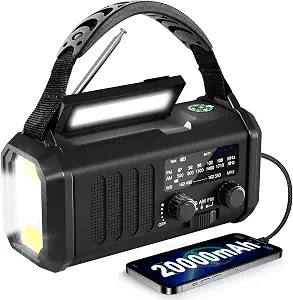
NOAA Weather Radio with 20000mAh Battery, Emergency Hand Crank, Solar, USB-C, AM/FM, Waterproof, SOS Alarm, Compass, Phone Charger
This model leads with a massive 20000mAh battery, designed for extremely long operation in emergencies or outdoor expeditions. Compared to smaller-capacity radios like the B08SWF34ZF, its extended battery life and multiple power sources—including USB-C and solar—make it ideal for multi-day trips. Its waterproof rating (IPX3) offers some protection, but it isn’t fully waterproof, so heavy rain could be a concern. The inclusion of a built-in compass and extended antenna enhances outdoor utility, but its weight and bulk may be a hindrance for casual users seeking portability. This pick is perfect for serious adventurers or preppers who need maximum durability, extended power, and a comprehensive set of features for outdoor navigation and communication.
Pros:- High-capacity 20000mAh battery for long-term use
- Reliable NOAA and FM reception with extended antenna
- Waterproof design, SOS alarm, and built-in compass
Cons:- Heavier and bulkier, less portable for everyday carry
- Requires manual operation for some power sources
Best for: Backcountry hikers, survivalists, or outdoor enthusiasts requiring maximum power, durability, and navigation tools
Not ideal for: Urban users or casual users who prefer lightweight, simple emergency radios, as this unit is more bulky and feature-rich
- Battery Capacity:20000mAh
- Antenna:Extended telescopic
- Frequency Range:NOAA: 162.400-162.550 MHz, FM: 87-108 MHz, AM: 520-1710 kHz
- Waterproof Rating:IPX3
- Weight:1.1 lbs (500g)
Our verdict“This is best suited for outdoor explorers and preppers seeking maximum power, durability, and navigation features in a rugged design.”

How We Picked
The products were selected based on a combination of performance, build quality, and feature set. Priority was given to models with reliable NOAA alerts, versatile power options, and durability. Usability factors like display clarity, ease of charging, and emergency features also influenced the ranking. Cost-effectiveness was considered, but higher-priced options were only included if they offered meaningful durability or additional safety features. This approach ensures that each product serves a specific role, from budget-friendly choices to premium, feature-rich models.Factors to Consider When Choosing Weather Alert Radio With Solar Charging
Choosing a weather alert radio with solar charging involves several important considerations beyond basic features. Understanding these factors helps ensure you select a device that performs reliably in emergency situations, offers lasting power, and matches your specific needs. Let’s explore the key aspects that influence your decision and common pitfalls to avoid.Power Options and Battery Life
Look for models with large, rechargeable batteries and multiple charging methods, including solar, hand crank, and USB. A longer battery life means your radio stays operational during extended outages. Some radios also feature power banks, allowing you to charge phones or other devices. Beware of models with small batteries or limited charging options, as they may quickly run out of power when you need them most.
Durability and Weatherproofing
If you plan to use your radio outdoors or in harsh conditions, opt for a rugged, water-resistant design. Features like rubberized exteriors, sealed ports, and waterproof ratings extend the device’s lifespan and reliability. Cheaper models may lack these protections, risking damage or failure during storms or rough handling. Consider where and how you’ll use the radio to determine the necessary durability level.
Emergency and Alert Features
Ensure the radio receives NOAA alerts and includes features like SOS alarms, flashing lights, or loud sirens. Some models also offer multiple alert channels, including AM/FM and SW, increasing the chances of receiving critical warnings. Remember, a device with overly complex controls can be difficult to operate in stressful situations, so prioritize intuitive interfaces and reliable alert mechanisms.
Additional Features and Convenience
Extras like built-in flashlights, reading lamps, Bluetooth connectivity, and headphone jacks add value but often come at a higher price. Decide which extras are genuinely useful for your needs—overloading on features can complicate operation or increase costs unnecessarily. Focus on what enhances your safety and convenience without sacrificing core reliability.
Price and Value Balance
While premium models offer enhanced durability and additional features, they come at a higher cost. Budget options can suffice for basic alerting and emergency use, but may lack longevity or weatherproofing. Consider your environment, frequency of use, and budget to find a model that offers the best balance of cost and performance. Avoid overly cheap options that compromise on essential safety features.
Frequently Asked Questions
How long do the batteries typically last on these radios?
The battery life varies depending on the model and usage but generally ranges from 8 to 48 hours on a full charge. Larger capacity batteries, like 12000mAh, can power the radio for several days, especially with infrequent use. Models with solar charging or hand crank backup help extend usability during prolonged outages. Keep in mind that actual runtime depends on the alert frequency, screen use, and whether additional features like flashlights are active.
Can I rely solely on solar charging in cloudy or rainy weather?
While solar charging provides a renewable power source, its efficiency drops significantly in overcast or rainy conditions. Most radios combine solar with other power options like hand cranks or USB charging to ensure reliability. If solar is a primary power method, consider models with large solar panels and backup options. Always have a full battery or alternative charging method available for extended emergencies.
Are these radios suitable for outdoor activities like camping?
Yes, many weather alert radios with solar charging are designed for outdoor use, featuring rugged, waterproof, and shock-resistant builds. These devices often include LED flashlights, reading lamps, and multiple power sources, making them versatile for camping and outdoor adventures. However, check the specific durability ratings and portability features to ensure the model suits your activity level and environment.
What should I do if the solar panel doesn’t seem to charge properly?
If the solar panel isn’t charging effectively, ensure it’s exposed to direct sunlight and clean from dirt or debris. Some models require a certain orientation or angle for optimal charging. Additionally, verify that the battery isn’t fully drained or damaged. If problems persist, use alternative power sources like USB or hand crank to maintain operation, and consider replacing the device if the solar feature remains ineffective.
Is it better to buy a radio with AM/FM or solely NOAA alert channels?
A radio with both NOAA alerts and AM/FM capability offers broader entertainment and information options, which can be helpful during emergencies or downtime. NOAA alerts are essential for receiving weather warnings, but AM/FM can keep you informed of local news or updates. Choosing a model with multiple channels ensures you stay connected in various scenarios, but be sure that NOAA alert reception is reliable, as some cheaper models may lack strong signal sensitivity.
Conclusion
For most users, the NOAA Weather Radio with 12000mAh Battery provides the best balance of power, reliability, and features, making it ideal for emergency preparedness at home or in the field. Budget-conscious buyers may prefer the Prunus J-366 Emergency Radio, which offers essential functions in a compact design. Outdoor enthusiasts and those needing rugged durability should consider models like the FosPower NOAA Emergency Weather Radio A1 for their weatherproofing and extra safety features. For newcomers or casual users, simpler models with basic NOAA alerts and solar charging will suffice, but always check for solid build quality and clear alert mechanisms to prevent missed warnings.
Halloween Picks
halloween
As an affiliate, we earn on qualifying purchases.