
For a dedicated underwater camera for scuba diving, the SeaLife Micro 3.0 is my best overall pick because its sealed design avoids the separate waterproof housing many action cameras need. The OM SYSTEM Olympus Tough TG-7 is a strong choice for divers who want a rugged compact camera, while the DJI Osmo Action 5 Pro suits those who value action-camera video and stabilization. The main tradeoffs are dedicated underwater handling versus a more versatile action-camera setup, along with housing depth limits, controls, and image-making flexibility. Some listed cameras advertise waterproofing only to 33 feet, which is not enough for most scuba dives without a suitable dive-rated housing. Read on for the full comparison and guidance on matching a camera to your depth, experience, and shooting priorities.

Give the gift of listening to someone you love
- Choose a 1-, 3-, 6- or 12-month membership
- They pick the audiobooks they love
- Easy to send by email
Complete the kit


Key Takeaways
- The SeaLife Micro 3.0 stands apart for scuba use because its sealed camera body is designed for underwater operation without opening a battery or memory-card compartment between dives.
- The TG-7 offers a different kind of versatility: it is a rugged compact camera for buyers who want more than an action-camera-style setup, but divers still need to check its depth rating and housing needs for their dives.
- The DJI Osmo Action 5 Pro is the video-focused pick in this group; action-camera stabilization and a compact form suit moving footage, though accessories and dive housing affect the full setup.
- Several AKASO models overlap heavily, so compare the exact model, included accessories, screen, and housing specification instead of treating similar names as proof of distinct underwater capability.
- Advertised shallow-water limits are not scuba ratings: the two generic dual-screen listings specify 33 feet, making them poor choices for a typical scuba profile unless a separately rated housing supports the intended depth.
| SeaLife Micro 3.0 64GB Underwater Camera, 16MP, 4K Video |  | Best for Dedicated Scuba Diving | Sensor: 16MP 1/2.3-inch CMOS | Video: 4K at 30 fps; 1080p at 120 fps | Internal memory: 64GB | VIEW ON AMAZON | See Our Full Breakdown |
| AKASO EK7000 4K Action Camera, 20MP, Wi-Fi, EIS, Waterproof Case, Remote Control |  | Best Entry-Level Case-Based Pick | Video: 4K at 30 fps; 2.7K at 30 fps | Photo resolution: 20MP | Water resistance: Waterproof with included case; rated to 131 feet | VIEW ON AMAZON | See Our Full Breakdown |
| 8K Underwater Camera with WiFi, 33FT Waterproof, 70MP, Dual Screens, 64GB Card Included |  | Best for Snorkeling and Shallow-Water Travel | Waterproof depth: 33 feet | Video resolution: 8K UHD | Photo resolution: 70MP | VIEW ON AMAZON | See Our Full Breakdown |
| DJI Osmo Action 5 Pro Essential Combo Waterproof 4K Action Camera |  | Best for Stabilized Action Footage | Sensor: CMOS, 1/1.3-inch | Video resolution: 4K | Stabilization: 360° HorizonSteady | VIEW ON AMAZON | See Our Full Breakdown |
| AKASO EK7000 4K Action Camera with EIS, WiFi, and Waterproof Case |  | Best for Mounting and Hands-Free Capture | Video: 4K at 30 fps; 2.7K at 30 fps | Photo resolution: 20MP | Waterproof depth: 131 feet (40 meters) with case | VIEW ON AMAZON | See Our Full Breakdown |
| 4K Waterproof Underwater Camera with Dual Screens and 64MP Photos |  | Best for Shallow-Water Selfies | Photo resolution: 64MP | Video resolution: 4K | Waterproof depth: 16 feet | VIEW ON AMAZON | See Our Full Breakdown |
| AKASO Brave 4 Action Camera 4K 30fps with EIS, WiFi, and Waterproof Case | 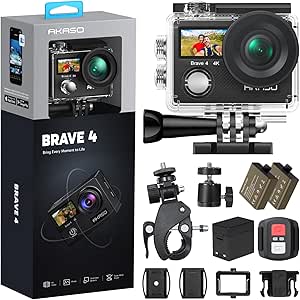 | Best Value for Scuba Video | Video resolution: 4K at 30fps | Photo resolution: 20MP | Waterproof depth: 40 meters (131 feet) with case | VIEW ON AMAZON | See Our Full Breakdown |
| OM SYSTEM Olympus Tough TG-7 Waterproof Camera, Red |  | Best for Macro Underwater Photography | Waterproof depth: 15 meters (50 feet) | Photo resolution: 12MP | Video resolution: 4K | VIEW ON AMAZON | See Our Full Breakdown |
| AKASO EK7000 Pro 4K Action Camera with Touch Screen and Accessories |  | Best Accessory Bundle for Scuba Trips | Video resolution: 4K at 30fps; 1080p at 60fps | Photo resolution: 20MP | Waterproof depth: 131 feet with case | VIEW ON AMAZON | See Our Full Breakdown |
| AKASO EK7000 Pro 4K Action Camera with Touchscreen and Waterproof Case |  | Best Simple Deep-Rated Action Camera | Video resolution: 4K at 30fps; 1080p at 60fps | Photo resolution: 20MP | Waterproof depth: 131 feet with case | VIEW ON AMAZON | See Our Full Breakdown |
| underwater camera for scuba diving | Photo resolution | Waterproof depth | Video resolution | Display |
|---|---|---|---|---|
| SeaLife Micro 3.0 64GB Underwa | — | — | — | 2.4-inch TFT color LCD, 260K resolution |
| AKASO EK7000 4K Action Camera | 20MP | — | — | 2 inches |
| 8K Underwater Camera with WiFi | 70MP | 33 feet | 8K UHD | — |
| DJI Osmo Action 5 Pro Essentia | — | — | 4K | — |
| AKASO EK7000 4K Action Camera | 20MP | 131 feet (40 meters) with case | — | 2 inches |
| 4K Waterproof Underwater Camer | 64MP | 16 feet | 4K | — |
| AKASO Brave 4 Action Camera 4K | 20MP | 40 meters (131 feet) with case | 4K at 30fps | 2-inch rear screen and 0.96-inch front screen |
| OM SYSTEM Olympus Tough TG-7 W | 12MP | 15 meters (50 feet) | 4K | — |
| AKASO EK7000 Pro 4K Action Cam | 20MP | 131 feet with case | 4K at 30fps; 1080p at 60fps | 2-inch touchscreen |
| AKASO EK7000 Pro 4K Action Cam | 20MP | 131 feet with case | 4K at 30fps; 1080p at 60fps | 2-inch IPS touchscreen |
More Details on Our Top Picks
SeaLife Micro 3.0 64GB Underwater Camera, 16MP, 4K Video
The SeaLife Micro 3.0 is the most scuba-focused choice here: its permanently sealed body is rated to 200 feet, deeper than the 131-foot case ratings listed for either AKASO EK7000. With no user-maintained O-rings, it avoids one common point of upkeep for divers, while its rubber-armored construction adds protection between dives. It records 4K at 30 fps and can save RAW DNG stills for more editing flexibility than the AKASO models specify. The tradeoffs matter: storage and battery are internal, so you cannot swap cards or batteries on a dive day, and there is no built-in flash. Compared with the DJI Osmo Action 5 Pro, it gives up the larger sensor and advanced horizon stabilization, but its greater rated depth and sealed design make it the more purpose-built pick for deeper scuba use.
Pros:- Permanently sealed, O-ring-free body is rated to 200 feet.
- Rubber-armored, shock-resistant construction suits frequent travel and dive handling.
- Records 4K video and captures 16MP stills with RAW DNG support.
- Built-in 64GB storage and Wi-Fi transfer are ready without a separate memory card.
Cons:- Internal memory cannot be expanded or swapped between dives.
- Internal battery cannot be replaced mid-trip.
- No built-in flash for adding light to nearby underwater subjects.
Best for: Scuba divers who want a compact camera rated for dives up to 200 feet and prefer a permanently sealed body over a case with user-maintained seals.
Not ideal for: Divers who need replaceable memory cards or batteries, or who rely on a built-in flash for close subjects in dim water.
- Sensor:16MP 1/2.3-inch CMOS
- Video:4K at 30 fps; 1080p at 120 fps
- Internal memory:64GB
- Lens:19mm equivalent; 100° diagonal angle of view; f/2.8
- Display:2.4-inch TFT color LCD, 260K resolution
- Image formats:RAW DNG, MP4
- Weight:11.68 oz
Our verdict“Choose the SeaLife Micro 3.0 for deeper scuba dives and sealed-body convenience, but skip it if swappable storage or lighting matters more.”
AKASO EK7000 4K Action Camera, 20MP, Wi-Fi, EIS, Waterproof Case, Remote Control
The AKASO EK7000 offers a straightforward way to try underwater video without stepping up to the dedicated SeaLife Micro 3.0. Its included case is rated to 131 feet, enough for many recreational dives, and electronic image stabilization can help tame some movement in footage. The 20MP photo claim is higher than the SeaLife’s 16MP, but megapixels alone do not settle underwater image quality, and this model lacks the SeaLife’s permanent seal and RAW still format. Its wrist remote is not waterproof, so it should not be treated as an underwater control; the camera’s Wi-Fi is better suited to transfer and setup on the surface. A 90-minute listed battery life and the need to supply a microSD card add planning. Compared with the other EK7000 listing, this version specifies a black finish and a 90-minute battery figure.
Pros:- Included waterproof case is rated to 131 feet.
- Records 4K at 30 fps and lists 20MP still capture.
- Electronic image stabilization can reduce visible shake.
- Wi-Fi and a wrist remote are included for surface-side control and sharing.
Cons:- MicroSD card is not included.
- Listed battery life is 90 minutes, which may constrain a long day of recording.
- The wrist remote is not waterproof and cannot serve as an underwater control.
Best for: First-time recreational divers who want a low-commitment 4K camera in a supplied case and are comfortable managing a memory card and battery time.
Not ideal for: Divers planning deeper or longer trips who want a permanently sealed body, RAW capture, or replaceable storage and batteries during the dive day.
- Video:4K at 30 fps; 2.7K at 30 fps
- Photo resolution:20MP
- Water resistance:Waterproof with included case; rated to 131 feet
- Stabilization:Electronic image stabilization
- Display:2 inches
- Connectivity:Wi-Fi; 2.4G wrist remote
- Battery life:90 minutes
- Weight:2 ounces
Our verdict“Pick this EK7000 for basic recreational dives with a case-based setup, but choose the SeaLife Micro 3.0 for deeper use and sealed-body simplicity.”
8K Underwater Camera with WiFi, 33FT Waterproof, 70MP, Dual Screens, 64GB Card Included
This dual-screen camera is aimed at travelers who move between snorkeling, hiking, and casual photography, rather than scuba divers heading deep. Its 33-foot water rating is the key limitation: that falls far short of the SeaLife Micro 3.0’s 200-foot rating and the AKASO EK7000 case’s 131 feet, so it is not a sensible choice for typical scuba depth. On the other hand, the front and rear screens make self-framing easier, and the included 64GB card means storage is supplied. The listed 8K video and 70MP photos promise high resolution, but the product data does not specify stabilization, leaving moving underwater footage less reassuring than on the DJI Osmo Action 5 Pro or AKASO models with EIS. Its macro focus distance is useful for close subjects in shallow water, not a substitute for depth capability.
Pros:- Dual front and rear screens help with selfies and framing.
- Includes a 64GB card, so separate storage is not listed as a requirement.
- Lists 8K UHD video and 70MP photo capture.
- Macro focus distance of 1.97 inches supports close-up subjects.
Cons:- 33-foot depth rating is too limited for most scuba diving.
- No image stabilization feature is specified.
- Small screens may make underwater composition and menu use harder.
Best for: Snorkelers and travel photographers who want dual-screen framing, included storage, and one camera for shallow water plus land outings.
Not ideal for: Scuba divers who descend beyond 33 feet or need stated stabilization for swimming footage.
- Waterproof depth:33 feet
- Video resolution:8K UHD
- Photo resolution:70MP
- Storage:64GB card included
- Displays:2.88-inch front; 1.44-inch rear
- Battery capacity:2500mAh
- Macro focus distance:1.97 inches
- Connectivity:Wi-Fi
Our verdict“Choose this model for snorkeling and mixed travel use, not for scuba dives that exceed its 33-foot rating.”
DJI Osmo Action 5 Pro Essential Combo Waterproof 4K Action Camera
The DJI Osmo Action 5 Pro is the strongest fit here for divers who prioritize steady, dynamic footage over maximum depth rating. Its 360° HorizonSteady system is built to keep video level as the camera moves, a useful contrast with the AKASO EK7000 models, which list EIS but not horizon-level correction. The 1/1.3-inch sensor is also larger than the 1/2.3-inch sensor specified for the SeaLife Micro 3.0, though sensor size alone does not guarantee better results underwater. Its IP68 rating supports use to 20 meters, less depth than SeaLife’s 200-foot rating, so deep divers should compare those limits carefully. Front and rear OLED touchscreens simplify framing and changes, while the stated battery runtime is generous. The Essential Combo does not list a microSD card or curved adhesive base, so accessory needs remain.
Pros:- 360° HorizonSteady helps keep footage level during camera movement.
- 1/1.3-inch sensor is larger than the sensor specified for the SeaLife Micro 3.0.
- IP68-rated underwater use is listed to 20 meters.
- Front and rear OLED touchscreens support framing and camera adjustments.
Cons:- 20-meter depth limit is below the SeaLife Micro 3.0’s 200-foot rating.
- A microSD card is not listed among the included accessories.
- Essential Combo does not include a curved adhesive base.
Best for: Divers filming movement who value level, stabilized 4K footage, a larger specified sensor, and convenient front-and-rear screens within a 20-meter depth limit.
Not ideal for: Deep scuba divers who need a camera rated beyond 20 meters, or buyers seeking a complete kit with memory card and curved adhesive mount included.
- Sensor:CMOS, 1/1.3-inch
- Video resolution:4K
- Stabilization:360° HorizonSteady
- Maximum underwater depth:20 meters
- Displays:Front and rear OLED touchscreens
- Battery capacity:1950mAh
- Maximum recording time:Up to 4 hours
- Connectivity:Bluetooth, Wi-Fi
Our verdict“Choose the DJI for stabilized action footage and screen flexibility within 20 meters, but favor the SeaLife for deeper scuba use.”
AKASO EK7000 4K Action Camera with EIS, WiFi, and Waterproof Case
This EK7000 makes the most sense for divers who want a lightweight, mount-friendly action camera and already plan to use a case. Its listed 131-foot (40-meter) rating matches the other EK7000 in this batch, while the supplied mounting accessories and 2.4GHz wrist remote add flexibility for surface-side setup. The remote is not waterproof, so underwater control should not be part of the plan. EIS helps reduce shake, but manual focus can be a weakness when fish or other subjects move quickly; the SeaLife Micro 3.0 is a better fit for divers who want RAW stills and a sealed body, while the DJI Osmo Action 5 Pro offers more advanced horizon stabilization. This listing specifies two 1050mAh batteries and microSD storage, unlike the other EK7000 listing, but it also calls for a compatible card and notes limited Wi-Fi range.
Pros:- Waterproof case is rated to 131 feet (40 meters).
- Electronic image stabilization helps reduce shake in moving footage.
- Includes two 1050mAh batteries and a 2.4GHz wrist remote.
- Lightweight 1.76-ounce camera body is easy to mount.
Cons:- The wrist remote is not waterproof.
- Manual focus may be difficult for fast-moving underwater subjects.
- Wi-Fi range is listed at approximately 10 meters, limiting connection distance.
Best for: Recreational divers who want a lightweight, case-protected camera with mounting options and are comfortable pre-setting focus and controls before entering the water.
Not ideal for: Divers who need waterproof remote operation, dependable focus on fast-moving subjects, or a sealed camera without a housing.
- Video:4K at 30 fps; 2.7K at 30 fps
- Photo resolution:20MP
- Waterproof depth:131 feet (40 meters) with case
- Stabilization:Electronic image stabilization
- Display:2 inches
- Battery:Two 1050mAh lithium polymer batteries
- Storage:MicroSD; Class 10, UHS-I, V60 listed
- Weight:1.76 ounces
Our verdict“Choose this EK7000 for lightweight mounted footage and included batteries, but select the SeaLife or DJI if focus, sealing, or stabilization is a higher priority.”
4K Waterproof Underwater Camera with Dual Screens and 64MP Photos
This compact camera suits snorkeling and shallow-water trips better than scuba dives: its stated waterproof limit is just 16 feet, well below the 40-meter case rating of the AKASO Brave 4 or the 131-foot cases on both EK7000 Pro models. Dual screens make it easier to frame selfies and buddy shots, while autofocus offers a simpler point-and-shoot approach than the fixed-focus action cameras here. Its advertised 64MP photos and 4K video give it strong headline resolution, but resolution alone does not establish underwater image quality. The 70-minute underwater battery estimate also calls for short sessions or careful power management. I’d choose it for surface-level exploring and easy group photos, not for a camera to take on a typical scuba descent.
Pros:- Dual screens help frame selfies and group shots.
- Advertises 4K video and 64MP still photos.
- Autofocus supports straightforward point-and-shoot use.
- Includes a 32GB microSD card for getting started.
Cons:- 16-foot depth limit is unsuitable for most scuba diving.
- About 70 minutes of underwater use may not cover a long outing.
- Expanded storage requires a separate microSD card.
Best for: Snorkelers and vacationers who want a lightweight camera for shallow water, selfies, and short outings.
Not ideal for: Scuba divers planning deeper descents; its 16-foot waterproof limit is far shallower than the cased AKASO Brave 4 and EK7000 Pro options.
- Photo resolution:64MP
- Video resolution:4K
- Waterproof depth:16 feet
- Battery capacity:1250mAh
- Underwater battery life:Up to 70 minutes
- Storage support:microSD cards up to 128GB
- Included storage:32GB microSD card
Our verdict“Choose this for shallow-water photos and selfies, but pick a case-rated action camera for scuba depth.”
AKASO Brave 4 Action Camera 4K 30fps with EIS, WiFi, and Waterproof Case
The Brave 4 is a practical entry point for scuba footage because its included case is rated to 40 meters (131 feet), a much more useful stated depth than the 16-foot limit of the dual-screen 64MP camera. Its electronic image stabilization can help reduce the shakiness of handheld clips, while two batteries and a dual charger give divers more flexibility between sessions. The tradeoff is a fixed-focus fisheye lens, which offers less close-up flexibility than the Olympus Tough TG-7 and its 1cm macro mode. The Brave 4 also captures 20MP stills rather than the higher advertised photo resolution of some compact alternatives, and it has no included memory card. I’d favor it for affordable, wide-angle action footage, not macro-focused still photography.
Pros:- Waterproof case is rated to 40 meters (131 feet).
- Electronic image stabilization helps steady moving footage.
- Includes two batteries and a dual charger.
- Front and rear screens simplify framing and playback.
Cons:- Fixed-focus fisheye lens limits close-up versatility.
- MicroSD card is not included.
- Digital zoom does not provide optical magnification.
Best for: New scuba divers who want a case-rated action camera, stabilization, and spare batteries for wide-angle video.
Not ideal for: Divers prioritizing close-up marine-life stills or ready-to-shoot storage; the lens is fixed focus and a microSD card is not included.
- Video resolution:4K at 30fps
- Photo resolution:20MP
- Waterproof depth:40 meters (131 feet) with case
- Image stabilization:Electronic
- Display:2-inch rear screen and 0.96-inch front screen
- Batteries included:Two 1050mAh batteries
- Battery life:Up to 90 minutes per battery
- Connectivity:Wi-Fi and HDMI
Our verdict“Pick the Brave 4 for stabilized, wide-angle scuba video with spare batteries, rather than close-up photography.”
OM SYSTEM Olympus Tough TG-7 Waterproof Camera, Red
The TG-7 earns its place for divers who want to photograph small subjects, not just record wide-angle swim-throughs. Its 1cm macro focus can bring tiny marine life into the frame, a capability the fixed-focus AKASO Brave 4 and EK7000 Pro models do not offer. The F2.0 lens and 4K video add flexibility, while rugged protection extends beyond water to shocks, crushing, dust, and cold. Its stated 15-meter (50-foot) waterproof rating is shallower than the 40-meter Brave 4 case and the 131-foot EK7000 Pro cases, so divers must match it to their planned depth. The 12MP still resolution is also lower than those action cameras’ 20MP figures. I’d choose the TG-7 for macro and all-weather versatility, not maximum depth or highest pixel count.
Pros:- Macro mode focuses as close as 1cm from the lens.
- Rugged protection includes shock, crush, dust, and freeze resistance.
- Records 4K and high-speed video at 120fps.
- Built-in Wi-Fi and Bluetooth support wireless connectivity.
Cons:- 15-meter waterproof rating is shallower than the AKASO case-rated options.
- 12MP still resolution is lower than the 20MP AKASO action cameras.
- Recording capacity is listed as 30 minutes.
Best for: Divers and outdoor photographers who want close-up shots of small marine life and a rugged camera for trips beyond the water.
Not ideal for: Scuba divers whose planned depth exceeds 15 meters, or buyers focused on higher-resolution stills and deeper case ratings.
- Waterproof depth:15 meters (50 feet)
- Photo resolution:12MP
- Video resolution:4K
- Macro focus distance:1cm from lens
- Lens maximum aperture:F2.0
- High-speed video:120fps
- Screen size:3 inches
- Rugged protection:Shockproof to 2.1m, crushproof to 100kgf, freezeproof to -10°C
Our verdict“Choose the TG-7 for macro subjects and rugged versatility if its 15-meter depth rating covers your dives.”
AKASO EK7000 Pro 4K Action Camera with Touch Screen and Accessories
This EK7000 Pro bundle stands out for the gear packed around the camera: two batteries, a floating hand grip, dual charger, carrying case, and wristband remote make it useful for divers who want a ready-made travel kit. Its waterproof case is rated to 131 feet, matching the separate EK7000 Pro listing, and electronic stabilization supports steadier 4K clips. Compared with the AKASO Brave 4, this version adds a touchscreen and a more extensive set of listed accessories, though both use fixed-focus fisheye lenses and digital zoom. The stated battery life of up to 140 minutes per battery is generous, but real recording time can vary; the bundle does not list a memory card or external microphone. I’d select it for accessory convenience, not for close-focus work.
Pros:- Waterproof case is rated to 131 feet.
- Includes two batteries, a dual charger, floating grip, and wristband remote.
- Electronic stabilization helps smooth 4K footage.
- 2-inch touchscreen supports direct setting changes.
Cons:- Fixed-focus fisheye lens limits close-up flexibility.
- Memory card is not listed as included.
- External microphone is not included.
Best for: Scuba travelers who want a deep-rated action-camera kit with spare batteries, a floating grip, and a remote included.
Not ideal for: Divers who need macro focus, a memory card in the box, or an external microphone for narrated clips.
- Video resolution:4K at 30fps; 1080p at 60fps
- Photo resolution:20MP
- Waterproof depth:131 feet with case
- Image stabilization:Electronic
- Display:2-inch touchscreen
- Battery:Two 1350mAh rechargeable batteries
- Battery life:Up to 140 minutes per battery
- Included accessories:Floating hand grip, carrying case, USB dual charger, wristband remote, and accessory kit
Our verdict“Choose this bundle if the included grip, remote, and spare batteries matter more than macro flexibility.”
AKASO EK7000 Pro 4K Action Camera with Touchscreen and Waterproof Case
This EK7000 Pro is the straightforward pick for divers who want a touchscreen, stabilization, and a 131-foot case rating without relying on the larger accessory bundle of the other EK7000 Pro listing. Its 4K/30fps video and 20MP photos match that bundle’s core imaging figures, while two included batteries support longer outings than the shallow-water 64MP camera’s 70-minute underwater estimate. The product data lists Wi-Fi and Micro HDMI, though it does not list the floating grip or wristband remote supplied with the other EK7000 Pro package. Like that version and the Brave 4, its fixed-focus wide-angle design is better for broad scenes than small creatures, and the memory card is not listed as included. I’d choose it for basic scuba video; macro-focused divers should look to the TG-7.
Pros:- Waterproof case is rated to 131 feet.
- 2-inch touchscreen makes settings and playback accessible.
- Electronic stabilization supports steadier footage.
- Includes two 1350mAh batteries rated for up to 140 minutes each.
Cons:- Water protection depends on the included case.
- Memory card is not listed as included.
- Fixed-focus wide-angle lens is less suited to close-up subjects.
Best for: Divers seeking a compact, touchscreen action camera with a deep-rated case and two batteries, without needing a large accessory bundle.
Not ideal for: Macro photographers and buyers who want a memory card or the floating grip and wristband remote listed with the other EK7000 Pro bundle.
- Video resolution:4K at 30fps; 1080p at 60fps
- Photo resolution:20MP
- Waterproof depth:131 feet with case
- Display:2-inch IPS touchscreen
- Image stabilization:Electronic
- Battery:Two 1350mAh rechargeable lithium polymer batteries
- Battery life:Up to 140 minutes per battery
- Connectivity:Wi-Fi and Micro HDMI
- Memory card compatibility:Micro SDXC; U1 or U3, UHS Speed Class 3, V30
Our verdict“Pick this EK7000 Pro for touchscreen scuba video and spare-battery capacity, but choose the TG-7 for macro photography.”

How We Picked
I ranked these cameras by how well their stated design and included equipment suit actual scuba diving, rather than by headline resolution alone. The key factors were depth protection and housing requirements, underwater usability, video and photo flexibility, stabilization, controls, and the practicality of changing batteries or storage between dives. A camera advertised as waterproof is not automatically suitable for scuba depth, so listings with a stated limit of 33 feet rank below options intended for deeper underwater use unless a compatible dive housing is part of the plan.
Dedicated dive suitability leads the ranking, followed by image-making versatility and the likelihood that a diver can assemble a usable system without confusing accessory needs. Action cameras can be compelling for compact video, but their underwater performance depends on the correct housing and accessories; low-cost listings with similar names also need careful model-by-model checking. The product information supplied does not establish every camera’s complete depth rating or underwater performance, so buyers should verify the manufacturer’s current specifications before diving.
| underwater camera for scuba diving | Connectivity |
|---|---|
| SeaLife Micro 3.0 64GB Underwa | — |
| AKASO EK7000 4K Action Camera | Wi-Fi; 2.4G wrist remote |
| 8K Underwater Camera with WiFi | Wi-Fi |
| DJI Osmo Action 5 Pro Essentia | Bluetooth, Wi-Fi |
| AKASO EK7000 4K Action Camera | — |
| 4K Waterproof Underwater Camer | — |
| AKASO Brave 4 Action Camera 4K | Wi-Fi and HDMI |
| OM SYSTEM Olympus Tough TG-7 W | — |
| AKASO EK7000 Pro 4K Action Cam | — |
| AKASO EK7000 Pro 4K Action Cam | Wi-Fi and Micro HDMI |
Factors to Consider When Choosing Underwater Camera For Scuba Diving
Choosing a scuba camera is less about chasing the biggest resolution number and more about building a system that will work at your planned depth. I would start with the dive profile, then weigh handling, lighting, and how much setup you are willing to manage.
Match the Depth Rating to Your Dive Plan
Check the camera’s official depth rating, not just whether the listing says waterproof. A rating suitable for swimming or snorkeling may fall short of recreational scuba depth, and a supplied waterproof case may have its own limit. If you plan to use a housing, confirm that it is made for the exact camera model and rated beyond your maximum planned depth. Leave a margin rather than treating the rating as a target to reach. A housing can add bulk and make buttons harder to operate, so review its controls before buying. When specifications conflict across a product page, manual, and accessory listing, use the manufacturer’s documentation as the deciding source.
Decide Whether You Want a Dedicated Dive Camera or an Action Camera
A dedicated underwater camera can reduce setup steps, while an action camera may suit divers who also record cycling, travel, or other activities. That versatility does not remove the need to check underwater protection: the camera’s own waterproof rating and the housing’s scuba rating are separate questions. Think about how often you will use the camera topside, because an accessory-heavy setup can be less convenient for occasional dives. Also check whether the camera remains easy to start and stop once enclosed. A compact body is useful, but large buttons and a secure attachment matter more when wearing gloves. Choose around your full use pattern, not the broadest list of advertised features.
Plan for Light Before Comparing Resolution
Water absorbs color and reduces available light, so a high megapixel or 4K label cannot guarantee vivid underwater images. At depth, a video light or strobe may improve color and detail more than a modest increase in resolution. Lighting also adds cost, charging, mounting, and handling tasks, so decide whether you want natural-light snapshots or a more involved photo setup. A wide view helps capture divers and reef scenes, but it can make distant subjects appear small. For close subjects, learn the camera’s focusing and minimum-distance behavior before a trip. Prioritize a manageable lighting plan over headline specifications that do not address underwater conditions.
Check Controls, Screens, and Handling With Dive Gear
Touchscreens can be convenient on land but less dependable through a housing or with wet hands and gloves. Physical buttons and clearly marked controls may be easier to use underwater, especially when you need to change a setting quickly. Consider whether you can see the screen in bright conditions and whether the camera gives clear recording or battery indicators. A wrist remote can help in some situations, but it does not replace accessible camera controls or a reliable tether. Before committing, look for housing reviews and manuals that show how each control works when sealed. The best interface is the one you can operate without taking attention away from your dive.
Budget for the Whole Underwater Setup
The camera body is only one part of a scuba imaging kit. A dive-rated housing, spare batteries, memory cards, lights, mounts, and anti-fog supplies can all affect what you carry and how you prepare. Confirm that accessories are compatible with the exact model; similar product names do not guarantee matching housings or mounts. Check how the battery and card are accessed, since frequent opening of a seal creates extra maintenance and leak risk. Rinse the camera or housing with fresh water after saltwater use, and follow the maker’s instructions for drying and seal care. Compare complete system requirements rather than choosing by camera features alone.
Frequently Asked Questions
Can I take a camera rated waterproof to 33 feet on a scuba dive?
Not for a typical scuba dive unless the camera is inside a housing rated for the depth you plan to reach. A 33-foot waterproof rating is generally a shallow-water limit, not a scuba-depth guarantee. Check the exact camera and housing specifications, including whether the rating applies to repeated use or only specific conditions. Do not rely on a generic waterproof label or assume a case is dive-rated because it is included. If the manufacturer does not provide a suitable depth rating, choose another setup.
Do I need a separate housing for an action camera when scuba diving?
That depends on the exact action-camera model and its official underwater rating. Some cameras are waterproof on their own to limited depths, but that may not cover your dive plan; a scuba-rated housing can extend protection when the manufacturer supports it. Check whether the housing fits the precise model and preserves access to the controls you need. A housing also adds bulk and can affect sound, screen use, and mounting. Treat the camera and housing as a combined system, and verify the depth rating for that combination.
Is 4K resolution enough for underwater video?
For many divers, 4K is more than adequate for sharing and editing, but resolution is only one part of image quality underwater. Light, color, stabilization, focus, and the camera’s lens all shape the result. A camera with strong stabilization can produce more watchable footage than a higher-resolution model with shaky handling. Lighting becomes increasingly useful as depth and distance from the subject increase. Choose a resolution that fits your editing and storage needs, then put attention on lighting and steady camera technique.
Should I choose a compact underwater camera or a waterproof action camera?
Choose based on the type of images you want and the setup you are willing to carry. An action camera is a natural fit for compact, wide-angle video and may serve other outdoor activities, but its scuba use can depend on a separate housing. A compact camera may offer a more familiar still-photo approach and different handling, though it can be larger and still need a dive housing. Compare the full system’s controls, depth rating, and accessory requirements rather than the camera body alone. If you mostly want quick clips, an action camera may suit you; if still photography and broader control matter, a compact model may be the better direction.
What should I check before taking a new camera on a dive trip?
Confirm the depth rating for the complete camera-and-housing setup, then inspect the manual for seal care and maintenance. Test the controls, recording, battery, memory card, and mounts in shallow water before relying on the camera during a dive. If using a housing, check its seal exactly as instructed and avoid opening it where sand or lint can reach the gasket. Pack spare power and storage, plus any lighting or anti-fog supplies the setup requires. A practice session also lets you learn the controls without adding distraction during a dive.
Conclusion
For most divers seeking a camera built around underwater use, I would start with the SeaLife Micro 3.0 as best overall. The AKASO EK7000 is the best value direction for buyers who want a basic action-camera setup and are prepared to verify the housing and depth rating; the supplied product details do not establish one clear value winner among the similar AKASO variants. For best premium video capability, consider the DJI Osmo Action 5 Pro, while confirming the scuba-rated housing needed for your depth. The TG-7 is my pick for beginners who want a rugged compact-camera approach rather than a simple action-camera workflow. For specific needs, the TG-7 suits buyers seeking a more versatile compact camera, while the 33-foot dual-screen models are better left to shallow-water use unless paired with a verified dive-rated housing. Match the depth rating and complete accessory system to your dives before choosing.