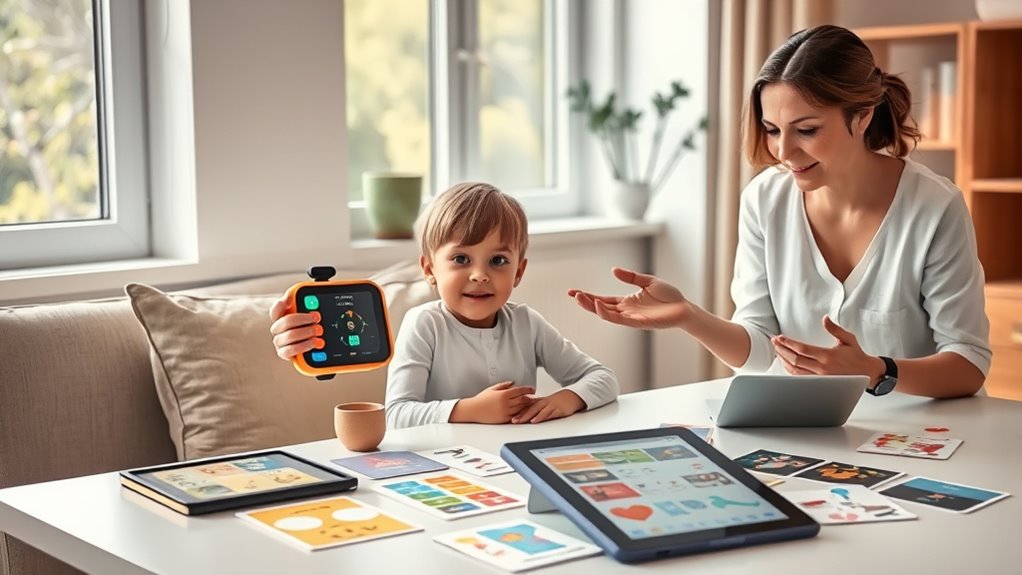
If you’re looking for the best communication aids for non-verbal adults, I suggest tools like waterproof communication boards, electronic AAC devices with customizable buttons, and portable speech therapy devices. These aids help users express their needs, feelings, and preferences more easily, improving connections and quality of care. They’re durable, easy to use, and suited for various environments, whether at home or in healthcare settings. Keep exploring to discover which options best suit your situation.
Key Takeaways
- Durable, waterproof communication boards with clear symbols facilitate quick understanding and ease of use in various settings.
- Electronic AAC devices with customizable buttons and voice options support personalized, effective communication for non-verbal adults.
- Portable, lightweight speech therapy tools and voice amplifiers boost confidence and improve daily interactions.
- Visual aids with high-contrast designs and simple imagery enhance emotional expression and social connection.
- Selection should prioritize ease of use, durability, portability, and customization to meet individual needs and environmental demands.
Plastic Communication Board for Non Verbal Adults


If you’re looking for an effective way to help non-verbal adults communicate, a plastic communication board is an excellent choice. I’ve seen how these boards enable users to express needs, preferences, and requests clearly. Designed with simplicity, they feature an intuitive layout tailored to different communication needs. Made from durable plastic, they withstand frequent use in hospitals and care homes. Their portability makes them easy to carry anywhere, ensuring continuous support. Whether requesting assistance or sharing opinions, these boards facilitate meaningful connections, making daily interactions smoother and more effective for non-verbal adults.
Best For: non-verbal adults, including stroke patients, individuals with aphasia, and residents in hospitals or care homes who need a simple, durable communication tool.
Pros:
- Facilitates clear and effective expression of needs and preferences
- Made from high-quality, durable plastic suitable for frequent use
- Portable and lightweight, easy to carry and use in various settings
Cons:
- May require some initial training for optimal use by users and caregivers
- Limited to basic communication needs; not suitable for complex conversations
- The layout might need customization to best fit individual user preferences
Joyreal AAC Device for Autism, Speech Therapy & Stroke Rehab

The Joyreal AAC device stands out as an ideal communication tool for non-verbal individuals, especially those with autism, speech impairments, or stroke-related difficulties. It features 37 pre-installed picture and color-coded buttons that quickly convey basic needs like yes, no, thirsty, or sleepy. With 8 programmable buttons, you can record personalized messages in your voice, making communication more natural. The device offers a male or female voice option and adjustable volume to suit different environments. Lightweight and portable, it runs on 3 AAA batteries and includes a storage bag, making it perfect for everyday use and travel.
Best For: Non-verbal children, individuals with autism, speech impairments, stroke patients, and anyone needing an alternative communication method.
Pros:
- User-friendly with 37 pre-installed picture and color-coded buttons for quick understanding
- Customizable with 8 programmable buttons and voice options (male/female) for personalized communication
- Portable and lightweight, powered by 3 AAA batteries with travel storage included
Cons:
- Limited to 37 preset buttons, which may not cover all specific needs for some users
- Requires batteries replacement or charging if used extensively
- May need additional training for users unfamiliar with AAC devices
Communication Boards Set for Autism, Aphasia, Stroke Patients — Home & Hospital Use

When caring for non-verbal individuals with autism, aphasia, or stroke, having a reliable communication tool can make a significant difference. I recommend the Communication Boards Set, which includes two durable, waterproof double-sided boards with clear picture symbols. Perfect for home or hospital use, these boards help caregivers and patients communicate effectively across various settings. Their compact size and lightweight design make them easy to carry and use anywhere. Made in the UK with professional-grade standards, they’re built to last, sanitize easily, and support meaningful interaction for both children and adults with communication challenges.
Best For: individuals with autism, aphasia, or stroke who require non-verbal communication aids at home or in healthcare settings.
Pros:
- Durable, waterproof plastic construction for long-lasting use and easy sanitation
- Compact size (30 x 21 cm) and lightweight, making it portable and convenient for various locations
- Features clear medical communication symbols suitable for both children and adults in hospital and home environments
Cons:
- May have a limited number of symbols, which could restrict complex communication needs
- Double-sided design might require careful handling to prevent damage or wear on the symbols
- Not customizable; users cannot add or modify symbols to suit specific communication requirements
6Pcs Communication Board for Non Verbal Adults

Are you looking for a reliable communication tool for non-verbal adults? The 6Pcs Communication Board set is designed to help. Each board features a different theme, like feelings, personal needs, or food, with matching picture symbols and words. Made from durable, high-quality plastic, they resist tearing and stains, perfect for daily use in hospitals, homes, or care facilities. The wipeable surface makes cleaning easy, maintaining hygiene. These versatile boards support speech therapy and everyday communication, enabling non-verbal adults to express themselves clearly and confidently, strengthening connections and improving care.
Best For: non-verbal adults, children, and individuals with communication challenges such as autism, aphasia, or stroke, in care, therapy, or home environments.
Pros:
- Durable and high-quality plastic construction resists tearing and stains, ensuring long-term use.
- Wipeable surface allows for quick and hygienic cleaning, maintaining hygiene in busy settings.
- Features six vibrant themes with matching symbols and words, enhancing communication effectiveness for various needs.
Cons:
- May require guidance or training for optimal use, especially for users unfamiliar with picture communication tools.
- Limited to predefined themes, which might not cover all individual or cultural communication needs.
- The size and portability of the boards may vary, potentially affecting ease of handling for some users.
Communication Board for Adults

If you’re seeking a reliable communication aid for adults with limited speech, the Communication Board is an excellent choice because of its large, clear letters and simple design. Its portable vinyl surface with a rubber backing guarantees stability during use, whether on a lap or table. Available in ABC or QWERTY layouts, it’s perfect for patients with conditions like aphasia, Parkinson’s, or post-surgery recovery. The thick rubber prevents slipping, and the compact size makes it easy to carry in a wheelchair or bag. Designed for quick, frustration-free communication, it helps both patients and caregivers connect more effectively in any setting.
Best For: adults with limited speech, aphasia, Parkinson’s, or recovering from surgeries who need a portable, easy-to-use communication aid.
Pros:
- Large, clear letters and simple design enhance ease of use for users and caregivers.
- Non-slip vinyl surface with rubber backing provides stability during communication.
- Compact and portable, fitting easily into wheelchairs, bags, or bedside trays for versatile use.
Cons:
- Limited to alphabet and QWERTY layouts, which may not suit all communication preferences.
- May require some initial familiarization for optimal use, especially for those with severe impairments.
- As a visual aid, it may not replace more advanced communication devices for complex needs.
3 Pcs Communication Boards for Non Verbal Adults

For non-verbal adults who need a reliable way to communicate, the three-pack of PCS communication boards offers an ideal solution. These colorful, lightweight boards are easy to carry, making them perfect for home or on-the-go use. Each board features diverse symbols and images that cover daily needs, emotions, and activities, helping users express themselves clearly. Designed specifically for adults with aphasia, stroke, or autism, they bridge communication gaps effectively. Having multiple boards allows placement in different locations, ensuring accessibility wherever needed. Overall, this cost-effective set enhances independence and reduces frustration for both users and caregivers by supporting extensive, versatile communication.
Best For: non-verbal adults, including those with aphasia, stroke, or autism, seeking a portable and comprehensive communication solution.
Pros:
- Colorful, engaging design makes communication easier and more accessible.
- Lightweight and compact for convenient transport and placement in multiple locations.
- Covers a wide range of daily needs, emotions, and activities to support independence.
Cons:
- May require some initial familiarization to use symbols effectively.
- Limited to visual symbols; may not suit users needing more detailed or spoken communication.
- Durability depends on material quality; frequent use might cause wear over time.
10 Pcs Nonverbal Communication Board for Aphasia Patients

The 10-piece waterproof nonverbal communication board is an excellent choice for aphasia patients who struggle to speak, as it provides an extensive set of tools to express their needs and feelings. Its large, clear text and intuitive pictures make communication easier and more effective. Each board measures 10.6 by 13.8 inches, lightweight for comfortable use, and constructed from durable, waterproof materials that resist damage over time. It covers essential topics like emotions, pain, preferences, and social interactions. This versatile tool helps patients convey their thoughts, reducing frustration and improving connection with caregivers, making everyday communication more manageable and meaningful.
Best For: individuals with aphasia, stroke survivors, brain injury patients, or those unable to speak due to medical procedures who need a reliable communication aid.
Pros:
- Provides comprehensive communication tools covering emotions, pain, preferences, and social interactions.
- Made from durable, waterproof materials ensuring long-lasting use and resistance to damage.
- Features large, clear text and intuitive images that enhance ease of understanding and use.
Cons:
- May require some initial familiarization for users unfamiliar with visual symbols.
- The size (10.6 x 13.8 inches) might be cumbersome for very limited hand mobility.
- Does not include electronic or digital features, which could limit use in certain settings.
Joyreal AAC Device for Autism and Speech Therapy

The Joyreal AAC Device stands out as an excellent communication tool for non-verbal children and individuals with autism or speech impairments. It offers a versatile solution with 24 pre-installed picture and color-coded instructions, making it easy to understand common phrases like “yes,” “no,” or “I’m thirsty.” The device features six programmable buttons for personalized recordings, adjustable volume, and a lightweight design with a carrying bag for portability. Powered by three AAA batteries, it’s suitable for various environments. This device helps expand language skills, reduce anxiety, and build confidence, making everyday communication more accessible and meaningful.
Best For: non-verbal children, individuals with autism, speech impairments, stroke rehabilitation patients, and those needing personalized communication support.
Pros:
- Includes 24 pre-installed picture and color-coded instructions for easy understanding of common phrases
- Features 6 programmable buttons for personalized recordings, enhancing tailored communication
- Lightweight, portable design with a carrying bag makes it convenient for travel and on-the-go use
Cons:
- Powered by 3 AAA batteries, which require regular replacement or recharging if using rechargeable batteries
- Limited to 6 customizable buttons, which may not cover all individual communication needs for some users
- May have limited advanced features compared to more sophisticated electronic communication devices
Communication Boards Set for Non Verbal Adults Aphasia Stroke Patients

If you’re caring for non-verbal adults with aphasia or recovering from a stroke, communication boards offer an effective way to bridge the gap. These sets include two durable, portable boards with clear symbols and words, making it easy for users to express needs, emotions, and preferences. Their simple design allows for quick understanding and active participation in daily routines. Suitable for hospitals, care homes, or home use, they promote independence and improve communication. Despite moderate ratings, they remain a practical solution for enhancing connection and care for those with speech challenges, helping them stay engaged and understood.
Best For: individuals with aphasia, stroke survivors, or non-verbal adults requiring visual and tactile communication support in healthcare, care home, or home environments.
Pros:
- Durable, high-quality plastic construction for long-term use
- Simple, intuitive design with clear symbols and words for quick understanding
- Portable and lightweight, easy to carry and use in various settings
Cons:
- Moderate customer ratings with an average of 3.2 out of 5 stars
- Limited to two boards, which may restrict communication options for some users
- Price and availability can vary, potentially affecting accessibility
Adult Communication Board with Non-Slip Surface and Visual Aids

Designed with adult users in mind, the communication board features a non-slip surface that stays firmly in place during use, making it ideal for patients with limited mobility or stability issues. Its 9.5 x 8-inch size offers ample space for clear, effective communication. The smooth vinyl surface allows easy finger movement, and the rubber back prevents slipping on laps or tables. Compact and durable, it’s perfect for wheelchairs, backpacks, or bedside use. With large letters, symbols, and visual aids, it simplifies communication for nonverbal adults, including those with aphasia, Parkinson’s, or after surgery. It truly enhances connection and reduces frustration in care settings.
Best For: adults with limited verbal skills or mobility challenges seeking an effective, portable communication aid in care, home, or clinical settings.
Pros:
- Large, clear letters and visual aids facilitate quick and effective communication.
- Non-slip, sturdy surface ensures stability during use, reducing frustration.
- Compact, durable design makes it easy to carry and suitable for various environments.
Cons:
- May require some initial familiarization for optimal use by new users.
- Limited to predefined layouts (QWERTY or ABC) and symbols, which might not cover all specific needs.
- Not electronic, so it doesn’t support voice output or digital integration.
AAC Device for Autism, Communication Tools with Touch Buttons

This AAC device with touch buttons is especially effective for nonverbal children and adults with autism or speech challenges, as it allows them to communicate basic needs and feelings quickly and easily. It features 14 pre-recorded phrases with clear icons, helping users express themselves with minimal effort. The device can be customized with three buttons using loved ones’ voices, boosting confidence and speech development. Its adjustable volume ensures clarity in various environments, and its lightweight, durable design makes it portable for daily use at home, school, or outdoors. This tool reduces frustration, fosters independence, and creates a more connected communication experience.
Best For: individuals with autism, speech challenges, or speech recovery needs seeking an easy-to-use communication tool to express basic needs and feelings.
Pros:
- Includes 14 pre-recorded phrases with vivid icons for quick recognition and use
- Customizable with three personalized buttons using loved ones’ voices to boost confidence
- Lightweight, durable, and portable, making it suitable for daily use at home, school, or outdoors
Cons:
- Requires 3 AAA batteries (not included), which need to be purchased separately
- Limited to 14 pre-recorded phrases, which may not cover all specific communication needs
- Touch-sensitive interface may require some adjustment for users with motor challenges
5Pcs Nonverbal Communication Board for Aphasia Patients

The Pcs Nonverbal Communication Board is an excellent choice for aphasia patients who struggle to speak but want to express their needs and feelings confidently. Its five double-sided, waterproof cards feature clear symbols and words, making communication straightforward. The large, easy-to-read text and appealing blue design enhance visibility and comfort. Made from durable waterproof paperboard, these cards withstand daily use, spills, and environmental factors. Suitable for adults, children, and caregivers, the set allows for customizable communication, helping users share emotions, pain, or needs effectively. It’s a reliable, user-friendly tool that markedly improves connection and quality of life.
Best For: individuals with aphasia, stroke, brain injury, cerebral palsy, or other speech impairments seeking an easy-to-use communication aid for expressing needs and feelings.
Pros:
- Durable waterproof construction suitable for daily use and various environments
- Large, clear symbols and text for effortless comprehension
- Versatile, customizable design accommodating different communication needs
Cons:
- Limited to the symbols and words included on the cards, which may require additional customization for specific users
- Set includes five identical cards, potentially limiting variety in some scenarios
- May not be suitable for users needing highly specialized or detailed communication options
Special Supplies AAC Communication Device for Speech Therapy
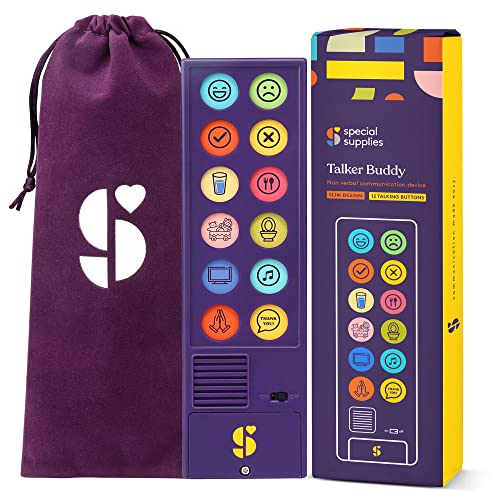
If you’re looking for an easy-to-use communication aid for non-verbal individuals, the Special Supplies AAC Communication Device, Talker Buddy, is an excellent choice. It’s designed specifically for speech therapy, autism, stroke, or other special needs, making communication more accessible at home, school, or therapy sessions. The device features a simple layout with soft touch buttons and is preprogrammed with 12 common phrases, words, and sentences to meet basic communication needs. Its lightweight, portable design comes with a stylish travel bag, so it’s easy to carry and use anywhere, helping users gain independence and connect more effectively.
Best For: individuals with speech challenges, including non-verbal children and adults with autism, stroke, or other special needs, seeking an easy-to-use communication device.
Pros:
- User-friendly with soft touch buttons and simple layout for quick learning
- Preprogrammed with 12 common phrases, words, and sentences for immediate use
- Lightweight, portable, and comes with a stylish travel bag for convenient transportation
Cons:
- Limited to 12 preprogrammed phrases, which may require additional customization for specific needs
- May not support extensive vocabulary or complex communication beyond basic phrases
- Battery life and durability details are not specified, which could impact long-term use
AAC Device for Autism, Joyreal Non Verbal Communication Tools

For non-verbal children or individuals with autism who struggle to communicate their needs verbally, the Joyreal AAC device offers a practical and customizable solution. It includes 23 pre-installed picture and color-coded instructions for simple expressions like “yes,” “no,” or “I’m hungry.” The device also has six programmable buttons for recording personalized messages in your voice, plus a male/female voice switch and adjustable volume. Its lightweight design with a storage bag makes it portable, perfect for travel or daily use. This versatile tool helps reduce frustration, build confidence, and support social interactions, making communication more accessible and meaningful for users and their loved ones.
Best For: non-verbal children, individuals with autism, speech impairments, stroke patients, or anyone needing a simple, customizable communication aid.
Pros:
- Customizable with 6 programmable buttons for personalized messages and voice options.
- Portable lightweight design with a storage bag for easy transport.
- Includes 23 pre-installed pictorial and color-coded instructions for quick communication.
Cons:
- Requires 3 AAA batteries, which need regular replacement.
- Limited to 23 pre-installed phrases, possibly requiring additional customization for complex needs.
- May have a learning curve for users unfamiliar with AAC devices or technology.
Patient Communication Board, Laminated 11″x17″ for Hospitals and Care Homes

Designed with healthcare professionals and caregivers in mind, the laminated 11″ x 17″ patient communication board offers a durable and easy-to-clean solution for non-verbal patients. Its laminated surface guarantees longevity, making it ideal for busy hospital and care home settings. The board features point-to-words, letters, numbers, and pictures, helping patients communicate pain, feelings, and needs effectively. Large, bold words and illustrations enhance visibility and understanding. This versatile tool enables patients to express themselves clearly, improving interactions with staff and loved ones. Made in the USA, it’s suitable for all ages and supports better care and connection for those unable to speak.
Best For: healthcare professionals, caregivers, and family members caring for non-verbal patients in hospitals, nursing homes, and home care settings.
Pros:
- Durable laminated surface for long-term use and easy cleaning
- Includes a variety of visual aids like pictures, letters, and numbers to facilitate communication
- Enhances patient interactions by improving clarity and understanding
Cons:
- Large size may require significant wall space or storage area
- May be overwhelming for very young children or those with cognitive impairments
- Not customizable beyond the included labels and visuals
Factors to Consider When Choosing Communication Aids for Non-Verbal Patients

When selecting communication aids for non-verbal patients, I focus on ease of use and how well the device fits their daily needs. Durability standards and visual clarity are also vital to guarantee the aid lasts and is easy to understand. Additionally, I consider portability and customization options to make sure the device is practical and tailored to each patient’s unique situation.
Ease of Use
Choosing a communication aid that’s easy to use is essential to guarantee non-verbal patients can operate it confidently and independently. An intuitive layout allows users to understand and navigate the device quickly, without needing extensive training. Large, clear symbols, words, or pictures enhance readability and help users formulate messages faster. Devices should feature simple interfaces with minimal buttons and straightforward functions to reduce cognitive load and make operation more accessible. Features like easy finger sliding or touch activation are crucial for those with limited motor skills, ensuring effective use. Additionally, clear instructions or visual cues help both users and caregivers operate the device confidently, minimizing frustration and promoting smoother communication. Ease of use directly impacts the user’s independence and overall experience.
Durability Standards
Durability standards are essential because non-verbal patients rely heavily on their communication aids daily, often in challenging environments. I look for devices made from high-quality, waterproof, and tear-resistant materials that can withstand frequent use and cleaning. It’s important that these aids resist impacts, bending, spills, and dirt to ensure longevity. Non-toxic, hypoallergenic materials are a must to keep patients safe during handling. Reinforced edges and sturdy construction help prevent breakage and maintain functionality over time. I also check if the products have undergone regular testing and certification to meet safety and durability standards. This safeguards the device can endure demanding conditions without compromising its integrity, providing both reliable support and peace of mind.
Visual Clarity
Selecting the right communication aid involves more than just durability; visual clarity plays a vital role in effective communication. Clear symbols and words help non-verbal patients understand messages quickly and reduce confusion. High-contrast color schemes improve visibility, especially for those with visual impairments. Using large, legible text and simple illustrations allows for quick recognition and response, making communication more efficient. It’s imperative to avoid cluttered or overly detailed visuals, as they can overwhelm or distract users. Consistent iconography and layout across different aids help patients learn and recall symbols more easily, fostering familiarity and confidence. Overall, prioritizing visual clarity ensures that communication aids serve their purpose effectively, bridging gaps and enhancing connection.
Portability Features
Have you ever considered how portability impacts the effectiveness of communication aids for non-verbal patients? A lightweight, compact device makes it easier for patients to use their aids across different environments—home, hospital, or while traveling. Devices with built-in batteries offer the freedom to move without being tethered to electrical outlets, boosting independence. Foldable or easily stowable tools simplify packing and transport, guaranteeing continuous communication support during transitions. Carrying cases or protective bags add convenience and safeguard the device during daily activities or outdoor outings. Size also matters; devices that fit comfortably into wheelchairs or bags seamlessly integrate into the patient’s routine. Prioritizing portability guarantees that communication aids are accessible whenever and wherever they’re needed, enhancing the patient’s overall connection and quality of care.
Customization Options
When choosing communication aids for non-verbal patients, customization options play a crucial role in ensuring the device meets their unique needs. Personalizing features like recording messages or selecting symbol sets makes communication more relevant and effective. Devices with adjustable layouts or content can adapt to changing abilities and preferences over time, keeping the aid useful long-term. The ability to add or modify symbols, words, and phrases ensures the tool remains engaging and tailored to the user’s evolving communication skills. Customization not only improves accuracy but also boosts the patient’s confidence and independence by providing more meaningful and precise communication tools. Ultimately, a highly customizable device better supports individual needs, fostering stronger connections and enhancing overall care.
Environmental Suitability
Choosing the right communication aid requires careful consideration of the environment where it will be used. I look at factors like humidity, temperature, and cleanliness to guarantee the device can withstand regular cleaning and won’t degrade quickly. Size and portability matter too—whether it’s for a hospital, care home, or home setting—so it’s easy to access and handle. I also check if the visual and tactile features are clear in different lighting conditions, including low-light situations, to ensure effective communication at all times. Noise levels are another consideration; devices with adjustable volume or visual cues help in loud environments like hospitals or clinics. Overall, the aid must be durable, adaptable, and suitable for the specific environment to be truly effective.
Maintenance Requirements
Selecting a communication aid means considering how easy it is to maintain and keep hygienic. I look for devices that are simple to clean and disinfect, reducing infection risks. Durable materials like waterproof plastic or laminated surfaces are ideal, as they resist spills and stains and last longer. Wipeable surfaces make quick cleaning straightforward, especially in healthcare settings. I also check for signs of wear, such as fading symbols or damaged parts, to guarantee the device remains functional. For battery-powered aids, easy access to recharge or replace batteries is vital to avoid interruptions. Overall, choosing aids with manageable maintenance requirements ensures they stay safe, hygienic, and effective for everyday use. This focus helps provide consistent, reliable support for non-verbal patients.
Cost Effectiveness
Considering the maintenance needs and durability of communication aids helps guarantee they remain reliable over time. When selecting tools, I look for options that balance affordability with sturdiness, ensuring they last without frequent replacements. Buying in bulk or opting for multi-pack solutions can considerably reduce costs per unit, making them more economical for caregivers and institutions. Versatile aids that serve multiple communication purposes can also save money by eliminating the need for several specialized devices. I weigh the initial price against potential long-term benefits, such as decreased caregiver effort and better patient outcomes, which can justify higher upfront costs. Additionally, I consider ongoing expenses like batteries or cleaning supplies to get an accurate picture of the true investment involved.
Frequently Asked Questions
How Do I Assess the Most Suitable Communication Aid for a Patient?
To assess the most suitable communication aid for a patient, I start by observing their current abilities and preferences. I involve the patient and their caregivers to understand what works best for them and consider their daily environment. I also evaluate their motor skills, cognitive level, and comfort with different tools. Trial and feedback are key, so I test various options to find the one that enhances connection and is easiest for them to use.
What Training Is Needed for Effective Use of Communication Devices?
You’d think mastering a communication device is as simple as pressing a button, but no, it’s more like learning a new language! I recommend hands-on training with a speech therapist or specialist, focusing on device operation, troubleshooting, and customizing settings. Regular practice is key, plus ongoing support guarantees I stay confident. After all, if I’m going to help someone connect, I better be fluent myself!
How Do Communication Aids Support Emotional Well-Being in Non-Verbal Patients?
Communication aids truly boost emotional well-being in non-verbal patients by giving them a way to express feelings and needs. I’ve seen how devices like speech-generating tools or picture boards help patients feel understood, valued, and less isolated. When they can share their thoughts, it builds trust, reduces frustration, and fosters a stronger connection with caregivers and loved ones. It’s amazing how these aids transform emotional health and quality of life.
Are There Options for Customizing Communication Tools for Individual Needs?
Customizing communication tools is like tailoring a suit—every detail matters. I find that many options, from speech-generating devices to picture boards, can be adapted to suit each patient’s unique needs. I work closely with caregivers and specialists to modify these aids, ensuring they’re intuitive and effective. This personal approach helps patients express themselves better, fostering genuine connection and improving their overall care experience.
How Can Caregivers Encourage Consistent Use of Communication Aids?
I encourage consistent use of communication aids by making them part of daily routines and ensuring they’re easily accessible. I also spend time demonstrating how to use them and praising the patient’s efforts. Creating a positive, low-pressure environment helps build confidence. Regularly updating and customizing tools based on the patient’s progress keeps engagement high. Finally, I stay patient and supportive, understanding that consistency takes time and gentle encouragement.
Conclusion
Choosing the right communication aid isn’t just about technology; it’s about bridging worlds—connecting silence with understanding, chaos with calm. While these devices open doors, they also remind us that true connection goes beyond words, rooted in patience and compassion. As I explore these tools, I see how they serve as bridges—not just for patients but for us all—to foster empathy, trust, and meaningful care amidst the silence.