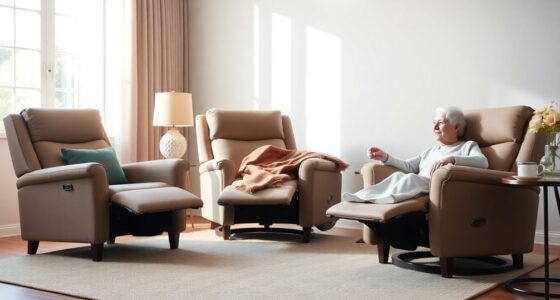
Chair lift cushions for seniors can make standing from a chair easier, but the right choice depends on the user’s mobility, chair, and need for portability. I’d put the Seat Boost Electric Lifting Cushion first for its powered lift, with the Carex Upeasy Seat Assist Plus standing out for portable, non-electric assistance and the Seat Boost Air Pneumatic Cushion for users who prefer a mechanical option. The main tradeoffs are powered convenience versus portability, and stronger lift assistance versus a cushion that fits more seats. A lifting cushion is not a substitute for a mobility assessment, especially if balance or transfer safety is a concern. Read on for how the nine options compare and which buyer each one suits.

Turn quiet afternoons into listening time
- Thousands of audiobooks, podcasts and originals
- Listen on your phone, tablet or Echo — also offline
- Cancel anytime
Complete the kit


Key Takeaways
- Powered lift is the clearest fit for buyers prioritizing assisted rising: the Seat Boost Electric and Juswell models belong on that shortlist, while their motors and power needs make them less simple to move or maintain than a non-electric cushion.
- The Carex Upeasy and pneumatic Seat Boost serve buyers who want to avoid a motor: they trade powered operation for a more portable or mechanically assisted approach, so the user’s strength and control matter.
- Seat Boost’s lineup separates by how much assistance and convenience buyers want: its electric, portable, air-powered, and V2 models are not interchangeable; check each model’s support details and intended use.
- The FinityPro remote adds a distinct control option: it may suit someone who wants remote operation, though buyers should verify that the remote setup and cushion dimensions work in their particular seating arrangement.
- The Recliner Seat Cushion is the outlier: its dual-purpose design addresses sagging-seat replacement as well as getting up, so it may appeal where seat condition matters as much as lift assistance—but it is not a direct substitute for a powered lift cushion.
| Seat Boost Electric Lifting Cushion for Sit-to-Stand Assistance |  | Best Plug-In Pick | Product type: Electric lifting cushion | Maximum supported weight: 240 lbs | Weight: 8.5 lbs | VIEW ON AMAZON | See Our Full Breakdown |
| Seat Boost Portable Lift Assist Cushion |  | Best for Higher Weight Capacity | Lift mechanism: Hydropneumatic gas spring | Lift assistance: Up to 70% | Weight capacity: Up to 350 lbs | VIEW ON AMAZON | See Our Full Breakdown |
| Carex Upeasy Seat Assist Plus Portable Lifting Seat Cushion |  | Best for Easy-Care Portability | Material: Polyester | Weight: 9 lbs | User weight range: 200–340 lbs | VIEW ON AMAZON | See Our Full Breakdown |
| Seat Boost Air Pneumatic Seat Assist Lifting Cushion |  | Best for Button-Controlled Lifting | Model: SBA10 | Weight capacity: 220 lbs | Maximum lifting angle: 35° | VIEW ON AMAZON | See Our Full Breakdown |
| SeatBoost Electric Lifting Cushion V2, Supports up to 240 lbs | | Best for a Longer Reach to an Outlet | Model: Electric SeatBoost V2 | Maximum supported weight: 240 lbs | Item weight: 8.5 lbs | VIEW ON AMAZON | See Our Full Breakdown |
| Portable Lifting Seat Chair Lift Assist Cushion for Elderly and Disabled |  | Best Battery-Free Portable Lift | Weight capacity: 330 lb | Assistance: Up to 70% | Materials: Memory foam, steel | VIEW ON AMAZON | See Our Full Breakdown |
| FinityPro Motorized Chair Lift Assist Cushion with Remote |  | Best Low-Profile Motorized Pick | Weight capacity: 200 lb (90 kg) | Closed height: 4.7 in (12 cm) | Memory foam layer: 1.5 in (4 cm) | VIEW ON AMAZON | See Our Full Breakdown |
| Recliner Seat Cushion for Elderly – Dual Design for Sagging Recliner Replacement & Easy Get Up, 20x20x5 Inches, Dark Grey |  | Best Recliner Support Cushion | Dimensions: 20 x 20 x 5 in | Materials: Memory foam, polyester | Color: Dark grey | VIEW ON AMAZON | See Our Full Breakdown |
| Juswell Electric Seat Lift Cushion for Seniors |  | Best for Higher-Capacity Electric Lifting | Model: US-DS-AL1007GY | Lift angle: 36° | Lifting force: 3000 N | VIEW ON AMAZON | See Our Full Breakdown |
| chair lifts for seniors lifting cushion | Weight capacity |
|---|---|
| Seat Boost Electric Lifting Cu | — |
| Seat Boost Portable Lift Assis | Up to 350 lbs |
| Carex Upeasy Seat Assist Plus | — |
| Seat Boost Air Pneumatic Seat | 220 lbs |
| SeatBoost Electric Lifting Cus | — |
| Portable Lifting Seat Chair Li | 330 lb |
| FinityPro Motorized Chair Lift | 200 lb (90 kg) |
| Recliner Seat Cushion for Elde | — |
| Juswell Electric Seat Lift Cus | 264 lb |
More Details on Our Top Picks
Seat Boost Electric Lifting Cushion for Sit-to-Stand Assistance
The Seat Boost Electric Lifting Cushion suits someone who wants powered help rising from a chair and has an outlet nearby. At 8.5 pounds, it is easier to move between rooms than the 14-pound Seat Boost Air Pneumatic Seat Assist, though it depends on a cord rather than that model’s button-controlled pneumatic lift. Its lifting action is designed to assist standing without pushing the user forward, which may make the motion feel more controlled for users who need help rising. The tradeoff is its 240-pound capacity, below the 350-pound limit listed for the Seat Boost Portable Lift Assist Cushion. It is also an assistive device, not a plush seat replacement, so buyers seeking everyday cushioning should look elsewhere.
Pros:- Powered assistance helps with standing up and sitting down
- Designed to lift without pushing the user forward
- At 8.5 pounds, it is portable between rooms
- May reduce physical strain for users and caregivers
Cons:- Requires access to a wall outlet
- Supports less weight than the Seat Boost Portable Lift Assist Cushion
- Not designed as a comfortable everyday seat cushion
Best for: People who need powered help rising from a chair or couch, weigh no more than 240 pounds, and can sit near a wall outlet.
Not ideal for: People who need a battery-powered lift, exceed its 240-pound capacity, or want a cushion primarily for comfortable seating.
- Product type:Electric lifting cushion
- Maximum supported weight:240 lbs
- Weight:8.5 lbs
- Power source:Wall outlet
- Battery powered:No
- Intended use:Sit-to-stand lifting assistance
Our verdict“Choose this for lightweight, plug-in standing assistance when the user is within its 240-pound limit and an outlet is close by.”
Seat Boost Portable Lift Assist Cushion
For buyers who need a self-powered lift and a higher stated capacity, the Seat Boost Portable Lift Assist Cushion has a clear advantage over the electric Seat Boost cushion: it supports up to 350 pounds and needs no outlet or batteries. Its hydropneumatic spring supplies up to 70% lift assistance, while the 8.5-pound body and 20-by-17-inch footprint make it practical to carry between suitable chairs. That broader weight range comes with a firm memory foam surface, which favors stable lifting support over a soft, cushioned sit. Compared with the Carex Upeasy Seat Assist Plus, it lists a higher maximum weight, but the Carex specifies a waterproof, washable cover. Choose this Seat Boost for capacity and cord-free use; skip it if comfort or a cleanable cover is the priority.
Pros:- Supports up to 350 pounds
- Provides up to 70% lift assistance
- Works without electricity or batteries
- Portable at 8.5 pounds and has a hand-washable surface
Cons:- Firm memory foam may be uncomfortable for users seeking plush seating
- Designed for lifting assistance rather than everyday seat comfort
- Listed size range is Large (200–340 lbs), despite a 350-pound maximum capacity
Best for: Users weighing 200–340 pounds who want self-powered lift assistance for compatible chairs and can tolerate a firm seat surface.
Not ideal for: People seeking a soft, cushioned seat or a waterproof, washable cover like the Carex Upeasy Seat Assist Plus.
- Lift mechanism:Hydropneumatic gas spring
- Lift assistance:Up to 70%
- Weight capacity:Up to 350 lbs
- Size range:Large (200–340 lbs)
- Material:Memory foam
- Firmness:Firm
- Weight:8.5 lbs
- Dimensions:20 × 17 in
- Care:Hand washable
Our verdict“Pick this self-powered model when its higher stated capacity matters more than a soft seat or a waterproof cover.”
Carex Upeasy Seat Assist Plus Portable Lifting Seat Cushion
The Carex Upeasy Seat Assist Plus stands out for buyers who want portable, self-powered assistance and a cover that is waterproof and washable. Like the Seat Boost Portable Lift Assist Cushion, it uses a hydro-pneumatic mechanism and offers up to 70% assistance without batteries or electricity. Its built-in handle and 9-pound weight help with moving it between compatible chairs, while the 15-inch base width is a useful fit detail to check against the seat. The Carex is intended for most armchairs and firm sofas; it is not recommended for wheelchairs, recliners, or soft sofas, and its user range is 200–340 pounds. Compared with the broader Seat Boost capacity claim, Carex prioritizes cover care and fit guidance. It is best for users who can walk independently and need help rising, not a lift for every seating setup.
Pros:- Provides up to 70% assistance without electricity or batteries
- Built-in handle and 9-pound weight aid portability
- Waterproof, washable cover simplifies cleanup
- Lists a 15-inch base width and compatible seating types
Cons:- Not recommended for wheelchairs, recliners, or soft sofas
- Intended for users who can walk independently
- User weight range is 200–340 pounds
Best for: Independent walkers weighing 200–340 pounds who use a firm armchair or sofa and want a washable, waterproof cover.
Not ideal for: Wheelchair users, people using recliners or soft sofas, or anyone who needs powered lifting assistance.
- Material:Polyester
- Weight:9 lbs
- User weight range:200–340 lbs
- Weight support:Up to 70% assistance
- Base width:15 in
- Power:Self-powered hydro-pneumatic gas spring; no batteries or electricity
- Cover:Waterproof and washable
- Compatibility:Most armchairs and firm sofas; not recommended for wheelchairs, recliners, or soft sofas
Our verdict“Choose Carex for self-powered help from a compatible firm seat when easy cover care and portability are priorities.”
Seat Boost Air Pneumatic Seat Assist Lifting Cushion
Unlike the self-powered Seat Boost Portable Lift Assist Cushion, the Seat Boost Air Pneumatic Seat Assist uses up, down, and stop buttons to control its lift. Its angle reaches 35 degrees, and removable handles plus a non-slip soft pad are aimed at users who want a more structured seat-lift setup. At 14 pounds, it is heavier than the 8.5-pound electric Seat Boost cushions, so moving it from room to room takes more effort, even though it can be stored under a bed. The main fit limits deserve attention: it supports up to 220 pounds and is not recommended for wheelchairs or chairs with non-lockable wheels. That makes it a narrower choice than the portable gas-spring cushions, but the controls and lifting angle may suit someone who wants a powered seat lift for a stable chair.
Pros:- Up, down, and stop buttons provide direct lift control
- Lifts to an angle of up to 35 degrees
- Removable handles and a non-slip soft pad
- Can be stored under a bed
Cons:- 220-pound capacity is lower than the Seat Boost Portable Lift Assist Cushion
- At 14 pounds, it is heavier than the other Seat Boost cushions in this batch
- Not recommended for wheelchairs or chairs with non-lockable wheels
Best for: Users weighing up to 220 pounds who want button-controlled lifting from a stable, compatible chair.
Not ideal for: People using wheelchairs or chairs with non-lockable wheels, or anyone prioritizing a lighter cushion for frequent carrying.
- Model:SBA10
- Weight capacity:220 lbs
- Maximum lifting angle:35°
- Dimensions:16.5 × 16 × 13 in
- Item weight:14 lbs
- Controls:Up, down, and stop buttons
- Color:Orange
- Setup:No tools needed
Our verdict“Choose this for button-controlled lifting from a stable chair if its 220-pound limit and 14-pound weight suit the user.”
SeatBoost Electric Lifting Cushion V2, Supports up to 240 lbs
The SeatBoost Electric Lifting Cushion V2 makes the most sense for buyers who want plug-in lift assistance but need to place the chair a little farther from an outlet: its 66-inch power cord is a specific advantage over the first Seat Boost Electric Lifting Cushion, whose listed data does not give a cord length. Both support up to 240 pounds, weigh 8.5 pounds, and focus on standing assistance rather than seat comfort. The V2 adds listed dimensions of 15 by 4 by 17 inches, memory foam fill, and a wipe-clean surface, making basic care straightforward. It still requires a wall outlet and is not a cushioned seating upgrade. Compared with the 14-pound Seat Boost Air Pneumatic model, this is lighter, but its 240-pound capacity is only suitable for users within that limit.
Pros:- 66-inch cord offers more placement flexibility than a shorter reach may allow
- Lightweight at 8.5 pounds
- Wipe-clean care is simple
- Memory foam fill is specified
Cons:- Requires a wall outlet and is not battery powered
- Supports less weight than the Seat Boost Portable Lift Assist Cushion
- Designed for lifting assistance rather than comfortable seating
Best for: Users weighing up to 240 pounds who want a lightweight electric lift cushion and need a listed 66-inch cord to reach an outlet.
Not ideal for: People who need a battery-powered cushion, exceed 240 pounds, or want a comfortable replacement seat cushion.
- Model:Electric SeatBoost V2
- Maximum supported weight:240 lbs
- Item weight:8.5 lbs
- Dimensions:15 × 4 × 17 in
- Power:Plug-in; not battery powered
- Power cord length:66 in
- Fill material:Memory foam
- Care:Wipe clean
Our verdict“Pick the V2 when a lightweight plug-in lift and its 66-inch cord fit the chair location and the user’s weight.”
Portable Lifting Seat Chair Lift Assist Cushion for Elderly and Disabled
Its hydraulic spring provides up to 70% lifting assistance without batteries or a wall outlet, which makes this the most practical choice here for moving between rooms or taking a lift cushion on the go. At 5 kg, it is portable, and the carry handle helps with transport. The 15.7-inch memory foam seat offers a padded perch, while adjustable height lets users adapt the lift to different chairs. Compared with the Juswell Electric Seat Lift Cushion, this model avoids cords and electrical setup, but requires manual height adjustment and may offer less consistent support for some body types. Its 330 lb capacity exceeds the limits listed for both electric cushions in this batch. The tradeoff is a relatively small seat and a maximum assistance level that may not be enough for someone who needs more help standing.
Pros:- Hydraulic spring provides up to 70% lifting assistance without batteries
- 5 kg weight and carry handle make it easier to move between chairs
- 330 lb stated weight capacity is higher than the electric cushions in this batch
- Memory foam adds padding to the compact seat
Cons:- 15.7-inch seat may feel small for some users
- Height changes require manual adjustment
- Adjustment range may not fit every body type or chair
Best for: People who need portable, battery-free assistance at home and away, and weigh no more than 330 lb
Not ideal for: Users who need powered lifting at the press of a button, a wider seat, or more tailored fit than manual height adjustment allows
- Weight capacity:330 lb
- Assistance:Up to 70%
- Materials:Memory foam, steel
- Cushion size:15.7 x 15.7 in
- Cushion thickness:1.9 in
- Adjustable height:10.2–14.1 in
- Base size:13.7 x 13.7 in
- Net weight:5 kg
Our verdict“Choose this portable cushion if you want battery-free lifting assistance and a 330 lb capacity, and are comfortable with a compact seat and manual adjustments.”
FinityPro Motorized Chair Lift Assist Cushion with Remote
A wired remote controls the motorized lift, so users can raise or lower the seat without relying on a hydraulic spring or manually changing settings. Its 4.7-inch closed height keeps the cushion relatively low-profile, while the water-resistant PU leather cover can be wiped clean. Compared with the Juswell Electric Seat Lift Cushion, FinityPro has a lower stated capacity at 200 lb and is described for firm chairs and standard sofas, but its seat has a memory foam layer and a low starting profile. That makes chair fit especially important: a firm, stable seat is the intended match, while a soft or sunken sofa may undermine support. The stated 15.5-inch size may also feel compact. This is a focused option for users within its weight limit who want remote operation and an easy-clean surface.
Pros:- Wired remote operates the motorized raising and lowering
- 4.7-inch closed height keeps the seat relatively low-profile
- Water-resistant PU leather cover can be wiped clean
- Memory foam layer adds cushioning
Cons:- 200 lb weight capacity is lower than the Juswell and hydraulic models in this batch
- Not recommended for very soft or sunken seating
- 15.5-inch size may be narrow for some users
Best for: People weighing up to 200 lb who use a firm chair or standard sofa and want motorized lifting with a wipe-clean cover
Not ideal for: People over 200 lb or those who sit on soft, sagging, or deeply cushioned furniture
- Weight capacity:200 lb (90 kg)
- Closed height:4.7 in (12 cm)
- Memory foam layer:1.5 in (4 cm)
- Size:15.5 in
- Materials:Metal, PU leather, memory foam
- Color:Brown
- Controls:Wired remote
- Recommended use:Assistance rising from a seated position
Our verdict“Pick FinityPro for remote-controlled lifting on firm furniture if its 200 lb limit and compact seat fit your needs.”
Recliner Seat Cushion for Elderly – Dual Design for Sagging Recliner Replacement & Easy Get Up, 20x20x5 Inches, Dark Grey
This is a supportive foam cushion, not a powered lift: its dual-layer construction and non-slip bottom aim to add a steadier sitting surface and make getting up easier. At 20 x 20 x 5 inches, it has a larger footprint than the 15.7-inch seat on the Portable Lifting Seat Chair Lift Assist Cushion, which may suit someone who wants more coverage on a recliner. A removable, washable cover also makes routine cleaning simpler. Unlike the FinityPro Motorized Chair Lift Assist Cushion, it does not raise the user with a remote or motor, so it cannot provide that kind of active lifting support. Its appeal is simpler: added foam support for a recliner seat, with no stated power requirements. Fit remains a real concern because recliner dimensions vary, and the supplied details do not give a weight capacity or lift height.
Pros:- 20 x 20 in footprint offers more seat coverage than the portable hydraulic lift in this batch
- Dual-layer foam is designed to balance cushioning and support
- Non-slip bottom helps limit movement on the chair
- Removable, washable cover supports easier cleaning
Cons:- Does not provide powered or spring-assisted lifting
- Size may not match every recliner seat
- Foam may need fluffing after unpacking
Best for: Older adults who want a larger, washable foam cushion to improve support on a recliner and can stand without powered lifting
Not ideal for: People who need mechanical assistance to rise, or buyers who need a confirmed weight capacity and precise recliner fit
- Dimensions:20 x 20 x 5 in
- Materials:Memory foam, polyester
- Color:Dark grey
- Shape:Square
- Pattern:Plain
- Thickness:5 in
- Bottom:Non-slip
- Cover:Removable and washable
Our verdict“Choose this cushion for added recliner support and washable foam, but look to a powered or hydraulic lift if standing requires active assistance.”
Juswell Electric Seat Lift Cushion for Seniors
Juswell combines a wired remote with a 36° lift angle, giving users powered assistance from a seated position. Its 264 lb stated capacity is higher than the FinityPro cushion’s 200 lb limit, though it remains below the 330 lb capacity of the Portable Lifting Seat Chair Lift Assist Cushion. A quiet motor, high-density foam, and PU leather upholstery make this a more fully specified electric option, and the 5.9 ft power cord gives some room to position it near a standard outlet. The cord still ties use to outlet access, unlike the battery-free hydraulic model. Juswell is portable between chairs, but each chair still needs a suitable surface and a nearby power source. Buyers should also check that the lift angle and cushion setup match their mobility needs; the supplied information does not list cushion dimensions.
Pros:- 36° lift angle and wired remote provide powered standing assistance
- 264 lb capacity exceeds the FinityPro model’s stated 200 lb limit
- Quiet motor and high-density foam are specified
- PU leather upholstery is easy to clean
Cons:- Requires a standard wall outlet during use
- 5.9 ft power cord may limit placement
- No cushion dimensions are provided in the supplied specs
Best for: People weighing up to 264 lb who want powered standing assistance and can place the cushion near a wall outlet
Not ideal for: People who need a cordless option, weigh over 264 lb, or require listed seat dimensions before checking chair fit
- Model:US-DS-AL1007GY
- Lift angle:36°
- Lifting force:3000 N
- Weight capacity:264 lb
- Upholstery:PU leather
- Power cord length:5.9 ft
- Voltage:100–240 V, 50/60 Hz
- Warranty:2 years
- Included components:Charger, cushion, remote control
Our verdict“Choose Juswell if you want a specified electric lift angle and a 264 lb capacity, with a nearby outlet available.”

How We Picked
I ranked these options by how directly they address the central job: helping a senior rise from a seated position. I gave priority to clearly described lifting mechanisms, practical usability, and whether the design appears suited to a particular need, such as powered help, portability, or a sagging recliner. I also weighed fit and support information: a lift cushion is only useful when its dimensions, seat height, and stated capacity match the person and chair.
The order reflects distinct use cases rather than treating every cushion as equivalent. Powered models lead for buyers seeking lift assistance at the touch of a control; portable and pneumatic choices follow for those who value simpler transport or non-motorized operation. Models with less clearly specified mechanisms or a broader seat-cushion purpose rank lower because buyers may need to confirm more details before relying on them for standing assistance. I would verify current manufacturer specifications and consult a clinician or mobility professional if transfer safety is uncertain.
Factors to Consider When Choosing Chair Lifts For Seniors Lifting Cushions
Before choosing a chair lift cushion, I’d start with the person and the chair rather than the feature list. These cushions vary in how they lift, how much effort the user must contribute, and whether they fit a particular seat. The following checks can help narrow the field and avoid a mismatch.
Match the lifting action to the user’s ability
A powered cushion may reduce the effort needed to rise, while pneumatic and other non-electric designs rely more on the user’s movement and control. That difference matters if someone has limited leg strength, hand dexterity, or trouble coordinating a transfer. A common mistake is choosing based on the word “assist” without finding out how the mechanism moves and how the user must operate it. Ask a clinician or mobility professional to assess the transfer if there are concerns about balance, pain, or falling. The strongest lift is not automatically the safest option if the user cannot sit down and stand up in a controlled way.
Check the chair and cushion dimensions together
Measure the chair’s usable seat area, including its depth and width, and compare those measurements with the cushion’s listed dimensions. Also check whether armrests, a recliner’s moving parts, or a soft seat could interfere with stable placement. A cushion that overhangs or shifts can make the starting position less secure. Seat height matters too: adding a cushion changes how far the user’s feet reach the floor and where the knees sit. I’d check the fit with the person seated before relying on it for everyday transfers.
Treat weight capacity as a firm fit requirement
Compare the user’s weight with the manufacturer’s stated capacity for the exact model, not a similar cushion from the same brand. Capacity alone does not show whether the seat will feel stable or comfortable, so look for any manufacturer guidance on use and positioning as well. Avoid guessing when a listing leaves these details out; contact the manufacturer or seller before purchase. A generous capacity figure also does not make a cushion suitable for every chair or transfer situation. If the user’s weight may change, leave a practical margin within the stated limit.
Weigh portability against setup and power needs
A portable, non-electric cushion can be easier to move between rooms or take along, while a motorized model may require access to charging or a power connection, depending on its design. Before choosing, find out how the product is powered, how long it can operate between charges if applicable, and whether the controls are manageable for the intended user. Buyers sometimes focus on portability but overlook the effort of lifting and repositioning the cushion itself. If the cushion will stay in one chair, a stable setup may matter more than carrying convenience. If it will move frequently, check the full weight and handling instructions.
Decide whether you need a lift aid or a better seat
A lifting cushion is meant to assist with rising, while a replacement or support cushion mainly changes comfort and seating position. Some designs try to address both, but the two jobs are not the same. If a recliner sags, first decide whether restoring a firmer seat is the main need; a seat cushion may help with that while offering less lift than a dedicated powered device. Conversely, adding height or firmness does not guarantee safe standing assistance. Choose based on the difficulty the user faces most often, then confirm that any dual-purpose model meets both needs.
Plan for cleaning, upkeep, and dependable use
Check how the cover and cushion can be cleaned, and ask whether any parts need routine care or replacement. With an electric model, find the instructions for charging, storage, and what to do if power or controls fail. Non-electric mechanisms also need clear operating instructions and a stable surface. Consider who will set up the cushion and help with upkeep if the user cannot manage those tasks. A design that is simple to operate and maintain may be a better everyday choice than one with extra controls the user rarely needs.
Frequently Asked Questions
How do I decide between an electric and a non-electric lifting cushion?
Start by asking how much effort the user can safely contribute to standing. A powered model may offer more direct assistance, while pneumatic or other non-electric designs can be easier to move and do not rely on a motor. Check how each one is activated and whether the user can manage its controls or movement. If balance, strength, or transfer technique is uncertain, ask a clinician or mobility professional to assess the user before choosing. Also check the exact model’s power and maintenance instructions.
Can I use a lifting cushion on any chair or recliner?
No single fit should be assumed across chairs. Compare the cushion’s dimensions with the seat, then check whether the chair’s surface, armrests, or reclining mechanism could cause shifting or interfere with movement. Recliners deserve extra care because their shape and motion can affect stability. Follow the manufacturer’s guidance about compatible seating and placement. If the cushion does not sit flat and securely, do not rely on it for transfers.
Will a lifting cushion work if the user has poor balance?
A lifting cushion may help with the effort of rising, but it does not provide full-body support or correct poor balance. The rising movement itself can change the user’s center of gravity, so an unstable user may still need hands-on assistance or a different mobility aid. Ask a physical or occupational therapist to evaluate the transfer and recommend equipment for the person’s specific needs. Avoid leaving someone to use a new device alone until they have been shown how it works and can use it safely. Follow the model’s operating guidance each time.
What should I check before buying a cushion for a sagging recliner?
First decide whether the main problem is a soft or sagging seat, difficulty standing, or both. A replacement-style cushion such as the Recliner Seat Cushion is aimed at seating support as well as easier rising, whereas a powered lift cushion is designed more directly to assist the standing motion. Measure the seat and check how the cushion interacts with the recliner when it moves. Confirm that the user’s feet still reach the floor comfortably when seated. If the recliner itself is unstable or damaged, a cushion may not solve the underlying issue.
What if the user cannot manage a remote or other controls?
Control simplicity should be part of the choice, not an afterthought. Check the size, placement, and operation of any button or remote, and whether it can be used from the seated position without awkward reaching. A remote-controlled option such as FinityPro may suit some users, but its control method still needs to match the person’s dexterity and vision. Ask the seller or manufacturer for operating details if the listing is unclear. If a caregiver will operate the device, confirm the instructions allow that and practice the sequence together.
Conclusion
For buyers who want powered help as the main priority, I’d start with the Seat Boost Electric Lifting Cushion as the best overall fit in this lineup. The Carex Upeasy Seat Assist Plus is my value-minded pick for someone who wants a portable, non-electric approach and can manage its operation; it is also the most approachable starting point for buyers who prefer fewer powered components. For a premium-style control feature, consider the FinityPro Motorized Cushion with Remote, after checking the remote and fit. The Seat Boost Air Pneumatic Cushion suits those seeking mechanical assistance without a motor, while the Recliner Seat Cushion is the specific-needs choice when sagging-seat support is part of the problem. Before selecting any model, confirm its dimensions, capacity, operating method, and suitability for the user’s transfer needs.
Halloween Picks
halloween
As an affiliate, we earn on qualifying purchases.