

Turn quiet afternoons into listening time
- Thousands of audiobooks, podcasts and originals
- Listen on your phone, tablet or Echo — also offline
- Cancel anytime
Complete the kit



Key Takeaways
- The lineup spans 21-, 28-, 31-, 42-, and 56-day formats, so capacity should match the medication schedule rather than serve as a stand-in for ease of use.
- The e-Pill MedSmart Voice model has a distinct role for buyers seeking spoken reminders; several other picks focus on alarms, capacity, locks, or app features instead.
- The 42-day model with expandable three-tray storage and the Ideerfit 56-day model prioritize fewer refill sessions, while their larger organizers may take more room and setup.
- Lockable lids appear across several models, but a lock is useful only when the caregiver can manage access and the senior can still follow the intended routine.
- The roundup includes both simpler alarm-based dispensers and connected or app-controlled designs, making caregiver involvement and comfort with setup key ranking factors.
| 28-Day Automatic Pill Dispenser with Alarm and Desiccant |  | Best for Limited Grip Strength | Capacity: 28 compartments | Operation: Manual, one-button dispensing | Alerts: Sound-only, light-only, or sound and light | VIEW LATEST PRICE | See Our Full Breakdown |
| 42-Day Automatic Pill Dispenser with Expandable 3-Tray Organizer |  | Best for Remote Family Support | Capacity: 3 trays with 14 slots each; 42 slots total | Dosing schedule: Up to once daily for 42 days; more frequent schedule capacity is unclear | Setup: Companion app or on-device buttons with voice prompts | VIEW LATEST PRICE | See Our Full Breakdown |
| Med-Q Electronic Pill Dispenser with Alarm |  | Best for Low Vision | Capacity: 7 days, AM/PM; 14 compartments | Compartment capacity: Up to 23 full-size 325 mg aspirin per compartment | Alarm: Increases in volume over 5 minutes; repeats every 30 minutes until pills are taken | VIEW LATEST PRICE | See Our Full Breakdown |
| e-Pill MedSmart Voice Automatic Pill Dispenser |  | Best for Frequent Daily Reminders | Compartments: 28 | Daily reminders: Up to 9 | Voice alerts: English or Spanish | VIEW LATEST PRICE | See Our Full Breakdown |
| Betife 2nd Gen Automatic Pill Dispenser with Alarm |  | Best for Easy-to-Read Controls | Controls: Six-button console | Display: Extra-large LCD screen | Alarm: Medication reminder alarm | VIEW LATEST PRICE | See Our Full Breakdown |
| Colorwing Smart Pill Dispenser for Seniors, 31-Slot Automatic Medication Organizer |  | Best for Custom Reminders | Capacity: 31 slots | Access control: Fingerprint scanner and mechanical backup key | Reminders: Custom voice recording or 3 alert tones | VIEW LATEST PRICE | See Our Full Breakdown |
| EziMedPil 28-Day Automatic Pill Dispenser with Lockable Frosted Lid |  | Best for High-Capacity Refills | Compartments: 28 | Capacity per compartment: Up to 24 aspirin-sized tablets | Total capacity: Up to 672 pills | VIEW LATEST PRICE | See Our Full Breakdown |
| Windtrace Automatic Pill Dispenser with Alarm |  | Best for Straightforward Retrieval | Compartments: 28 | Daily reminder times: 1 to 6 | Dose rings: 6 | VIEW LATEST PRICE | See Our Full Breakdown |
| Automatic Pill Dispenser with 9 Alarms and Front Key Lock |  | Best for Frequent Daily Doses | Daily alarms: Up to 9 | Alert types: Sound and flashing light | Volume and tones: 3 volume levels; 3 ringtones | VIEW LATEST PRICE | See Our Full Breakdown |
| Betife Automatic Pill Dispenser with Alarm, 31 Compartments |  | Best for Plug-In Reliability | Compartments: 31 | Dose rings: 7 double-sided | Access design: Press-to-open | VIEW LATEST PRICE | See Our Full Breakdown |
| 21-Day Bluetooth Automatic Pill Dispenser with Rising Pods |  | Best for App-Based Tracking | Capacity: Up to 21 days | Dose rings: 8 | Alarms: 8 | VIEW LATEST PRICE | See Our Full Breakdown |
| 28-Day Automatic Pill Dispenser with Expandable 2-Tray Design |  | Best for Flexible Home Setup | Capacity: 28 slots across 2 trays | Once-daily schedule: Up to 28 days | Twice-daily schedule: Up to 14 days | VIEW LATEST PRICE | See Our Full Breakdown |
| LiveFine Automatic Pill Dispenser for Elderly, 28-Day Supply with Clear Lid | 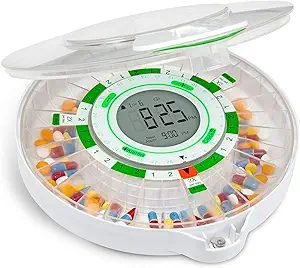 | Best for Frequent Daily Dosing | Capacity: 28 days | Maximum doses per day: 9 | Dosage rings: 9 interchangeable rings | VIEW LATEST PRICE | See Our Full Breakdown |
| Ideerfit 56-Day Automatic Pill Dispenser with App Control, Digital Lock, and Alerts, 4-Tray, White |  | Best for Longer Refill Intervals | Storage capacity: Up to 56 days | Trays: 4 | Slots per tray: 14 | VIEW LATEST PRICE | See Our Full Breakdown |
| LiveFine Automatic Pill Dispenser, 28-Day Capacity, Locking Lid |  | Best for Simple, Button-Based Setup | Capacity: 28 days | Pills per slot: Up to 18 | Dosage rings: 9 interchangeable | VIEW LATEST PRICE | See Our Full Breakdown |
| automatic pill dispensers for senior | Capacity |
|---|---|
| 28-Day Automatic Pill Dispense | 28 compartments |
| 42-Day Automatic Pill Dispense | 3 trays with 14 slots each; 42 slots total |
| Med-Q Electronic Pill Dispense | 7 days, AM/PM; 14 compartments |
| e-Pill MedSmart Voice Automati | — |
| Betife 2nd Gen Automatic Pill | — |
| Colorwing Smart Pill Dispenser | 31 slots |
| EziMedPil 28-Day Automatic Pil | — |
| Windtrace Automatic Pill Dispe | — |
| Automatic Pill Dispenser with | — |
| Betife Automatic Pill Dispense | — |
| 21-Day Bluetooth Automatic Pil | Up to 21 days |
| 28-Day Automatic Pill Dispense | 28 slots across 2 trays |
| LiveFine Automatic Pill Dispen | 28 days |
| Ideerfit 56-Day Automatic Pill | — |
| LiveFine Automatic Pill Dispen | 28 days |
More Details on Our Top Picks
28-Day Automatic Pill Dispenser with Alarm and Desiccant
For a senior who finds small lids difficult to handle, this dispenser’s one-button release and slide door give it a clear purpose in this lineup. Its 28 compartments support a longer stretch of home use than the Med-Q Electronic Pill Dispenser, which holds a week of morning and evening doses, while the Med-Q offers more explicit low-vision features such as braille and large labels. Here, the sound and light alerts can be used separately or together, and a 15-minute-early to 30-minute-late window allows some flexibility around dose time. Dual desiccant chambers and a sealed lid add moisture protection. The tradeoff is a manual, button-press release rather than the automated carousel style found in the e-Pill MedSmart. It also cannot accept add-on trays, and the product is intended for home use, not regulated care.
Pros:- One-button release and slide door are designed to reduce the effort of handling a dose.
- 28 compartments organize more days than the Med-Q’s 14-slot weekly layout.
- Sound and light alerts can be selected independently or combined.
- Water-resistant lid, silicone seal, and dual desiccant chambers support dry storage.
Cons:- Requires the user to press the button to dispense each dose.
- Does not support add-on trays, limiting expansion.
- Gummy-style capsules are not recommended, and it is not intended for regulated facilities.
Best for: Seniors at home who have limited grip strength and want a simple dispenser with a longer supply than a weekly organizer.
Not ideal for: People who need automatic dose release, expandable capacity, or a dispenser approved for regulated care settings.
- Capacity:28 compartments
- Operation:Manual, one-button dispensing
- Alerts:Sound-only, light-only, or sound and light
- Dose timing window:15 minutes early to 30 minutes late
- Moisture protection:Water-resistant lid, silicone seal, and dual desiccant chambers
- App required:No
- Intended use:Home or non-institutional use
Our verdict“Choose this for home use when easier button operation and moisture protection matter more than automatic release or expandable capacity.”
42-Day Automatic Pill Dispenser with Expandable 3-Tray Organizer
When a family caregiver needs to help manage medication from another location, this model stands apart through app-based setup and remote monitoring. Its 42 slots also hold more scheduled doses than the e-Pill MedSmart Voice Automatic Pill Dispenser, which has 28 compartments and supports up to nine reminders each day. The e-Pill’s English or Spanish voice prompts may suit a user who wants spoken cues at the dispenser; this model instead combines app access with on-device setup, voice guidance, and several alert choices. A digital lock and sealed, desiccant-equipped lid address accidental access and storage concerns. The capacity claims need care: once-daily use is stated for 42 days, while the product content gives unclear capacity for more frequent schedules. I would not choose it until that schedule fits the user’s actual regimen. It is for home use, not regulated facilities.
Pros:- App-based setup and monitoring can help caregivers follow scheduled or missed medication.
- 42 slots provide more capacity than the e-Pill MedSmart’s 28-compartment tray.
- Voice prompts and multiple alert formats give setup and reminders more flexibility.
- Digital lock, sealed lid, and built-in desiccant address access and moisture concerns.
Cons:- Capacity for twice- or three-times-daily schedules is unclear in the product information.
- App features may add setup demands for users or caregivers who prefer a standalone device.
- Not suitable for regulated care facilities.
Best for: Families supporting a senior at home who want app access, dose tracking, and the option to configure the dispenser remotely.
Not ideal for: People who need clearly specified capacity for multiple daily doses or equipment intended for a regulated care facility.
- Capacity:3 trays with 14 slots each; 42 slots total
- Dosing schedule:Up to once daily for 42 days; more frequent schedule capacity is unclear
- Setup:Companion app or on-device buttons with voice prompts
- Alerts:LED light, voice alert, buzzer, or melody
- Storage:Sealed lid with built-in desiccant pack
- Security:Digital lock with remote unlock options
- Display:LCD display
- Intended use:Home, non-institutional use
Our verdict“Pick this for a home care team that values remote oversight and can confirm the tray capacity against the senior’s dosing schedule.”
Med-Q Electronic Pill Dispenser with Alarm
The Med-Q is the most accessibility-focused choice here for someone who needs to identify and retrieve doses by touch or with clearer labeling. Its large letters, braille markings, oversized tabs, and flashing dose light provide several cues in one compact weekly organizer. Compared with the 28-Day Automatic Pill Dispenser with Alarm and Desiccant, it offers less storage time but more explicit low-vision support; the 28-day model instead gives users a longer supply and a slide-door design aimed at easier dispensing. The Med-Q’s alarm grows louder over five minutes and repeats every 30 minutes until the pills are taken, which may help when a reminder is missed. That persistence can also be disruptive, and the device relies on two AA batteries. Its removable AM/PM compartments suit a weekly routine, but not someone seeking a month-long supply in one fill.
Pros:- Braille markings and large letters support dose identification for users with low vision.
- Oversized fingertip tabs make compartments easier to open.
- Flashing red light and escalating repeating alarm provide both visual and audible cues.
- Removable compartments organize seven days of morning and evening doses.
Cons:- Holds only a week of AM/PM doses, less than the 28-day dispenser in this lineup.
- Alarm repeats every 30 minutes until pills are taken and may be disruptive.
- Requires two AA batteries.
Best for: Seniors with low vision who want tactile markings, large labels, and distinct morning and evening compartments for a weekly routine.
Not ideal for: People who want several weeks of capacity, dislike persistent alarms, or need a rechargeable or mains-powered unit.
- Capacity:7 days, AM/PM; 14 compartments
- Compartment capacity:Up to 23 full-size 325 mg aspirin per compartment
- Alarm:Increases in volume over 5 minutes; repeats every 30 minutes until pills are taken
- Dose indicator:Flashing red light
- Accessibility:Large letters, braille markings, and oversized fingertip tabs
- Power:2 AA batteries; about 14 months of battery life
- Dimensions:8.75 × 4.5 × 1 inches
- Water resistance:Water-resistant case
Our verdict“Choose the Med-Q for a visually accessible weekly AM/PM routine, provided its repeating alarm and battery-powered design suit the household.”
e-Pill MedSmart Voice Automatic Pill Dispenser
For seniors with several medication times across the day, the MedSmart Voice’s defining advantage is support for up to nine daily reminders. That gives it more room for a frequent schedule than the 42-Day Automatic Pill Dispenser, whose clearly stated capacity covers once-daily use for 42 days and leaves more frequent dosing unclear. The MedSmart pairs English or Spanish voice prompts with flashing LEDs, so reminders are both spoken and visible. Its locking cover and backup batteries add access control and continuity if household power is interrupted. By comparison, the Med-Q offers more tactile accessibility features, including braille and oversized tabs, but only organizes a week of AM/PM doses. The MedSmart’s 28-compartment tray does require careful schedule setup, and it does not offer the longer capacity of the 42-day model. Its best fit is a home routine with multiple reminder times.
Pros:- Supports up to nine medication reminders per day.
- English or Spanish voice prompts pair with flashing LED alerts.
- Four AA backup batteries help maintain reminders during a power outage.
- Locking cover and security keys help restrict access.
Cons:- Medication schedules require setup and may take caregiver involvement.
- The 28-compartment tray offers less capacity than the 42-slot organizer.
- No app-based remote monitoring is listed.
Best for: Seniors with several medication times each day who benefit from spoken reminders and a locked dispenser at home.
Not ideal for: People seeking a long multiweek supply, tactile braille labeling, or a dispenser with remote app monitoring.
- Compartments:28
- Daily reminders:Up to 9
- Voice alerts:English or Spanish
- Visual alerts:Flashing LED lights
- Power:AC adapter or 4 AA backup batteries
- Security:Locking cover with keys
- Warranty:1 year
Our verdict“Choose the MedSmart Voice when frequent daily reminders and spoken cues matter more than extended capacity or remote app access.”
Betife 2nd Gen Automatic Pill Dispenser with Alarm
Betife’s second-generation dispenser is aimed at seniors who want readable controls and guided setup without relying on a smartphone. The extra-large LCD, oversized icons, and spoken quick-start guide can make first use more approachable than the 42-Day Automatic Pill Dispenser, which adds app control and remote monitoring for caregiver involvement. Betife instead emphasizes the interaction at the device: a six-button console, a sealed tray designed to limit pills moving between slots, and a built-in lock. The gearbox has been tested for more than 5,000 carousel rotations, a useful durability detail, though it does not tell buyers how the device performs over a particular period of home use. The tradeoff is the lack of listed app or remote features. It suits a senior or nearby caregiver who can manage the schedule at the dispenser and values clear on-device prompts.
Pros:- Extra-large LCD and oversized icons make on-device information easier to read.
- Spoken quick-start guide supports setup without depending on app instructions.
- Sealed tray is designed to limit pills moving between slots.
- Built-in lock helps restrict access, and the gearbox has been tested for more than 5,000 rotations.
Cons:- No app or remote monitoring features are listed, unlike the 42-day model.
- The product details do not specify capacity or number of daily reminders.
- Schedule management depends on access to the dispenser’s six-button console.
Best for: Seniors who prefer large on-device controls and spoken setup guidance, with a caregiver available nearby for schedule management.
Not ideal for: Families who need remote monitoring or app-based schedule changes while supporting a senior from a distance.
- Controls:Six-button console
- Display:Extra-large LCD screen
- Alarm:Medication reminder alarm
- Tray seal:Less than 2 mm
- Security:Built-in access lock
- Gearbox testing:More than 5,000 carousel rotations
Our verdict“Pick Betife for readable, guided on-device operation when remote caregiver monitoring is not part of the routine.”
Colorwing Smart Pill Dispenser for Seniors, 31-Slot Automatic Medication Organizer
The Colorwing pairs fingerprint access with a mechanical key, so scheduled medication stays controlled while a caregiver still has a backup way in. Its standout feature is the option to record a personal voice reminder, which can make an alert more recognizable than the tones offered by the EziMedPil 28-Day Automatic Pill Dispenser. Bluetooth app support adds setup and tracking tools without a subscription, though it also brings more setup steps than simpler battery-operated dispensers. The 31 slots and seven reversible dose rings give households flexibility when organizing a routine. Its rechargeable battery is rated for more than 30 days in energy-saving mode, but actual life may vary. I’d choose it for users who benefit from familiar prompts and app support, and skip it if pairing an app would add friction.
Pros:- Custom voice reminders can use familiar wording or a caregiver’s voice.
- Fingerprint access and a mechanical key provide two ways to control access.
- 31 slots and seven reversible dose rings support flexible scheduling.
- Rechargeable battery is rated for over 30 days in energy-saving mode.
Cons:- Bluetooth pairing and initial setup may require caregiver help.
- Battery life can vary with use.
Best for: Seniors whose medication routine benefits from a recorded voice prompt, with a caregiver available to help pair the app.
Not ideal for: People who want a simple setup without Bluetooth pairing or who prefer replaceable batteries.
- Capacity:31 slots
- Access control:Fingerprint scanner and mechanical backup key
- Reminders:Custom voice recording or 3 alert tones
- Dose rings:7 reversible rings
- Battery:1200mAh rechargeable
- Battery life:Rated for 30+ days in energy-saving mode
- Connectivity:Bluetooth 5.0; companion app, no subscription required
Our verdict“Choose the Colorwing if personal voice prompts and app tracking matter more than a quick, app-free setup.”
EziMedPil 28-Day Automatic Pill Dispenser with Lockable Frosted Lid
The EziMedPil is built around 28 compartments and a stated capacity of up to 672 aspirin-sized tablets, helping reduce how often a caregiver needs to refill it. Its alarms pair sound and visual alerts, with up to six daily reminders and high, low, or mute volume settings. That gives it more alarm flexibility than the Windtrace Automatic Pill Dispenser, which also offers six reminder times but does not list volume choices. A lockable frosted lid helps limit casual access, while the detachable tray can make cleaning and transport easier. The tradeoff is a four-AA battery setup and controls that some users may need help programming. Compared with the app-connected Colorwing, EziMedPil keeps things more conventional, but offers less digital tracking.
Pros:- 28 compartments with stated capacity up to 672 aspirin-sized tablets.
- Up to six daily alarms combine audible and visual alerts.
- Three volume settings, including mute, allow adjustment to the household.
- Lockable lid and detachable tray support controlled access and cleaning.
Cons:- Requires four AA batteries.
- Setup may require caregiver assistance for some users.
Best for: Caregivers managing a multi-dose daily schedule who want a large stated pill capacity and adjustable alert volume.
Not ideal for: Users who need wireless pill tracking or are likely to struggle with programming without caregiver support.
- Compartments:28
- Capacity per compartment:Up to 24 aspirin-sized tablets
- Total capacity:Up to 672 pills
- Daily alarms:Up to 6
- Alerts:Audible and visual; 2 ringtones
- Volume settings:High, low, or mute
- Power:4 AA batteries included
- Display and lid:High-brightness LCD; lockable frosted lid
Our verdict“Pick the EziMedPil when refill capacity and adjustable alerts outweigh app-based tracking.”
Windtrace Automatic Pill Dispenser with Alarm
Windtrace emphasizes the moment that matters in daily use: taking the scheduled dose through an easy-access retrieval window, a design intended to help seniors and people with arthritis. It stores medication in a removable 28-compartment tray and supports one to six daily reminder times with both an audible alarm and flashing blue light. The EziMedPil 28-Day Automatic Pill Dispenser offers similar capacity and adds selectable volume levels and mute; Windtrace’s simpler listed alert setup may suit someone who needs a direct visual cue but does not need those adjustments. Its six dosage rings and included AA batteries help get it started, although programming may take more effort than the short feature list suggests: the product data points users to an instructional video. I’d favor it for accessible retrieval, not for app tracking or especially simple programming.
Pros:- Easy-access retrieval window is designed with arthritis-friendly access in mind.
- Audible alarm and flashing blue light provide two alert modes.
- Removable 28-compartment tray can simplify cleaning and refilling.
- Includes four AA batteries and six dosage rings.
Cons:- Programming may require following the instructional video.
- Runs on four AA batteries and has no listed app connectivity.
Best for: Seniors who value a reachable dispensing window and visual reminders, with help available for initial programming.
Not ideal for: People who need app connectivity, adjustable alarm volume, or programming they can complete without instructions.
- Compartments:28
- Daily reminder times:1 to 6
- Dose rings:6
- Alerts:Audible alarm and flashing blue light
- Display:LCD
- Tray:Removable, food-grade material
- Batteries included:4 AA
Our verdict“Choose Windtrace if the retrieval window is your priority and someone can help with setup.”
Automatic Pill Dispenser with 9 Alarms and Front Key Lock
With support for up to nine daily alarms, this dispenser is suited to schedules that exceed the six reminders listed for the EziMedPil and Windtrace models. Sound and flashing-light alerts, three volume levels, and three ringtones give users a choice of cues without adding a phone app. Its four-button setup and settings that remain saved during battery changes keep the feature set focused, while a clear lid helps a caregiver see what is loaded and a front-mounted key lock helps restrict access. The tradeoff is that it relies on four AA batteries and has no Bluetooth or Wi-Fi for remote tracking. I’d rank it for frequent, structured dosing rather than connected care: the Colorwing offers app support and voice reminders, but this model makes more sense when nine alarm times matter most.
Pros:- Supports up to nine daily medication alarms.
- Sound and flashing-light alerts offer audible and visual cues.
- Three volume levels and three ringtones allow alert adjustments.
- Settings stay saved during battery changes; batteries and dosage rings are included.
Cons:- Requires periodic replacement of four AA batteries.
- No app, Bluetooth, or Wi-Fi for remote tracking.
Best for: Seniors with several scheduled doses each day who want up to nine reminders and an app-free device.
Not ideal for: Caregivers who need remote monitoring, pill logging, or a rechargeable power setup.
- Daily alarms:Up to 9
- Alert types:Sound and flashing light
- Volume and tones:3 volume levels; 3 ringtones
- Controls:4-button setup
- Lock and lid:Front-mounted key lock; transparent lid
- Power:4 AA batteries; up to 2–3 months per set
- Connectivity:No app, Bluetooth, or Wi-Fi
- Included:9 dosage rings, 2 keys, 4 AA batteries, and manual
Our verdict“Choose this model for a schedule with more than six daily dose times when connected monitoring is unnecessary.”
Betife Automatic Pill Dispenser with Alarm, 31 Compartments
The Betife combines 31 compartments with a press-to-open design, aiming to make scheduled access easier for seniors who find small lids difficult to handle. Fingerprint unlocking and a mechanical backup lock add access control, while custom voice reminders and app-based pill logging bring it closer to the Colorwing Smart Pill Dispenser than to the app-free Windtrace. Its key distinction is plug-in everyday power with a 1200 mAh backup battery for outages, rather than the Colorwing’s rechargeable battery rated for extended energy-saving use. That can suit a fixed home setup, but it ties normal use to an outlet. Fingerprint access may also be awkward for some users, so the backup lock matters. I’d choose it for a stable counter location and app logging, and skip it when portability is a priority.
Pros:- Press-to-open access is designed to reduce difficulty for users with arthritis.
- Fingerprint unlocking is paired with a mechanical backup lock.
- Custom voice reminders and app-based pill logging support routine tracking.
- Backup battery can support operation during power outages.
Cons:- Everyday use requires plug-in power.
- Fingerprint unlocking may be difficult for some users.
Best for: Seniors with a fixed medication station who want press-to-open access, app logging, and backup power.
Not ideal for: People who need a portable dispenser or may have difficulty using fingerprint recognition.
- Compartments:31
- Dose rings:7 double-sided
- Access design:Press-to-open
- Security:Fingerprint unlocking and mechanical backup lock
- Reminders:3 standard alarm tones or custom voice recordings
- Connectivity:Bluetooth-enabled app
- Power:Plug-in with 1200 mAh backup battery
Our verdict“Pick the Betife for a fixed home setup where app logging and backup power matter more than portability.”
21-Day Bluetooth Automatic Pill Dispenser with Rising Pods
The Bluetooth connection and individual rising pods set this dispenser apart from the more traditional LiveFine 28-Day Automatic Pill Dispenser with Clear Lid. App reminders, light alerts, and medication records can give a caregiver a clearer view of a routine, while the lock helps limit accidental access or double-dosing. Its 21-day capacity is shorter than the LiveFine’s 28 days, but the pods hold up to 12 capsules or softgels each and are designed to keep medication dry. A removable tray also makes filling and cleaning more manageable. The tradeoff is a more involved setup: users need to pair the device with a phone to use its app features, and records cover only the past 14 days. It suits households that value connected reminders more than a longer refill interval.
Pros:- App reminders, alarms, and flashing light alerts support multiple cues for scheduled doses.
- Individual pods are designed to help keep medication dry and fresh.
- A lock helps reduce accidental access and double-dosing.
- The removable tray makes filling and cleaning easier.
Cons:- Bluetooth pairing and app setup add steps for users who prefer on-device controls.
- Medication records in the app cover only 14 days.
- Its 21-day capacity requires refilling sooner than the LiveFine 28-day model.
Best for: Seniors whose caregivers want Bluetooth reminders and recent medication records, and who are comfortable with app setup.
Not ideal for: People who want a simple device without phone pairing, or who need medication history retained for longer than 14 days.
- Capacity:Up to 21 days
- Dose rings:8
- Alarms:8
- Pod capacity:Up to 12 capsules or softgels per pod
- Connectivity:Bluetooth 5.0
- Medication records:14 days in the app
- Power:Battery or plug-in operation
- Battery life:Over 2 months
Our verdict“Choose this model if connected caregiver reminders and pod-based storage matter more than a 28-day refill interval.”
28-Day Automatic Pill Dispenser with Expandable 2-Tray Design
This dispenser is a strong fit for households that want a choice between app scheduling and on-device setup. Voice prompts can guide setup, and alerts can use a light, voice, buzzer, or melody, giving families more ways to match reminders to a senior’s hearing and preferences. Its two trays support up to 28 days at once-daily dosing or 14 days at twice-daily dosing; that flexibility is useful, though the slot count means more frequent refills for more complex schedules than the 56-day Ideerfit. Caregivers can check dose history and manage schedules remotely through the app, while a sealed lid and desiccant pack help protect medication from moisture. The main boundary is its stated use: it is for home settings, not regulated care facilities. Remote features also depend on using the companion app.
Pros:- Schedules can be set through the app or on-device buttons with voice prompts.
- Voice, buzzer, melody, and LED alerts offer several reminder styles.
- Caregivers can check dose history and manage schedules remotely through the app.
- A sealed lid and built-in desiccant pack help protect stored pills from moisture.
Cons:- The stated intended use excludes regulated facilities such as nursing homes.
- Remote schedule management and history checks depend on the companion app.
- Capacity drops to 14 days for twice-daily dosing, shorter than the Ideerfit 56-day model.
Best for: Seniors living at home who benefit from voice-guided setup and caregivers who want remote schedule management.
Not ideal for: People in nursing homes or regulated assisted living, or households that do not want app-dependent remote features.
- Capacity:28 slots across 2 trays
- Once-daily schedule:Up to 28 days
- Twice-daily schedule:Up to 14 days
- Setup:Mobile app or on-device buttons with voice prompts
- Alerts:LED light, voice, buzzer, or melody
- Display:LCD
- Security:Digital lock with app-controlled lid locking
- Storage:Sealed lid with built-in desiccant pack
Our verdict“Pick this for a home routine that needs voice-guided setup and caregiver access, provided its shorter capacity at twice-daily dosing fits.”
LiveFine Automatic Pill Dispenser for Elderly, 28-Day Supply with Clear Lid
For a senior with several scheduled doses each day, this LiveFine model’s support for up to nine doses daily is its clearest advantage. Interchangeable dosage rings let families set up a routine around the prescribed schedule, while the jumbo LCD and audio and visual alerts make the device easier to read and notice. The clear, lockable cover and sliding retrieval window give the user a defined access point; compared with the app-connected 21-Day Bluetooth dispenser, this model does not add phone pairing or caregiver records. That simpler setup comes with fewer connected tools. The description does not specify power or battery details, and the lock uses a manual key, so a caregiver needs to manage access and confirm the power arrangement before relying on it. Its 28-day supply also means less frequent refilling than the Bluetooth model.
Pros:- Supports up to nine doses per day with interchangeable dosage rings.
- Jumbo LCD pairs with audio and visual reminders.
- Three volume levels and three beep patterns allow alert adjustment.
- A sliding retrieval window provides a defined place to collect a dose.
Cons:- The lock requires a manual key, which a caregiver must keep track of.
- The product description does not specify power or battery details.
- It lacks the app reminders and medication records offered by the 21-Day Bluetooth dispenser.
Best for: Seniors with multiple daily medication times who need a large display, adjustable alerts, and a straightforward dispenser.
Not ideal for: Caregivers who need app-based dose history or remote schedule management, or buyers who require clearly stated power details.
- Capacity:28 days
- Maximum doses per day:9
- Dosage rings:9 interchangeable rings
- Display:Jumbo LCD
- Alerts:Audio and visual
- Alert settings:3 volume levels and 3 beeping patterns
- Cover:Lockable, with manual key
- Lid:Clear
Our verdict“Choose this LiveFine for a frequent-dose schedule and clear on-device prompts if remote app tracking is not a requirement.”
Ideerfit 56-Day Automatic Pill Dispenser with App Control, Digital Lock, and Alerts, 4-Tray, White
The Ideerfit’s four trays and 56-day capacity make it the longest-storage option in this batch, reducing how often a caregiver needs to refill it for a suitable schedule. It supports one to four doses per day, and schedules can be entered on the device or in the app. That gives it more flexibility than the 28-Day Expandable 2-Tray dispenser, though both are described for home use rather than regulated institutions. Multiple alert choices and a sealed, desiccant-protected design add practical support, while the digital lock and remote unlock can help caregivers manage access. The extra capacity may be more than a user needs, and app-based monitoring depends on a compatible device and connection. Buyers should match the tray schedule to the person’s actual regimen; a longer supply alone does not simplify a complicated routine.
Pros:- Four trays provide up to 56 days of storage.
- Supports schedules from one to four doses per day.
- Schedules can be set on the device or through the Ideerfit app.
- Digital locking, remote unlock, and moisture-protected storage add caregiver controls.
Cons:- The stated intended use excludes nursing homes and other regulated institutions.
- Remote monitoring depends on a compatible device and connection.
- Its capacity is longer than the 28-Day Expandable 2-Tray model, but buyers still need to check that its schedule fits the prescribed routine.
Best for: Home caregivers who want fewer refill sessions and need a dispenser that supports schedules of one to four daily doses.
Not ideal for: People in regulated care facilities, or households that cannot use the compatible app and connection for remote features.
- Storage capacity:Up to 56 days
- Trays:4
- Slots per tray:14
- Doses per day:1 to 4
- Setup:On-device or Ideerfit app
- Alerts:LED light, sound, buzzer, or melody
- Security:Digital lock with remote unlock
- Storage protection:Sealed design with built-in desiccant
Our verdict“Choose the Ideerfit if a home caregiver wants up to 56 days of organized medication and can use its app features when needed.”
LiveFine Automatic Pill Dispenser, 28-Day Capacity, Locking Lid
The three-button interface gives this LiveFine a straightforward setup for seniors and caregivers who want an on-device routine without companion-app scheduling. It holds up to 28 days, supports as many as nine daily alerts, and pairs a jumbo LCD with audio and visual reminders. A sliding retrieval window can help users with limited dexterity collect the dose, while the manual-key locking lid restricts access. Compared with the other LiveFine 28-Day model in this lineup, this version specifies battery operation, three-button controls, and up to 18 pills per slot; the other listing specifies alert volume and beep-pattern choices instead. The tradeoffs are battery dependence and a stated per-slot limit, which may not suit larger medication loads. It is a practical, less connected choice when simple controls matter more than remote monitoring.
Pros:- Three-button controls keep setup on the device.
- Supports up to nine daily doses with audio and visual alerts.
- Jumbo LCD includes three volume levels.
- Sliding retrieval window may help users with limited dexterity.
Cons:- Battery-operated power means batteries must be available and replaced as needed.
- Each slot holds up to 18 pills, which may not fit every regimen.
- The manual-key lock and lack of app features offer less remote caregiver oversight than connected models.
Best for: Seniors who want physical buttons, a large display, and frequent daily alerts without app-based controls.
Not ideal for: Caregivers who need remote monitoring, or users whose scheduled slot may require more than 18 pills.
- Capacity:28 days
- Pills per slot:Up to 18
- Dosage rings:9 interchangeable
- Daily alerts:Up to 9 doses
- Alert types:Audio and visual
- Display:Jumbo LCD with 3 volume levels
- Controls:3-button interface
- Power and security:Battery-operated; locking lid with manual key
Our verdict“Pick this LiveFine if simple button controls and a sliding retrieval window fit the user better than app-based caregiver monitoring.”

How We Picked
I compared the 15 listed dispensers around the needs that shape daily use for seniors: dose capacity, reminder style, access control, organizer design, setup demands, and how much caregiver involvement each concept may call for. A reminder is useful only if the person can notice and respond to it, and a large supply is useful only if refilling and organizing it remain manageable. I treated voice prompts, alarms, app alerts, locks, clear or frosted lids, and expandable trays as distinct benefits with corresponding usability tradeoffs.
The ranking favors options with a clear fit for a common buyer need and a feature set that supports that role. The e-Pill MedSmart Voice leads for shoppers who value audible guidance; longer-capacity dispensers stand out for less frequent refills, while app-connected and multi-tray models suit households willing to take on added setup. Models with similar alarm-and-compartment designs rank by the specific distinction in their names and configurations. Product details provided here do not establish clinical suitability or performance in every home, so buyers should confirm compatibility with the medication routine and care plan.
Factors to Consider When Choosing Automatic Pill Dispensers For Seniors
Choosing a dispenser starts with the routine around the medication: who fills it, who responds to reminders, and what happens if a dose is missed. I’d settle those practical questions before comparing compartment counts or connected features.Match capacity to the refill routine
Count how many separate doses the dispenser must hold, then check whether its stated day capacity assumes one dose per day or a particular schedule. A 56-day label can sound like a long supply, but a person taking several doses daily may use compartments much faster. Larger organizers can reduce refill sessions for a caregiver while making filling more involved. Think about who will sort the medication and whether that person can manage a larger tray without mixing doses. A shorter capacity may be easier to refill accurately and simpler to store. Match the format to the actual medication schedule, and confirm the dispenser’s compartment layout before relying on its day count.
Choose reminders the user will notice
Alarm, voice, and app reminders reach people in different ways. Someone who may not notice a tone could benefit from a spoken prompt, while a caregiver may value remote alerts when they cannot be present. Connected reminders can bring pairing, notification, and phone-access steps that a basic alarm does not require. Check whether the intended user can hear the alert, understand what action it calls for, and silence or respond to it. Ask what should happen when a reminder is missed, since an alert alone does not resolve uncertainty about whether a dose was taken. Choose a reminder pattern the household can monitor consistently.
Plan access around safety and independence
A locking lid can limit unintended access, but it also adds a key or code that someone must manage. Decide who should be able to open the organizer and how that person will access it if the primary caregiver is unavailable. A senior who fills or handles their own medication may need more direct access than someone whose caregiver controls refills. Do not assume that a lock by itself prevents medication mistakes; it does not confirm that the correct prescription or dose was loaded. Keep the access method understandable and agree on a backup plan with the caregiver. If medication storage requirements are unclear, ask a pharmacist or clinician how the dispenser should be used.
Treat setup and refilling as part of usability
Buying a dispenser is only the first step; the recurring task is loading the right medication into the right compartments. Before choosing a complex organizer, consider dexterity, vision, reading comfort, and whether the person filling it can follow the layout. Clear lids may help some users see what is inside, while frosted or covered designs may offer a different balance of visibility and access. Multi-tray or app-controlled models may require more initial setup than a basic alarm dispenser. Ask the caregiver to walk through a typical refill and reminder response before committing to a feature-heavy design. A setup that the household can repeat reliably is more useful than one with features nobody maintains.
Check fit with the care plan and medication routine
Automatic dispensers organize and remind; they do not decide which medicines belong together or whether a dose is safe to take. Confirm the compartment schedule against the prescribed routine, especially when medication times change or a pill must be taken separately. Some medicines have storage instructions that may not suit a general-purpose organizer, so verify those requirements with a pharmacist. Plan how updates will be communicated to whoever fills the dispenser and how leftover medication will be handled after a change. If the routine includes as-needed doses, alternating schedules, or frequent adjustments, ask a healthcare professional whether an automatic dispenser is appropriate. These checks can prevent a convenient organizer from creating confusion.
Frequently Asked Questions
Is a 56-day dispenser a better choice than a 28-day model?
It depends on the number of doses per day, the tray layout, and who handles refills. A longer stated capacity can mean fewer refill sessions for a caregiver, but it may require more room and a larger sorting task at each refill. A 28-day unit may fit a smaller storage area and be simpler to check. Compare the number of compartments with the user’s actual schedule rather than relying on the day count alone. Confirm the layout before purchasing.
Should I choose voice prompts, an alarm, or app alerts for a senior?
Choose the reminder the intended user is most likely to notice and understand. Voice prompts may help when spoken instructions are useful, while alarms may suit someone who responds reliably to a sound. App alerts can help a caregiver monitor reminders remotely, but they depend on device setup and notification access. Consider who will maintain the phone connection and respond if a dose alert goes unanswered. If possible, match the reminder style to the person’s hearing, routine, and caregiver support.
Do I need a locking pill dispenser if a senior lives independently?
A lock may be useful when accidental access is a concern, but it can add friction for someone who manages medication independently. Decide who will keep the key or manage the code and how the senior will get help if that access method is unavailable. A lock does not verify that medication was loaded correctly or that a dose was taken. Compare the access controls with the person’s abilities and the caregiver’s role. Ask the care team about storage needs for the specific medicines.
Can I put every prescription and supplement into an automatic dispenser?
Do not assume every medicine belongs in a general-purpose pill organizer. Some medicines may have specific storage instructions, need to remain in original packaging, or follow a schedule that does not fit the dispenser’s compartments. Ask a pharmacist to review the medication list and dispenser format before transferring pills. This is especially relevant when doses change often or a medicine is taken only as needed. The dispenser can support a routine, but medication suitability needs professional guidance.
What should a caregiver check before relying on a dispenser for missed-dose reminders?
Find out what the alert means, how the user acknowledges it, and whether a caregiver receives any notification when the dose is not taken. The presence of an alarm or app feature does not by itself establish that a missed dose is tracked or escalated. Agree on who checks in and what the household should do when a reminder goes unanswered. Review the dispenser instructions and test the notification path during setup. Ask a pharmacist or clinician for instructions on missed doses rather than improvising from the device alert.
Conclusion
For the broadest fit in this lineup, I’d start with the e-Pill MedSmart Voice Automatic Pill Dispenser if spoken reminders suit the user. For best value in routine management, compare the 28-day alarm models and choose based on the lock and lid design that fits your household. The 42-day expandable three-tray dispenser is a strong match for caregivers who want fewer refill sessions, while the Ideerfit 56-day app-controlled model is the premium-style pick for households prepared to manage connected features and larger capacity. For beginners, I’d favor a straightforward alarm-based model with a compartment layout the person filling it can handle confidently. For users who need remote caregiver involvement, examine the Colorwing or Ideerfit connected features closely and confirm the setup fits the care routine before choosing.
Halloween Picks
halloween
As an affiliate, we earn on qualifying purchases.