The best home emergency alert system overall in this roundup is the SecuLife Medical Alert Pendant, a strong fit for people who need GPS and two-way calling as well as help at home. For simpler caregiver-to-roommate alerts, the CallToU Wi-Fi Caregiver Pager offers a different approach, while the Medical Guardian MGMini suits buyers seeking a compact medical alert device. The main choice is between a system that connects the wearer to emergency help and a household pager that signals a nearby caregiver. Connectivity, coverage, fall detection, and whether a subscription is needed can change which setup makes sense. Read on for the full breakdown and help matching a system to the person and home.

Turn quiet afternoons into listening time
- Thousands of audiobooks, podcasts and originals
- Listen on your phone, tablet or Echo — also offline
- Cancel anytime
Complete the kit


Key Takeaways
- SecuLife and Medical Guardian MGMini serve a different need from caregiver pagers: the former are personal alert devices, while many other picks signal someone nearby rather than connecting directly to a monitoring service.
- Wi-Fi is not the same as emergency response: several CallToU and DAYTECH options are designed to notify a caregiver, so buyers should not assume they summon emergency services.
- Landline and mobile coverage change the decision: Freedom Alert is built around landline use, while GPS-enabled pendants such as SecuLife and LogicMark Guardian Alert 911 Plus are better suited to people who leave home.
- More buttons and receivers can solve household coverage gaps: systems from SINGCALL, Greetmed, and FullHouse vary in transmitter and receiver configurations, which can matter across multiple rooms or caregivers.
- Fall detection should not be treated as a guarantee: products that list it may help in some situations, but no alert device catches every fall; a wearable call button and a response plan still matter.
| SecuLife Medical Alert Pendant for Seniors with Fall Detection, GPS Tracking and Two-Way Calling |  | Best for Mobile Independence | Connectivity: 4G LTE cellular | Alert features: Fall detection and SOS calling | Communication: Two-way calling and hands-free auto-answer | VIEW LATEST PRICE | See Our Full Breakdown |
| CallToU Wi-Fi Caregiver Pager with Call Button, Watch Button, and Receiver |  | Best for App-Connected Home Alerts | Wireless technology: 433 MHz | Wi-Fi compatibility: 2.4 GHz only | Maximum range: Up to 328 feet (100 m) | VIEW LATEST PRICE | See Our Full Breakdown |
| SYNLETT Caregiver Pager with 2 Wireless Call Buttons |  | Best Simple Two-Button Pager | Included components: 2 call buttons and 1 receiver | Maximum range: Up to 500 feet in open areas | Alert modes: Chime and continuous alarm | VIEW LATEST PRICE | See Our Full Breakdown |
| Freedom Alert Landline Personal Emergency Device |  | Best No-Monthly-Fee Landline Option | Connection: Landline phone service required | Communication: Two-way voice via pendant | Pendant battery: Rechargeable | VIEW LATEST PRICE | See Our Full Breakdown |
| CallToU Caregiver Pager Wireless Alert Button | 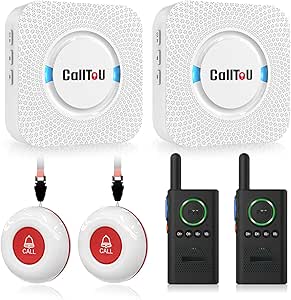 | Best Multi-Room Intercom Kit | Package contents: 2 call buttons, 2 receivers, 2 walkie-talkies | Maximum outdoor range: Up to 500 feet | Recommended indoor range: Under 300 feet | VIEW LATEST PRICE | See Our Full Breakdown |
| CallToU Caregiver Pager Wireless Call Button Nurse Alert System |  | Best for Bathroom and Outdoor Coverage | Manufacturer: CallToU | Part number: CC01US+01A | Wireless range: 500+ feet through walls | VIEW LATEST PRICE | See Our Full Breakdown |
| Medical Guardian MGMini Medical Alert Device for Seniors, Black |  | Best for Monitored Help Away from Home | Brand: Medical Guardian | Connectivity: Cellular with Wi-Fi backup | Monitoring: 24/7 monitoring subscription required | VIEW LATEST PRICE | See Our Full Breakdown |
| DAYTECH Wi-Fi Caregiver Call System with 2 Buttons, Wrist Button, and Receiver |  | Best for Shared Smartphone Alerts | Brand: DAYTECH | Model: CR02TY-CT02WR-WB06WH | Included alert devices: Two call buttons and one wrist button | VIEW LATEST PRICE | See Our Full Breakdown |
| SINGCALL Remote Emergency Strobe Siren Alarm Kit with 4 Emergency Buttons |  | Best for Multi-Room, High-Visibility Alerts | Brand: SINGCALL | Model: J008 520C | Included components: Two sirens and four emergency buttons | VIEW LATEST PRICE | See Our Full Breakdown |
| FullHouse Wireless Caregiver Pager with Emergency Call Button |  | Best No-Monthly-Fee Pick | Brand: Full House | Maximum range: 1,000 feet in open air; 500 feet through walls | Volume: Five levels, up to 110 dB | VIEW LATEST PRICE | See Our Full Breakdown |
| FullHouse Wireless Caregiver Pager with Emergency Call Button and Wristband |  | Best for Long-Range, No-Fee Home Alerts | Open-air range: Up to 1,000 feet | Range through walls: 500 feet | Melodies: 52 | VIEW LATEST PRICE | See Our Full Breakdown |
| Greetmed Wireless Caregiver Pager System with Dual Receivers and Two SOS Transmitters |  | Best for Two-Point Caregiver Coverage | Receivers: 2 | Transmitters: 2 | Open-area range: At least 1,000 feet | VIEW LATEST PRICE | See Our Full Breakdown |
| CallToU Wi-Fi Caregiver Call Button Emergency Alert System |  | Best for Family App Notifications | Wireless technology: 433 MHz RF | Wi-Fi support: 2.4 GHz | Wireless range: 328 feet / 100 meters | VIEW LATEST PRICE | See Our Full Breakdown |
| LogicMark Guardian Alert 911 Plus Emergency Pendant with Fall Detection |  | Best for Direct Emergency Response Without Monthly Fees | Model: 40711 | Network compatibility: 4G LTE | Communication: Two-way voice | VIEW LATEST PRICE | See Our Full Breakdown |
More Details on Our Top Picks
SecuLife Medical Alert Pendant for Seniors with Fall Detection, GPS Tracking and Two-Way Calling
I’d place the SecuLife pendant ahead of home-only pager systems for someone who spends time away from the house. Its 4G LTE connection, GPS tracking, and geofence alerts add location information that the CallToU Wi-Fi Caregiver Pager and SYNLETT pager do not provide. Fall detection and two-way calling can also help a wearer contact selected people without reaching for a phone. The tradeoff is an ongoing subscription, while the Freedom Alert Landline Personal Emergency Device has no monthly operating fee but depends on a landline and is intended for home use. SecuLife is also more involved than a simple call-button-and-receiver setup: buyers need to account for charging, cellular service, and a battery-life listing that varies between the description and product information.
Pros:- Fall detection can send alerts to selected emergency contacts.
- GPS tracking and geofence alerts support location awareness outside the home.
- Two-way calling and hands-free auto-answer allow voice communication through the pendant.
- IP67 water resistance suits daily wear, including exposure to water.
Cons:- A monthly subscription is required for service.
- Battery life is reported as up to six days in the description but five days in product information.
- The cellular pendant requires regular charging and is less suitable for buyers seeking a simple, plug-in home pager.
Best for: Older adults who regularly leave home and want GPS location sharing, fall alerts, and direct voice contact with selected contacts.
Not ideal for: People who want a no-subscription home pager, do not carry or charge a wearable, or need battery-life figures to be consistent before choosing.
- Connectivity:4G LTE cellular
- Alert features:Fall detection and SOS calling
- Communication:Two-way calling and hands-free auto-answer
- Location features:GPS tracking and geofencing
- Battery capacity:1000 mAh
- Battery life:Up to 6 days in description; 5 days in product information
- Water resistance:IP67
- Compatibility:Android and iOS smartphones
Our verdict“Choose SecuLife if mobility, location sharing, and wearable fall alerts matter more than avoiding a monthly subscription.”
CallToU Wi-Fi Caregiver Pager with Call Button, Watch Button, and Receiver
This CallToU system fits households that want both an in-room alert and a notification on caregivers’ phones. A receiver with audible and visual alerts provides a local signal, while the app can share notifications with family members. That makes it more connected than the SYNLETT Caregiver Pager, whose listed setup centers on its portable receiver and call buttons. The included call button and watch button give the person requesting help different ways to trigger an alert, and customizable names can make app notifications easier to identify. The limits are practical: Wi-Fi must be 2.4 GHz, and phone or text alerts require a paid subscription. Unlike the SecuLife pendant, this is a home Wi-Fi pager rather than a GPS-connected wearable for use away from home.
Pros:- Combines app notifications with audible and visual alerts from the receiver.
- Includes both a call button and a wearable watch button.
- App alert sharing and customizable button names help distinguish who needs assistance.
- Receiver offers 20 ringtones and five volume levels.
Cons:- The receiver connects to 2.4 GHz Wi-Fi only.
- Phone and text alerts require a paid subscription.
- The listed 328-foot button range may not reflect performance through walls and other indoor obstacles.
Best for: Families with a 2.4 GHz Wi-Fi network who want shared app alerts alongside an audible and visual receiver at home.
Not ideal for: Households using only 5 GHz Wi-Fi, caregivers who need paid-service-free phone or text alerts, or older adults who need an alert device away from home.
- Wireless technology:433 MHz
- Wi-Fi compatibility:2.4 GHz only
- Maximum range:Up to 328 feet (100 m)
- Included components:1 call button, 1 watch button, 1 receiver
- Receiver alerts:20 ringtones and 5 volume levels
- Power:Battery powered; 2 AAA batteries included
- Control:App and touch
- Warranty:1 year
Our verdict“Pick this model for a 2.4 GHz-connected household that wants app sharing without giving up a dedicated in-home receiver.”
SYNLETT Caregiver Pager with 2 Wireless Call Buttons
The SYNLETT is the straightforward choice when a household needs two ways to call for help and a portable receiver, without the app setup found in the CallToU Wi-Fi Caregiver Pager. Its two wireless buttons can be wall-mounted or worn on the included lanyards, so a user can keep one nearby and place another where help is often needed. The receiver’s chime and continuous alarm modes let caregivers choose between a less persistent notice and a sustained alert. A listed 500-foot range in open areas offers flexibility across a property, but that figure is not a promise for a home with walls or other obstructions. Unlike the SecuLife pendant, this pager has no listed GPS, fall detection, or two-way voice calling; it alerts a nearby caregiver rather than serving as a mobile monitoring service.
Pros:- Includes two wireless call buttons and a portable receiver.
- Buttons can be worn with lanyards or wall-mounted.
- Chime and continuous alarm modes offer different alert styles.
- The listed open-area range reaches up to 500 feet.
Cons:- The maximum range is specified for open areas and may be shorter indoors.
- No app alerts, GPS tracking, or two-way voice communication are listed.
- Call buttons use 12V batteries, separate from the receiver’s included AA batteries.
Best for: Caregivers who want a basic two-button alert system for one home, with wearable or wall-mounted call options and a portable receiver.
Not ideal for: People who need GPS, automatic fall alerts, two-way conversation, or confirmed long-range performance through a large or obstructed home.
- Included components:2 call buttons and 1 receiver
- Maximum range:Up to 500 feet in open areas
- Alert modes:Chime and continuous alarm
- Sound level:90 dB
- Receiver power:4 AA batteries included
- Call-button batteries:12V batteries
- Mounting:Wall mount; buttons can also be worn with included lanyards
- Warranty:1 year
Our verdict“Choose SYNLETT for a simple two-button home pager, but look to SecuLife or an app-connected system for mobile or remote monitoring features.”
Freedom Alert Landline Personal Emergency Device
Freedom Alert stands apart from the pager kits by offering two-way voice through a wearable pendant, so pressing for help can lead directly to a conversation with family or emergency personnel. Its strongest distinction is the absence of monthly operating fees, which may appeal to buyers who prefer a landline-based home setup over the SecuLife pendant’s subscription service. A 24-hour battery backup also offers a fallback during a power interruption. That simplicity comes with a firm boundary: an existing landline is required, and the listed features do not include GPS, geofencing, or automatic fall detection. Compared with the CallToU Wi-Fi pager, Freedom Alert prioritizes voice communication and fee-free operation rather than app sharing and receiver customization. It is a home-focused choice, not a mobile alert system.
Pros:- Pendant supports two-way voice communication with family or emergency personnel.
- No monthly operating fees are listed.
- Rechargeable pendant avoids disposable-battery replacement for the wearable.
- Includes a 24-hour battery backup.
Cons:- Requires existing landline phone service.
- The listed setup is home-based and does not provide GPS tracking for outings.
- Automatic fall detection is not listed.
Best for: Landline households seeking a wearable emergency button with two-way voice and no monthly operating fees.
Not ideal for: People without landline phone service, or those who need GPS location tracking, automatic fall detection, or alerts while away from home.
- Connection:Landline phone service required
- Communication:Two-way voice via pendant
- Pendant battery:Rechargeable
- Backup power:24-hour battery backup
- Monthly operating fees:None
- Alert control:Wearable pendant button
Our verdict“Choose Freedom Alert if a landline is available and direct voice contact without monthly operating fees matters more than mobile coverage.”
CallToU Caregiver Pager Wireless Alert Button
Among these home-focused options, this CallToU kit is the most suited to caregivers who want alerts in more than one room and a way to speak across the home. It includes two call buttons, two receivers, and two walkie-talkies, unlike the SYNLETT pager’s single receiver and lack of listed voice communication. The buttons can be worn as pendants or mounted, while waterproof and dustproof devices support placement where a basic pager may be less practical. Its advertised outdoor range is 500 feet, but the recommended indoor range is under 300 feet, so room layout and walls matter. The intercom and pager systems are separate and cannot be paired, a limitation that can make the overall setup less seamless. Like the other local pager kits, it does not provide the GPS-based away-from-home coverage of SecuLife.
Pros:- Includes two call buttons, two receivers, and two walkie-talkies.
- Buttons can be worn as pendants or mounted.
- Waterproof and dustproof devices suit placement near bathrooms or outdoor areas.
- Offers 55 selectable ringtones and adjustable volume up to 110 dB.
Cons:- Indoor range is recommended at under 300 feet and can be reduced by obstacles.
- The pager and intercom systems are separate and cannot be paired.
- The outdoor range specification does not establish equivalent coverage inside a home.
Best for: Households with caregivers in different rooms who want multiple receivers, wearable or mounted call buttons, and separate intercom communication.
Not ideal for: Buyers expecting the pager and walkie-talkies to work as one paired system, or those who need reliable coverage well beyond the recommended indoor range.
- Package contents:2 call buttons, 2 receivers, 2 walkie-talkies
- Maximum outdoor range:Up to 500 feet
- Recommended indoor range:Under 300 feet
- Audible noise level:Up to 110 dB
- Ringtones:55 selectable
- Device protection:Waterproof and dustproof
- Mounting:Wall mount or door mount; buttons can be worn as pendants
- Power:Battery powered; package lists 2 batteries, including lithium polymer batteries
Our verdict“Choose this kit for multi-room alerting and separate intercom communication, but not if you need one integrated system or mobile GPS monitoring.”
CallToU Caregiver Pager Wireless Call Button Nurse Alert System
The CallToU suits households that need a simple way to call a nearby caregiver from more than one part of the home. Its 500+ ft through-wall range and waterproof, dustproof button make it more adaptable around damp or dusty areas than the FullHouse pager, whose button is splash-resistant but should not be immersed. Caregivers can carry the receiver, while 55 ringtone choices and volume up to 110 dB help tailor the alert to the household.
This is a local caregiver pager, not a monitored medical alert service: it does not provide a response team or GPS assistance like the Medical Guardian MGMini. The receiver also needs an outlet, and the call button relies on a replaceable 12V alkaline battery. I’d choose it for in-home signaling, but not as a substitute for emergency-response monitoring.
Pros:- Stated wireless range exceeds 500 feet through walls.
- Waterproof and dustproof design suits areas where splash-resistant buttons may be less suitable.
- Up to 110 dB volume and 55 ringtone choices allow alert customization.
- Portable receiver can travel with the caregiver.
Cons:- The receiver must remain plugged into an outlet.
- The button requires a replaceable 12V alkaline battery.
- It signals a nearby caregiver rather than connecting to a monitoring team.
Best for: Households that need a loud, local call button in bathrooms or other damp areas, with a caregiver close enough to hear the receiver.
Not ideal for: People who need 24/7 monitoring, GPS location assistance, or a receiver that works without an outlet.
- Manufacturer:CallToU
- Part number:CC01US+01A
- Wireless range:500+ feet through walls
- Maximum sound level:110 dB
- Ringtones:55 selectable
- Button battery:One 12V alkaline battery required
- Receiver power:Plug-in receiver
- Protection:Waterproof and dustproof
Our verdict“Choose the CallToU for loud, local alerts in damp areas, but pick the Medical Guardian MGMini if you need monitored help beyond the home.”
Medical Guardian MGMini Medical Alert Device for Seniors, Black
Unlike the CallToU and FullHouse pagers, which alert someone nearby, the Medical Guardian MGMini connects to a 24/7 monitoring team when its SOS button is pressed. Its two-way speaker lets the user communicate with responders, and GPS location assistance adds value for people who may need help outside the house. The included lanyard and belt clip offer two ways to wear it, while a charge can last up to 72 hours.
That broader coverage comes with ongoing service requirements: monitoring must be activated and requires a subscription. Fall detection is optional, not included, and adds a separate monthly fee. The MGMini is a stronger fit than a household pager for someone who goes out alone, but a less suitable choice for buyers seeking a no-subscription button that only alerts a caregiver at home.
Pros:- Connects users to a 24/7 monitoring team after service activation.
- Two-way speaker supports direct communication during an alert.
- GPS location assistance is useful when the user is away from home.
- Includes a lanyard, belt clip, and charging cradle.
Cons:- A monitoring subscription is required before use.
- Fall detection is an additional paid option.
- Battery life is limited to up to 72 hours per charge, so it needs regular charging.
Best for: Older adults who spend time outside the home and want a wearable SOS device with two-way contact to a 24/7 monitoring team.
Not ideal for: Households seeking a no-subscription, local-only caregiver pager or anyone unwilling to keep a wearable device charged.
- Brand:Medical Guardian
- Connectivity:Cellular with Wi-Fi backup
- Monitoring:24/7 monitoring subscription required
- Communication:SOS button and two-way speaker
- Location assistance:GPS
- Battery life:Up to 72 hours
- Charging time:4 hours
- Fall detection:Optional add-on
- Included accessories:Lanyard, belt clip, charging cradle, and power cord
Our verdict“Pick the MGMini for monitored, wearable protection beyond the home, and choose a CallToU or FullHouse pager for simpler local alerts without a service subscription.”
DAYTECH Wi-Fi Caregiver Call System with 2 Buttons, Wrist Button, and Receiver
The DAYTECH stands apart from basic plug-in pagers by sending app notifications over 2.4 GHz Wi-Fi, so family members can receive alerts on their phones rather than relying only on hearing a receiver. Its package includes two call buttons and a wrist button, giving households several ways to request help from different locations. Shared notifications can suit relatives who take turns checking in, while 20 ringtones and five volume levels let users adjust the local alert.
Compared with the FullHouse pager, DAYTECH adds app-based sharing but brings Wi-Fi setup and network compatibility into the picture. It works only with 2.4 GHz Wi-Fi; phone and text alerts require an upgrade, so buyers should not assume all remote notifications are included. The receiver still needs an outlet, making this a better fit for connected households than for people who want a fully independent wearable medical alert.
Pros:- App notifications can reach caregivers beyond the room with the receiver.
- Shared alerts support multiple family members.
- Includes two standard call buttons and a wrist button.
- Offers 20 ringtone options and five volume levels.
Cons:- Works only with 2.4 GHz Wi-Fi.
- Phone and text notifications require an upgrade.
- The receiver must be plugged into an outlet.
Best for: Families with multiple caregivers who want shared app alerts and several call buttons around the home.
Not ideal for: Buyers with only 5 GHz Wi-Fi, or anyone expecting phone and text alerts without an upgrade or a monitored emergency service.
- Brand:DAYTECH
- Model:CR02TY-CT02WR-WB06WH
- Included alert devices:Two call buttons and one wrist button
- Receiver:One plug-in receiver
- Wi-Fi band:2.4 GHz only
- Ringtones:20 options
- Volume:Five levels
- Item weight:10.2 ounces
Our verdict“Choose DAYTECH if shared app alerts and multiple buttons matter more than simple setup; choose FullHouse for a no-monthly-fee pager without Wi-Fi dependence.”
SINGCALL Remote Emergency Strobe Siren Alarm Kit with 4 Emergency Buttons
The SINGCALL is built for a different job than the one-button CallToU or FullHouse pagers: it pairs four large call buttons with two sirens, making it more suited to a home or care setting where alerts need to be heard and seen in several areas. Its 120 dB siren and flashing red indicator make a press difficult to miss, while the stated range reaches up to 100 meters. That combination may help when a caregiver is not within earshot of a quieter receiver.
The tradeoff is intensity and simplicity. A 120 dB alarm may be disruptive in a household, and the siren sounds for up to five minutes unless canceled. Unlike the Medical Guardian MGMini, this is not a monitoring service and provides no two-way conversation or GPS assistance. It also runs on alkaline batteries, so buyers must manage power rather than rely on a charged wearable.
Pros:- Includes four emergency buttons and two sirens.
- 120 dB sound and a flashing red indicator provide conspicuous alerts.
- Stated maximum range is 100 meters.
- Large, touch-sensitive buttons are straightforward to press.
Cons:- The siren can sound for up to five minutes unless canceled.
- Battery-powered units require alkaline battery management.
- Does not provide monitoring, GPS, or two-way communication.
Best for: Large households or care settings that need multiple call points and a prominent audible and visual alert.
Not ideal for: People who need discreet alerts, two-way communication, or a connection to a 24/7 monitoring team.
- Brand:SINGCALL
- Model:J008 520C
- Included components:Two sirens and four emergency buttons
- Power source:Battery powered
- Batteries included:Two AA batteries
- Audible level:120 dB
- Maximum range:100 meters
- Siren dimensions:4.4 × 7.9 × 2.8 inches
Our verdict“Choose SINGCALL when multiple call points and a conspicuous local alarm matter most; choose the MGMini for monitored help and two-way communication.”
FullHouse Wireless Caregiver Pager with Emergency Call Button
FullHouse is a straightforward choice for households that want a local alert without a monthly fee. The button can be worn around the neck or mounted on a wall or door, and the receiver offers five volume levels up to 110 dB, 52 melodies, and a silent LED alert. Compared with DAYTECH, it avoids Wi-Fi setup and app-related upgrades; compared with the CallToU, it lists a longer open-air range of up to 1,000 feet.
That headline range drops to about 500 feet through walls, so layout and receiver placement still matter. The button is IP55 splash-resistant, not immersible, which makes it less suitable for shower use than the waterproof CallToU. It also alerts a nearby caregiver rather than a response team, so I’d treat it as an in-home communication aid, not monitored medical protection.
Pros:- No monthly fee is required for the local pager function.
- Stated range is up to 1,000 feet in open air and 500 feet through walls.
- Button can be worn around the neck or mounted on a wall or door.
- Offers a silent LED alert, five volume levels, and 52 melodies.
Cons:- The IP55 button is splash-resistant but should not be immersed.
- The receiver must be plugged into an outlet.
- It does not connect users to a monitoring team.
Best for: Households wanting a simple, no-monthly-fee call button with flexible wearing or mounting and a silent alert option.
Not ideal for: People who need a waterproof button for bathing, app-based shared alerts, or 24/7 emergency monitoring.
- Brand:Full House
- Maximum range:1,000 feet in open air; 500 feet through walls
- Volume:Five levels, up to 110 dB
- Melodies:52
- Water resistance:IP55 splash-resistant; not immersible
- Button battery:One included CR2032 battery
- Mounting and wear:Wall mount, door mount, or worn around the neck
- Included items:One call button and one plug-in receiver
Our verdict“Pick FullHouse for flexible, subscription-free alerts around the home, but choose CallToU for a button rated waterproof or MGMini for monitored assistance.”
FullHouse Wireless Caregiver Pager with Emergency Call Button and Wristband
This FullHouse pager is a straightforward choice for households that want a caregiver to hear or see a call without adding a subscription. Its stated 1,000-foot open-air range is generous for a home alert system, though the listed range falls to 500 feet through walls, so placement matters in larger or multi-level homes. The receiver offers five volume levels, 52 melodies, and a silent LED-only mode, giving caregivers options for a quiet bedroom or a noisier shared space. Unlike the CallToU Wi-Fi Caregiver Call Button Emergency Alert System, this model does not depend on Wi-Fi or an app. The tradeoff is that it alerts nearby caregivers rather than sending an alert to a phone or emergency service, and its splash-proof button should not be immersed.
Pros:- No monthly fee or Wi-Fi connection required
- Stated range reaches up to 1,000 feet in open air
- Sound, adjustable volume, and silent LED-only alert options
- Call button can be worn or placed near a bed, wheelchair, or bathroom wall
Cons:- Stated range drops to 500 feet through walls
- Call button is splash-proof but should not be immersed
- Alerts are for a nearby caregiver, not a remote contact or emergency service
Best for: Households wanting a no-subscription alert between a caregiver and someone who spends time in different rooms, with flexibility to wear or position the call button.
Not ideal for: People who need remote phone notifications, emergency-service contact, or a call button safe for immersion in a bath or shower.
- Open-air range:Up to 1,000 feet
- Range through walls:500 feet
- Melodies:52
- Volume levels:5, from 0 dB to 110 dB
- Alert modes:Sound and LED flash; silent LED-only mode
- Water resistance:IP55; splash-proof, not for immersion
- Batteries:2 C batteries, included
- Weight:8.1 ounces
Our verdict“Choose this FullHouse pager for flexible, no-fee alerts around the home, but not for remote monitoring or bathing use.”
Greetmed Wireless Caregiver Pager System with Dual Receivers and Two SOS Transmitters
Greetmed earns its place for households that need alerts available in more than one room: the package includes two plug-in receivers and two SOS transmitters, rather than asking buyers to expand a single-receiver setup. That makes it a better fit for caregivers who split time between floors or shared care settings. It works without Wi-Fi, cellular service, or a monthly fee, unlike the app-connected CallToU Wi-Fi system, but that also means alerts stay within the home rather than following caregivers to their phones. The stated open-area range is at least 1,000 feet, while the indoor figure is at least 165 feet; walls and layout can limit coverage. Transmitters can be carried, worn as pendants, or wall-mounted, though they require separate 23A 12V batteries.
Pros:- Includes two receivers and two SOS transmitters
- Operates without Wi-Fi, cellular service, or a subscription
- Transmitters can be wall-mounted, carried, or worn as pendants
- Offers 38 selectable melodies and distinct button alerts
Cons:- Transmitter batteries are 23A 12V cells that may need replacement
- Listed indoor range is at least 165 feet, well below the open-area figure
- Alerts depend on receivers being plugged in and within wireless range
Best for: Families or small care teams who want two receivers and two call buttons to cover separate rooms without relying on internet or cellular service.
Not ideal for: Caregivers who need alerts on a phone when away from the receivers, or buyers who want to avoid replacing transmitter batteries.
- Receivers:2
- Transmitters:2
- Open-area range:At least 1,000 feet
- Indoor range:At least 165 feet
- Melodies:38
- Receiver volume:At least 70 dB at 1 meter
- Receiver power:100–240V AC, 50/60Hz
- Transmitter battery:23A 12V
Our verdict“Pick Greetmed when two in-home receiver locations matter more than phone-based alerts or outdoor coverage.”
CallToU Wi-Fi Caregiver Call Button Emergency Alert System
For households where caregivers may be in another part of the home—or out of earshot—the CallToU adds app notifications to the usual receiver alert. Its package includes two call buttons, a wrist button, and a receiver, while 433 MHz wireless links the buttons to the receiver and 2.4 GHz Wi-Fi connects the system to the Tuya app. That gives it a useful remote-notification advantage over the no-network FullHouse pager, and family members can share app alerts. The distinction matters: app notifications are free, but phone or text alerts require a subscription. Its stated wireless range is 328 feet, and 5 GHz Wi-Fi is unsupported, so it suits homes with compatible Wi-Fi and modest coverage needs better than large properties or households avoiding app setup.
Pros:- Sends alerts to both the receiver and the Tuya app
- Includes two call buttons and one wrist button
- Family members can share app notifications
- Receiver offers five volume levels and 20 ringtones
Cons:- Supports 2.4 GHz Wi-Fi only
- Phone or text notifications require a subscription
- Stated wireless range is 328 feet and may not suit larger homes
Best for: Families with reliable 2.4 GHz Wi-Fi who want multiple caregivers to receive app notifications as well as alerts from an in-home receiver.
Not ideal for: Buyers without 2.4 GHz Wi-Fi, those wanting a fully offline system, or anyone who expects phone or text alerts without a subscription.
- Wireless technology:433 MHz RF
- Wi-Fi support:2.4 GHz
- Wireless range:328 feet / 100 meters
- Included devices:2 call buttons, 1 wrist button, 1 receiver
- Ringtones:20
- Volume levels:5
- Power source:2 AAA batteries, included
- Warranty:Lifetime warranty
Our verdict“Choose this CallToU system for shared app alerts over compatible Wi-Fi, but skip it if you want a subscription-free phone or text service.”
LogicMark Guardian Alert 911 Plus Emergency Pendant with Fall Detection
Unlike caregiver pagers such as the Greetmed dual-receiver system, the LogicMark Guardian Alert 911 Plus is designed for the wearer to reach emergency personnel through two-way voice. Its 4G LTE connection and fall detection make it a more self-contained option for someone who may be alone and unable to press a button after a fall. It also avoids a monthly fee and is listed as water resistant for bath or shower use, addressing situations where a room-to-room pager may not be enough. Those capabilities come with questions buyers should resolve before choosing it: the product details do not state battery life, and they leave the routing of fall alerts unclear. It is a different kind of protection from the CallToU Wi-Fi pager, not a multi-room caregiver notification network.
Pros:- Two-way voice communication with emergency personnel
- Fall detection can trigger an alert if the user cannot press the button
- Works with 4G LTE and does not require a monthly fee
- Water resistant for use around the bath or shower
Cons:- Battery life is not specified in the product details
- Details about who receives fall-detection alerts are unclear
- Provides a different, personal-response function from a multi-receiver home caregiver pager
Best for: A person living independently who wants a wearable emergency contact device with two-way voice, fall detection, and no monthly fee.
Not ideal for: Households seeking a multi-room caregiver pager, or buyers who need confirmed battery-life and fall-alert routing details before purchase.
- Model:40711
- Network compatibility:4G LTE
- Communication:Two-way voice
- Fall detection:Yes
- Power source:Battery powered
- Battery type:Lithium-ion
- Water resistance:Water resistant; listed for use in the bath or shower
- Monthly fees:None
Our verdict“Choose the LogicMark for personal emergency calling and fall detection without a monthly fee, after confirming alert routing and battery expectations.”

How We Picked
I ranked these systems by how well their core alert path matches common home-safety needs: reaching a monitoring or emergency response service, contacting a caregiver nearby, or covering a larger home with multiple alert points. I also weighed connection type, portability, stated fall-detection support, two-way communication, included buttons and receivers, and how much setup a household may need. A product that can reach help beyond the home has a different role from a pager that only alerts someone within its receiver range, so I did not treat those categories as interchangeable.
The leading positions go to options with broader personal-alert functionality and clearer use beyond a single room, while simpler caregiver pagers rank for households that already have someone available to respond. Within those pager systems, button count, receiver arrangement, and Wi-Fi features help separate the picks. Buyers should confirm subscription terms, cellular coverage, fall-detection limits, operating range, and compatibility with their home before purchase; product names and feature listings alone do not establish those details.
Factors to Consider When Choosing Best Home Emergency Alert Systems
Before choosing, decide who receives the alert and what happens next. A wearable medical alert, a landline unit, and a caregiver pager can all be called emergency alert systems, but they solve different problems. These checks help prevent paying for features that do not match the household’s response plan.
Choose the person or service that receives the alert
Start by tracing the alert from button press to response. Some systems are intended to connect the wearer to an emergency response service, while caregiver pagers notify a person close enough to hear or receive the signal. A pager can be a sensible choice when a caregiver is reliably present, but it is not a substitute for outside help when the person lives alone. Ask who will hear the alert overnight, during errands, or when the primary caregiver is away. The common mistake is buying based on the word “emergency” without checking whether the system contacts anyone beyond the home. Match the alert path to a realistic backup plan, not just the best-case routine.
Check connectivity, coverage, and what happens during an outage
Home systems may rely on landline service, Wi-Fi, cellular networks, or a local radio link between button and receiver. Those are not interchangeable: a household pager may still depend on the receiver being in range, while a mobile alert may depend on cellular coverage where the wearer travels. Before buying, check the signal in bedrooms, bathrooms, basements, and outdoor areas the person uses. Ask what continues working if the internet or power goes out, and whether batteries need regular replacement or charging. A system that works well in one room can leave a serious gap across a large or multi-story home. Choose based on the weakest coverage point, not the most convenient one.
Treat fall detection as backup, not the whole safety plan
Fall detection can add a layer of protection when someone cannot press a button, but it does not identify every fall or guarantee an alert. Movement, device placement, and the type of fall can affect whether a signal is triggered. Ask how detection works, whether it can be disabled, and whether the wearer can still call for help manually. A pendant or wrist button is most useful when the person will wear it consistently, including while bathing if the device is rated for that use. Buyers sometimes focus on detection and overlook fit, comfort, and daily charging. Build a plan that includes a wearable call option and a named person or service to respond.
Compare recurring obligations with the equipment
The device itself may not tell the full story: monitoring, cellular service, app access, or replacement parts can involve separate terms. Confirm any subscription, activation requirement, cancellation conditions, and whether the system can be used without a paid service. For caregiver pagers, find out if additional buttons or receivers are compatible and whether they are sold separately. This matters when a household’s needs change or one receiver cannot cover the whole home. Avoid assuming that a Wi-Fi label means remote monitoring or that a no-subscription device includes a staffed response service. Compare the complete operating arrangement, not just the hardware in the box.
Plan for who will wear and maintain the device
The most capable device has little value if the wearer leaves it on a dresser or cannot manage its controls. Consider pendant versus wrist wear, button size, charging routine, water exposure, and whether the person can hear or speak through the unit. A caregiver pager may be simpler for someone who prefers not to wear a device, but it only helps if the call button stays within reach and a caregiver can respond. Set a regular test schedule that fits the manufacturer’s instructions, and assign someone to check batteries, charging, and contact details. For households with cognitive or dexterity challenges, favor a straightforward routine over a long feature list. A successful setup is one the person and caregiver can keep using reliably.
Frequently Asked Questions
Do caregiver pager systems automatically call emergency services?
Usually, a caregiver pager is designed to notify its paired receiver or caregiver, not to contact emergency services automatically. That makes it useful when someone is close by and able to respond, but it leaves a gap if the alert goes unanswered. Check the product’s alert path and range rather than relying on terms such as “SOS” or “emergency.” If the wearer lives alone or needs a response when family is away, look for a service that explicitly includes monitoring or direct emergency calling. Decide in advance who will act on an alert and what the backup is.
Should I choose a landline system or a mobile alert pendant?
A landline-based system can suit someone who spends most of their time at home and has a dependable phone connection. A mobile pendant is a better match when the wearer goes outside, visits others, or needs the alert to work away from the base unit, provided cellular coverage is available. Compare the actual coverage area and service requirements before choosing; “portable” does not mean it works everywhere. Also consider whether the wearer will charge and carry the device consistently. If both home and away coverage matter, verify that the chosen service supports both rather than assuming one device covers every setting.
Can fall detection replace wearing or pressing an alert button?
No. Fall detection can provide an additional route to an alert, but it may miss some falls and can sometimes trigger when there has not been one. A wearable button remains useful because the person can call for help after a fall or during another emergency. Ask how the system handles an accidental alert and whether a responder can speak with the wearer. Fit and regular use matter as much as the feature itself. Treat fall detection as backup within a broader response plan, not as a promise that every fall will be detected.
What should I check before relying on a Wi-Fi alert system?
Confirm which network connection the system needs and whether the alert still reaches a receiver if internet service drops. Test the signal where the person spends time, especially in bathrooms, bedrooms, and across floors. Find out whether the system notifies someone only through a local receiver, through an app, or through a staffed service; these options provide different levels of response. Check power backup and battery expectations for both buttons and receivers. A Wi-Fi system can be convenient, but a reliable response still depends on a reachable recipient and a working connection.
How many call buttons and receivers does a household need?
Base the number on the home’s layout and who needs to respond, rather than choosing the largest bundle by default. A second button can help cover another room or give the wearer a wearable option, while an extra receiver can make an alert easier to hear in a distant part of the house. Check the manufacturer’s stated range and test through walls and floors, since layout can affect reception. If multiple caregivers need notifications, confirm whether the system supports that arrangement or only sounds locally. Add equipment only where it closes a real coverage or response gap.
Conclusion
For the best overall personal-alert fit, I’d start with the SecuLife Medical Alert Pendant for its combination of GPS and two-way calling, while checking service terms and coverage before committing. The best value for a household with an available caregiver is one of the simpler CallToU or FullHouse pager setups, chosen by the number of buttons and receivers needed. For a buyer who wants a compact mobile device, the Medical Guardian MGMini is the standout to compare; for beginners, a basic pager with a clear local receiver may be easier to manage than a system with more connectivity features. Choose Freedom Alert if a landline setup fits the home, and look at the multi-button SINGCALL or Greetmed kits when coverage across rooms or multiple alert points is the priority. The right pick depends on who will receive the alert and whether that response plan still works when the usual caregiver is unavailable.
Cold & flu season Picks
humidifiers
As an affiliate, we earn on qualifying purchases.