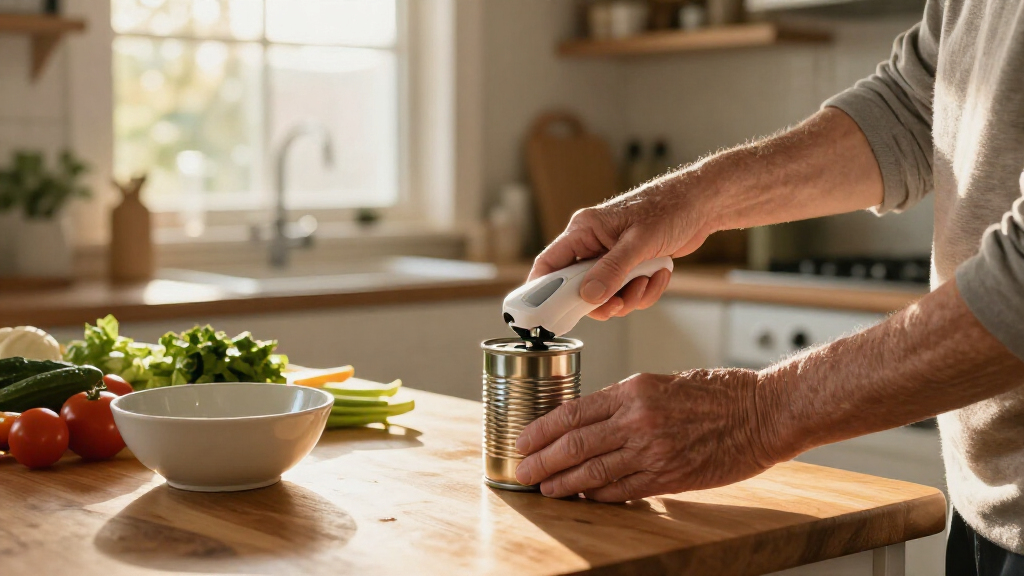

Choosing an easy-to-use electric can opener comes down to where you want the effort to go: a hands-free countertop model holds and turns the can for you, while a handheld model asks you to guide the tool around the rim. Both can reduce the grip strength and wrist motion required by a manual opener, but they suit different kitchens and users.

Turn quiet afternoons into listening time
- Thousands of audiobooks, podcasts and originals
- Listen on your phone, tablet or Echo — also offline
- Cancel anytime

Kitchen Mama Mini Plus Rechargeable Electric Can Opener, Metal Gray
- ✔ Brand: Kitchen Mama
- ✔ Model: Mini Plus
- ✔ Dimensions: 2.4 in W x 4.7 in H
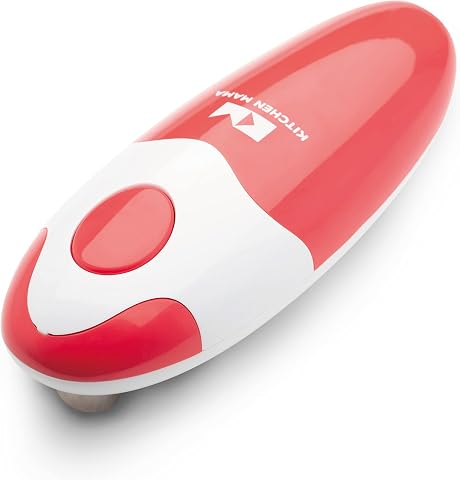
Kitchen Mama Auto Electric Can Opener, Battery Operated, Red
- ✔ Brand: Kitchen Mama
- ✔ Model number: CO1100-R
- ✔ Color: Red

HZW Home Rechargeable Electric Can Opener
- ✔ Brand: HZW Home
- ✔ Type: Rechargeable electric can opener
- ✔ Operation: Hands-free, one-touch
Countertop openers are the stronger choice for frequent use, limited hand strength, or anyone who wants to steady a can with minimal handling. Handheld openers are easier to store, often cost less, and make sense when cabinet space is tight or cans are opened only occasionally. The main tradeoff is straightforward: more assistance and a permanent place on the counter, or less assistance in a smaller, less expensive package.
At a Glance
| Criteria | Hands-Free Countertop Electric Can Openers | Handheld Electric Can Openers | Winner |
|---|---|---|---|
| Effort and control | Holds the can and powers the cutting action; little guidance is needed. | Motor turns the cutter, but the user positions and guides it around the rim. | A |
| Counter and storage space | Bulky appliance that needs counter space or a roomy cabinet. | Compact and typically easy to fit in a drawer. | B |
| Handling different cans | Often convenient for standard cans; performance varies with can shape and size. | Can be maneuverable, though positioning may take practice and results vary by model. | Depends |
| Lid and edge safety | Some models leave a smoother edge or lift the lid with a magnet; design varies. | Safety depends on the cutting mechanism; some leave sharp edges or require lid handling. | Depends |
| Cleaning and upkeep | The cutting head and nearby surfaces may need wiping after spills. | The head may detach or be wipeable, depending on the design. | Depends |
| Portability | Designed to stay in a kitchen; awkward to pack or carry. | Easy to store, move between kitchens, or take along. | B |
| Price and value | Usually costs more, with the biggest payoff for frequent use or limited hand strength. | Often less expensive; good value for occasional use when the user can guide it. | Depends |
Kitchen Mama Mini Plus Rechargeable Electric Can Opener, Metal Gray
The Mini Plus is our most balanced choice for people who want an electric opener ready for regular kitchen use. Its hands-free operation reduces the need to grip and twist a manual opener, while USB-C recharging avoids keeping disposable batteries on hand. The listed 1500 mAh battery is described as supporting 130+ openings per charge, which may suit a household that opens cans often; actual use between charges will depend on how frequently it is used.Compared with the battery-operated Kitchen Mama Auto, the Mini Plus trades replaceable batteries for charging and adds auto shut-off. That makes it the more convenient pick for an everyday drawer, though a depleted battery means pausing to recharge. At 2.4 inches wide and 4.7 inches tall, it is also the most compact model with detailed dimensions in this lineup. The HZW Home shares USB-C power and one-touch use, but the Mini Plus provides clearer details on its size and battery capacity.Its compact format has a boundary: the maker says it may not suit very large or unusually shaped cans. We would choose another approach if those cans are common in our pantry. For ordinary cans and users who value low-effort operation without routine battery swaps, it earns the top position.
Pros:
- Hands-free operation reduces manual twisting and gripping.
- USB-C charging avoids disposable battery replacement.
- Auto shut-off adds convenience after operation.
- Compact 2.4-by-4.7-inch size is easy to store.
Cons:
- Requires recharging, so it may be unavailable if the battery is depleted.
- May not handle very large or unusually shaped cans.
- Plastic construction may not suit buyers seeking an all-metal body.
Best for: People who open cans regularly and want a compact, rechargeable opener with hands-free operation and auto shut-off.
Not ideal for: People who frequently open very large or unusually shaped cans, or who prefer a device that works without recharging.
Bottom line: We recommend the Mini Plus first for its useful mix of hands-free opening, USB-C charging, auto shut-off and compact storage.
“We recommend the Mini Plus first for its useful mix of hands-free opening, USB-C charging, auto shut-off and compact storage.”
Kitchen Mama Auto Electric Can Opener, Battery Operated, Red
The Kitchen Mama Auto keeps the interaction simple: position it on a suitable can and use one-touch operation to do the cutting. Its battery-powered cordless design does not tie it to a charging cable, which can be handy in a small kitchen, camper or travel bag. The stated weight is just 8.48 ounces, so carrying it is less of a burden than storing a bulky countertop opener.Against the rechargeable Mini Plus, this model gives up USB-C charging and auto shut-off in exchange for a familiar replaceable-battery setup. That can work well for occasional use when fresh batteries are already available, but repeated battery replacement is a drawback for frequent opening. It shares the Mini Plus’s smooth-edge side-cutting intent, so the choice between them is more about power routine and size than the basic idea of reducing hand effort. HZW Home adds a magnetic lid holder, a feature not specified for this model.The Auto is described as a fit for seniors and people with limited hand strength, and hands-free cutting is central to that appeal. Still, its stated compatibility caveat matters: unusually sized or deep cans may not fit. We would pick it for straightforward operation and portability, but skip it if we want rechargeable power or need wider can compatibility.
Pros:
- One-touch, hands-free operation helps reduce hand strain.
- Cordless and lightweight for storage or travel.
- Side-cutting design is intended to leave smooth edges.
- Ergonomic shape is described as comfortable to hold.
Cons:
- Requires batteries, so operation depends on battery life and replacements.
- May not fit unusually sized or deep cans.
- Auto shut-off is not listed among its features.
Best for: People who want a lightweight, cordless one-touch opener for ordinary cans and occasional kitchen, travel or camping use.
Not ideal for: Frequent users who would rather recharge than replace batteries, or anyone who often opens unusually deep or oversized cans.
Bottom line: We choose the Kitchen Mama Auto when simple battery-powered portability matters more than rechargeable convenience.
“We choose the Kitchen Mama Auto when simple battery-powered portability matters more than rechargeable convenience.”
HZW Home Rechargeable Electric Can Opener
The HZW Home rechargeable opener stands out for what it does after the cut: a magnetic lid holder lifts the separated lid. That detail can make lid handling more convenient, especially for people who prefer not to pinch or lift a loose lid by hand. Its one-touch, hands-free operation also addresses the core reason to choose an electric opener: less manual twisting than a conventional opener.Like the Mini Plus, HZW Home uses USB-C charging, so both rechargeable models need enough charge before use. The Mini Plus ranks higher for us because its dimensions, weight and battery capacity are specified, and it includes auto shut-off. HZW Home instead offers the more distinctive lid-lifting feature and says it accommodates most can sizes and shapes. That broader wording is useful, but it is not a precise compatibility list; the Auto and Mini Plus both make specific caveats about certain cans.The tradeoff is a thinner specification picture. The supplied information does not state battery capacity, dimensions or weight, making it harder to compare charging intervals and storage needs with the Mini Plus. We see this as the right alternative for buyers who value magnetic lid pickup over detailed battery and size information. Anyone who needs certainty about fit should confirm compatibility for their usual cans before choosing it.
Pros:
- One-touch cordless operation reduces manual effort.
- Magnetic holder lifts the separated lid.
- USB-C rechargeable power avoids disposable battery replacement.
- Lightweight design is described as easy to store or carry.
Cons:
- Requires recharging before use when the battery is depleted.
- Battery capacity and dimensions are not provided in the supplied specifications.
- Compatibility is described as fitting most cans, with exceptions not detailed.
Best for: People who want one-touch rechargeable opening and a magnetic holder to lift the cut lid.
Not ideal for: Buyers who need published dimensions, battery capacity or clear confirmation that the opener fits a particular unusual can.
Bottom line: We recommend HZW Home when lifting the cut lid with a magnet is a higher priority than detailed size and battery specifications.
“We recommend HZW Home when lifting the cut lid with a magnet is a higher priority than detailed size and battery specifications.”
As an Amazon Associate we earn from qualifying purchases.
Key Differences
The biggest difference is how much the user has to do while the motor runs. A countertop opener typically grips a can and guides the cutting mechanism with little intervention. That can make a daily task much easier for someone with arthritis, weak grip, or wrist discomfort. A handheld electric opener still removes much of the turning force, but the user must place it correctly and steer it around the rim. That distinction matters more than the word “electric” on the box.
Space and cost pull in the opposite direction. Countertop machines are larger and generally cost more, so their convenience is worthwhile when they will be used often or solve a real physical limitation. Handheld models tuck away easily and usually make more sense for occasional cans, small kitchens, or a second home. Neither format guarantees a safer cut or easier cleaning: blade design, lid handling, removable parts, and the manufacturer’s care instructions matter more than the category alone.
Detailed Comparison
Effort and control (Hands-Free Countertop Electric Can Openers wins — major)
Hands-free countertop models win, with a major gap for users who have limited grip or wrist strength. They hold the can and run the cutting action, reducing the need to keep a tool aligned while it moves. A handheld model powers the cutter but still requires the user to position it and guide it around the rim. For a person who finds manual openers painful, that guidance can remain the hard part. For someone with comfortable hand control, the difference is smaller and a handheld tool may feel simple enough.
Counter and storage space (Handheld Electric Can Openers wins — moderate)
Handheld models win, with a moderate to major advantage in compact kitchens. Their small bodies usually fit in a drawer, leaving the counter available for food preparation. A countertop opener takes up more room and may be inconvenient if it must be brought out, plugged in, then put away after every use. If it earns a permanent spot beside other frequently used appliances, that footprint may be a fair exchange for easier operation.
Handling different cans (moderate difference)
The winner depends on the particular model and the cans you use. Countertop openers can make routine cans easy to start because the can is held in position, but a model may be awkward with unusually tall, small, or shaped containers. Handheld openers offer more freedom to approach a rim from different angles, though that flexibility calls for steadier placement and control. Check the product’s stated compatibility and user guidance if your pantry includes nonstandard cans; the format alone does not settle this comparison.
Lid and edge safety (moderate difference)
Neither category wins across the board; the cutting mechanism is the deciding factor. Some openers cut along the side of the rim and leave a smoother edge, while others produce a conventional cut that can leave a sharp lid. A magnetic lid lifter can reduce direct contact with the lid, but it is not universal. Compare how each candidate cuts, whether the lid must be handled, and what the manual says about safe use. If a smooth edge is a priority, seek that specific feature instead of assuming that electric operation makes every can safer.
Cleaning and upkeep (minor difference)
This is a model-level decision, so the category has no reliable winner. Food residue can collect around either type’s cutting head, especially after opening cans with liquid contents. A removable cutter assembly or clearly wipeable design makes routine cleaning easier; a fixed head with awkward crevices takes more care. Before buying, check whether parts detach and whether they are hand-wash only. Follow the maker’s instructions, since motors and electrical components should not be immersed unless the manual explicitly allows it.
Portability (Handheld Electric Can Openers wins — moderate)
Handheld models win by a moderate margin. Their small size makes them easier to carry to another kitchen, pack for travel where an opener is useful, or store in a crowded cupboard. Countertop models are heavier and take up more space in a bag or box. If the opener will live in one kitchen, portability may barely affect the decision; for shared kitchens, limited storage, or occasional trips, the compact form is more practical.
Price and value (major difference)
Value depends on how often you open cans and how much assistance you need. Handheld electric openers commonly cost less, making them a sensible purchase when use is occasional and steering the tool is comfortable. A countertop machine costs more, but that premium can pay off if it is used daily or makes opening cans possible without help. Paying more for an automatic format is not worthwhile by default; it is worthwhile when its reduced handling solves a recurring problem.
Hands-Free Countertop Electric Can Openers: Pros and Cons
Pros:
- Reduces positioning and steering effort during opening.
- A practical fit for frequent use or limited hand strength.
- Can stay ready on the counter for quick access.
Cons:
- Uses more counter and cabinet space.
- Typically costs more than a compact handheld model.
- Needs an accessible outlet and may be cumbersome to move.
Handheld Electric Can Openers: Pros and Cons
Pros:
- Compact enough for a drawer in many kitchens.
- Often the lower-cost electric option.
- Easy to move or store between uses.
Cons:
- Requires the user to position and guide it around the rim.
- May take practice to start cleanly on a can.
- Still requires hand control that may be difficult for some users.
Who Should Choose What
Choose Hands-Free Countertop Electric Can Openers if:
- You open cans often and want the opener ready on the counter.
- Grip strength, arthritis, or wrist comfort makes guiding a handheld tool difficult.
- You value a more assisted process enough to give an appliance permanent space.
Choose Handheld Electric Can Openers if:
- You have limited counter or cabinet space.
- You open cans occasionally and can comfortably position and guide the tool.
- You want an electric assist at a lower typical purchase cost or need a portable option.
Skip both if: Skip both electric formats if you rarely open cans, have no convenient outlet, or prefer the simplicity of a manual opener and can use one comfortably.
Value for Money
Paying more for a countertop opener is worth it when its hands-free support addresses a frequent task or a genuine limitation in grip and wrist movement. In that case, the extra cost buys less handling each time the opener is used, not just a larger appliance. For someone who opens a can every few weeks and has steady hand control, that benefit may not justify the counter space or price.
For occasional use, a handheld electric model is usually the better value because it offers motorized cutting in a compact format. Compare specific models before deciding: a removable cutting head, a lid-lifting magnet, and compatibility with your usual cans can matter more than a small price difference. Choose the least expensive option that meets your actual need for assistance, storage, and safe lid handling.
Final Verdict
For most people who specifically want an easy-to-use electric opener, a hands-free countertop model is the stronger choice when the goal is to minimize effort. Choose it if cans are opened regularly, if guiding a tool is uncomfortable, or if dependable assistance matters more than keeping the counter clear. A handheld electric opener is the better buy for people who can steer it comfortably and want a compact tool they can tuck away. The deciding factor is not simply electric versus manual: it is whether you need the machine to hold and guide the can. Pay the countertop premium only when that extra assistance will make a routine task meaningfully easier.
Frequently Asked Questions
Which type is easiest for someone with arthritis?
A hands-free countertop model is often the easier format because it reduces the need to hold and guide the opener. Check the controls and can placement too: a stiff switch or awkward release can still be difficult. Choose a specific model based on the user’s range of motion and the maker’s instructions.
Are handheld electric can openers easier to store?
Usually. Their compact shape often fits in a drawer, while countertop machines need more shelf or counter space. Measure the storage location and the appliance before buying, since designs vary.
Do electric can openers leave safer edges?
Not automatically. Edge sharpness depends on the cutting design. Look for a model that states it leaves a smooth edge if that feature matters, and check whether a magnet lifts the lid away from fingers.
Is a more expensive countertop opener worth the price?
It can be, when you open cans frequently or need the opener to do more of the positioning and holding. For occasional use with comfortable hand control, a lower-cost handheld model is generally better value.