
TL;DR

Turn quiet afternoons into listening time
- Thousands of audiobooks, podcasts and originals
- Listen on your phone, tablet or Echo — also offline
- Cancel anytime
A Fit&Well report recommends four exercises to build strength and balance for everyday activities: seated knee lifts with sit-to-stands, a dumbbell leg raise, farmer carries and shoulder presses. The routine calls for two rounds, with eight repetitions per side where relevant and 30-second carries; the report offers practical guidance, not evidence that this is a clinically proven or universally suitable program.
A Fit&Well report has set out four strength and balance exercises for later life, pairing movements such as sit-to-stands, farmer carries and shoulder presses with everyday tasks including rising from a chair, carrying groceries and reaching overhead. The routine is presented by a chair-workout instructor who says her older students exercise to help maintain independence; it is practical guidance, not a clinical finding that the four moves will prevent disability or falls.
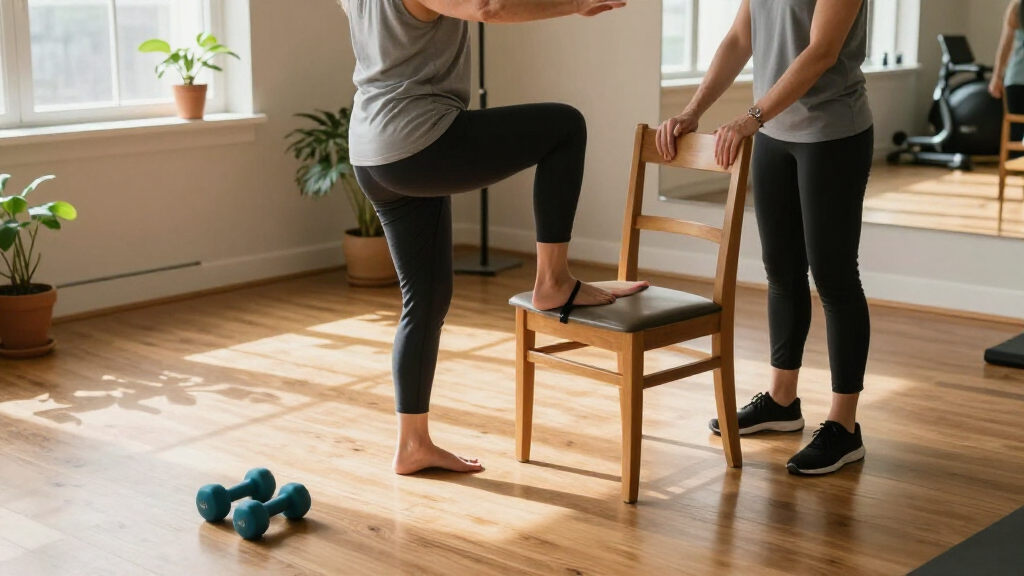
The routine uses a sturdy chair and a pair of dumbbells. The report advises choosing weights that can be controlled throughout each movement, completing two rounds, and doing eight repetitions of each exercise—or eight on each side when applicable. Farmer carries are performed for 30 seconds, with 30 seconds of rest stated between carries.
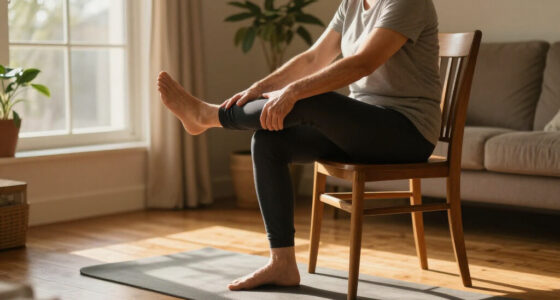
The first exercise combines seated knee lifts and sit-to-stands. From the front of a chair, the participant lifts each knee in turn, then places both feet on the floor, leans forward slightly and stands before lowering back under control. The instructor links the knee lifts to moving the legs in and out of a car and the standing movement to getting up from a low seat.
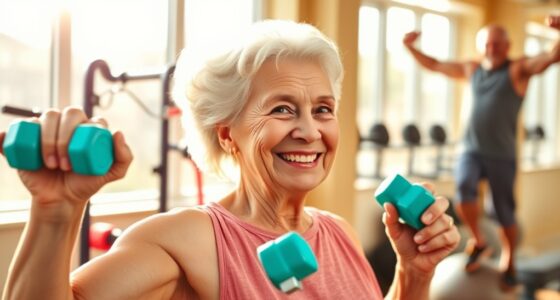
For the dumbbell hold and leg raise, a person holds a weight in one hand and raises the opposite leg sideways without leaning, then switches sides. The farmer carry involves walking with a dumbbell in each hand while keeping the torso upright. The final movement, a shoulder press, can be done seated or standing: weights move from shoulder height overhead and back down, with the torso kept steady.
Training for Everyday Independence
The exercises are framed around tasks that can become harder when strength, balance or mobility changes: standing up, walking while carrying weight and reaching overhead. That functional focus may help readers understand how a basic strength routine relates to day-to-day life, rather than treating exercise as an abstract goal.
The instructor says her students, whose ages range from their late 60s to early 90s, attend because they want to remain independent. She describes clients who report improvements in activities such as getting into a car and walking farther. Those examples are personal accounts from the instructor; the report does not provide measurements, a comparison group or research showing that this particular sequence produced the reported changes.
The article also says building strength earlier, including in a person’s 40s and 50s, may help prepare for later-life activities. That is the instructor’s recommendation. The routine itself does not establish how much exercise an individual needs or whether these moves suit every person.
As an affiliate, we earn on qualifying purchases.
How the Four Moves Are Framed
The report is based on the perspective of an instructor who teaches chair workout classes for older adults. Its examples connect each exercise to a specific movement: knee lifts and sit-to-stands to getting out of a car, the one-sided leg raise to balance, carries to holding shopping bags, and presses to placing items on a high shelf.
It also notes that grip strength is used as a marker of overall muscle strength and has been associated with long-term health outcomes. The report does not cite a particular study or quantify that association, so it should be read as background rather than as a result from this workout. The material supplied does not include a publication date, named instructor or independent expert review.
Limits of the Exercise Guidance
The report does not provide a clinical trial, outcome data or expert consensus statement establishing that these are the four best exercises for all older adults. “Best” is the article’s framing, not a ranking supported by comparative evidence in the material provided. The reported client improvements are anecdotes, and it is unclear how long participants exercised or what other factors contributed.
Individual ability, balance, joint or health conditions, and experience with weights can affect whether a movement is appropriate. The report advises using manageable weights and offers chair support for the seated exercise, but it does not set out modifications for every circumstance or explain how to judge readiness. It also does not specify how often the routine should be repeated across a week.
Applying the Routine Safely
The published report gives readers a repeatable structure: eight controlled repetitions, two rounds, and 30-second farmer carries. It does not announce a follow-up study or a forthcoming update. Anyone considering the routine can use the described movements and equipment as a starting point, while recognizing that the article is general exercise content rather than an individualized plan.
People with concerns about balance, pain, existing health conditions or using weights can ask a qualified health professional or exercise specialist about suitable options before beginning. The available material does not confirm whether the instructor or publisher will provide further guidance, nor does it report longer-term outcomes from participants following the sequence.
Key Questions
What are the four exercises in the routine?
The routine combines seated knee lifts with sit-to-stands, a dumbbell hold with a side leg raise, farmer carries and shoulder presses.
How many repetitions and rounds does the report recommend?
It recommends two rounds and eight repetitions per exercise, doing eight on each side where relevant. Farmer carries last 30 seconds, with 30 seconds of rest stated between carries.
What equipment is needed?
The report calls for a sturdy chair and a pair of dumbbells. It advises starting with weights that can be controlled throughout each movement.
Does the report prove these are the best exercises for older adults?
No. The supplied report describes an instructor’s recommendations and client anecdotes, but does not present comparative research or clinical outcome data proving the routine is best for everyone.
Is the routine suitable for every person?
The report does not establish that. A person’s balance, health and ability can affect which movements are appropriate. Those with concerns can consult a qualified health professional or exercise specialist about suitable options.
Source: rss
Cold & flu season Picks
humidifiers
As an affiliate, we earn on qualifying purchases.