TL;DR
Physical therapist Rajan Cheema says a knee sleeve or brace can help some walkers with pain, mild osteoarthritis or recovery of confidence after injury. He cautions against using support as a substitute for strengthening or medical assessment, particularly after trauma or with major instability.
A physical therapist interviewed by Fit&Well says knee sleeves and braces may help walkers manage some pain or instability, but they do not address underlying weakness and should not replace assessment when symptoms are severe. Rajan Cheema, a registered physical therapist in Canada, says the type of support should depend on the symptoms and that some cases call for professional advice rather than choosing a brace alone.

Give the gift of listening to someone you love
- Choose a 1-, 3-, 6- or 12-month membership
- They pick the audiobooks they love
- Easy to send by email
Cheema told Fit&Well that knee pain can relate to overuse or weakness in muscles around the calves, quadriceps, hamstrings and glutes. A support may provide help during activity, he said, but it does not build strength. The report presents his guidance as practical advice for walkers, not as a diagnosis for any individual reader.
According to Cheema, support may be worth considering when aching during or after walks settles with rest, when a knee feels unstable, when someone is regaining confidence after an injury, or when diagnosed mild-to-moderate osteoarthritis flares during walking. A sleeve or brace may offer added stability and help manage symptoms in these situations, but the report does not say that a brace treats the cause of pain.
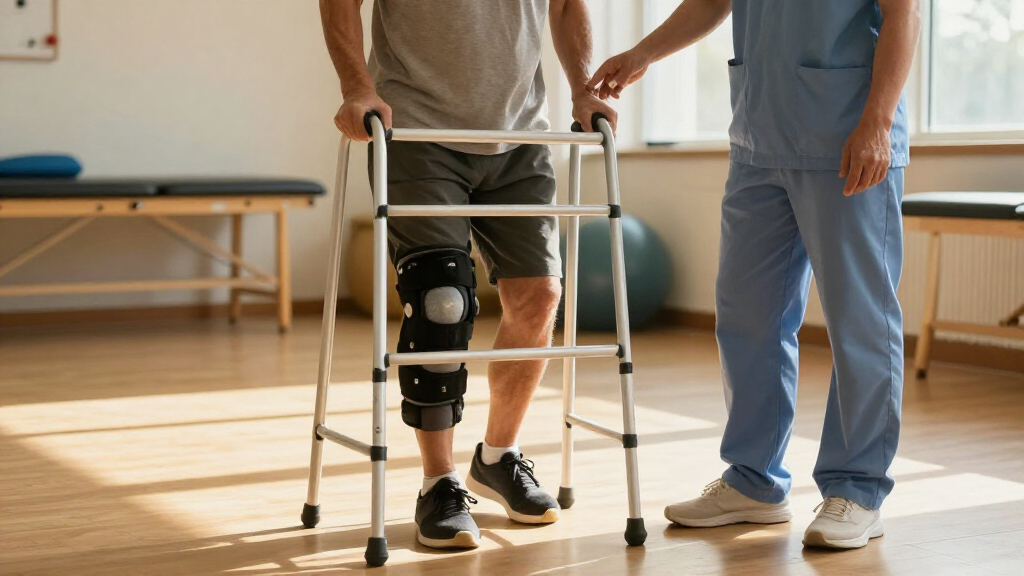
Cheema advises a lightweight compression sleeve for mild aching or warmth and a sleeve with a patella pad or open kneecap for some pain around or behind the kneecap. For what he describes as true instability or a history of ligament injury, he recommends involving a physiotherapist in choosing a hinged brace. He says rigid or custom braces for significant instability, recent injury or severe arthritis should not be self-selected.
Choosing Support Without Missing Injury
The advice matters because a brace can make walking feel more manageable while also potentially obscuring a problem that needs evaluation. Cheema cautions against relying on a sleeve instead of strengthening, and says feeling unable to walk without one may signal that the underlying issue needs attention from a physiotherapist or another healthcare provider.
The report also identifies warning signs that call for assessment rather than trial-and-error product use. Acute swelling, locking or giving way after trauma should be checked before a walker relies on a brace. Numbness, tingling or skin breakdown while wearing support may indicate a poor fit or unsuitable brace. Cheema advises measuring the knee and says a brace that slips may not provide useful support, while one that is too tight can be harmful.
For readers, the distinction is between temporary support during a walk and a plan for the cause of persistent symptoms. The guidance does not establish that every walker with pain needs a brace, or that a particular design will work for everyone. Cheema recommends professional input when instability is significant or the right brace is uncertain.
Products Worth Considering

Withings Body Smart Scale, Black

Levoit Core 400S-P Smart Air Purifier for Large Rooms

Oral-B iO7 Rechargeable Electric Toothbrush, Deep Clean + Protect, Sapphire Blue
As an affiliate, we earn on qualifying purchases.
The Evidence Cited for Osteoarthritis
Fit&Well’s report cites a 2017 study of 44 people with knee osteoarthritis. It says participants who wore a knee brace reported reduced pain and instability and greater confidence while walking on a treadmill. The report also says they completed a 10-minute walk test and a get-up-and-go test faster than participants without additional support.
The study’s authors described a soft brace as an “efficacious intervention” in the “immediate term” for patients with knee osteoarthritis, as quoted in the report. The supplied material does not provide the study’s full methods or enough detail to assess how broadly its findings apply. Cheema’s practical recommendations and the study findings should not be read as proof that braces resolve knee problems or replace rehabilitation.
“A knee sleeve is a seatbelt, not a wheelchair.”
— Rajan Cheema, MPT, registered physical therapist and founder of Richmond Physiotherapist, speaking to Fit&Well
Limits of the Brace Guidance
The supplied report does not state when it was published, provide the full details of the 2017 study, or identify the brace that is best for any individual walker. Its study summary concerns a small group of 44 people with osteoarthritis and does not establish the same effects for all causes of knee pain. The report also does not provide a clinical assessment of readers’ symptoms.
Cheema’s suggestions are general guidance relayed by Fit&Well. Whether a sleeve or brace is appropriate depends on the person’s symptoms, injury history and fit. The source material does not specify how long someone should try support before seeking care or set out a treatment plan. New or worsening symptoms, especially after trauma, warrant assessment rather than an assumption that a brace is sufficient.
When to Seek an Assessment
Walkers considering knee support can use Cheema’s symptom categories as a starting point, but the report recommends professional help for true instability, significant symptoms after injury, or uncertainty about brace type and fit. A physiotherapist or other qualified healthcare provider can assess the knee and advise on support and strengthening. Cheema also says a brace should generally be worn for the walk and removed at home so the muscles continue working.
The next step for anyone with acute swelling, locking, giving way after trauma, or numbness and skin problems from a brace is to have the issue assessed. The supplied material does not announce new research or a policy change; it offers practical guidance, and no further development is specified.
Key Questions
When might a walker consider a knee sleeve or brace?
Cheema says support may help when aching during or after walking settles with rest, the knee feels unstable, confidence is returning after an injury, or diagnosed mild-to-moderate osteoarthritis flares during walks. These are general signs, not a diagnosis.
When should someone avoid relying on a knee brace?
Cheema advises against using a brace instead of strengthening or relying on one to avoid addressing a persistent problem. Acute swelling, locking or giving way after trauma should be assessed first. Numbness, tingling or skin breakdown may signal a poor fit or unsuitable support.
Which type of knee support does the report describe?
Cheema suggests a lightweight compression sleeve for mild aching or warmth, and a sleeve with a patella pad or open kneecap for some pain around or behind the kneecap. He recommends professional input for hinged braces used for true instability and for rigid or custom braces.
Should a knee brace be worn all day?
Cheema’s rule of thumb is to wear it for the walk, not all day, and remove it at home. The report says fit matters: measure the knee, and seek advice if the brace slips or feels tight enough to affect circulation.
Source: fitandwell.com