
TL;DR

Turn quiet afternoons into listening time
- Thousands of audiobooks, podcasts and originals
- Listen on your phone, tablet or Echo — also offline
- Cancel anytime
Fit&Well published a yoga therapist’s seven-part seated movement routine for older adults and people who find floor exercises difficult or uncomfortable. The therapist describes the movements as gentle and potentially energizing, while advising people to work within their own range; the report does not provide clinical evidence that the routine improves health outcomes.
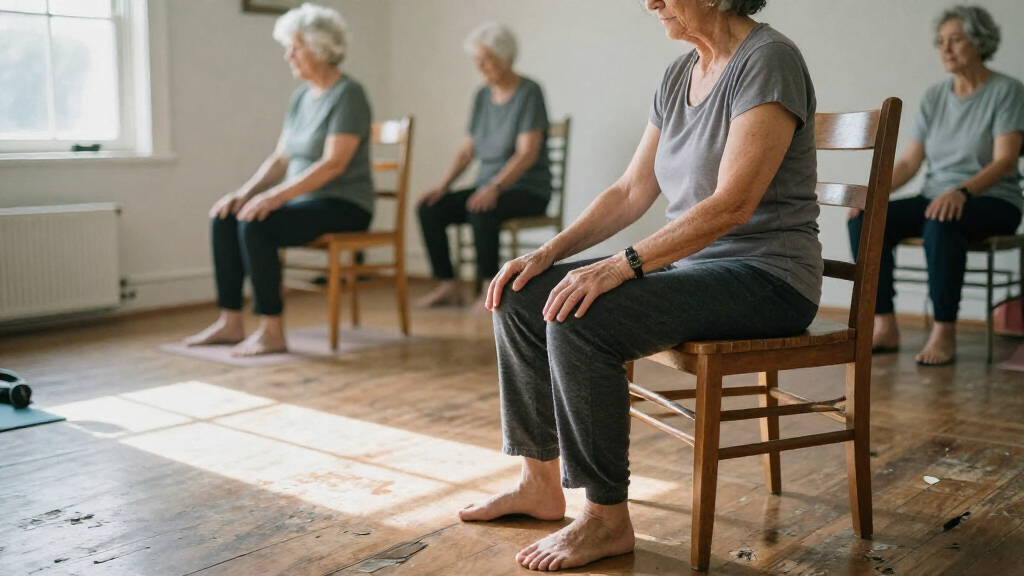
Fit&Well has published a seven-part chair-based movement routine recommended by a yoga therapist who works with older adults, including people with Parkinson’s, other movement disorders and chronic health conditions. The sequence is designed for people who prefer seated movement or have difficulty with floor-based exercise, and the therapist says participants can adapt each movement to their own ability.
The routine uses a sturdy chair and room to raise the arms. It begins with one minute of sitting upright, placing both feet on the floor and settling the breath. The therapist then suggests arm sweeps into prayer, seated torso twists, single and double arm raises, side bends, a seated cat-cow movement and a forward fold.
Most movements are prescribed for three to five repetitions, while twists and side bends are suggested three times on each side. The instructions pair movement with breathing: participants inhale during some lifts and returns to upright, and exhale during lowering, twisting or bending. The report presents this as a sequence to try while seated, not as a test of flexibility or a requirement to achieve a particular posture.
Several movements include ways to reduce the demand. During a side bend, a person can hold the chair for support instead of reaching an arm down; during a forward fold, hands can stay on the knees. The therapist advises moving within the range and capacity of each person’s body. The supplied report does not name a specific medical study or provide measured results for the routine.
A Seated Option for Gentle Movement
The sequence offers readers a way to follow a short movement routine without getting down onto the floor. That may be relevant for older adults who find floor transfers difficult, as well as people who simply feel more comfortable exercising from a chair. The therapist’s examples of chair support and hands-on-knees modifications make the instructions more adaptable than a routine that assumes everyone can reach the same positions.
The therapist says her groups experience stretching, joint movement and a calmer feeling through mindful movement, and that gentle postures can still feel energizing. Those are the therapist’s descriptions of her practice, not findings established by outcome data in the Fit&Well report. The distinction matters: the article provides exercise guidance, but does not show that this particular flow treats a condition, prevents falls or produces a specific health benefit.
For readers, the practical takeaway is the emphasis on comfort, support and individual range, rather than copying a pose exactly. The exercises may offer a starting point for seated movement, but the source does not assess whether every movement is suitable for every person with a health condition.
Products Worth Considering

Oura Ring 5 Smart Ring, Silver, Size 7

Levoit Core 400S-P Smart Air Purifier for Large Rooms

TheraGun Therabody PRO Plus 6-in-1 Deep Tissue Massage Gun, Black
As an affiliate, we earn on qualifying purchases.
How the Seven-Move Flow Works
The therapist says she uses chair-based yoga with people who do not have the mobility for floor-based movement and with people who prefer a chair. Her work focuses mainly on older adults living with Parkinson’s, other movement disorders and chronic health conditions, so she describes the postures she uses as gentle. The Fit&Well report supplies her professional perspective and the sequence, but does not include independent evaluation of the exercises.
The order moves from settling into the chair to upper-body motion and spinal movement. After the breathing pause, participants sweep their arms overhead and bring their palms to the chest, rotate the torso to each side, raise one arm at a time and then both arms, and bend sideways. The final movements alternate between rounding and opening the back, then folding the upper body forward and returning upright.
According to the report, no equipment beyond a chair is needed. Its instructions ask people to keep the chair stable, sit with feet grounded and leave enough space to raise their arms. The sequence is described as a set of accessible options rather than a fixed shape that participants must reproduce.
““I encourage everyone to move within the range and capacity of their body—there’s no particular shape or position to achieve.””
— The yoga therapist quoted in Fit&Well
Evidence and Individual Suitability
The supplied report does not state when the routine was published, cite clinical research on these seven movements or provide measurements of participants’ strength, mobility, balance or wellbeing. It is therefore unclear from this material how often the sequence was used, how many people took part, or whether outcomes were assessed beyond the therapist’s account of her classes.
It also does not specify whether each movement is appropriate for people with particular diagnoses, pain, balance concerns or restrictions on movement. The therapist advises adapting the exercises, but the article does not give condition-specific guidance. Readers should not treat the routine as individualized medical or rehabilitation advice; anyone uncertain about an exercise can ask a qualified health professional who understands their needs.
No Further Testing Reported
The source provides a routine readers can try, but it does not announce a trial, follow-up report or formal evaluation. No additional research or publication date is given in the supplied material. For now, the next step described is simply the seated sequence itself: begin with a stable chair, use the listed supports where helpful, and stay within a comfortable range rather than forcing a movement.
Any future evidence about the routine’s effects would need to be reported separately from the therapist’s current account. The Fit&Well article, as supplied, does not say whether further guidance or testing is planned.
Key Questions
What exercises are in the chair-based routine?
The flow includes a one-minute settling exercise, arm arcs into prayer, seated twists, single and double arm raises, side bends, seated cat-cow and a forward fold. The report gives suggested repetitions for each movement.
What equipment does the sequence require?
The report says participants need a sturdy chair and enough space to raise their arms comfortably. It does not list additional equipment.
Can the movements be modified?
Yes. The report suggests holding the chair for extra support during side bends and keeping hands on the knees during a forward fold. The therapist also says to stay within each person’s range and capacity.
Does the report show that the routine improves health?
No clinical study or measured outcome is provided in the supplied report. Claims about feeling calmer, rested or uplifted are attributed to the therapist’s experience with her groups.
Is the routine suitable for everyone with a health condition?
The article does not establish that every movement is suitable for every diagnosis or limitation. People who are unsure whether an exercise is appropriate for them can consult a qualified health professional familiar with their needs.
Source: fitandwell.com